Ian
-
Posts
751 -
Joined
-
Last visited
-
Days Won
3
Everything posted by Ian
-
There's a good free calculator here: http://www.changeplan.co.uk/u_value_calculator.php Click on the drop down menu for Element Type to show "Ground Floor (floating)" for the bit of the calculator you need. Ian
-
If you want to go into to the issue more deeply BS 8300:2009 goes into more detail than Building Regs. Small extract below but it would be best to read the whole of the standard: "5.9.2 Design of steps and stairs COMMENTARY ON 5.9.2. Slips on steps and stairs occur in both ascent and descent, but a slip on descent is more likely to lead to a fall and an injury. Research has shown that slips while descending stairs are more likely to occur when the user oversteps, placing only 50% to 60% of their foot on the tread. The likelihood of an overstep decreases significantly with increased going size, and beyond 300 mm, is very rare. Beyond 350 mm, it is unlikely that a large overstep will occur within the lifetime of the building, even with 2 000 users per day. Excessively high risers can result in excessive strain being placed on the knee and/or hip joints of ambulant disabled people, when descending flights of stairs. When ascending a stair, people who wear callipers or who have stiffness in hip or knee joints are particularly at risk of trapping the toes of their shoes beneath projecting nosings, and of tripping as a result. In addition, some partially sighted people can feel a sense of insecurity when looking through open treads, and assistance dogs might refuse to proceed. The preferred dimensional ranges for steps and stairs are between 150 mm and 180 mm for the rise and between 300 mm and 450 mm for the going. NOTE There is now compelling research evidence to indicate that a larger going helps to avoid accidents on a stair, particularly in descent, as it allows a person to place more of their foot on the step. Larger goings can also benefit people who wish to pause mid-flight to rest. The rise and going of each step within a flight, and preferably between a series of flights, should be uniform. Preferably, a step should not overlap the one below. If there is an overlap, the nosing should not project over the tread below by more than 25 mm. The riser should not be open and its profile should ensure that people who drag their feet do not trip when ascending. 5.9.3 Rise of a flight No flight on an external stepped access route should contain more than 20 risers and, as far as possible, the numbers of risers in successive flights should be uniform. NOTE 1 In determining the number of risers in a flight, designers need to strike a balance between minimizing the number of risers between landings so as to create more frequent resting points, and maximizing the number between landings so that the number of potential accident danger spots (when moving from a landing to a flight) is minimized. The former approach is likely to benefit people with restricted mobility and the latter approach is likely to help blind or partially sighted people. Single steps should be avoided as, even when highlighted using visual contrast, they present a significant trip hazard. Thus, where there is a change in level of two steps or more, it should be treated as a stair and should include handrails each side and all other features of a stair. A stair should always be provided in addition to a ramp, unless the change in level is less than 300 mm, where it would otherwise be necessary to have a single step (see also 5.8.1). NOTE 2 The 300 mm dimension assumes a minimum step rise of 150 mm. 5.9.4 Stair width The surface width of a stair, between enclosing walls, strings, balustrades or upstands, should be not less than 1 200 mm, and the width between handrails should be not less than 1 000 mm. Where the width between handrails exceeds 2.0 m, the stair should be divided into two or more channels with a distance between handrails of not less than 1 m, or not more than 2 m, to ensure that all users have access to a handrail."
-
No probs - it's partly what I do for a living and there are elements of the regs which are often 'grey' areas where different Building Inspectors interpret the regs in different ways. Eg I rang up a very experienced L.A. Building Inspector in London today for a judgement on the surface spread of flame regs for a job we're doing with them and he didn't know the answer - he's gone off to ask a fire specialist in their department.
-
In table 1.1 it defines the maximum rise and goings as well as the minimum so if you want comfort it's easy to make a judgement.
-
So I understand that creating a new downstairs toilet in my existing home will need to abide by some building regs one being in Part M that the door needs to be wide enough for wheelchair access(1981 x 838 x 35mm). if you are modifying or extending an existing house and as long as you are not making the situation worse by eg removing a wheelchair accessible WC, Part M of the (English) Building Regs don't require you to design the new WC to comply with wheelchair accessible standards - effectively the regs only apply to new build. Page 11 of this link: http://webarchive.nationalarchives.gov.uk/20151113141044/http://www.planningportal.gov.uk/uploads/br/br_pdf_ad_m_2013.pdf
-
Part K of the Building Regs has the necessary guidance for things like rise, going, pitch and headroom. Link to English Part K: http://webarchive.nationalarchives.gov.uk/20151113141044/http://www.planningportal.gov.uk/uploads/br/br_pdf_ad_k_2013.pdf If you are outside England its worth checking the relevant Welsh, N Ireland and Scottish regs.
-
I want to make a brick. How hard can it be?
Ian replied to Construction Channel's topic in Brick & Block
why not enroll on a nightschool pottery class....you'll get access to the proper clay and a proper oven! -
I'm really pleased with them thanks. I'll try to remember to take a photo tomorrow and post it here so you can see if it's how you imagined it would be.
-
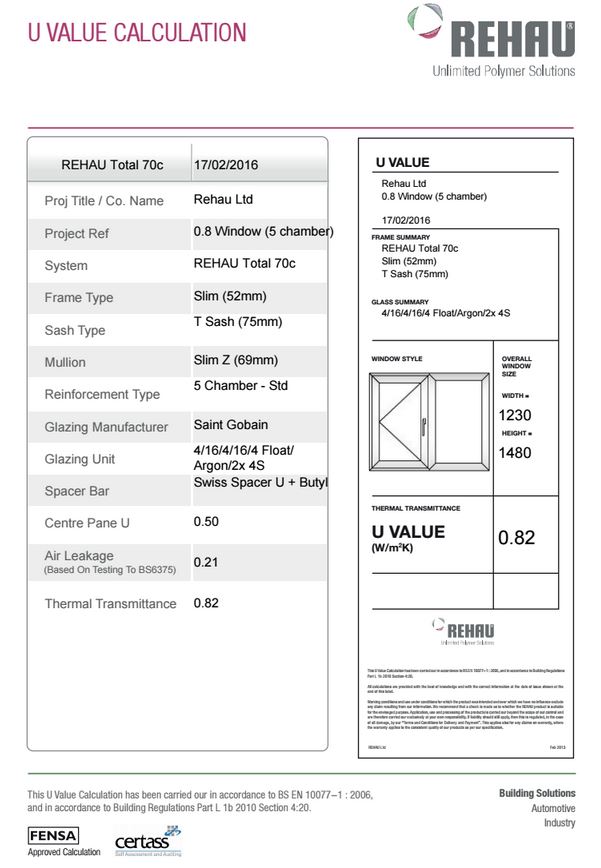
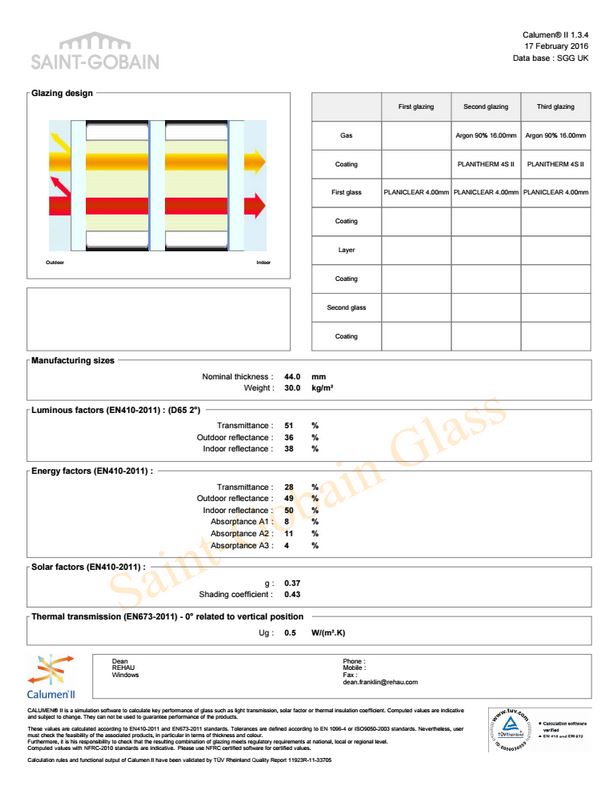
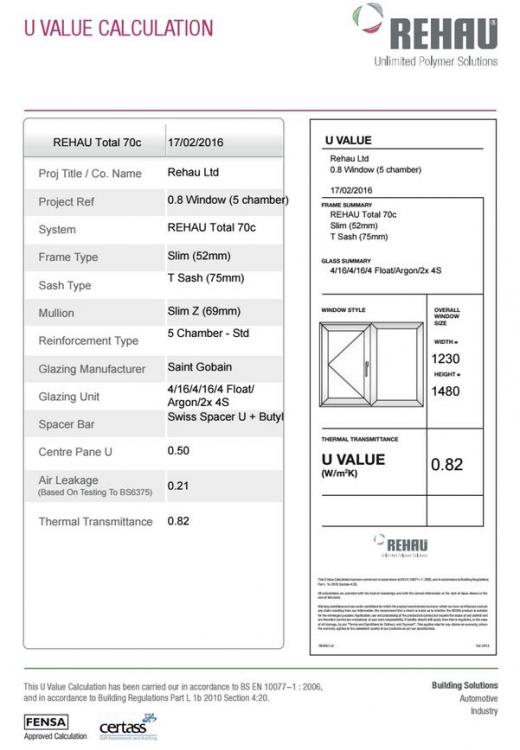
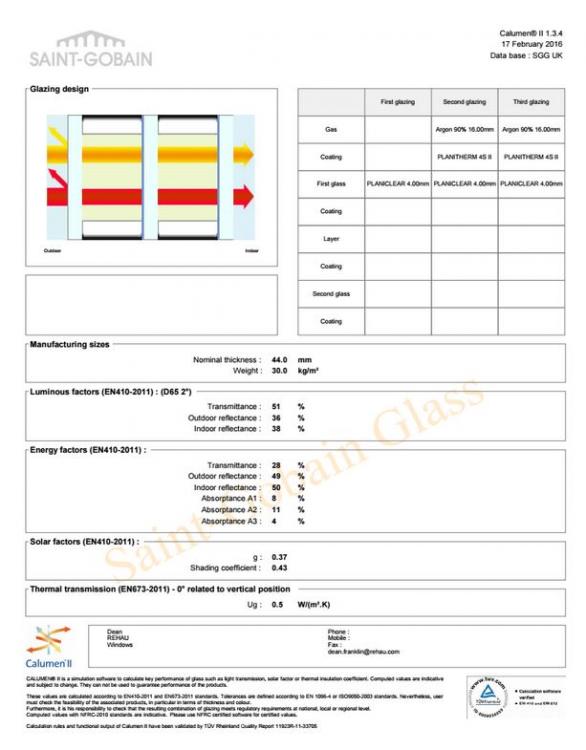
Any Rehau supplier will be able to quote but the prices I got back varied by about 30% so it's well worth shopping around. The window profiles are all standard Rehau sections but the window suppliers all buy the glass in from specialists. The glass spec obviously makes a big difference to the overall U value so it's important to stick with the St Gobain references on the sheets I posted.
-
Oh, almost forgot...the supply & fit price was £5k which was for 6 windows + 2 fully glazed double french doors and an unglazed front door.
-
Just a quick note for anyone interested in a 3g Upvc window that will achieve 0.8 U Value. I've recently had them installed a new build: It's Rehau's standard 'Total 70c' window profile which (unmodified) will accept triple glazing and the two elements combined achieve 0.8. It took me a while to get the exact spec as it isn't publicised anywhere but the attached spec is from Rehau's technical department:
-
Gimp, if you are considering employing a Planning Consultant in Wales I can highly recommend a company called Owen Devenport. They are based in North Wales (I'm not sure whereabouts in Wales you are). http://www.owendevenport.co.uk/ About a year ago they helped me get PP for a new build house on a site I own in an AONB in N Wales. It took over 2 years and an appeal as the LA Planning dept opposed us at every step of the way but in the end we got everything we wanted. Although I'm an architect there's absolutely no way I would have got PP without their expert guidance and advice. Their fees were very reasonable and they were very professional. Ive been lurking on the Forum (and the other one) for a long while and gleaned lots of useful info from here so it's nice to be able to contribute something myself. I'm now about 3 or 4 weeks from completion of our build and looking forward to moving in. Ian ps - I've got no ties/links to Owen Devenport but believe strongly in recommending great companies when I come across them.