


Dan F
-
Posts
1431 -
Joined
-
Last visited
-
Days Won
2
Everything posted by Dan F
-
It probably goes over 3kW when you are doing more than one of: cooking, kettle, iron, washing machine etc, but that isn't that much of the day and everything under 3.68kW you would consume from a battery during those periods anyway, so yes, could still make sense. Try to find 3.6kW, rather than 3kW though.
-
Is the 280L the vertical one? I've got two of them. Can't you go one size up with inverter? With 3kW inverter, you will only get cheap/e7 electricity if your consumption is below 3kW. Put the kettle/oven on, and you'll likely be paying peak rate..
-
I thought 100A was max for residential supplies. Not necesarily, you could get something G98 compliant and just install it. You don't need to ask for permission, just notify. Also, just because they want to reinforce supply, doesn't mean you'd necesarily have 5kW inverter denied.
-
Battery will do more than 6000 cycles, will just degredate in terms of usable capacity with use. The one assumption you are making is that you peak usage is never more than 21A (5kW). If you have peak usage above this, then you'll be pulling from the grid at 30p. BTW, do you have or plan to get PV too?
-
That makes more sense. Remember shouldn't be charged VAT now. As others have said, I'd avoid anyone that suggests you don't need a G99 application, you do.
-
£3k (if i found the round the right publication) for 15kWh battery, inverter, installation and DNO application is a bit too good to be true! Wouldn't be suprised it cutting some corners..
-
Which battery? Do you have a U.K supplier? Have a look at https://www.fogstar.co.uk/collections/solar-battery-storage too. I have two 14.3kWh Seplos batteries, but using Victron. Allow me to use 7.5p electricty all day in the winter..
-
Vaillant 7kw % efficiency rating for BREL Part L
Dan F replied to Post and beam's topic in Air Source Heat Pumps (ASHP)
I thought defaults from table a were only used if there was no SCOP on MCS certificate (or no MCS), but maybe it's not that simple. -
No value for extract air?
-
Vaillant 7kw % efficiency rating for BREL Part L
Dan F replied to Post and beam's topic in Air Source Heat Pumps (ASHP)
Or, in my case 4.36 and 381.57. Where do you see the 219%, I'm seeing 381.57 here: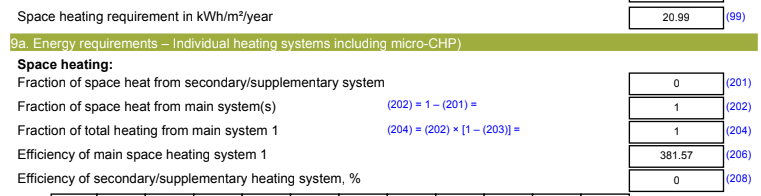
-
I have Zehender so config will be different. The way I think about efficienty isn't what it adds, but rather that the delta/loss between extract and supply is. 20C extract and 18C degree supply is 90% efficient @ 0C outside.
-
Vaillant 7kw % efficiency rating for BREL Part L
Dan F replied to Post and beam's topic in Air Source Heat Pumps (ASHP)
My MCS certificate (for 7kW aroTherm Plus) says: I'm unsure if/how this is used in SAP though.. anyone know? Or if SAP uses it's own numbers SAP Worksheets looks like it says "381.57 efficiency", no idea where this comes from though..
-
Vaillant 7kw % efficiency rating for BREL Part L
Dan F replied to Post and beam's topic in Air Source Heat Pumps (ASHP)
Thats COP not SCOP though. The values used for SAP are up on MCS website. Values for 35-55C design flow temp. 4.36 was used for my SAP AFAIK.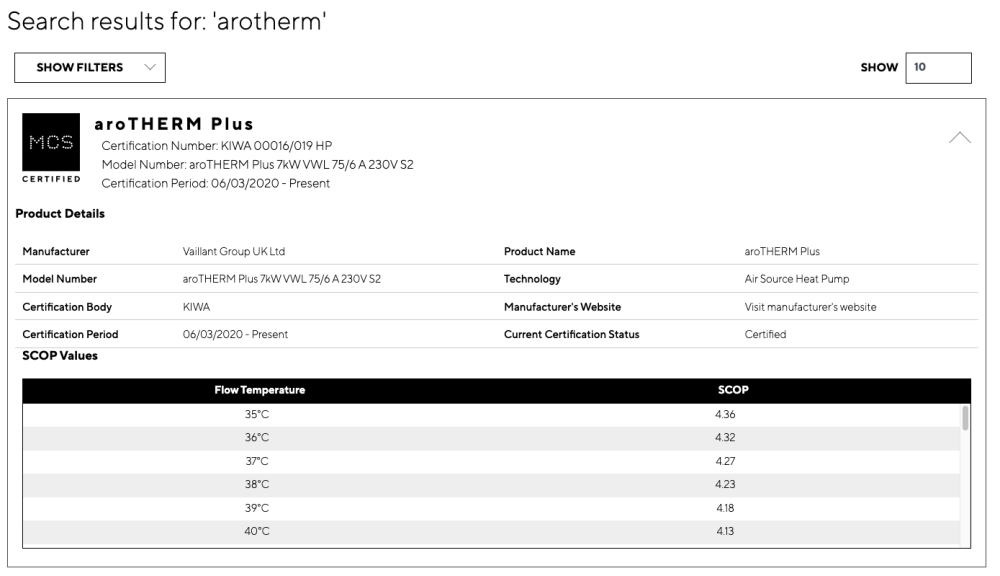
-
How to measure the remaining HW in an unvented cylinder
Dan F replied to Adsibob's topic in Boilers & Hot Water Tanks
Not sure about with 1 manifold, but I was fairly sure that the theory says that if you have 2+ such manifolds like this hydrualic seperation is a must. Direct from heat pump with no seperation, mixer, or additional pumps is defintily a workable and is the ideal approach, no question there. -
How to measure the remaining HW in an unvented cylinder
Dan F replied to Adsibob's topic in Boilers & Hot Water Tanks
My understanding was that the UFH pumps (after the mixing valves) need to pull from a buffer. The UFH flow rate is consistent, but the flow rate to the manifold changes based on the position of the mixing valve. Does this really work without hydraulic seperation? You'd need a bypass valve I assume, but doesn't the lack of buffer/LLH impact the correct operation/mixing of the UFH circuits? -
No, something wrong there! You might expect that in the summer if the unit is clever and does passive cooling based on internal temp being too high, but I don't know if brink does that and I wouldn't expect to see it in the winter either.
-
How to measure the remaining HW in an unvented cylinder
Dan F replied to Adsibob's topic in Boilers & Hot Water Tanks
Efficient install like yours seems it is will actually be cheaper to run than gas, and thats without considering overnight tarrifs or PV. As for the external unit, you can have them further away if requied... and gotta think about the planet too 😄 Question though: Why would you want/need to keep a boiler for HW? -
How to measure the remaining HW in an unvented cylinder
Dan F replied to Adsibob's topic in Boilers & Hot Water Tanks
Looks like you in perfect shape to move to a ASHP 🙂. Not make any sense in your case with £7.5k grant? -
How to measure the remaining HW in an unvented cylinder
Dan F replied to Adsibob's topic in Boilers & Hot Water Tanks
Yes, with aroTherm+. Each circuit has elecontric mixing valve, temp sensor and pump. All controlled by a VR71 wiring center: - 0.15 for UFH - 0.4 for a garden room which I plumbed into main house heating. - higher for comfopost which I hardly use anyway. -
How to measure the remaining HW in an unvented cylinder
Dan F replied to Adsibob's topic in Boilers & Hot Water Tanks
I have two mixed circuits that can at different temperatures (and follow their own heat curves). For this approach, each circuit needs a pump and mixer valve and you need hyraulic decoupling on the flow (a volumizer on the return doesn't help). I'm not sure exactly what @Adsibob has installed, but i would argue he needs pumps on UFH manifolds (for mixed circuits) or the circulation pump after the LLH and no pumps on manfiolds (all circuits running at same temp), not both. -
How to measure the remaining HW in an unvented cylinder
Dan F replied to Adsibob's topic in Boilers & Hot Water Tanks
IMO That gets complex having seperate zone just for towel rails. Also in spring/summer impacts efficiency as boiler/ashp has to produce max(zoneTemp1, zoneTemp2) and mix down typically, so you loose out on advantages of weather comp. Best to use electric towel rails and stick them on a timer so they are on for 1-2hrs after presense is my view. -
Same here! BTW, remember to leave a bit of slack on all the wires. If they are just right, they can become tight when you put the cover on slotted trunking and end up pulling on the connectors. I had a redo a few of mine because of this.
-
Also, if you are daisy-chaining lives (I didn't), using double ferrules is much better than twisting together and inserting two conductors in the same screw termination.
-
It improves the reliability of the connections. See https://www.youtube.com/watch?v=bJk0mzaATI4&t=35s I found that once I started using ferrules using with stranded cable, I now don't even consider screwing down withough using a ferrule first. Also makes moving things around after the fact super-easy, rather than needing to re-gather/twist the strands.
-
How to measure the remaining HW in an unvented cylinder
Dan F replied to Adsibob's topic in Boilers & Hot Water Tanks
Mixergy you can tell it to top-up when charge is 10% or 20% or whatever.


