


ab12
-
Posts
91 -
Joined
-
Last visited
Everything posted by ab12
-
I used Fibolite blocks on inner skin of my kitchen extension. 150mm cavity filled with Knauf mineral wool batts, outer skin is brick. Would like to get internal block skin wet plastered rather than dot and dab. Is wet plaster OK with such block types? Will need to get cavity closure fitted for the door and window reveals. Any ideas on how to tackle wet plaster on cavity closures? Thanks
-
Oh shiz. So I've had a kitchen extension built , standard 150 mm cavity filled Kanuf mineral woll insulation, inner aspect is fibolite blocks and outer aspect is brick. I wanted to have wet plaster in the kitchen. How will I get the window reveals and door reveals plastered if I will be using cavity closures??
-
Probably a daft question but is there a need to use ventilated fibre cement tiles in places on a pitched roof if when using a breather membrane. I suspect not but thought about belt and braces option. My current roof has old bitumen felt under fibre cement tiles, is ventilated at eaves and has a few ventilated fibre cement slates in places for airflow. Thing is old roofer actually cut through the felt just under ventilated slates and this is allowing water ingress in places. Also is there a need to leave an air gap between insulation and breather membrane when using an air and vapour open memnrane?
-
Joist and Rafters - actual vs nominal values.
ab12 replied to ab12's topic in Roofing, Tiling & Slating
I hate wasting, in actual fact I'm a bit of a hoarder. Would definitely make use of the timber in some meaningful way, maybe to use as noggin between adjacent floor joists etc. -
For those members who have a log burner what are the running costof timber fuel in the winter on average per month? Am thinking of getting 5Kw or possible 7kw log burner and want to have a rough idea if I was too run it every day for about 4 hours for the winter months, so at least 4 months, say November to February how much would it cost to purchase the timbers say per month on this basis? On average if you pack the burner with timbers how long does 1 burn cycle last? thanks
-
I'm a little bit confused. Have had a new extension built with pitched roof and 7 by 2 joists were use. When I measured the joist the other day to work out what insulation will fully fit the joits depth they weren't fully measuring 175mm but about 165mm. So technically theyre not truely 7 inches. Is this normal? Looks like real value is different from the nominal stated value. Does the same sort of things go for other timber e.g. studs. Bit confused
-
Fine tuning my IWI Solid wall (Warm Batten) design
ab12 replied to Annker's topic in Heat Insulation
I need to do the same stud walls and fluffy insulation between the studs- DIY project. I know its basic question but can you advise how to make sure I get the studs level both vertically and horizontally so that when plasterboard is attached to the boards it sits nice and flush and wall is nice and even to prevent cracking of plaster at the joins between adjacent boards. Will I need to use packers behind the studs to level them. I should have added some of the walls are bare to the brick so I will be getting plasterer to do a parge coat of lime based plaster for breathability. How long do I leave between the parge coat and adding the stud wall? dunno how long lime based plasters take to dry up and become nice and firm -
DIY project- need some tips please. So I need to plasterboard my ceilings. Problme joist are in good condition but old and when I put a level on the ceiling joists are not all level. Now If I fix plasterboard its not going to be level. How do I overcome this? Use packers between the plasterboard between the ceiling joists?
-
What is everyone's go to floor finish for UFH on a solid slab- LVT or tiles or something else. My main considerations are longevity of the floor finish and also one which gives the best heat outcome for UFH- basically which one will feel the warmest to walk on. Had a little google research LVT can last about 10-20 years wheres tiles can last a lot longer upto 50 years. I've got experience with neither floor finish. So floors in question are for living room, bathroom and a kitchen.
-
Best breather membrane- air and vapour permeable
ab12 replied to ab12's topic in Roofing, Tiling & Slating
Probably a daft question but is there a need to use ventilated fibre cement tiles in places on a pitched roof if when using a breather membrane. I suspect not but thought about belt and braces option. My current roof has old bitumen felt under fibre cement tiles, is ventilated at eaves and has a few ventilated fibre cement slates in places for airflow. Thing is old roofer actually cut thorugh the felt just under ventilated slates and this is allowing water ingress in places. Also is there a need to leave an air gap between insulation and breather membrane when using an air and vapour open memrane? -
OMG are we talking modern DG PVC sliding sashes? Kind of expect old single glazed timber sliding sashes to be draughty but not the current DG PVC types. Is it down to poor craftmanship? quality of profile? I was thinking of getting PVC sashes but this........the fact yoiu mentione they're draughty...... has kind of dented my confidence
-
Best breather membrane- air and vapour permeable
ab12 replied to ab12's topic in Roofing, Tiling & Slating
So just to recap, no taping for cold roof but better to tape for warm roof? -
Best breather membrane- air and vapour permeable
ab12 replied to ab12's topic in Roofing, Tiling & Slating
Which type of tape please? -
Best breather membrane- air and vapour permeable
ab12 replied to ab12's topic in Roofing, Tiling & Slating
Thank you everyone. Had a look at the prices and SD values Permavent £160 SD value 0.01 Roofshield £150 SD Value 0.013 and Klober £259 SD value 0.009 On paper Kolbre wins in terms of breathability but is there a bif difference between 0.009 and 0.1 SD value? If not then I think either Permavent or Roofshield Also I don't quite understand do these membranes to be taped or can they be used untaped. Look at the brochure if taped for example Permavent require 100mm overlap and if untaped then 150 mm overlap. In terms of tape- any specific type of tape ? or standard waterproof duck tape? -
All together 3 areas to cover: Area 1 approx 18m2 Area 2 approx 10m2 Area 3 approx 13m2 I was think of laying dry screed with help of about 2 or 3 labourers who will muck in do the screeding. Idea was to order ready made dry screed and levels it off. Off course liquid screed will be much quicker fix but I'm pretty sure there will be a cost differential but I dont know exactly how much. UFH installer recommended WET screed mainly because he feels it is slef levelling and you can get a more level finsih. Personally I think you should be able to get a decent finish with Dry screed aswell
-
I'm in the process of doing a full re-roof to replace old bitumen leaky felt. Would like to go with breather membrane that is air and vapour permeable. Any recommendations please. Pitched roof will be finished off with fibre cement tiles with a dry ridge system and eaves ventilation. It appears most of the membranes on the market are air tight and vapour permeable and a limited supply are both air and vapour permeable.
-
Is it possible to put in a request under Permitted Development for a dormer whilst planning request has already been granted for single storey rear ground floor extension? I dont know whether the council will require the first project to be completed (the rear extension) before the second can start (dormer)? Thanks
-
Dormer Flat Cold Roof Ventilation
ab12 replied to shbrooks's topic in Lofts, Dormers & Loft Conversions
I would be grateful if you could explain the reasoning behind this please. Im about to do my roof and have a dormer like this but it finishes flush with the external gable wall rather than on the pitched rood part. Now I would like to have toilet, shower and sink in the new room to be formed by a partition next to the dormer. Of course will have a good extractor fan in there. Is there a risk I will be introducing problems with moisture or condensation by having a shower room there? How can I mitigate any risk? Thanks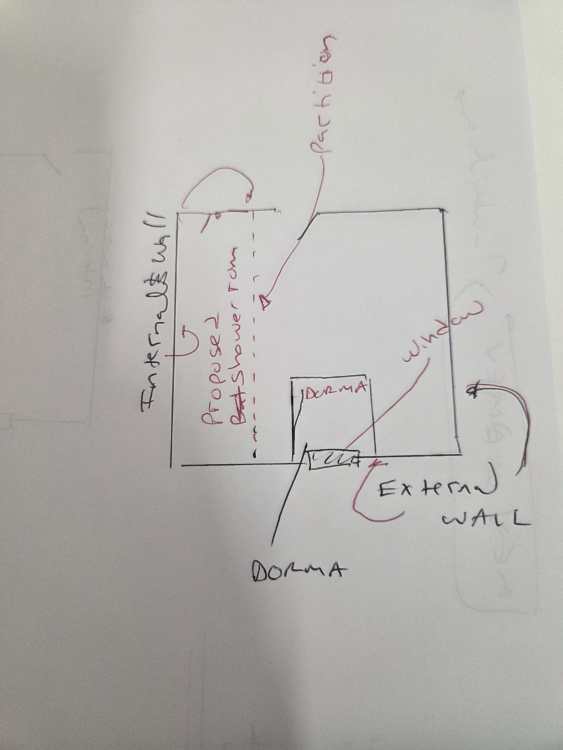
-
In terms of insulation I will putting 150mm PIR even though 100mm will suffice. Going with the extra insulation hopefully should be better. Initially though plan was to fit 100mm and so I purchased most of the boards already. Now have changed mind and will be ordering the 50mm boards. So I will be laying 50mm PIR first and them 100mm on top. In hindsight I should have ordered 150mm board. Other option is to use use 50mm Polystyrene such as Jabalit and then 100mm PIR on top- Cheaper option. Watched a you tube video about this and learnt the following: Polystyrene boards break easily and can be a bit more tricky to cut but I don't have prior experience so basing everything on what I saw in the video. Have you worked with Jabalite? Is it fairly easy to work with?
-
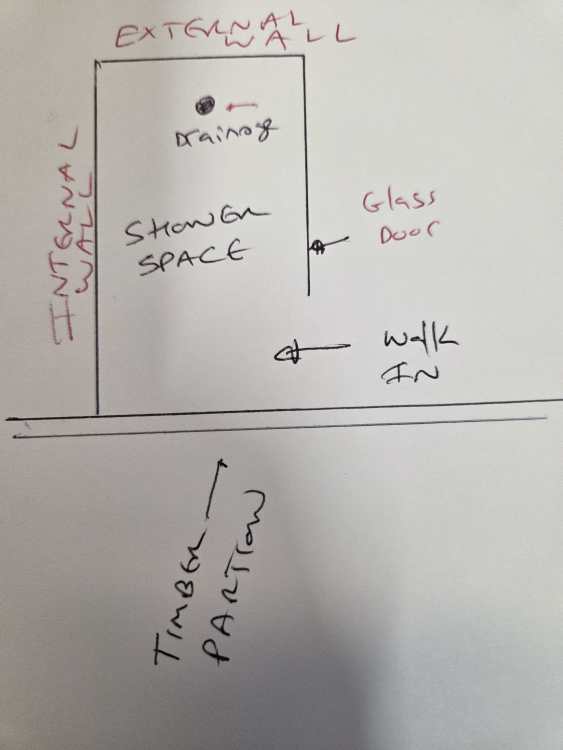
Having UFH for 3 rooms: a kitchen , a bathroom and a living room. In the bathroom I will be having a walk in shower in the shape of a rectangular box dimensions 165cm long and 90 cm wide but without a shower tray. Worried shower trays break easily and also I think it will more cost effective to create the falls needed in the shower area with dry screed. On one of the longer sides will be a fixed glass screen running from external wall with a gap to walk into the shower space and on the opposite side is the internal wall. Shower head and taps will be affixed to external wall on one of the shorter sides of the rectangular box- see diagram attached I will make a small rectangular partition in the floor where the shower space will be if I use wet screed so can get the falls for the drainage. Floors will be finished with tiles. I am in 2 minds about Dry vs Wet screed. Dry Screed will be cheaper but a bit more laborious which I don't mind. Wet will off course be a quicker install but cost premium attached. For Dry I will go with 75mm thickness and for Wet I think the recommended is 60 -65mm thickness. Considering it's a DIY project which screed finish would you opt for? Are both types of screed equally effective for UFH in terms getting the space warmed up quickly and avoiding cold spots?. I suppose the thicker the screed the more time the slab will take to warm up but equally I suppose the more time that heat will be stored in the slab. BTW I have no prior experience with living with UFH so not sure about which direction to proceed.
-
If you were doing a retro fit roof insulation to fit between rafters on a pitched roof and between joist below non usable loft space which insulation type would you use a) PIR or b) Breathable It appears there is inherent risk of using PIR due to inevitable risk of interstitial condensation and future issues down the line as there it is probably impossible to fit PIR between the rafters so that not even the smallest gap is left between the insulation and rafters. Also its going to be tricky to get 100% proof the VCL above the insulation again leading to risk of vapour betting trapped between insulation and timbers. With breathable insulation the moisture at least can be controlled in the sense that insulation will absorb the moisture and release it as conditions humidity conditions change so there is much less risk of causing future issues to timbers. But the trade off is U-value similar to PIR are difficult to achieve. By the way size of rafters tbc but may be 8 by 2 or 9 by 2. Please share your experiences and thoughts on this topic.
-
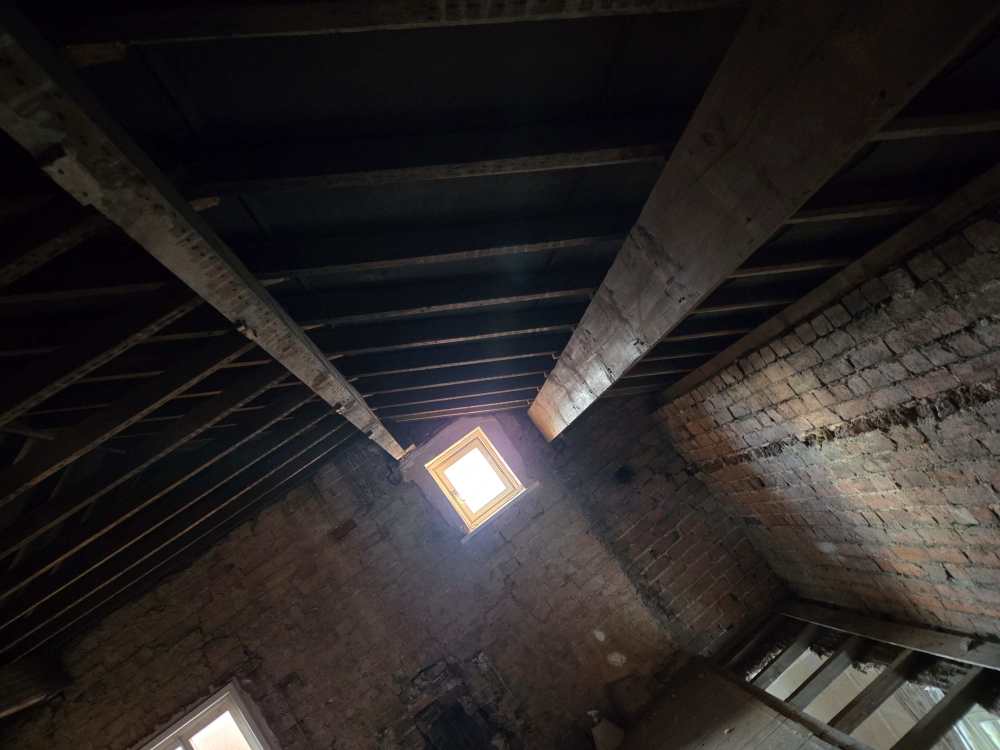
Want to re-roof 100 year semi detached property as 1 ) non breathable felt is failing and allows leaks into the rooms below 2 ) old 3 by 2 rafters in place, appear in good condition and supported by purlins .Purlins placed on opposite side of the room allowing for flat ceiling between the purlins in the room centre and sloped ceiling between the walls and purlins ( I have attached photograph for reference). Gable end is on the side of the property and not the front. There is a single 1 inch ridge board, about 9m, from wall to wall of the 2 adjacent rooms, Ridge board is not slotted into the brick work of either walls, its shy of the brickwork at either end by about 3 inches. There is no visible scarf joints in the board and although its old and it is in good condition. Plan: I want to install 8 by 2 rafters or even 9 by 2 rafters so I could maximally insulate between the rafters. Questions: 1) Can the old ridge board remain or will I need a new one.? Had chat with timber merchant, max timber length he can get is about 7.2m. How do I overcome this? Scarf joint between 2 lengths of timber to make one massive ridge board 2: Which is best breather membrane which allows both air and vapour to pass through it? Roof will be finished off with Fibre Cement tiles. Currently there some Vented fibre cement tiles above the flat ceiling spacing between the 2 purlins. Current fibre cement tiles are probably about 15 years old (a guess). Is it worth replacing them? How can I tell if they had their and need replacing I take it as I'm using a breather membrane I wont need vented tiles any longer. Thank you for the advice.
-
Thank you for the clarification. this may seem a daft question but is it possible to lay UFH pipes in a given area without them connecting to manifold as there is no manifold present at the moment , have them pressure tested and the area screeded and a later date have a manifold and boiler installed?? OR is this no go? Thanks
-
Rear single storey ground floor extension- Roof U-value
ab12 replied to ab12's topic in House Extensions & Conservatories
Now to the fitting part, So current joist size is 7 by 2 or depth of 175 mm in metric units. Now These loft rolls come in depth of 150mm or 200mm. If I select 150mm depth to go between the joist and fit on the furthermost end away from ceiling level there'll be a 25mm gap between the ceiling plasterboard and start of insulation. Is there potential for condensation in this place? I have the impression that the insulation should be fully fitted to the depth of the joist. -
In terms of tools I understand I will need a plastic float and a steel trowel. For levelling specifically can I get away with a wooden plank OR will I need metal squared edged board?



