DaveH
-
Posts
63 -
Joined
-
Last visited
Everything posted by DaveH
-
Sorry to resurrect an old thread but I am looking to create the reverse of this island feature in a couple of rooms with a lower border around the edge of the ceiling and a raised and illuminated centre. In the main, open plan living area the raised section will only be in the seating area with the lower ceiling running through the kitchen and dining area. I'm trying to decide what proportions would look correct (how much drop, inset etc) and what details I need to think about for the construction. Would the LED strips to illuminate the ceiling be better on the vertical part or on the horizontal lip? Does anyone have any photos of this type of feature during construction or a cross sectional drawing?
-
Natural Slate Roof - Looking for recommendations
DaveH replied to colin7777's topic in Roofing, Tiling & Slating
Another vote for a decent quality Spanish slate here. I can't remember which one exactly without digging out the paperwork but I sourced a slate from SSQ through a local roofing merchant Rinus. SSQ sent some samples out and the rep came to see me and once they had calculated quantities I ordered through Rinus. -
The PIR sheets will be foil backed and all joints taped. I understood that this was all I needed but happy to be proved otherwise (before it's too late!)
-
That's just the kind of thing I was thinking JFB (although slightly less rustic). Yours looks great. I was just unsure whether I would need a central post or not with the 5.5m span I have. I think I will install one regardless. And yes, I will be constructing a base for the logs to sit on with plenty of airflow. A lot of my pallets have already gone to friends to construct treehouses, rustic furniture, garden planters etc.
-
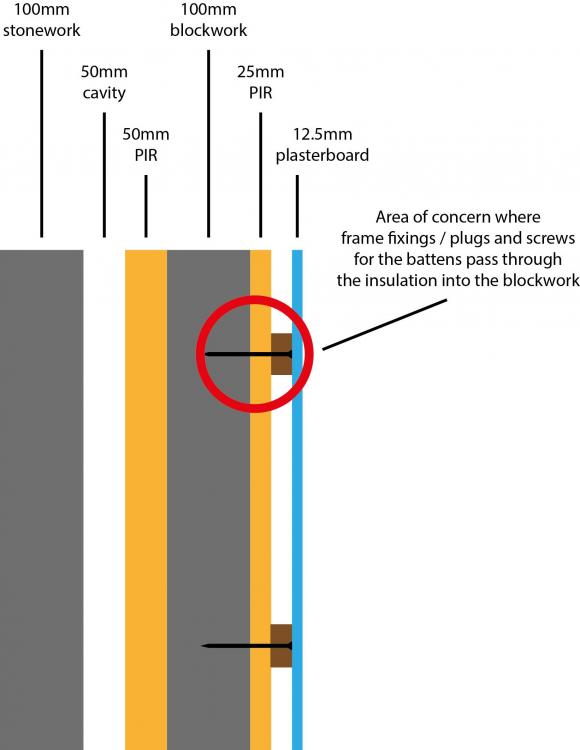
This is what I was thinking of doing (or alternately having the battens fixed directly to the blockwork and screwing insulated plasterboard on top). I will take the PIR right to the slab before additional floor insulation, UFH and screed is installed to ensure continuous insulation wall to floor to wall. Am I overthinking things by worrying about the spots where the fixings for the battens will be? Am I likely to create a load of small cold spots on the wall by breaking the 25mm PIR element? There is still 50mm PIR in the cavity so it's not like it's uninsulated or a solid wall. Your thoughts would be appreciated. Thanks.
-
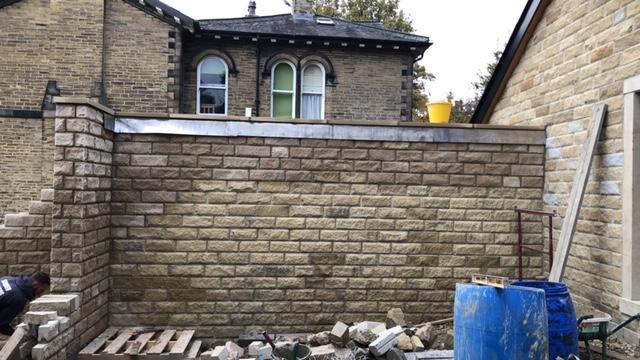
Hi all, I have some leftover slates from my house and garage build that I intend to use on my log and bin store area. I have a wall approx. 5.5m long with the garage at one end and a 1m return wall at the other end. I asked the builders to install some flashing before they laid the coping stones on the top of the wall. It will essentially be like a 5.5m long porch area. What would be the best way to construct the rafters etc? Due to the span will I need to use some steelwork? Or install a timber pillar in the middle?
-
For various reasons I need to put some additional insulation internally on my external blockwork walls. What is the preferred method of doing this (using PIR)? The obvious way would be to dot and dab insulated plasterboard but I'm not a huge fan of dot and dab. I was thinking of using sheets of PIR and then battening over the top to act as a service void and then screwing the plasterboard to the battens. Am I running the risk of thermal bridging by screwing the battens through the insulation and into the blockwork? Or alternatively battening onto the blockwork to create a service void and then screwing insulated plasterboard to the battens. It's a cavity wall with 50mm PIR insulation in the 100mm cavity. Am I overthinking this? Thanks
-
Thanks guys. As I said, I will be using 2.5mm single core for the bulk of the runs (with some 1.5mm for lighting in some of the runs). And also I'm aware of the factoring for the conduit size and also for the cable size and type. The factor for 20mm conduit in short straight runs is 460 and 2.5mm solid core is 39 which means that you could theoretically run 11 cables in one piece of conduit but I don't think you would physically fit that many in there! Just looking for advice on how many will physically fit in both sizes. My backup plan if I can't make it work in conduit is to run some 50mm trunking around the top of the walls and drop down in 20mm conduit to individual outlets. Not sure I like the aesthetics of this as much though.
-
I'm at the stage where I need to order and install all the electrical infrastructure for my garage/workshop. This will be surface mounted metalclad sockets and switches and galvanised conduit (it's robust and I like the industrial look in the garage). How many 2.5mm singles will I be able to get into 20mm conduit and how many into 25mm conduit? I understand about the conduit factoring and obviously won't exceed this but I'm talking about physical space. There will be a couple of 90 degree bends in the conduit run for the majority of the cables, with a few more in the straight run directly from the distribution board. Hoping someone will be able to share some experience of this. Also, I was originally planning to use the conduit as a common earth but my electrician has said that the Zs ohms reading 'probably' wont be good enough and he wants me to use separate earths for each circuit which obviously increases the number of cables in the conduit (hence my first question). Can someone please confirm that this is the case?
-
Thanks Temp
-
Evening all, I have a 32mm MDPE supply with a Plasson stop tap on it coming into my plant/utility room. The supply comes in on the ground floor where the kitchen, utility and a WC are located. On the first floor is the master ensuite and another separate toilet and the main house bathroom is on the second floor. Just starting to think about my plumbing specification now and I'm planning to use copper rather than plastic but would you go for a branch or manifold plan? I'm leaning towards a traditional branch plan for the reasons below: One of the advantages of manifold plumbing used in a plastic system is the lack of hidden joints but that doesn't apply if I'm using copper Manifold system would be a higher material cost as I would need a lot more pipe However, pressure and temperature variations would be less with a manifold system Which have you gone for and why? And would you go from 32mm MDPE into 28mm copper (I know the I/D are very similar) or straight down to 22mm? Thanks
-
Timber fence on top of stone wall - construction method
DaveH replied to DaveH's topic in Landscaping, Decking & Patios
Thanks for all the replies. After a discussion with the builder and throwing some ideas around I think I will make some steel box section vertical posts with a plate welded to the base which will be bolted directly to the foundations (possibly galvanised or just painted). They will have some tabs welded on to attach the horizontal timbers to and then the vertical timbers screwed to that. The dwarf wall will be built around the steels so that the posts are in the cavity and we will cut the copings to go around the steels. I'm favouring double sided, offset vertical timbers to give privacy but also allow airflow to reduce any potential wind loading. -
I'm shortly going to start on my permanent boundary wall so that the long suffering neighbours that sold me the plot can have their garden back! The boundary will be a natural stone wall approx 600mm tall on good concrete footings onto which I would like to put a wooden fence of around 1.5m. Any advice on how best to construct this? I was considering building some galvanised box sections or Easy Grip type post shoes into the cavity to accept some 75 or 100mm fence posts before the coping goes on. I can also concrete fill the cavity for additional strength if required. Also considering whether to use pre-manufactured fence panels or construct the whole thing from scratch.
-
So after taking further advice I'm looking to construct my internal walls in blockwork instead of timber studs. My builder has suggested using thermalite but I've heard negative remarks regarding the ability to mount heavy items to them (I'm thinking TV, MVHR unit etc etc). Does anyone have any practical advice regarding lightweight blocks vs medium density concrete blocks please?
-
Thanks
-
My roof makeup is 150x50mm rafters, breathable felt, 50x25 battens and natural slates with a dry ridge system. Underneath the felt I will leave a 50mm air gap and then 100mm Kingspan. The SAP calcs then call for insulated plasterboard underneath this. Will I need a separate VCL or will the foil covered Kingspan with taped joints be sufficient? Do I need to install soffit vents or will the breathable felt and dry ridge be adequate for ventilation? Thanks
-
Is it acceptable to build my ground floor internal walls in blockwork directly off the 6 inch reinforced concrete slab rather than constructing timber studwork walls? The only loadbearing wall has footings underneath but the room dividing walls would just be straight off the slab.
-
Thanks Peter
-
Thanks for that. That looks very similar to what I had in mind. One thing I wasn't sure though - from a safety point of view are there any issues having multiple phases in one area? I have been advised so far to keep each floor on a separate phase.
-
Thanks all. I had heard the Hager stuff was decent quality. Regarding the suggestions to put the incoming supply to the garage and then a submain to the house - all the ducting is now in place to bring the supply into the plant/utility room and the cable is going in on Monday (Northern Powergrid are coming to excavate the main in the road tomorrow). I will be running SWA cable back to the garage to a separate smaller 3ph board as my intention is to install a ramp at some point and as some of you have pointed out, 3ph garage/workshop equipment can sometimes be easier to come by especially secondhand. I always go over the top with the spec, although this does affect the budget somewhat! I like to futureproof! If I decide I want to use a standard single phase CU in the house is it acceptable to simply use one phase and leave the other two terminated? But also run all three back to the garage? Any diagrams or photos of 3 phase installs would be much appreciated to help me get my head around it (so I know what I'm talking about when speaking to the sparky!)
-
I have a new 3 phase connection going into my build shortly. There will be no 3 phase equipment initially - it was more about future proofing as the extra cost was very little over a single phase install. My Sparky is being very slow at getting back to me so I thought I'd turn to the collective knowledge on here in the meantime. I've not dealt with 3 phase before so any advice is appreciated. Are there any good deals to be had on 3 phase boards at the moment? I will also be running a separate, smaller 3 phase board in the detached garage. Any particular best practice to follow? Pitfalls to avoid? Thanks in advance
-
I just put a 100m coil of 25mm MDPE in the back of my SWB Shogun no problem. It's a lot smaller than you might imagine!
-
I have 2 new water connections going in before Christmas - a 25mm house supply and an unmetered 32mm firefighting supply for a sprinkler system. I want to tee off the house supply to send water to the detached garage too (obviously the tee will be inside the house and not underground). The pipes will be laid without ducting but could I send 2 or 3 pipes together through a short duct into the property or will I struggle once the pipes are lagged? Would they be better in individual ducts? Once inside the property can I tee and then add a stopvalve or is that asking for trouble? There will be a separate stopvalve in the garage and obviously one externally in the meter chamber. There will be drain off points by the main house stopvalve and garage stopvalve but do I need anything else? Check valve / non return valve? Thanks
-
Thank you
-
Sorry to dig up this post (pun intended!) As my build is on a private road and I have all necessary wayleaves from the neighbours to satisfy the various utility companies I'm having my own groundwork contractors dig the trenches for my utility connections right up to the mains. He has mentioned that his prices will be plus VAT. Can I ask him to zero rate this, and if he won't can I claim it back on my reclaim at the end of the build? Thanks