


Beelbeebub
-
Posts
1521 -
Joined
-
Last visited
-
Days Won
11
Everything posted by Beelbeebub
-
York Heatpumps - any experience?
Beelbeebub replied to Beelbeebub's topic in Air Source Heat Pumps (ASHP)
4 *small* units. -
York Heatpumps - any experience?
Beelbeebub replied to Beelbeebub's topic in Air Source Heat Pumps (ASHP)
It's.twofold. For when the whole house demand in late spring is far below the modulation of the HP sized for whole house demand in deep winter And to make the logistics, installation and price low. Just slap 2 or 3, or even 4 if it's a big place, units on the outside. So extreme economies of scale. If a unit fails, no probs, can be replaced quickly (no waiting for the right size unit) and unless you are a small flat with 1 unit, you still have the other units providing heating and DHW while you wait. Just a thought experiment. What we need is a unit than can modulate down low enough, reliably, to run without needing a buffer or similar. -
York Heatpumps - any experience?
Beelbeebub replied to Beelbeebub's topic in Air Source Heat Pumps (ASHP)
Looking at the stats, most UK homes have a max heat requirement under 10kw. If you had a simple outdoor unit (heatpump and PHX) rated to a max of say 3kw at -7. That would likely have a lower band around the 1.5kw at 15C. If the unit was cheap (say well under £1k) and (crucially) pretty small (say 500x500x300) you could fit multiple units for 3, 6, 9, 12 kw max. You could modulate down by just running on unit. The key bit would be a small and cheap single unit, not much more than the cheap pool heaters. -
York Heatpumps - any experience?
Beelbeebub replied to Beelbeebub's topic in Air Source Heat Pumps (ASHP)
What's interesting is the range I looked at had the same lower bound for the 5, 7 and 9 kw units. Your oversize issues will be no worse if you had a 5 or 9kw unit. The step up to the next size (12-16kw) does step the lower limit up. I wonder how many problem installs are related to oversize Vs undersize?. -
York Heatpumps - any experience?
Beelbeebub replied to Beelbeebub's topic in Air Source Heat Pumps (ASHP)
I'd be interested in the "wear" bit. I wonder what mechanism is causing the accelerated wear? The only one I can think of is lubricant starvation at startup, but that shouldn't be an issue if the thing only shut down recently. WRT efficiency, I can imagine there are some losses related to ramping up to operating minimum speed and the time taken to build pressure. But ultimately the issue is "is the (S)COP better than 3.5¹?. Is chasing the last few % of efficency worth pushing up the cost with large buffers and complex setup Vs just fitting a box outside. Gas boilers cycle quite a bit in shoulder months. Theoretically it increases wear (thermal cycling) and reduces efficency but nobody cares because slapping a box on the wall is much cheaper and simpler than lots of complex calculations, a box on the wall and a load of gubbins. The HP above (Panasonic) seems to be cycling like mad and still hitting well over 4 on the COP. At that point, I'd say it's fine. ¹ Or whatever the financial break even point is -
York Heatpumps - any experience?
Beelbeebub replied to Beelbeebub's topic in Air Source Heat Pumps (ASHP)
I redrew the common capacity vs demand graph using the figures for the 5kw york and a made up house thay uses 6kw at -5 and 0 from 12C. as you can see there is a significant "zone" below about 5C where the demand is less than the minimum, and we are likely to spend more time between 5 and 12C than below 5C. What is the issue with cycling? I know it is bad, but why? Is it wear on the pump? is it efficiency? How does the short cycling affect efficiency?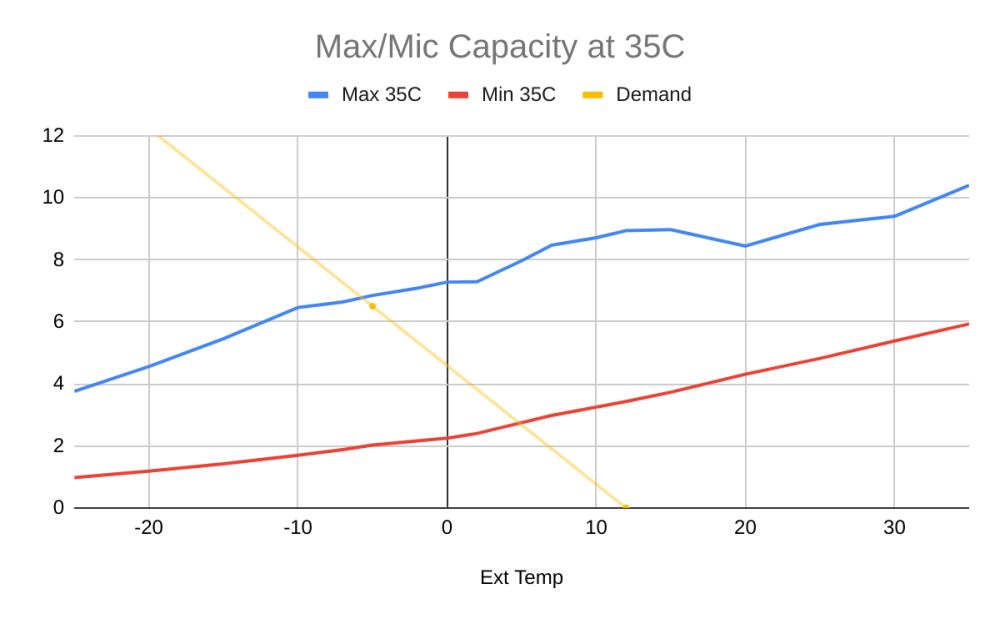
-
York Heatpumps - any experience?
Beelbeebub replied to Beelbeebub's topic in Air Source Heat Pumps (ASHP)
Reducing the need for a buffer would seem to be a good thing for heat pumps. It's an additional thing to buy, find space for and fit. It seems to me the big issue is basically the thermal inertia of the house (including the heating system) and a buffer is just adding thermal inertia to the heating system. A buffer is an easy way to add thermal mass to the system *if it is needed*. If you have UFH that should act as a buffer vessel. I think there is mileage in using the DHW tank as a buffer vessel in some cases (mainly where there is a higher flow temp like a retrofit) Maybe it's time to being back cast iron radiators! 😁 -
York Heatpumps - any experience?
Beelbeebub replied to Beelbeebub's topic in Air Source Heat Pumps (ASHP)
So whilst the compressor is.off, the water pump continues - sort of like overrun on a boiler? Presumably there is a.bitmof loss of heat as the water is flowing outside the thermal envelope and through the plate heat exchanger and back for the "off" period but it's negligible? -
York Heatpumps - any experience?
Beelbeebub replied to Beelbeebub's topic in Air Source Heat Pumps (ASHP)
How does that work? If you house needs 1kw to stay at 20C and your HP can only modulate down to 2kw, either your house eventually warms up or your HP has to shut off for a while. The only way I can see system volume helping is if it is large enough to act as a.thermal store in it's own right *and* you can keep circulating it even when the compressor is off. I can see how that might work with an external pump system like a Samsung, you could have a 3way valve that bypasses the heatpump and just circulates the water until it cools sufficiently, but how would that help with monoblocks with built in pumps? Or do they do just that? -
York Heatpumps - any experience?
Beelbeebub replied to Beelbeebub's topic in Air Source Heat Pumps (ASHP)
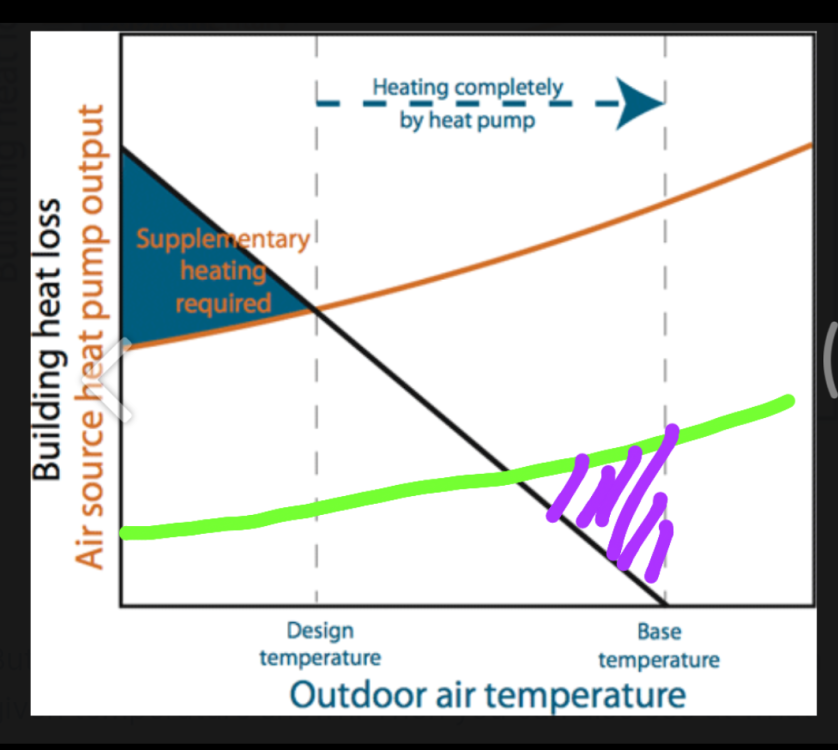
Basically this diagram, where green is lower limit and purple the "cycling zone"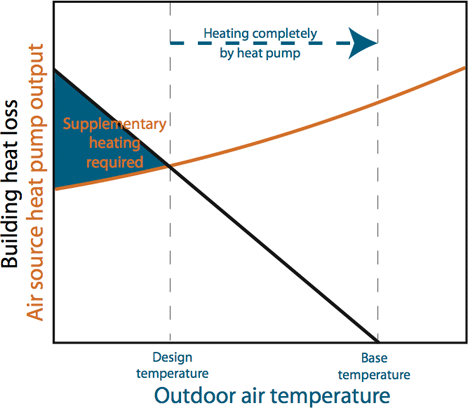
-
York Heatpumps - any experience?
Beelbeebub replied to Beelbeebub's topic in Air Source Heat Pumps (ASHP)
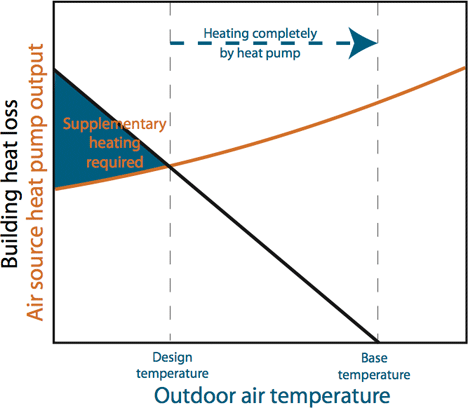
Habe we been looking at modulation a bit wrong? AFAIK we.look at the max power at a given outside temp and the.min power and then call that the ratio So for the vaillant another 5kw AT -7 the max power is 5.6kw and min is 1.6. a pretty impressive 3:1 of max. At 0C it's even better, 6.9->1.6kw or near 4:1 But shouldn't we be taking the minimum at a higher temp? After all that is when you actually will need to modulate down. So the arotherm at 15C is 2.5kw minimum, so a less impressive 2:1(ish). To some extent it depends where you take your min and max temps, the modulation from -2 to 10 is going to be better than -7 to 15. We often see this image, showing the falling HP max capacity as outside temp falls and heat demand increases. But maybe that graph needs the lowest power output at a given temperature shown. Then you can also see at what temperature you heatpump needs to start cycling as hearing demand falls below minimum output.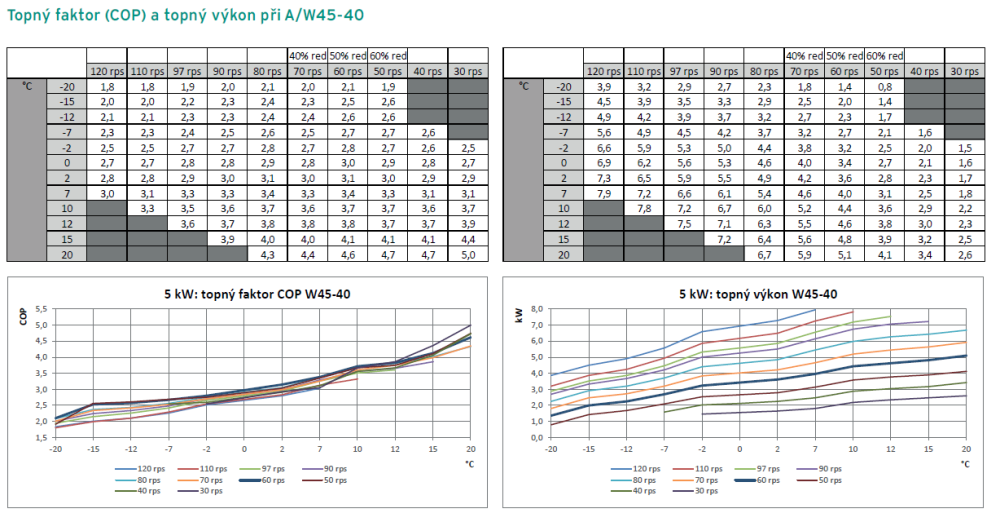
-
York Heatpumps - any experience?
Beelbeebub replied to Beelbeebub's topic in Air Source Heat Pumps (ASHP)
EDIT: I've just re-read the spec sheet and the 5,7,9kw units *all have the same charge* 1.25kg! So it looks like they are all physically identical and have the same charge.....so what is the difference (apart from price)? Surely the performance should be identical in all regimes? I'll ask next time I speak to technical.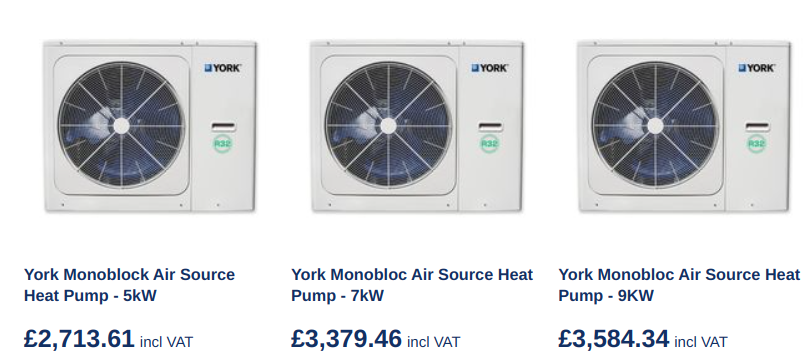
-
York Heatpumps - any experience?
Beelbeebub replied to Beelbeebub's topic in Air Source Heat Pumps (ASHP)
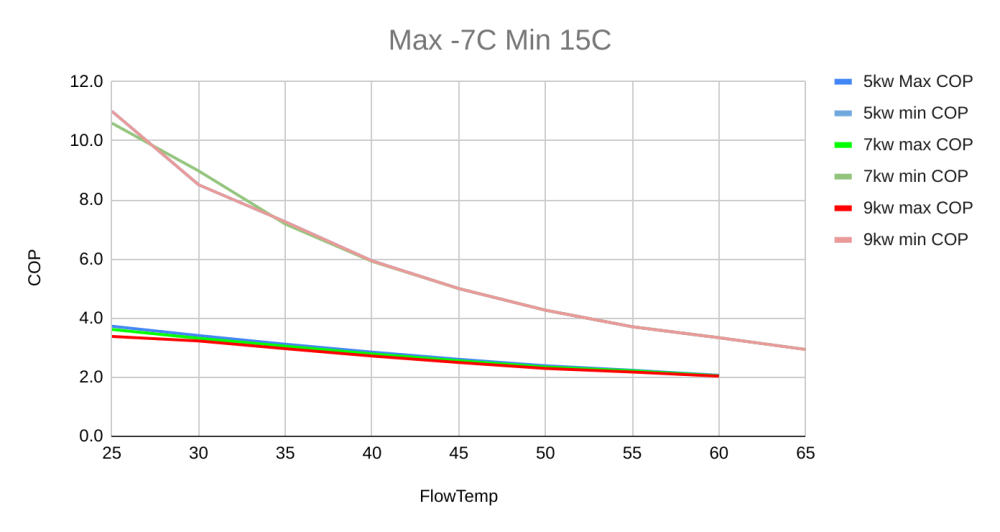
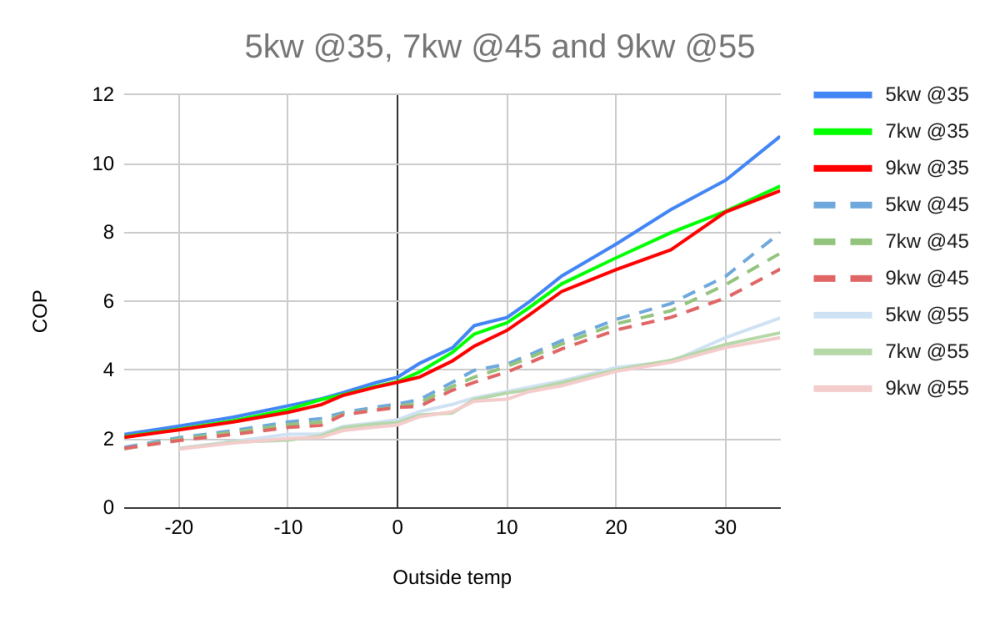
so more digging.... I've looked at the 5,7,9 kw machines as they appear to be identical except for the charge. This is specific to the York units but i suspect most modern r32 units are similar, it just depends where the manufacturers draw the line building different machines vs just tweaking the charge and control of an existing machine. I then took -7 as the coldest outside temp where you would want to be working at max power (regardless of your flow temp) Then 15C as a nominal point where you would want to be at minimum power as your barely need to heat the house. Then I graphed the max/min power outputs for each of the 3 units So it looks like the lower bound of modulation is the same regardless. You don't get any advantage of lower modulation by going for the "smaller" unit. I thin looked at COP at those extremes. In this case the COPs are pretty much the same. There is a small difference at the lower flow temperatures but by the time you get past 35C they are near identical. So far it looks like the only disadvantage of going for the bigger unit is purchase cost and possibly the slightly larger electrical supply to the unit. The final area i looked at was the COPs for the nominal power rating at 35, 45 and 55 flow temps as you can see below about 15C there isn't much difference except maybe at 35C. For 55C there is almost no difference even out to 30C outside temp If you are after the ultimate efficiency and can run at very low flow temps (35C) and definitely don't need the higher powers when cold, so basically a good spec new build, you could get away with the 5kw and save some money up front and maybe get a little more efficiency. For anyone else I reckon oversizing isn't going to be an issue with these units.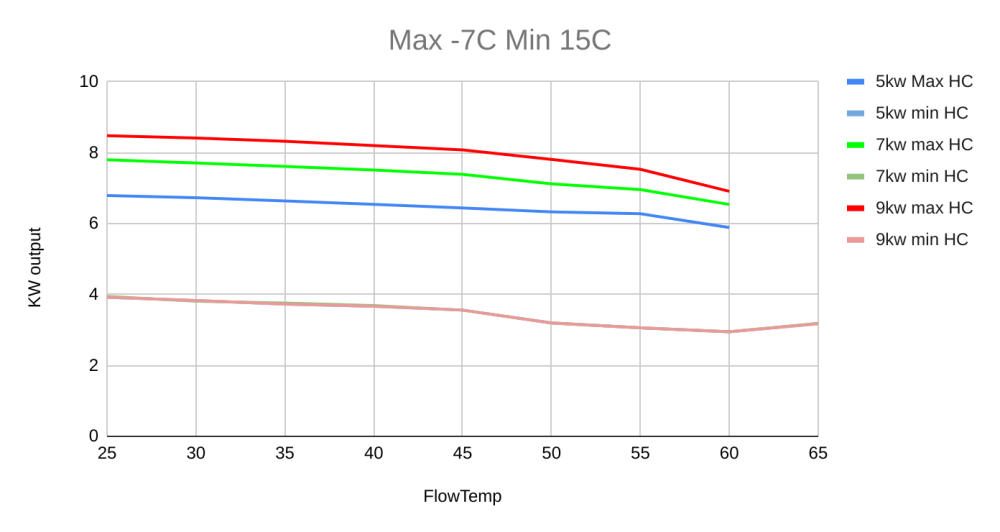
-
York Heatpumps - any experience?
Beelbeebub replied to Beelbeebub's topic in Air Source Heat Pumps (ASHP)
As an addendum to the post above, it's interesting the 5-9kw units and 12-16kw units are identical except for charge. This opens up the possibility of just holding 5-9kw and 12-16kw units at suppliers and then adjusting the charge on site. If the refrigerant were r290 the units could be supplied fully charged and then adjusted down to suit the property by simply bleeding (in a safe manner of course) the excess charge out during commissioning. Likewise, some careful monitoring over the first few years might be able to recommend up or down charging the system, which could be done at the next annual service. If the heatloss calculations were way out and the unit was too big/small despite charge adjustment the fact they are externally identical means the whole unit could be part exchanged for a bigger/smaller unit as required. Of course the dream would be to get the 5-16kw range (which would do most houses in the UK) into a single machine with and adjustable charge. That would massively simplify the logistics and manufacturing, hopefully making things cheaper. -
York Heatpumps - any experience?
Beelbeebub replied to Beelbeebub's topic in Air Source Heat Pumps (ASHP)
Had a bit of a dig, it appears the 5, 7, 9, 12, 14 and 16kw units are externally identical and all use the same hydraulic module (water pump, PHX etc) They also share fans, fan motors and (interestingly) evaporator/condenser coils. The 5, 7 and 9kw units are identical except for charge. The 12, 14 and 16kw units are identical except for the charge The differences are the compressor, expansion valve and 4 way valve (as you would expect). The units seem to be complete monoblocks so everything except 3 way valve and controls is in the box. Some other brands need external expansion vessels (Grant) or pumps (Samsung). York are a big wheel in the commercial refrigeration and air con world, particularly in the US and are part of Johnson Controls (hence the control units being seen elsewhere) The units are apparently made by an OEM exclusively to York design and spec. -
So if I understand it was - Turn up, remove old gas boiler & cap gas - Install Hp outside - drill holes in wall & connect to existing pipes - connect up control system - comission - home for tea and biscuits. For just over 5k including the HP? That's the sort of price and install we should be aiming at.
-
I'm guessing this is MCS cross checking the info they received from the installer corresponds with what happened?
-
Please tell me a government minster didn't say that! That line of thinking fundementally misunderstands the threats from rising global temperatures. It also happens to be a common argument from the "skeptic" community, which would indicate that lobby has the ear of that particular minster.
-
😂🤣😂🤣😂😂....😭😭
-
Came across this.... They call it "tankless", but it clearly has a big tank of water/glycol in it. They just call it a heat exchanger. I guess they are technically correct. It reminds of the story about NASCAR rules when they limited the size of the fuel tank. So the team out a 10 gallon fuel line in....
-
The real heating cost comparison to make?
Beelbeebub replied to Post and beam's topic in Air Source Heat Pumps (ASHP)
Your surface are for losses will go up just because of the semi->detached and the larger floor area. Depending on your form factor you could easily be doubling your surface area. So your fabric would need to be at least 2x as good just to stay in the same place! Depending on how.well.insulatwd your old place was thatau or maynot be realistic. A victorian solid wall flat uses less energy to heat than our super insulated detached bungalow. But it's half the floor area and benefits from only having 2 external surfaces Vs our 6! My suggestion is defo have UFH and get the heating system temp as low as possible. We can heat our house with a flow temp below 40C. MHRV is aust once you've got your walls up to a certain level. Oh and *don't* chase solar gain in the winter with lots.of south facing glazing! It will cause more problems with overheating on sunny days and especially in summer than it solves with "free heat" in the winter -
Tolerance in ASHP sizing? Drawbacks of oversizing?
Beelbeebub replied to embra's topic in Air Source Heat Pumps (ASHP)
Or presumably up rate with a larger charge? The "dream" would be to change the rating of a physical unit to match the load simply by adding or removing some charge and changing the software parameters. That would be a win for most people, the manufacturer would have simpler production, suppliers could stock one unit, installers would only need to handle one unit and could adjust "in situ" for the property. I'm pretty sure gas boilers already do this. I was told my WB 18kw was identical to the 12, 15 and 22kw units. Just a different chip in the PCB (which they won't sell you!). Vaillant go even better, their units are configurable by the installer who fits one unit with a wide range and the configures it for the property. Question: My understanding is the upper limit of performance is related to the charge. There is only so much heat you can transfer per kg of fluid. The lower limit is related to how slowly you can run the compressor before it becomes too inefficient. If the York units are physically the same (IE have a big coil and compressor for the 14kw but are down charged and slowed down for the lower ratings) could you extend the modulation of a HP by having a "reservoir" that you can increase or decrease the working charge with? IE, there is a gas bottle off the HP circuit and you can pump gas into it before sealing it off and then the remaing working circuit has less charge land the software rejigs). When you want more capacity you just bleed more gas from the bottle back into the system? -
Gas boiler lobby obstructing heatpumps
Beelbeebub replied to Beelbeebub's topic in Air Source Heat Pumps (ASHP)
Certain portions of the press! -
Agree! Sorry, what I meant was "not brazed joints", flare nuts would be fine but if there was an even more foolproof way (Daikin has a clever one with a green indicator to show it's done up properly) it would be better. It needs to be plug and play As for spares, yes if the system was cheap enough then just replace (hardly very sustainable tho!). The pig is installation. Swapping out a single head or outside unit is not too bad, but if you're replacing all the heads, the outside and then maybe the control wiring it becomes a bigger job. Be nice if it was a simple as a radiator swap.
-
Gas boiler lobby obstructing heatpumps
Beelbeebub replied to Beelbeebub's topic in Air Source Heat Pumps (ASHP)
Are they? Unless you are nicking for scrap, in which case any metal is vulnerable, you have to remove a HP fairly carefully or all you will end up with is scrap. Unless they turn up when you are away and pretend to be legit plumbers doing some work, someone (probably inside the house) will notice.


