Beelbeebub
-
Posts
1232 -
Joined
-
Last visited
-
Days Won
6
Everything posted by Beelbeebub
-
Regarding CoPs, If you can run your (modern) HP at 50C to get your cylinder up to 45C (IE you have a big coil) then the CoP is likely to be above 3.5 all the way down to 10C again, most of the year. Don't forget your HP will not spend all the.time at 50C it will creep up from the lowest temp it can sustain with sufficient heat transfer not to cycle. So you COP should.be better than 3.5 and it should be cheaper than gas.
-
I had a look at a table for an R32 York machine, it can produce 60C water from -15C to 30C (so all usual UK situations). At 0 it's min output at 60C is 3.6kw at a rather poor 2.3CoP So we would only be getting "worse than gas" performance on the few days of the year we are below 0. It only has to rise to 5C to start being more efficient than a boiler. At 20C the min output rises to 7kw but the cop is 3.6 A standard cylinder coil should be easily able to handle 6kw transfer at 60C
-
That would be true of an older pump using r410 similar. I think they tended to top out in the low 50's sometimes below. But an r290 can go up to 70+, basically the same range as a gas boiler. So it starts at 45/37 flow/return. But the coil is too small and the return is 42C (say) As you say, it ramps up, maybe tries 55/47. Still no good, the return is 49! At this point an old HP would just quit (as you say). But newer ones just try 65/57 At which point the cylinder can't tell the difference between 65C flow from.a gas boiler and 65C from a HP. The only issue I can see is the higher flow rate of the HP might cause hydraulic issues. But, as I said, 22mm pipes should be able to handle the 65/57 flow rates required to dump 6kw or so. There may be some cases where the run is long, has many bends and valves etc where we start to run into issues.
-
Exactly, and I reckon that you could make most (not all) existing cylinders work with a (modern) HP. Initially you would use the "boiler emulator" setting of 65 or 70C flow and thermostat. Not very efficient, but it works and the switchover job is much faster. Then you could tune the system to work best with existing setup. Once you've got to maximum efficiency then, if it's still not high enough, you look to fitting a "HP coil" cylinder. As I said, the magic number is around 2.5 As long as you overall scop is better than that the.UK burns less gas.
-
From what I have seen if HP performance tables the minimum power output is relatively flat as flow temp increases, actually falling abit. All the coil caers about is the temp coming in. The temp going out is a function of flow rate. Eg if you pumped 1lpm of 65c water in it would come out at whatever temp the s DHW was. If you pumped at 200lpm the water would come out at about 64C. The power dissipated is just the average dT between the DHW and the coil (and the area). If you double the average dT you double the power dissipated. So a regular boiler might flow 65c water in at 10lpm and the return is 45C. For 14kw If our HP could supply 65C at 10lpm with a return of 55C the power would be a bit above 7kw (because the average coil temp was now 60C and not 55C) The issue was always that the little coil couldn't provide enough SA to dump enough power at 50C or whatever the old HPs could pump out. The HP needed to raise the temp to dump enough heat to stop cycling, bit couldn't. Yea the cop of hearing a cylinder using 65c flow temps is it good, maybe 2. But, so what. It just drags the SCOP.down a bit. And, in time the cylinder cam be changed. Meanwhile the heating is much more efficient. The point is it is probably better for the UK to get more HPs in even if they aren't being super efficient at DHW, than people sticking with gas boilers because the cost of swapping is too much (because of the cylinder swap)
-
I get the point but a 16kw r32 HP has a minimum output of 6kw at 65C water temp. 16kw should be enough for most properties From the cylinder's point of view, all it knows is that it's connected to a 65C flow source and will extract the same heat. If anything, it will extract more with a HP as the return temp is lower thus the average coil temp is higher.(65/58 Vs 65/45) 6kw is well below the output of any gas boiler so any coil that works with a gas boiler, IE can dump enough heat to stop the boiler cycling, should be fine with a HP. The only thing I can think that might cause a problem is the follow through the coil being higher if the resistance is to much. But 22mm copper should be big enough and I can't imagine anyone using 15mm feeds for the coil in a large house. With old r410a pumps limited to lower temps, so I get the issue. But r32 and r290 especially can replicate the flow temps of a gas boiler. The could even do a legionella cycle and do away with the immersion heater. That would mean there is no possibility of the cylinder boiling. That works mean we won't need expensive g3 cylinders, installer ticket or annual checks.
-
I get why I vented and a booster seems less attractive. And I have experience with a really noisy crap old booster. But recently (about 2.years ago) I have fitted the pump linked to provide cold water mains pressure for 8 properties (from one pump!). It has an additional 50l expansion vessel to buffer it's output a bit, but to be honest it probably doesn't need it. It's very fast responding and just a mild "rustle" sound. If it was on an insulated pad in an airing cupboard you probably wouldn't notice it at all. It made me rethink my strategy for DHW cylinders a bit. For less than the cost of an unvented cylinder you can get a vented cylinder and pump and not have to bother with any invented regs or checks.
-
As a thought, You say you have crap water pressure anyway, why not a vented hot water cylinder with a high recovery coil and a booster pump This cylinder is about £450 https://mwphs.co.uk/product/ultra-high-recovery-117-litre-vented-hot-water-cylinder-900-x-450/ With 2m² coil And I have this water pump https://www.anglianpumping.com/product/water-boosting-pumps/stuart-turner-mainsboost-variq That is excellent, very quiet. Can both be installed by regular plumber with no unvented regs.
-
York Heatpumps - any experience?
Beelbeebub replied to Beelbeebub's topic in Air Source Heat Pumps (ASHP)
Sent you DM -
York Heatpumps - any experience?
Beelbeebub replied to Beelbeebub's topic in Air Source Heat Pumps (ASHP)
Have a word with York. I think the 12 & 16kw units are identical like the 6,7,9 lower units and Habe identical "bottom.ends" of performance, just different maximums. The frame sizes are nice and compact it seems. As for the modular concept, yes the idea would be the units could stack vertically and sideways. Electrically they would daisy chain i.e. the control would go to the master unit and then the other units would daisy chain off that for control, power and Comms. As for hydraulics, I assume they would be run in parallel, so a premade manifold would be provided and you Flexi connect all the flows to one and all the returns to another (prob only 22mm, maybe 15mm if the.nunbers work out) and then in the appropriate feed and return pipes into the building In fact grant make an external volumiser, basically an insulated box that sits behind the HP and provides 30L or so of volume. If you added extra ports into and out of the box, your volumiser would also be your manifold As I said it's a bit of a pie in the sky concept, more to provoke discussion than actually be a serious proposal -
York Heatpumps - any experience?
Beelbeebub replied to Beelbeebub's topic in Air Source Heat Pumps (ASHP)
The idea (such as it is).would be the units could.be fixed together so they are one unit. Say 2x1.or 2x2 or 1x2 or 3x1 or whatever. Again, this points to the need for some regulatory changes to boost HP take-up. -
York Heatpumps - any experience?
Beelbeebub replied to Beelbeebub's topic in Air Source Heat Pumps (ASHP)
4 *small* units. -
York Heatpumps - any experience?
Beelbeebub replied to Beelbeebub's topic in Air Source Heat Pumps (ASHP)
It's.twofold. For when the whole house demand in late spring is far below the modulation of the HP sized for whole house demand in deep winter And to make the logistics, installation and price low. Just slap 2 or 3, or even 4 if it's a big place, units on the outside. So extreme economies of scale. If a unit fails, no probs, can be replaced quickly (no waiting for the right size unit) and unless you are a small flat with 1 unit, you still have the other units providing heating and DHW while you wait. Just a thought experiment. What we need is a unit than can modulate down low enough, reliably, to run without needing a buffer or similar. -
York Heatpumps - any experience?
Beelbeebub replied to Beelbeebub's topic in Air Source Heat Pumps (ASHP)
Looking at the stats, most UK homes have a max heat requirement under 10kw. If you had a simple outdoor unit (heatpump and PHX) rated to a max of say 3kw at -7. That would likely have a lower band around the 1.5kw at 15C. If the unit was cheap (say well under £1k) and (crucially) pretty small (say 500x500x300) you could fit multiple units for 3, 6, 9, 12 kw max. You could modulate down by just running on unit. The key bit would be a small and cheap single unit, not much more than the cheap pool heaters. -
York Heatpumps - any experience?
Beelbeebub replied to Beelbeebub's topic in Air Source Heat Pumps (ASHP)
What's interesting is the range I looked at had the same lower bound for the 5, 7 and 9 kw units. Your oversize issues will be no worse if you had a 5 or 9kw unit. The step up to the next size (12-16kw) does step the lower limit up. I wonder how many problem installs are related to oversize Vs undersize?. -
York Heatpumps - any experience?
Beelbeebub replied to Beelbeebub's topic in Air Source Heat Pumps (ASHP)
I'd be interested in the "wear" bit. I wonder what mechanism is causing the accelerated wear? The only one I can think of is lubricant starvation at startup, but that shouldn't be an issue if the thing only shut down recently. WRT efficiency, I can imagine there are some losses related to ramping up to operating minimum speed and the time taken to build pressure. But ultimately the issue is "is the (S)COP better than 3.5¹?. Is chasing the last few % of efficency worth pushing up the cost with large buffers and complex setup Vs just fitting a box outside. Gas boilers cycle quite a bit in shoulder months. Theoretically it increases wear (thermal cycling) and reduces efficency but nobody cares because slapping a box on the wall is much cheaper and simpler than lots of complex calculations, a box on the wall and a load of gubbins. The HP above (Panasonic) seems to be cycling like mad and still hitting well over 4 on the COP. At that point, I'd say it's fine. ¹ Or whatever the financial break even point is -
York Heatpumps - any experience?
Beelbeebub replied to Beelbeebub's topic in Air Source Heat Pumps (ASHP)
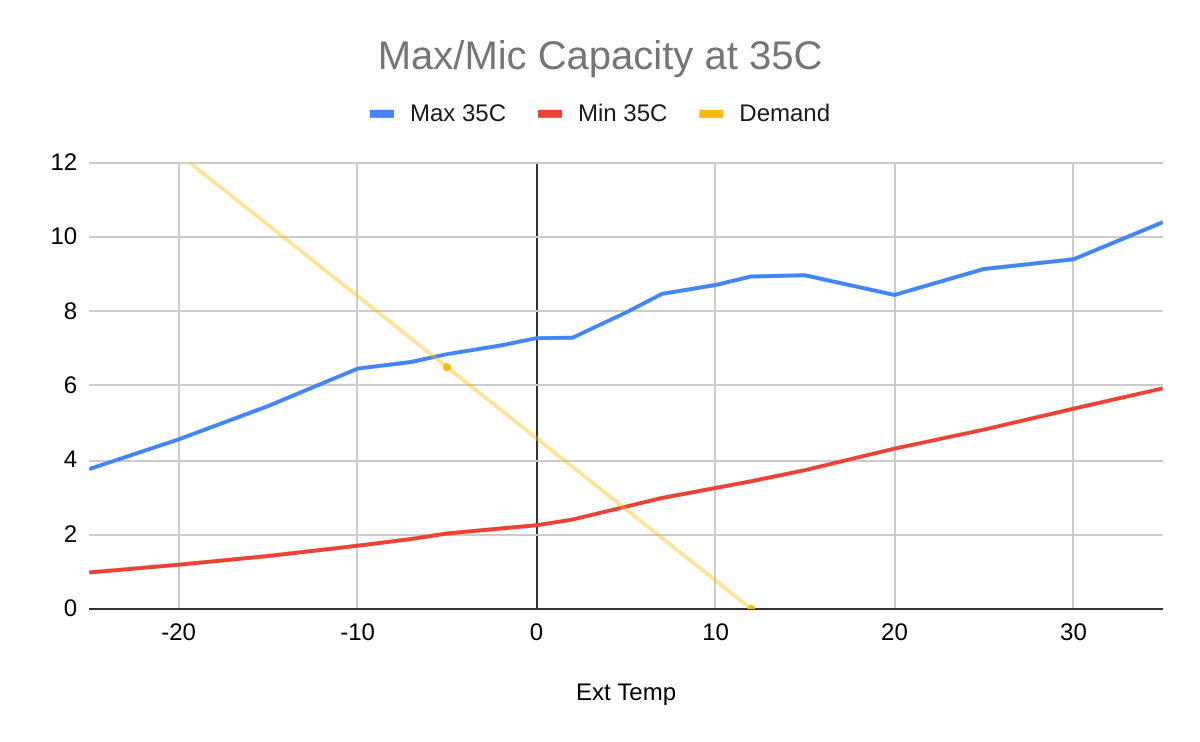
I redrew the common capacity vs demand graph using the figures for the 5kw york and a made up house thay uses 6kw at -5 and 0 from 12C. as you can see there is a significant "zone" below about 5C where the demand is less than the minimum, and we are likely to spend more time between 5 and 12C than below 5C. What is the issue with cycling? I know it is bad, but why? Is it wear on the pump? is it efficiency? How does the short cycling affect efficiency?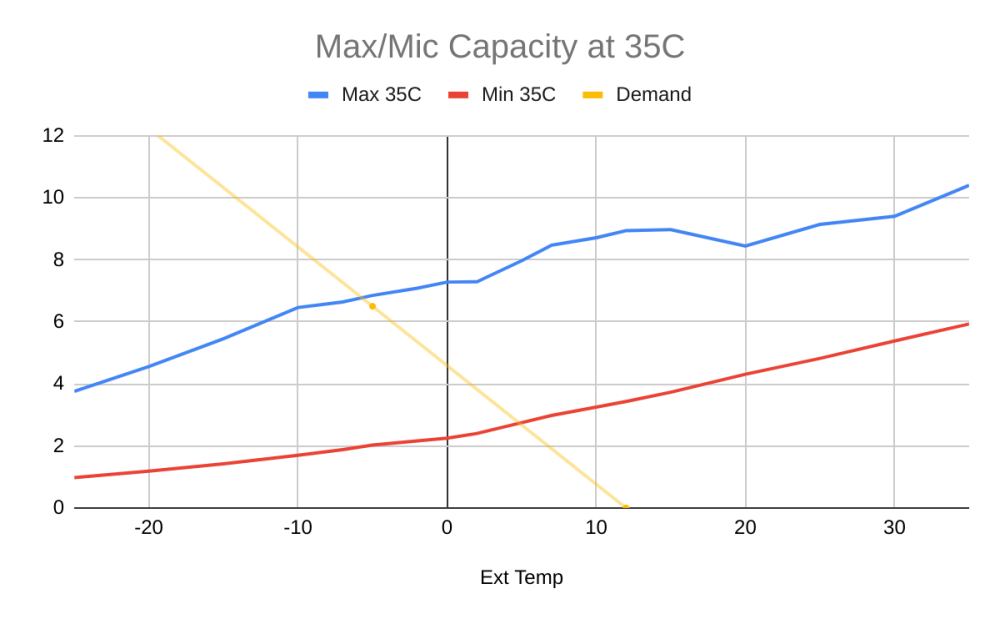
-
York Heatpumps - any experience?
Beelbeebub replied to Beelbeebub's topic in Air Source Heat Pumps (ASHP)
Reducing the need for a buffer would seem to be a good thing for heat pumps. It's an additional thing to buy, find space for and fit. It seems to me the big issue is basically the thermal inertia of the house (including the heating system) and a buffer is just adding thermal inertia to the heating system. A buffer is an easy way to add thermal mass to the system *if it is needed*. If you have UFH that should act as a buffer vessel. I think there is mileage in using the DHW tank as a buffer vessel in some cases (mainly where there is a higher flow temp like a retrofit) Maybe it's time to being back cast iron radiators! 😁 -
York Heatpumps - any experience?
Beelbeebub replied to Beelbeebub's topic in Air Source Heat Pumps (ASHP)
So whilst the compressor is.off, the water pump continues - sort of like overrun on a boiler? Presumably there is a.bitmof loss of heat as the water is flowing outside the thermal envelope and through the plate heat exchanger and back for the "off" period but it's negligible? -
York Heatpumps - any experience?
Beelbeebub replied to Beelbeebub's topic in Air Source Heat Pumps (ASHP)
How does that work? If you house needs 1kw to stay at 20C and your HP can only modulate down to 2kw, either your house eventually warms up or your HP has to shut off for a while. The only way I can see system volume helping is if it is large enough to act as a.thermal store in it's own right *and* you can keep circulating it even when the compressor is off. I can see how that might work with an external pump system like a Samsung, you could have a 3way valve that bypasses the heatpump and just circulates the water until it cools sufficiently, but how would that help with monoblocks with built in pumps? Or do they do just that? -
York Heatpumps - any experience?
Beelbeebub replied to Beelbeebub's topic in Air Source Heat Pumps (ASHP)
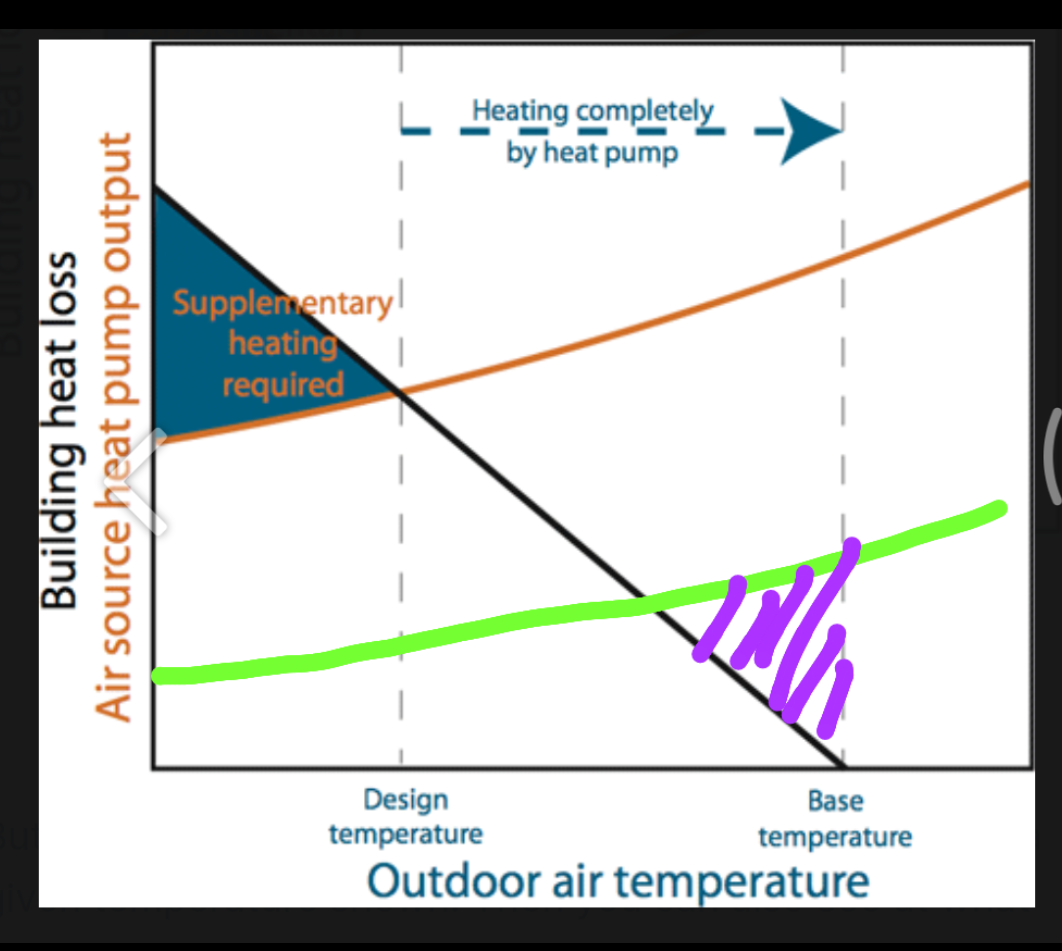
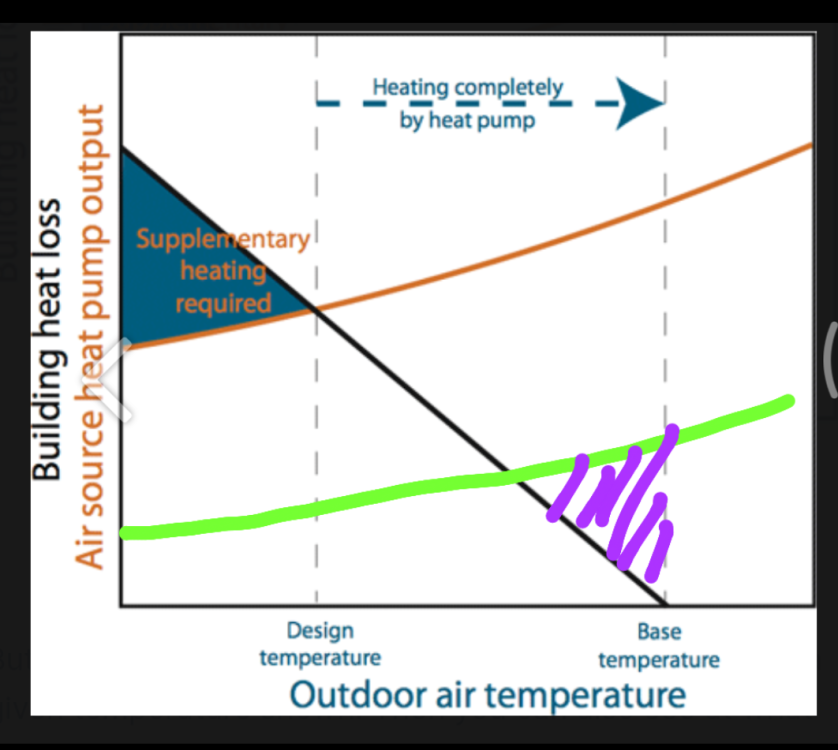
Basically this diagram, where green is lower limit and purple the "cycling zone"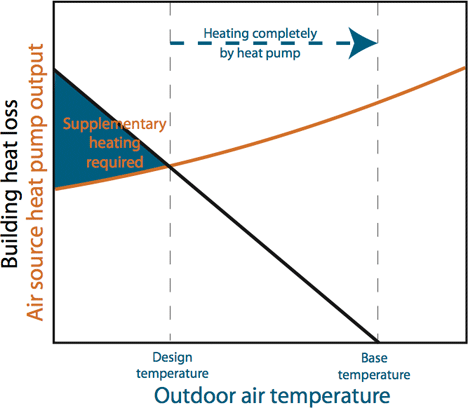
-
York Heatpumps - any experience?
Beelbeebub replied to Beelbeebub's topic in Air Source Heat Pumps (ASHP)
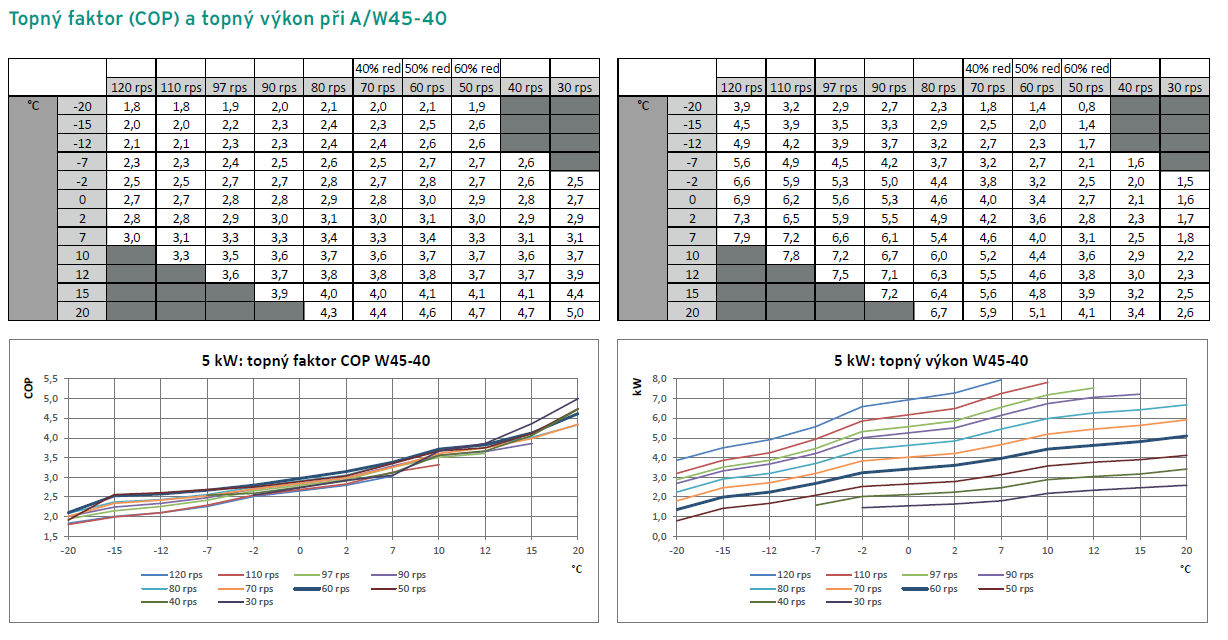
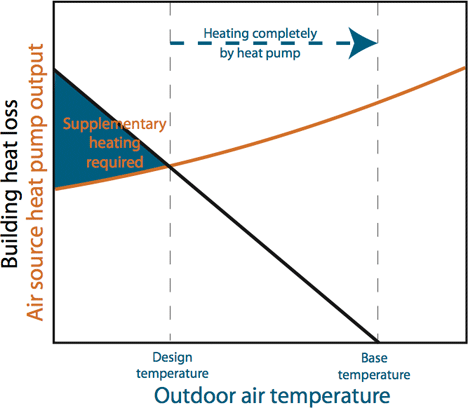
Habe we been looking at modulation a bit wrong? AFAIK we.look at the max power at a given outside temp and the.min power and then call that the ratio So for the vaillant another 5kw AT -7 the max power is 5.6kw and min is 1.6. a pretty impressive 3:1 of max. At 0C it's even better, 6.9->1.6kw or near 4:1 But shouldn't we be taking the minimum at a higher temp? After all that is when you actually will need to modulate down. So the arotherm at 15C is 2.5kw minimum, so a less impressive 2:1(ish). To some extent it depends where you take your min and max temps, the modulation from -2 to 10 is going to be better than -7 to 15. We often see this image, showing the falling HP max capacity as outside temp falls and heat demand increases. But maybe that graph needs the lowest power output at a given temperature shown. Then you can also see at what temperature you heatpump needs to start cycling as hearing demand falls below minimum output.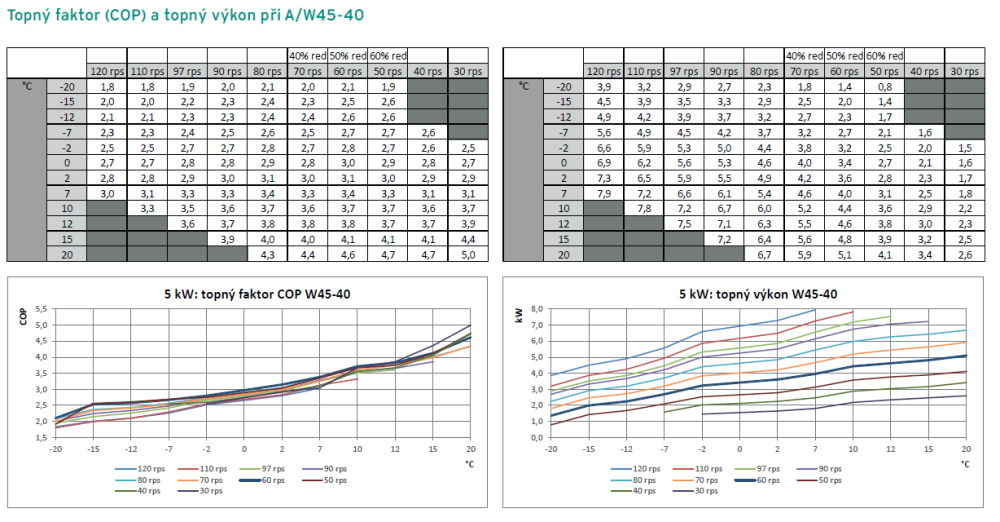
-
York Heatpumps - any experience?
Beelbeebub replied to Beelbeebub's topic in Air Source Heat Pumps (ASHP)
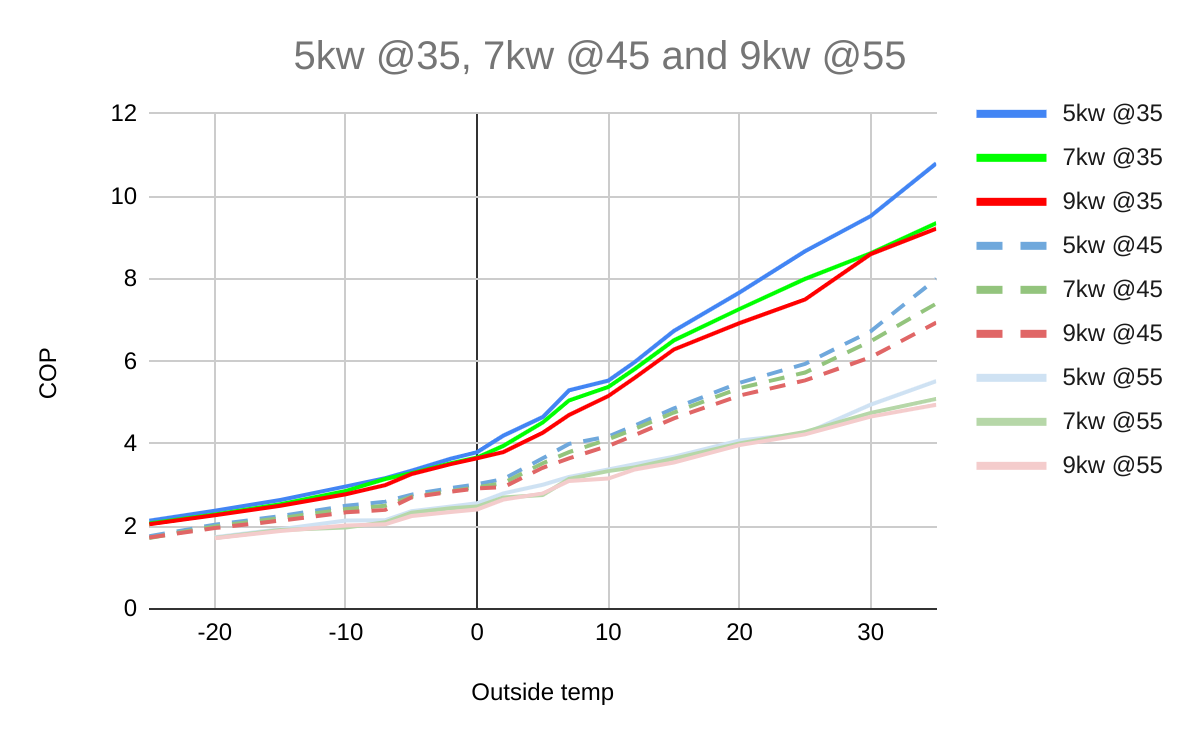
EDIT: I've just re-read the spec sheet and the 5,7,9kw units *all have the same charge* 1.25kg! So it looks like they are all physically identical and have the same charge.....so what is the difference (apart from price)? Surely the performance should be identical in all regimes? I'll ask next time I speak to technical.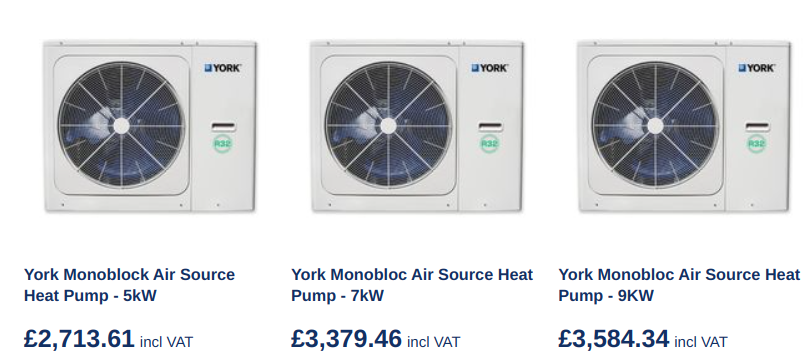
-
York Heatpumps - any experience?
Beelbeebub replied to Beelbeebub's topic in Air Source Heat Pumps (ASHP)
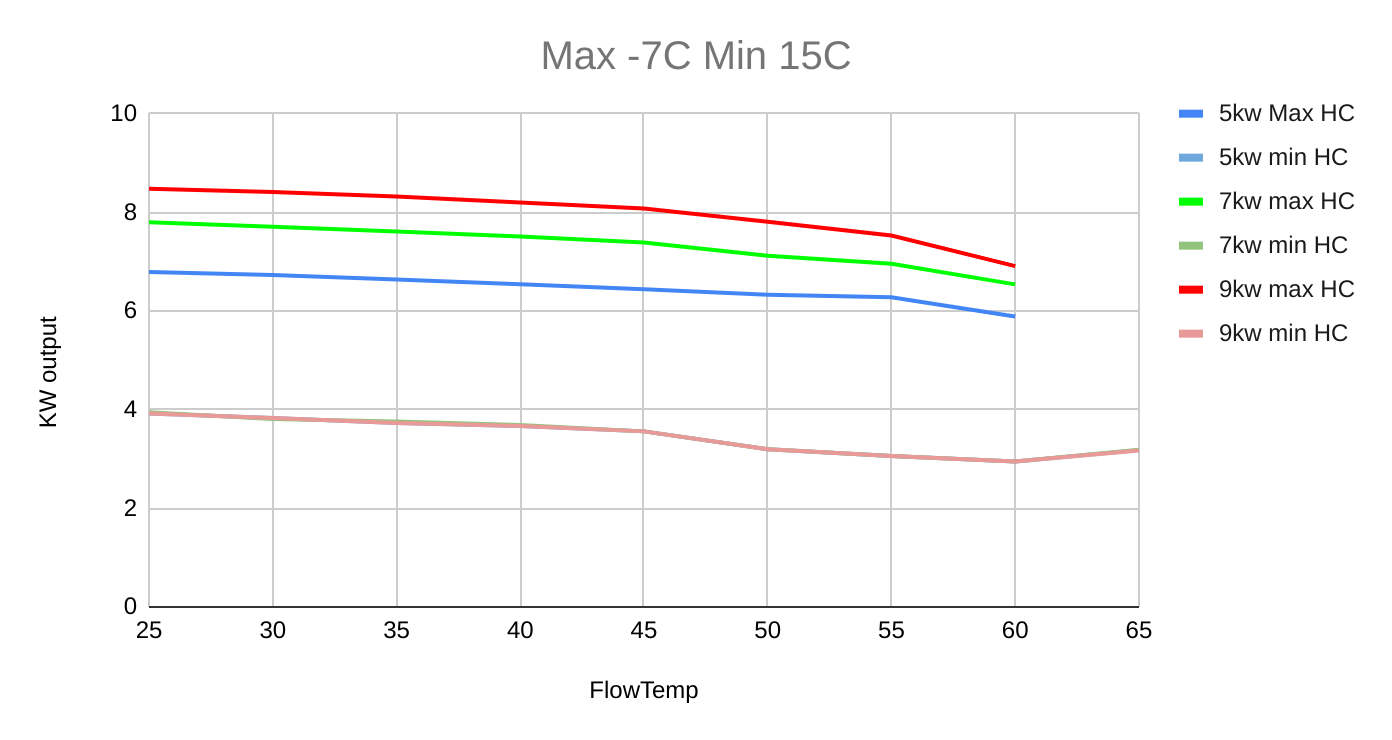
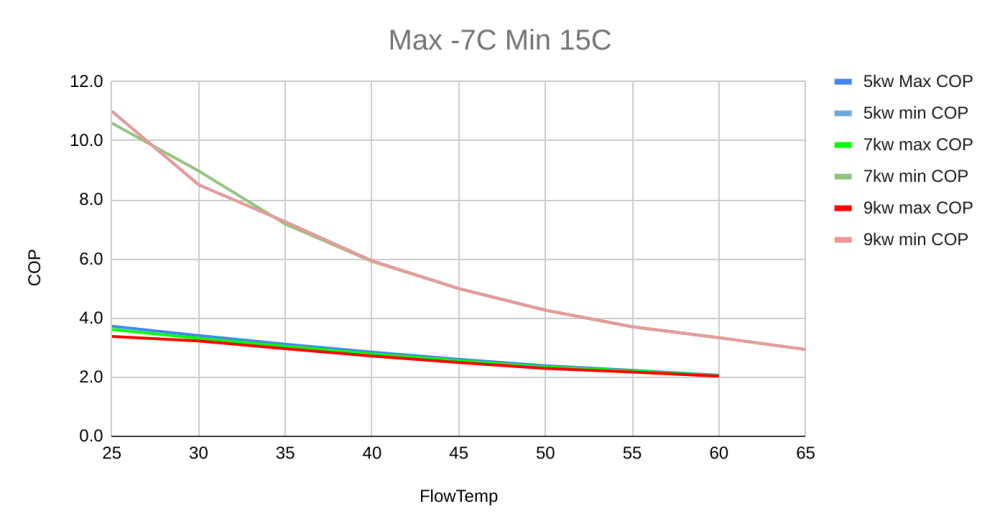
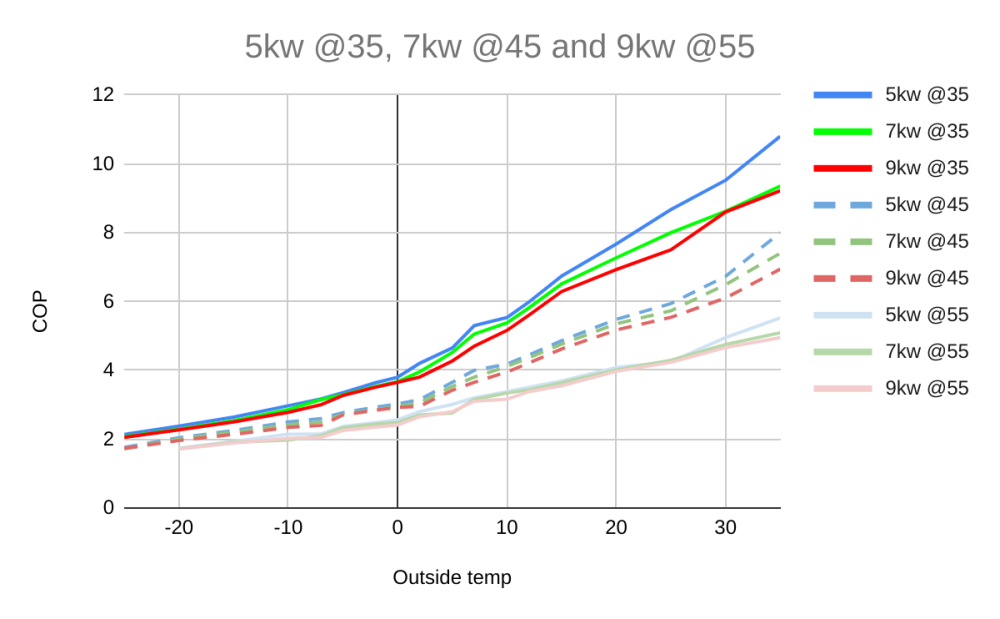
so more digging.... I've looked at the 5,7,9 kw machines as they appear to be identical except for the charge. This is specific to the York units but i suspect most modern r32 units are similar, it just depends where the manufacturers draw the line building different machines vs just tweaking the charge and control of an existing machine. I then took -7 as the coldest outside temp where you would want to be working at max power (regardless of your flow temp) Then 15C as a nominal point where you would want to be at minimum power as your barely need to heat the house. Then I graphed the max/min power outputs for each of the 3 units So it looks like the lower bound of modulation is the same regardless. You don't get any advantage of lower modulation by going for the "smaller" unit. I thin looked at COP at those extremes. In this case the COPs are pretty much the same. There is a small difference at the lower flow temperatures but by the time you get past 35C they are near identical. So far it looks like the only disadvantage of going for the bigger unit is purchase cost and possibly the slightly larger electrical supply to the unit. The final area i looked at was the COPs for the nominal power rating at 35, 45 and 55 flow temps as you can see below about 15C there isn't much difference except maybe at 35C. For 55C there is almost no difference even out to 30C outside temp If you are after the ultimate efficiency and can run at very low flow temps (35C) and definitely don't need the higher powers when cold, so basically a good spec new build, you could get away with the 5kw and save some money up front and maybe get a little more efficiency. For anyone else I reckon oversizing isn't going to be an issue with these units.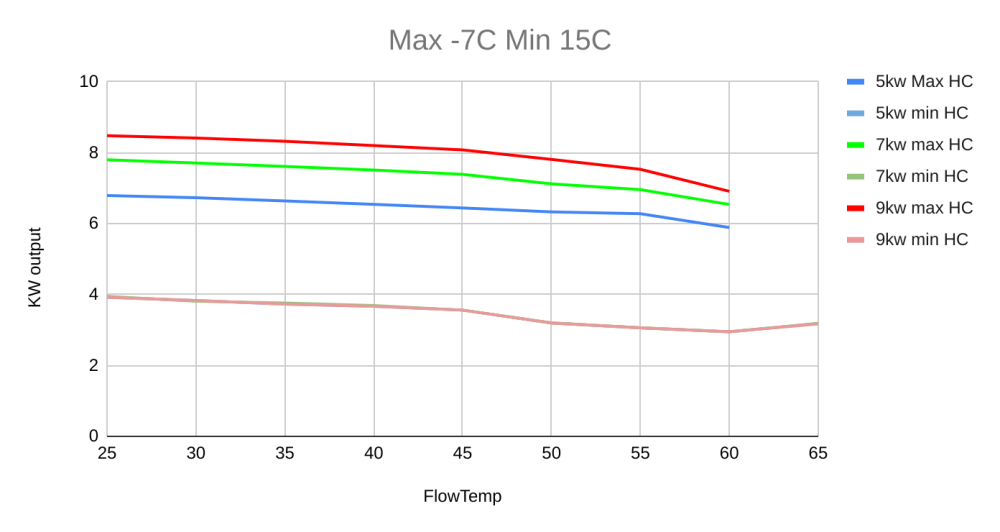
-
York Heatpumps - any experience?
Beelbeebub replied to Beelbeebub's topic in Air Source Heat Pumps (ASHP)
As an addendum to the post above, it's interesting the 5-9kw units and 12-16kw units are identical except for charge. This opens up the possibility of just holding 5-9kw and 12-16kw units at suppliers and then adjusting the charge on site. If the refrigerant were r290 the units could be supplied fully charged and then adjusted down to suit the property by simply bleeding (in a safe manner of course) the excess charge out during commissioning. Likewise, some careful monitoring over the first few years might be able to recommend up or down charging the system, which could be done at the next annual service. If the heatloss calculations were way out and the unit was too big/small despite charge adjustment the fact they are externally identical means the whole unit could be part exchanged for a bigger/smaller unit as required. Of course the dream would be to get the 5-16kw range (which would do most houses in the UK) into a single machine with and adjustable charge. That would massively simplify the logistics and manufacturing, hopefully making things cheaper.