


WisteriaMews
-
Posts
75 -
Joined
-
Last visited
Everything posted by WisteriaMews
-
Has anyone used White Haus (https://white-haus.com/) for their timber frame? They are one of the front runners for our passive house project and we were looking for feedback from anyone that might have used them / considered them. They seem to be one of the lesser known timber frame suppliers and are part of the Intelligent Membrane / Passive Purple group of companies.
-
I've spoke to a couple of warranty companies and they told me there were no special requirements for covering a basement. However, it seems to be standard that they don't cover water ingress (which is why they don't insist on an insurance backed guarantee). We're looking at Type B & C waterproofing on our basement. If anyone has any recommendations of companies they've used please let me know!
-
We having planning for a self build passive house that includes an 81 sqm basement. We've had for quotes for the basement and the most affordable one is from an old school groundworks / basement company that will build the box but don't do waterproofing so we'll probably get that done separately, using Type B & C. I had a couple of questions I'm hoping the forum might be able to help with: 1. We'll went a new build warranty with the house. Are there any warranty specific requirements for a basement? We've got an experienced structural engineer on board, it will meet building regs etc.... For our current self build, our warranty required us to get an insurance backed guarantee on the flat roof install. I'm guessing the warranty provider will want an insurance backed guarantee on the waterproofing. Is there anything else? I plan to call a warranty company as well, but would appreciate the thoughts of anyone who has been through the process. 2. Any advice around organising our own Type B & C waterproofing? I'm assuming we'll need a firm to design and install it (or to use one of the design firms approved installers) so that we get an insurance backed guarantee. Any recommendations of firms (I'm south east London based)? Indications of what it might cost? Thanks.
-
Are you running the tank purely from solar / grid electricity, or do you have it connected to an ASHP. We have planning for a passive house and I was thinking of a Sunamp, but have been put off by all the stories and the price, so am now thinking of an OSO running from solar / off peak grid electricity.
-
All of the quotes were from planning drawings. That's one of the reasons I expect the quotes to go up when they get to building regs and the lintels required over openings etc ... Per @TerryE you need to be aware of cladding costs. We're looking at a mix of metal standing seam and charred timber and it is looking like it will cost not much less than the timber frame installed.
-
I received some quotes before Christmas from 3 frame suppliers, including MBC, and the average was £800 per m2. The advice I got is that these were initial quotes and when you got into the detail of adding the necessary structural elements (e.g. the odd steel) it would nudge up a bit.
-
I'm not quite at the stage yet to plan the cables on my self build, but puncturing the airtight membrane is something I've half started to think about. Do you have any tips on how to avoid them? As I said I've not given it serious thought, but mains electric, connection from the solar panels and TV aerial needs to come in. Power for the outside sockets, lights, security cameras and alarm need to go back out. It's adding up to a worrying list.
-
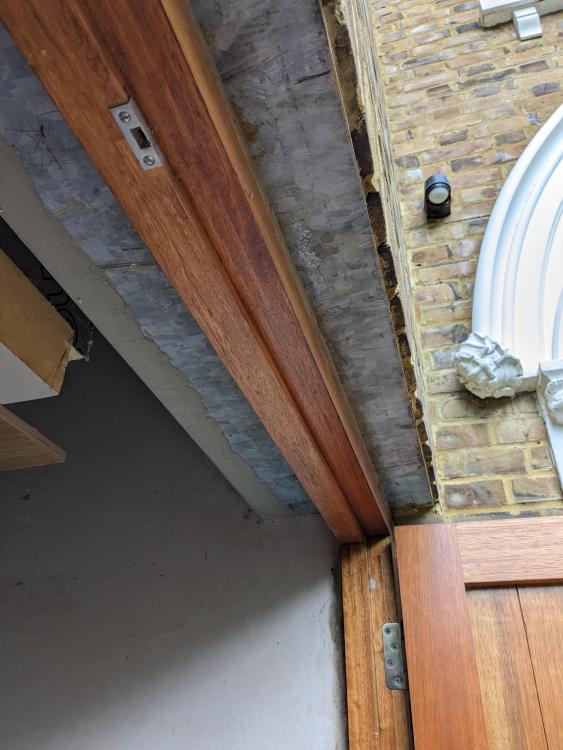
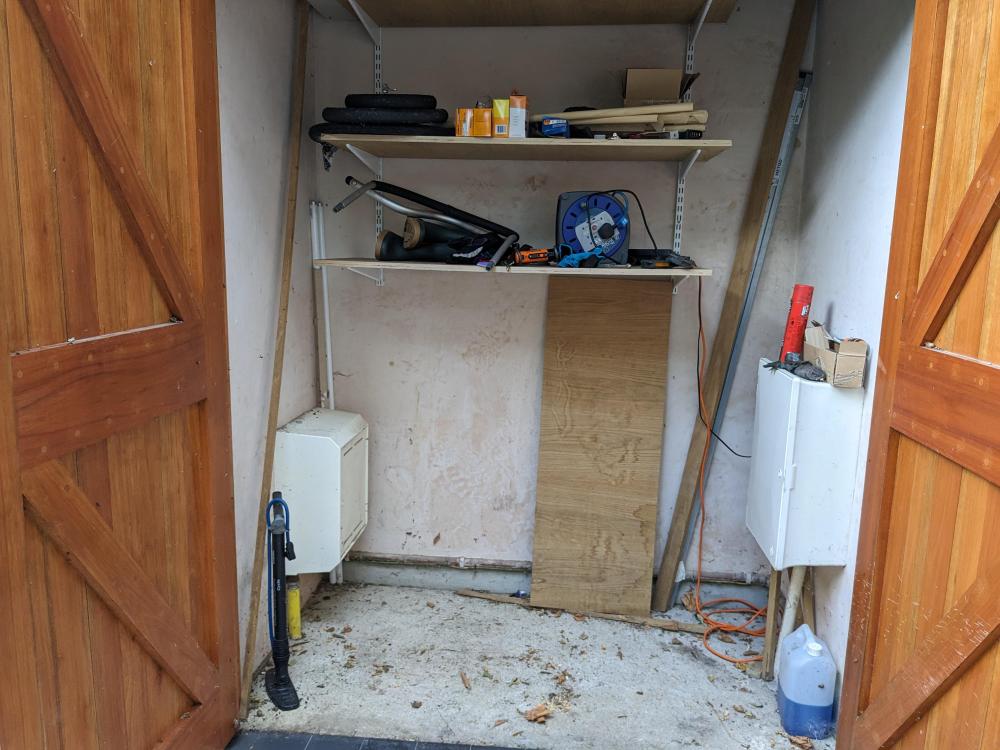
Attached are two more images showing the inside of the bike store and the steel above the door.
-
We have a bike store just to the left of our front door behind the wooden doors in the photo. It is recessed into the house with a bedroom above. The floor joists of the bedroom form the roof the the bike store and are well insulated with Kingspan between and below the joists. However, the interior walls of the bike store which are cold, effectively become the inside walls of one corner of the bedroom as they rise up through the building. They create a cold corner in the bedroom as there is no thermal break in the wall. Hopefully that makes sense as a description of the issue. I was thinking of cladding the inside of the bike store with insulated plasterboard to try and improve the situation. I appreciate insulated plasterboard doesn't have the best performance, but I'm limited on space if I still want to fit bikes in the store (which I do). I could omit the plasterboard and use that thickness to add more insulation, but I think leaving raw insulation would get damaged. I'm also not sure it is advised to leave exposed Kingspan? We are also likely to sell in the next year (to fund the next self build) so want to do something that is DIY and not too expensive. I had three questions I was hoping the forum could help with: 1. Does this sound worthwhile doing? 2. I'll add another photo below. There is a gas pipe, two meter boxes and a couple of other things which mean I won't be able to cover all of the bike store, probably around 80/90%. Would that still be worthwhile? 3. There is also a big steel over the door. Should I try to cover that or leave it exposed due to the condensation risk? Thank you!
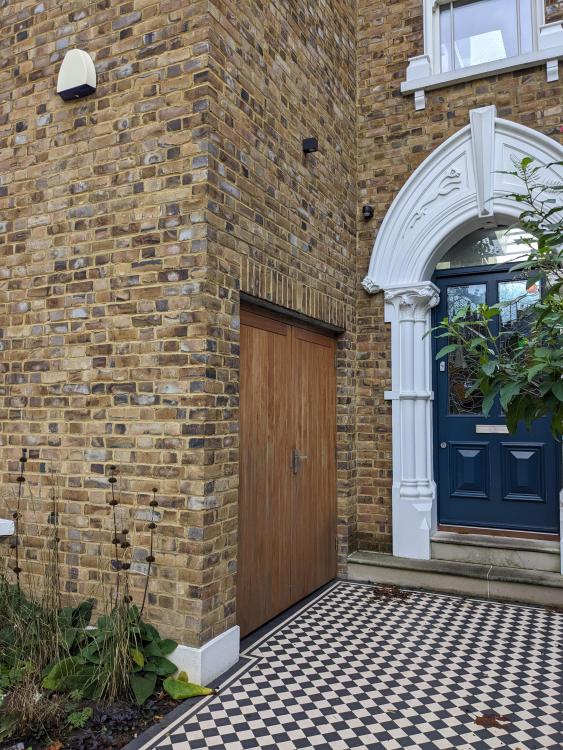
-
Thanks for the suggestions. We're still in planning so it will be a while before I have any concrete updates, but will post back when I do
-
[Deleted]
-
Thanks. Their website only mentions slate & tile roofs. As you suggest a call if probably to see if their system can work with metals roofs.
-
Good to know GSE integrated panels can be made to work with standing seam. None of the technical details I've found so far mention metals roofs but I'll take another look.
-
Do you have any details of the integrated system you used that you could share?
-
Thank you. We've looked at these (effectively) stick on panels and ruled them out due to a combination of low efficiency, short warranty, price and difficulty in replacing if needed. We'd like to go for standard size panels which are integrated into the roof but it doesn't seem very common!
-
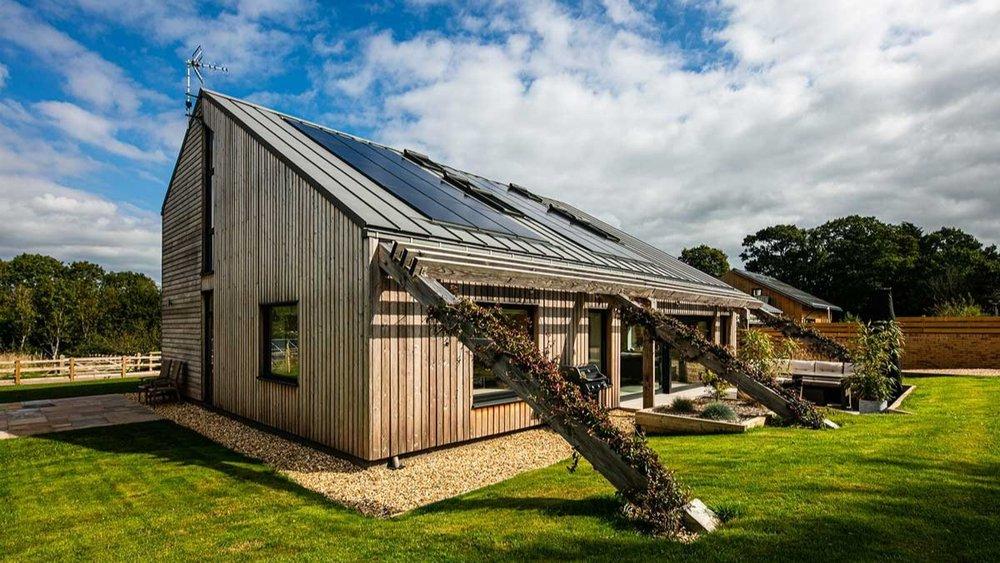
We're hoping to soon submit for planning on a new Passive House in a conservation area. We suspect we'll have an easier ride through planning if we show integrated/ flush solar panels on the roof. Integrated panels on tile roofs are pretty common (we have them on our current roof) but we can only find one example (attached image) of integrated panels on a metal standing seam roof which is what we are going for. Has anyone integrated panels on a standing seam roof? I'm hoping for an indication of whether it is doable/ isn't cost prohibitive before stating we can do it in planning.
-
No experience of approaching Nationwide directly, but we remortgaged with them via a broker to release equity to buy our plot. The broker said he fully disclosed the reason and Nationwide were fine. This was ~12 months ago.
-
Thanks. If you paid that 10 years ago I suspect our quote is reasonable. I managed to speak to someone in a neighbouring borough who had one done last year (?) and they paid about the same as our quote. I thought a desktop study should be a lot less but it appears not!
-
Thanks for the comment. They want the study to include showing there will be sufficient sunlight in all the rooms of my proposed design as well as the impact on neighbours. It is also a report they seem to be requiring on all new builds in the authority area, so I don't think I'll be able to talk them out of it.
-
The council have said that a daylight/sunlight assessment (both on neighbouring properties and internal quality) will be required with the planning application I am hoping to submit soon. My architect has sourced a few quotes and the cheapest is £2,250 + VAT. Has anyone else had experience of needing a daylight/sunlight assessment for their planning permission and found a cheaper consultant?
-
Structural engineer for a passive house basement
WisteriaMews replied to WisteriaMews's topic in Basements
Thanks. I've had a read through some threads and saw recommendations for TSD but they weren't specific to Passive House and looking at their website they didn't mention that as an area covered, but I will get in touch with them. -
Can anyone recommend a structural engineer they have used for a passive house basement? Ideally in the south east London / Kent area. We're currently designing a passive house and the planners are pushing us towards a basement as they want a limited structure above ground. Thanks.
-
We built our first house back in 2015/6 and are lucky enough to be in a position to do it all over again. We're currently choosing between architects. We're aiming for a four bedroom low energy home. Getting Passive House certification isn't a requirement, but we'd like to be approaching that level. We are considering using the architect that we used last time as we know we have a good working relationship with them, they are local and they have experience getting challenging planning permission applications granted (we have a tricky sight). On the downside they have very limited experience with Passive Houses. They are currently designing one for another client. As they don't currently have anyone qualified in the office, they are using a consulting firm for advice, PHPP modelling etc.. None of the contractors they work with have built a Passive House before. One of the other architects we're speaking to has been Passive House certified since 2010. They have done multiple new build and retrofit Passive Houses. Clearly they know how to reach Passive House standard and have relationships with timber frame companies and contractors who have achieved it in the past too. On the downside we don't know how well we'd work with them (I'd rate the relationship with your architect as the most important one of the whole process as it can be a 3yr journey together) and they are based a bit further away so have less local planning knowledge and would be less convenient for meetings etc... Would welcome the thoughts of those that have successfully built a low energy / Passive House before. How critical is the architect you choose? It is essential or as long as you get the PHPP modelling done and get a Passive House consultant it doesn't really matter?



