Jeremy Harris
-
Posts
26430 -
Joined
-
Last visited
-
Days Won
360
Everything posted by Jeremy Harris
-
I agree, Nick, IMHO it's not enough to assume that the installer will realise that the requirements of BS7671:2018 take precedence over the MIs, the MIs should really stipulate that this 0.75mm² must have over-current protection with a rating of no more than 6A (the normal max rating for this size flex). It's no problem if there's a switched fuse or 13A outlet available to just fit a 3A fuse to protect this cable, just in case. I did this simply because common sense mandated that protection was needed.
-
@Nickfromwales, One thing I've spotted in the Thermino MIs is that there is no over current protection mandated for the 0.75mm² always-on cable for the electronics, nor is there any cable length limit specified. They show the 0.75mm² cable fed directly from a 16A, perhaps 20A, protected supply, which is not a great idea. If there is an internal fuse then this might be allowable under the "3m back fusing" rule, but if there is no internal fuse, or if that 0.75mm² cable is over 3m long, then it's a clear breach of the regs. In our case I chose to feed the 0.75mm² cable to the UniQ control box via a 13A plug fitted with a 3A fuse, specifically to protect this cable, only because there was no mention of cable protection in the early draft of the MIs I had. This same cable can be used for its replacement, as it plugs into an outlet that's fed from the HW DP isolator and 16A RCBO.
-
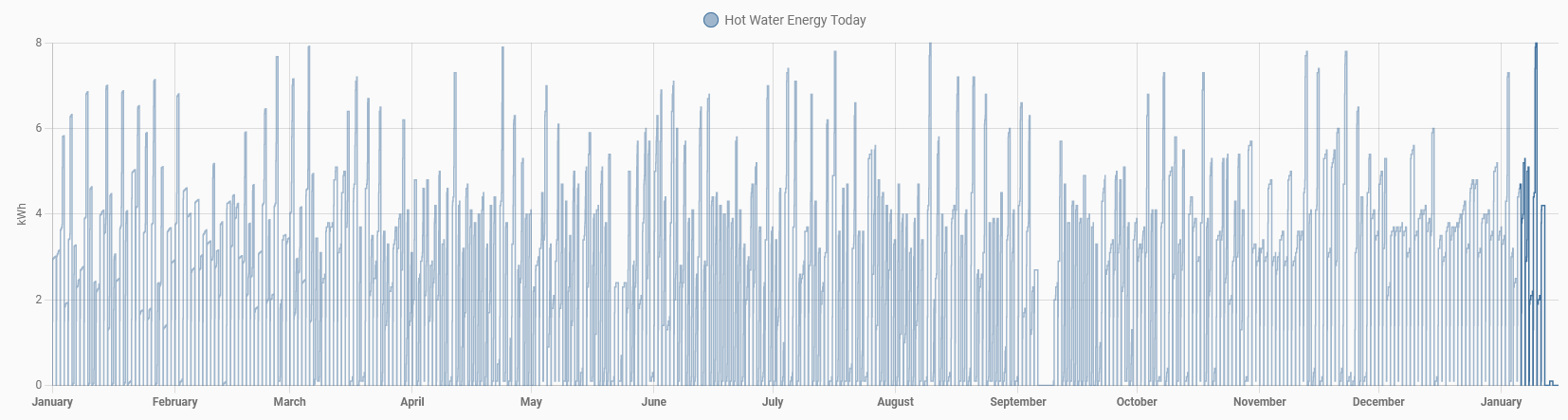
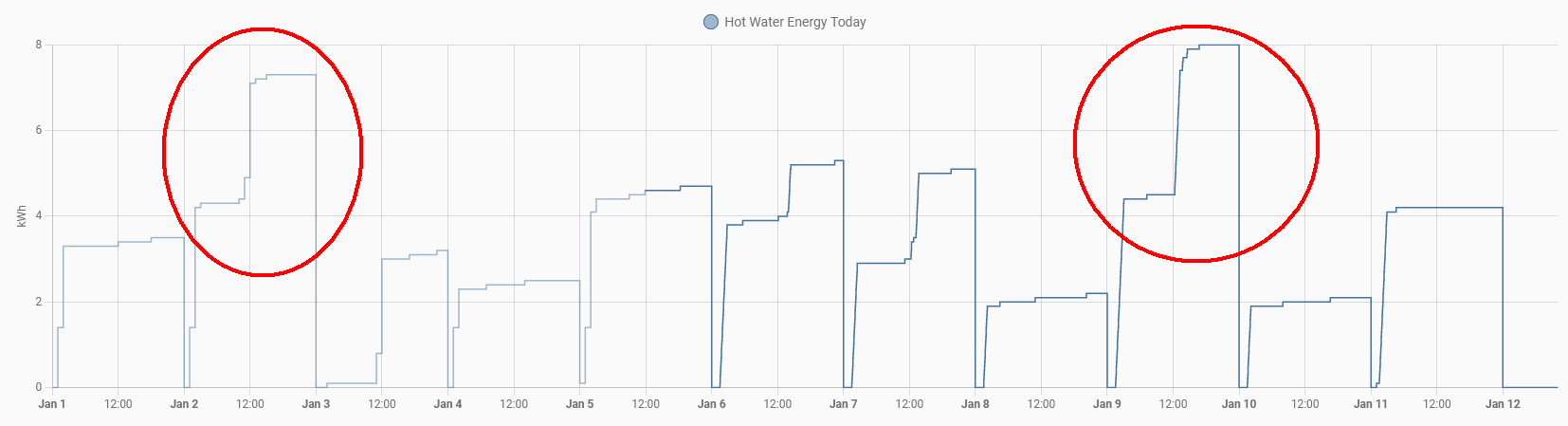
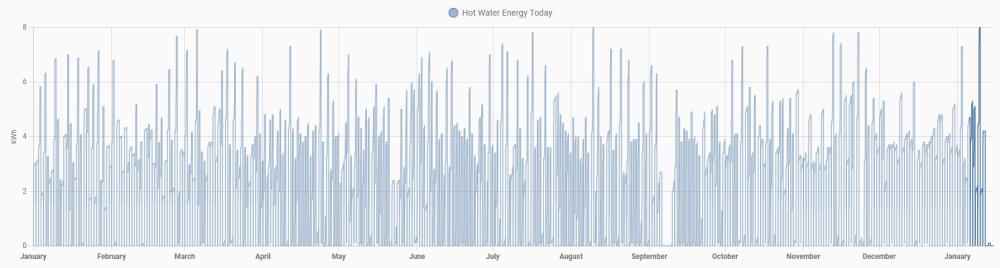
I've just been back through over a years worth of energy data for the Sunamp, back to 1st January 2024, to see if I could spot a pattern of the energy use having increased, perhaps due to the heating element staying on longer, as per the sensor string displacement theory. As well as just pulling graphical data from Home Assistant I've also downloaded the data as a csv file to play around with the numbers in more detail, to try and see if there is a trend that's developed. Despite my earlier excitement when I found two higher energy usage days this month, it seems they were not at all unusual, the pattern of energy use seems pretty consistent and it just so happens that on some days more charge is needed than others, almost certainly just down to the vagaries of putting the data into 24 hour hour daily bins, from 00:00 to 23:59 each day. The reason for this seems to be down to how much solar charge there has been. On days when there's been solar charge, but when there has also been an overnight off-peak charge which was partially used by the morning showers, the hot water energy seems higher, because the Sunamp is getting two lots of charging in that 24 hour period. This is definitely what happened on 9th January, the Sunamp was charged overnight from off-peak, partially discharged by two showers that morning, then partially re-charged from solar during the day. This is the whole year energy per day plot:
-
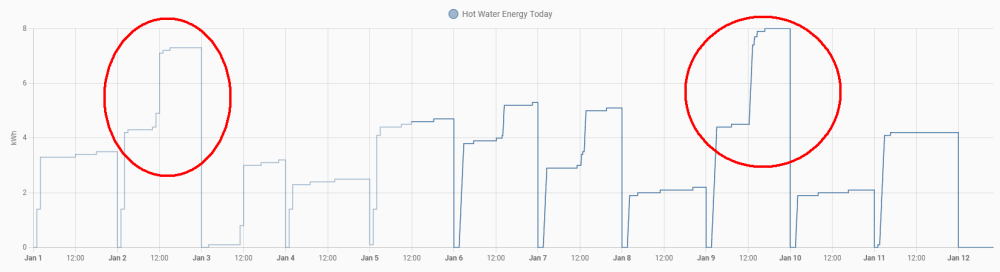
Very many thanks for that marathon response, Nick, full of tremendously helpful information, not least that it seems that my theory about over-pressure may well be completely awry! I've tried to trim down the key elements with replies, below Ours is fed from a Harvey water softener, always has been, and I've never seen any signs of scale in the pipes. Last time I did some work on the plumbing was to install a "bum washer" toilet a couple of years or so ago, and the pipes I cut into to plumb that in were as clean as a whistle, thankfully. I can understand how hard water would play havoc with something with small bore pipe work, though, but I doubt that has contributed to our failure. Matches our experience, I actually left the water supply on to the Sunamp after the failure, just because it didn't occur to me that this could be related to a water leak, given that the leakage had stopped. We both showered with reasonably hot water from it the following morning, both because this was going to be our last chance to use hot water for a while and because I felt it made sense to get the heat out of the unit so the PCM went solid and stopped leaking. It did puzzle me that the leakage just stopped, TBH, as you rightly say, if water at 3 bar was entering the PCM cell then it seems unlikely that solid PCM should stop it. This seems to make perfect sense to me. I haven't had the lid off (simply because I didn't want to interfere with anything Sunamp might request) but the PCM has mostly leaked out around/through the grommets where the pipes enter and exit at the rear. Looks to me as if the stuff may have come out of the top of the PCM cell, perhaps. It's then run down the back and formed that big icicle of solid PCM. Based on what you've suggested I've just had a look back at the energy data for the past couple of weeks (I run Home Assistant and have a separate OM115 meter on the Sunamp supply). What I tried to look for was an indication that it had drawn more energy than normal, in other words that the power had stayed on for longer, in the days leading up to the failure. There were two days when the energy used was much higher than I would have expected, first on 2nd January, then again two days before the failure, on 9th January. The night of the failure, 11th January, seems normal. TBH I can't see how we'd have used 8kWh of hot water on 9th January, there was nothing out of the ordinary the day before to have used a lot more hot water than usual, nor on 2nd January. Regarding the new requirement for a cold water PRV at 6 bar, in our case this is a bit of a nonsense requirement if it is intended to protect against the static cold water pressure exceeding 6 bar, simply because our well pump could never achieve that, even if the pressure switch were to fail and keep it turned on. I'm sure they will fit one, given that it's now a requirement, but I'm not going to be overly worried about it ever operating, TBH. I still have the drain and tundish from when the Sunamp PV was installed, so that can be re-used. It's easily visible, so I can check it regularly to see if there is ever a leak. Thanks again for taking the time to write this Nick, it's really helpful. I will try and take a look at the position of the sensor string when the unit is taken out, to see if it has worked its way up within the dip tube. If that may be the root cause, then it seems simple to better retain it. I had to change the sensor string when our original control box was replaced, and well remember it just being a loose drop fit down that dip tube. This was over 5 years ago now, though, and it has never occurred to me to check it.
-
IMHO, SAP has always had anomalies that need to be fixed, I think there are probably other threads here where I've highlighted how mad some of the assumptions and calculations it uses are. Part of me thinks this is just down to it always being out of date, but another part of me always questions the competence of those that create it.
-
I had hoped that you might have some words of wisdom, Nick, when I first started this thread, given that you've had a fair bit of experience with these things. What's not clear to me is just how many units have leaked out their PCM. I know of two (other than ours), @Andy T and Jonathan Porterfield, but assume there must be more, because Sunamp have clearly made significant changes that seem related to the cause of this issue. Be interested to know if you think that pressure is a contributory cause, given that there seems to be a lot of focus on reducing pressure-related events with the newer units.
-
Thanks Terry, that's very useful and may well change the way I go about trying to fix the ceiling damage. I had thought that I might get away with just washing off all the crystals that have blown the paint off, in the hope that the plaster might then dry out and allow the ceiling to be repainted. I could just make an insurance claim, get that section of the ceiling cut out, all the crystals removed and then patched, and may still do that, it all depends on how things go over the next week, with the replacement. One thing is for sure, and that is that I am going to add a bund around the replacement Sunamp to try and contain the goo if this should every happen again (and I sincerely hope it does not!).
-
No, the SAp was done with direct electric heating for hot water, as that was always the plan, initially with a thermal store, which then got swapped out for the Sunamp. We did take a hit for using direct electric heating for hot water, but it wasn't massive, but then our SAP was done using the 2012 version, IIRC, and things may well have changed since then.
-
Thanks Jason, the VOIP thing was me working out how to retain a working landline here, and getting a backup for when the power fails and our fibre cabinet falls over (as it still seems to). When the PSTN gets turned off later this year we risk being left without a reliable phone, and I wanted to jump the gun and get something tested and working before that happens. It does work, too, using a Mikrotik high gain dish antenna/router, a Grandstream VOIP adapter and a cheap account with Andrews and Arnold (who I'd very much recommend). We now have a working fall back "landline" phone that carries on working when storms take the power out, which is useful. Part of that is that we now have 22kWh of battery storage, that keeps the house going for a fair old time if there's a power cut. In some ways I wish that I'd kept enough free space for a UVC, but a large part of me wants the Sunamp to be the answer, mostly because, despite some of the issues, I still think the basic technology is sound. The fact that it's worked flawlessly, and very economically, from 2018 to last Saturday also makes me think it's worth sticking with. I do have a fall back plan that I've now written down, so someone could implement it if I'm not able to, which would allow a slimline UVC to fit, albeit with a lot of work.
-
Many thanks, Terry, that's very helpful and fills in a few gaps that I had sort of guessed at. I am near-certain that our failure is from a leak having developed internally in the heat exchanger, that has allowed water to pressurise the PCM cell. The PCM has then burst out of the cell (not 100% sure where, but I suspect either the pipe entry points or the fill port) causing the leakage I've experienced. One slight puzzle is that the leakage on ours self-healed. Despite having a pretty constant 3 bar of water pressure in the heat exchangers there was no further leakage. I can only assume that the PCM froze around the leak and sealed it up, although I'd have thought that, given the solubility of sodium acetate trihydrate in water, this wouldn't have been that likely. Perhaps it may have been that as the internal temperature dropped the leak sealed itself up a bit. All a bit unknown, really. I did think long and hard about replacing it with a UVC. Main problem is that I really don't have enough room, now. The services area has filled with stuff, and my only option would have been to try and squeeze in a very slim cylinder, but even that would have needed a lot of stuff to be relocated, at least a couple of days work, on top of installing the UVC. This all stems from having made decisions around the use of a Sunamp, right back in 2016! Sunamp seem committed to their ten year warranty for the PCM cell and heating elements, which is very reassuring. I'm tempted to fit a back up hot water option, though, just in case, and have been looking at some of the smaller, wall-hung, water heaters. They almost certainly wouldn't be a good option for all our hot water, but having something to fall back on that could provide a couple of quick showers a day would, right now, look like an attractive option! Sorry about the domain, thing, leaving the EU cancelled my .eu domain, so it stopped working. Finger trouble on my part meant that I screwed up the transfer to a new .uk domain and lost everything, which was a pain, but unlike you I'm very much an amateur when it comes to IT!
-
Thanks for the kind words (and to everyone else that's said similar). I'm reasonably confident that Sunamp are on top of this, if I wasn't, then I'd not have still been of a mind to buy another (before Sunamp agreed with the warranty thing). My view is that they have been going up a learning curve with these things, and, from what I've seen since 2016, when I first got involved with them, their technical approach has always been very good. The original Sunamp PV, for example, was technically a bit over-engineered. It was a complex solution to the challenge of evenly heating the PCM, using the same heat exchanger used to get the heat out to put the heat in, via multiple non-return valves, a variable speed pump and an inline electric heater. The thing was, if anything, too clever for its own good (although I still have the view that it was the best way to produce a more or less infinitely repairable unit!). It must have cost a fortune to manufacture though, given all the parts it had. If I had to guess, I'd say the primary cause of the early UniQ issues related to the switch to embedded electric heating elements and controls that were not really well-optimised for efficient charging from PV. This had been the unique selling point for the Sunamp PV, and the reason I was so enthusiastic about it, it was, as its name suggests, optimised for utilising excess PV generation (and it was very good at it indeed). What I'd not realised was that they had looked at the market and realised that it was a LOT broader than just people looking to make best use of their solar panels. They may even have been a bit prescient, and guessed that export payments might increase (now up to around 15p per kWh payment on some tariffs) and realised that this might kill off those looking to utilise spare PV generation for water heating. TBH, if we were able to have a smart meter (we can't - not enough signal here) then I'd not bother with using PV to heat the water, it'd be better value to sell any excess at 15p/kWh and then buy in off-peak at around half that price to heat the water. We have a heat pump, used solely for running the UFH and pre-heating the supply to the Sunamp (via a plate heat exchanger inline with the inlet) and it simply doesn't make sense to run that at the 65°C required to charge a Sunamp via hot water, as the COP is absolutely appalling at that flow temperature, especially in very cold weather. This is pretty much what convinced me to go down the path of an electrically heated hot water system, that could be heated in winter using cheap off-peak electricity (currently 6.308p/kWh on an SVR E7 tariff), and also use excess PV when that was available. Not a one-size-fits-all solution at all, but one that seems to fit well with our needs. Overall, I've always been impressed with the performance of the Sunamp. Having oodles of hot water on tap and just never having to even think about whether there is any need to be a bit careful with it is a lot less hassle. For years it has just sat there doing its thing with zero attention from me. About the only thing I do is glance at the Home Assistant screen each day to see how much energy we've used heating the water, and that's really only a casual interest thing (like noticing we've used an extra kWh of hot water because my wife's washed her hair . . . ).
-
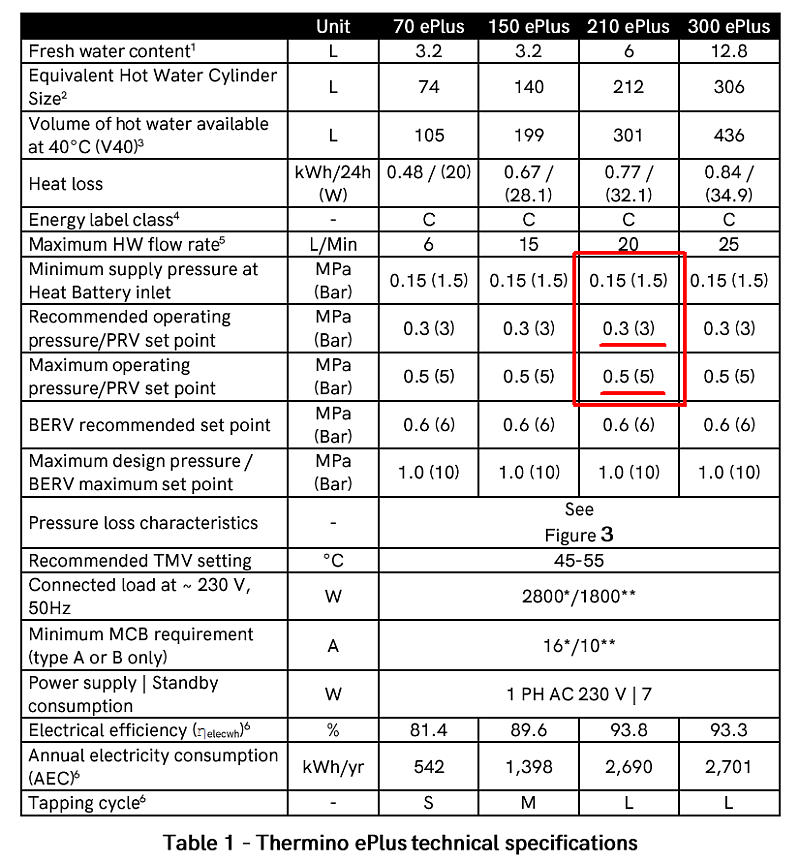
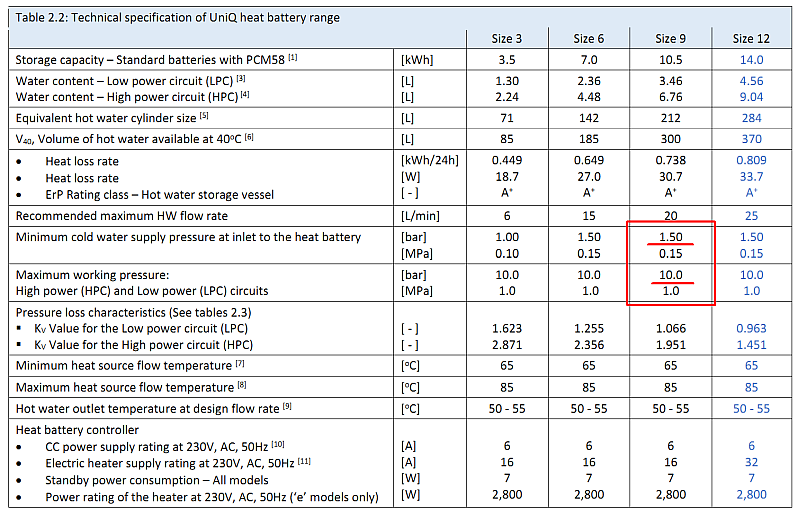
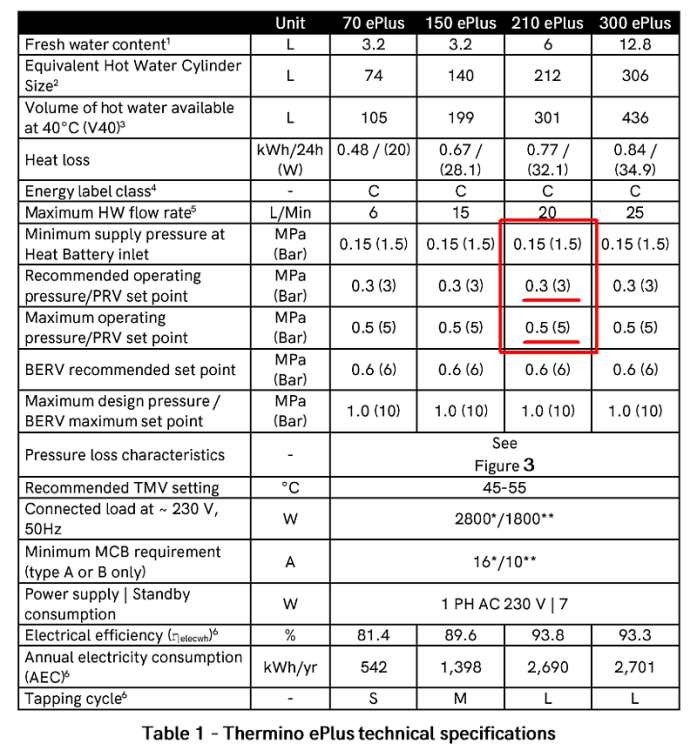
I've been trying to see if my theory about these issues being related to pressure might be born out, by comparing the specifications for the UniQ that we have and the newer Thermino (which seems to use essentially the same, or an extremely similar, core design). It's interesting that the pressure specs have changed. The UniQ has a minimum pressure of 1.5 bar and a max pressure of 10 bar, according to the last set of MIs I received, version 2.0, dated 17/06/2018: For the Thermino though these pressure specs have been very significantly reduced, to a minimum pressure of 1.5 bar but a maximum pressure of 5 bar, half that of the UniQ: Moot point for us, perhaps, as our well pump can only deliver 3.5 bar maximum and the pressure regulating valve has always been set to 3 bar, same as the pressure recommended for the Thermino, but it does suggest to me that there is a known pressure sensitivity issue. When combined with the emphasis in the new MIs that mandate the fitting of a pressure relief valve, set to 6 bar, together with the 0.5 litre pressure vessel I'm now more than ever convinced that the most likely cause of this failure is pressure, most probably some sort of repeated pressure shock from something like the shower turning off. Although we have a 100 litre pressure vessel only a metre or so away from the Sunamp, it seems possible, perhaps even probable, that this is too far away to mitigate some sort of fast pressure shock wave. This is all really just theory, but it does pretty closely fit with the known facts and details from Sunamp, and the experience of Jonathan Porterfield up in Orkney. Why else would Sunamp have reduced the maximum pressure permitted, and added these over-pressure mitigation devices, if it wasn't because over-pressure can cause issues like this?
-
Wasn't it @Andy T who had the same problem with his Sunamp? IIRC it leaked all over the floor of his conservatory. His will have been an earlier model of mine, as I think he had it as some sort of trial, much as I did originally. I think it may have been some sort of special, too, perhaps one of the PCM34 models that got dropped eventually. I remember seeing a photo of the goop all over his floor, if it is the same person. I met him face to face at the Swindon self build centre, some time after I'd installed the Sunamp, as I remember having problems with the charge points there, which will have been when I had the little BMW i3.
-
Interesting stuff, and does tally with comments that the secret to making a practical PCM thermal store was the additives used. AFAIK, Sunamp have never openly published what those additives are, presumably this is a part of whatever deal they did with the university.
-
I suspect it's a bit of both. If I'm right about the cause being related to stresses imposed on the heat exchanger from short duration high pressure events then there is a pretty good chance that this may be something that only happens with some installations, the exact circumstances of which may not have been simulated during all the extensive testing done during the design stage. I know their testing was pretty thorough, from conversations with one of their technical people, but it must be impossible to test for every possible installation condition, and being a relatively new company it may well be that they didn't have a secret stash of hard won experience to call on.
-
I can't be certain, but I'm convinced that it's a shock arrestor there to lessen the effect when a tap is suddenly closed. This seems to be more of an issue with ceramic tap inserts, that can close off the supply very quickly. Certainly I have occasionally heard a slight thump when shutting off our shower, probably because the location of it and the 90 deg turn off angle make it very easy to shut it off near-instantly. What I imagine happens is that the water is merrily whizzing down the pipe, the valve gets suddenly closed and that column of moving water in the pipe has no where to go, so bounces back as a shock wave. I can't believe that it's just there to deal with expansion in the internal pipes as the unit heats up, not least because the volume of water inside the thing is very small, plus the pipe work will be able to absorb a small increase, especially homes like ours with plastic piping. I'm sure that can tolerate a small amount of expansion, which makes me more convinced that this is really a shock arrestor.
-
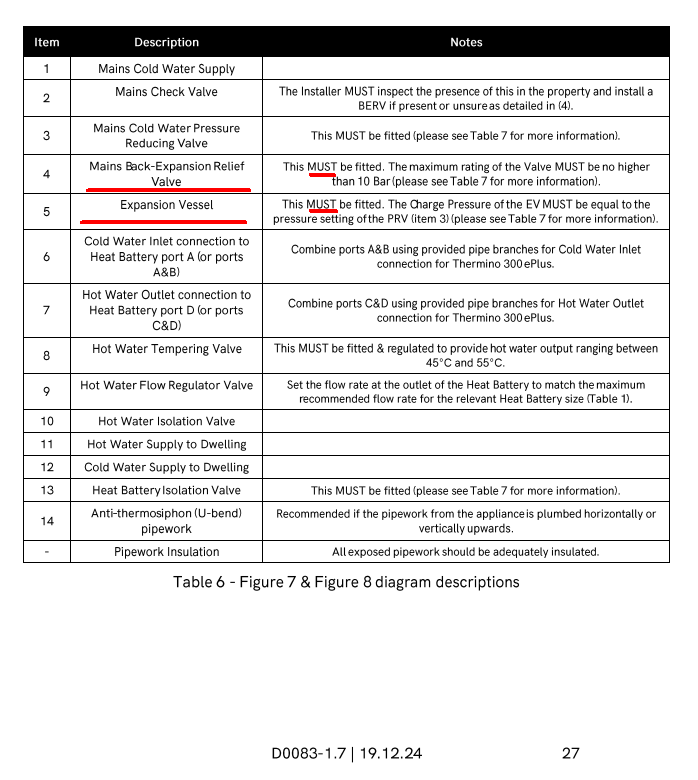
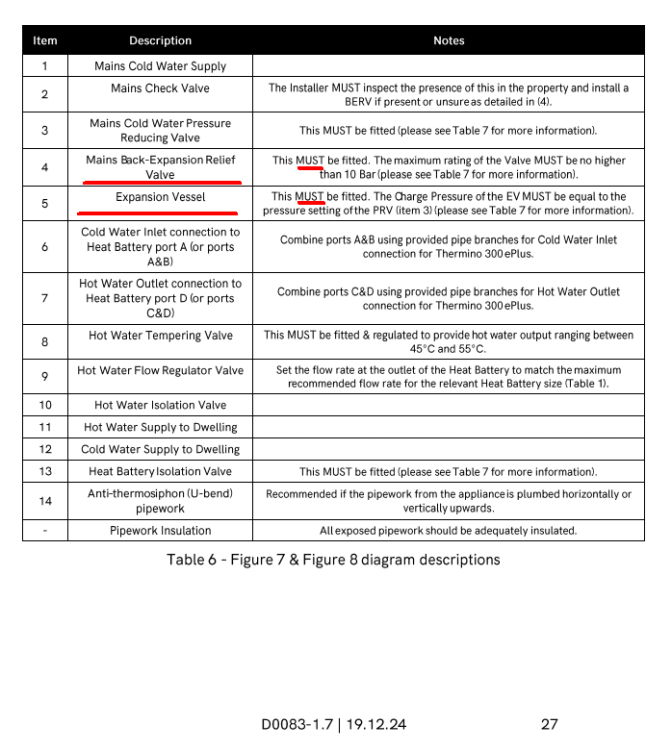
I did wonder about this when talking with the installer who gave me that very high quote yesterday. During our chat he specifically mentioned that he had installed lots of Sunamps without the now mandatory pressure relief valve on the supply, and all were still fine. I didn't challenge him about going back to all those customers and retroftting a relief valve, but it did occur to me that they might just be at risk of failure, if the theory that it might be something like water hammer that is contributing to the failure. Their current MIs are very clear about this requirement, though, and also the requirement for the 0.5 litre pressure vessel, with so much emphasis that I can't help but think these are now critical components:
-
It is indeed very good news, best I could have hoped for, as I really was not looking forward to trying to shift either the old one downstairs or the replacement back up stairs, TBH. I was even thinking of buying a second-hand stair climber, I'd found an ex-hire one for sale not too far away (Waterlooville) and was just about to agree to buy it and go down to pick it up, thinking that it would be worth it only if I used it twice, given the silly price I was quoted last night. On another positive note a local heating and plumbing company that I contacted yesterday called. They would have been happy to swap the unit over for me, and were very interested in the Sunamp, they'd not heard of it before. I spent five minutes on the phone explaining how it worked and the chap seemed keen to know more, so it may be that he might be interested in becoming an installer. He certainly seemed very down to earth and helpful on the phone.
-
I would think that may well be extremely probable! It's a good response from them whatever the reason, TBH. It could just be down to my email interaction with their customer service team having (I think) been divided between two or more people. Just a feeling I got from the replies. May be that the person that I sent the initial photos and model info to wasn't the same one that gave me the list of installers to contact.
-
Major news!!! Guess what? Sunamp have just emailed me to say that they are going to replace our unit as it is covered by the 10 year warranty on the core! They emailed me as I was typing the reply above.
- 242 replies
-
- 13
-

-
I don't think so, but there is a massive amount of marketing BS from Sunamp regarding the naming of this stuff. It's almost certainly just sodium acetate trihydrate, as everything about is is a perfect match for that compound. Same melting point (58°C), same safety assurance, the stuff even tastes the same (don't ask me how I now know that!). They originally gave it some daft name to try and make it it was some sort of magic compound and it seems they've now taken to calling it "Plentigrade", almost certainly just for marketing reasons. The main difference between my UniQ and the newer Thermino is that they've done some cost engineering work on it. The case is the same size and design, but they've integrated the control circuit board inside the top of the case, rather than as a separate wall mounted box. Looking at videos of the two that seems to be the only major difference. They've chosen to address the problem I had with the original controller, where it wasn't well suited to charging from excess PV generation, by adding a plug in "key" that changes the programme parameters. Before they did this by having a different control box for PV (I had to swap out the original because of this).
-
What I don't know is how common PCM leaks are. I know of two others, back in the very early days there was a chap who was, IIRC, working with Sunamp and who had one empty it's PCM all over the floor of his conservatory. That was definitely a pre-production unit though, as I am sure he had it on trial from Sunamp. He may have reported this failure here, I think. The other failure I know of is Jonathan Porterfield's, which bears an uncanny resemblance to my failure. That was only last year, and he gave the cause as a waterlogged 0.5 litre pressure vessel (which supports the theory that it's over-pressure events that cause this). In principle there is nothing much to go wrong with a Sunamp. They are, if anything, slightly simpler than a conventional cylinder. My gut feeling is that the vast majority of Sunamp's are reliable and likely to last for many years, but that there may be issues with the earlier models, like mine, particularly if there is any possibility of there being high pressure events within the heat exchanger, perhaps. With, say, a 6 bar pressure relief valve on the inlet, together with a 0.5 litre pressure vessel and the 2.5 bar pressure regulating valve any such high pressure events should be suppressed.
-
Very possible, my unit has the serial number 221, so was early in production, for sure, so early that they hadn't really finished writing the installation instructions, as I remember getting at least two, possibly three, different versions from them. There are mandatory requirements on the new Thermino instructions that weren't on mine. The most obvious is that they now require a pressure relief valve on the cold water supply, rated at no more than 10 bar. This is in addition to them now stipulating that the 0.5 litre pressure vessel needs to be close to the inlet. Putting two and two together I suspect the cause of the failures may possibly be related to over-pressure events in the heat exchanger. I have a 100 litre pressure vessel in the supply to ours, plus the required 2.5 bar pressure regulating valve and in theory it shouldn't be possible for the Sunamp heat exchanger to ever see more than 2.5 bar. It's supposedly rated at 10bar anyway. What I don't know is how the heat exchanger is constructed. I'd assumed it was just a zig zag of copper pipe with perhaps some copper fins. Perhaps there is some weakness that can develop that's related to pressure cycling, or short pulses of over-pressure from when a tap is closed suddenly. All just guess work though, based solely on the way Sunamp have imposed new mandatory installation requirements.
-
Many thanks, for some reason I didn't receive this with any of the paperwork that came with my unit, not sure why. All I had was an emailed invoice plus a copy of the installation instructions (which got amended once or twice IIRC). I've contacted Sunamp to check the warranty, have to see what they say. I can't honestly say I'm hopeful, TBH.
-
Excellent point! thanks. I'd forgotten about WEE. Looks like I just call Sunamp and tell them to take it away, then.