Redbeard
-
Posts
1532 -
Joined
-
Last visited
Everything posted by Redbeard
-
It looks like just inadequate adhesion/'keying' of the pink paint to the white under-layer (what is it?). Can I guess that you have maybe run the skirting paint (a top-coat) onto the wall? If this is the case then it's your reason; gloss (or satin or whatever) is a top coat and not designed to 'hold' another coat on top. Fine sandpaper, rough it up, preferably use an undercoat, then gloss/satin on top. (Alternatively I may have misunderstood the issue, in which case please tell me where I have 'mis-assumed' and correct me).
-
+1 to @Iceverge's a/t tape. Unless there is a solid layer behind the membrane I do not see how a squirt of sealant can be relied on to actually seal the hole. (And, come to think about it, if there is a solid layer you can't get to the hole itself anyway (to tape or to 'squirt' - You'd just have to squirt sealant down the batten-hole and hope. All a bit 'loose', perhaps.
-
Is this habitable space or a garage/outbuilding? And I assume the membrane is a breathable membrane to go under tiles or slates, not a 'flat roof' membrane such as EPDM or felt. Can you confirm? If it is to be battened and tiled or slated I'd say get the joiner to staple the membrane, unless you know the roofer is coming before it rains! On a related note (I am not a roofer) are you/is the roofer using counter-battens?
-
Where does your rainwater go?
-
It does but how would you detail the 'raw' PIR perimeter on the outside - just a timber (or Alu?) fillet?
-
Yes, FM330 is air-tight foam.
-
Strictly it does not help the paint adhere to the building; it (and a bit of scrubbing) takes off any algae to which the paint would otherwise adhere, rather than to the brick. If you paint over the algae - algae falls off; paint falls off. After application of the algaecide you once more have propitious conditions for the paint to stick to the wall.
-
Sorry, what is the 'it' in your Q ? The algaecide?
-
Help! How can we avoid trickle vents on a Jacobean cottage reno?
Redbeard replied to Amberella's topic in Windows & Glazing
Yes, in the wall, and no, not in every room. The idea is you put them in the wet rooms, so that the 'pull' extracting moist air from the wet rooms *pulls in* dry air via the other rooms, so yes, trickle (window or, as preferred, wall) vents in all or most 'dry' rooms. -
Help! How can we avoid trickle vents on a Jacobean cottage reno?
Redbeard replied to Amberella's topic in Windows & Glazing
Agreed 'get vents' but if the OP does not want them in the windows they can be elsewhere. (and see my point above). -
Help! How can we avoid trickle vents on a Jacobean cottage reno?
Redbeard replied to Amberella's topic in Windows & Glazing
I do fully understand that, but have spent years advising clients to design *out* the unintentional ventilation (draughts) and design *in* the intentional. Once you have vents and a couple of dMEV fans you can go mad stuffing draughts. Have a look at the Bldg Regs for the relevant cross-sectional area of ventilation you'll need. Goood luck! -
Potton Homes(Kingspan) out of business
Redbeard replied to Post and beam's topic in General Self Build & DIY Discussion
See also -
Strictly no, but I can give a good guess. Apply expanding form tape such as Compriband in the expansion gap. I have not come across the term 'penny-rolled' before, but assuming they use a 'standard EPDM 'detail' roller (which seems to have a min 40mm diameter) I would suggest just roll first across then up to the abutment.
- 1 reply
-
- 1
-

-
Help! How can we avoid trickle vents on a Jacobean cottage reno?
Redbeard replied to Amberella's topic in Windows & Glazing
Does that not depend on how air-tight the house is? It may be reasonable to assume 'not very', but AIUI PIV (Positive Input Ventilation) relies on drawing air in the loft and pushing it out through 'gaps'. No gaps, no functioning PIV? -
Help! How can we avoid trickle vents on a Jacobean cottage reno?
Redbeard replied to Amberella's topic in Windows & Glazing
https://www.gov.uk/guidance/appHelp! How can we avoid trickle vents on a Jacobean cottage reno?roved-document-f-volume-1-dwellings-frequently-asked-questions#can-background-ventilators-be-installed-through-a-wall-to-meet-the-part-f-requirements-instead-of-installing-trickle-ventilators-in-windows Can background ventilators be installed through a wall to meet the Part F requirements, instead of installing trickle ventilators in windows? Ventilation can be provided through any appropriate means. Installing a background ventilator through a wall that provides the equivalent areas described in Approved Document F, volume 1 can be an acceptable route to compliance. I realise your thread is entitled 'Help! How can we avoid trickle vents on a Jacobean cottage reno?' but as it goes on to talk about windows I assumed you meant 'trickle vents *in windows*. Maybe I'm wrong. Can you confirm? If you'd be happy with 'trickle' vents in walls then you don't need anyone to authorise a deviation 'cause there wouldn't be one. -
Help! How can we avoid trickle vents on a Jacobean cottage reno?
Redbeard replied to Amberella's topic in Windows & Glazing
Hello! I am not sure that is true. Decent (intentional, not accidental) ventilation *is* required by the Regs. Ask anyone on here with MVHR whether they have trickle vents!! You will, however, have to have some vents somewhere if not in the window frames. Search on here for decentralised mechanical extract ventilation (dMEV). I have not got chapter and verse to hand for my assertion, but if no-one comes up with it in the next few hours (I bet they will!) I will have a look for a source. -
UK Gov't guidance (https://assets.publishing.service.gov.uk/media/61d727d18fa8f50594b59305/retrofit-room-in-roof-insulation-best-practice.pdf) now suggests 50mm ventilation. The resultant 125mm of PIR between rafters is not, I think, going to meet the Building Regs target of 0.16W/m2K. Rough values: 125mm PIR (to leave that 50mm vent gap): R value 5.68m2K/W approx. 'Base case' R value of uninsulated roof (if indeed you allow it any): 0.5m2K/W. Total 6.18m2K/W. 1/R = U so U value (v. approx) = 0.1618W/m2K, but this leaves no allowance for the timbers which interrupt the insyulation every (?) 400mm, so it's not 'real'. When I was doing attic room re-fits on a regular basis I used to ignore the 'base case' value and look for a depth of PIR which would give me 0.16 on its own. Of course you could simply add 25mm PIR below the rafters and you have not only cloaked your thermal bridge but, with 125mm between the rafters, you'll achieve a 'gross' U value (of course assuming 150 throughout; it's not area-weighted) of around 0.147W/m2K. A lot depends on headroom as battens and plasterboard & skim will lose you another 40mm.
-
Stuck-on balcony causing water dripping down house wall
Redbeard replied to sniederb's topic in General Construction Issues
Definitely +1 to @ProDave and @Iceverge's suggestions. Gets rid of most of the issue. (Doesn't, of course, alter the fact that the timber balcony will rot out in the long term, but at least with the suggested revision the timescale for both support and decking may be similar, instead of the support rotting out first). -
Stuck-on balcony causing water dripping down house wall
Redbeard replied to sniederb's topic in General Construction Issues
Can we have a pic from a distance showing how the Veluxes come into the equation? What I can visualise up to now is a pitched roof 1 floor above the balcony 'collecting' water between the Veluxes and 'tipping' it down the wall. But why doesn't the gutter stop that? I am sure the answer is simple, but I cannot see it yet. More info and context = more comprehensive answers. Many thanks in advance. -
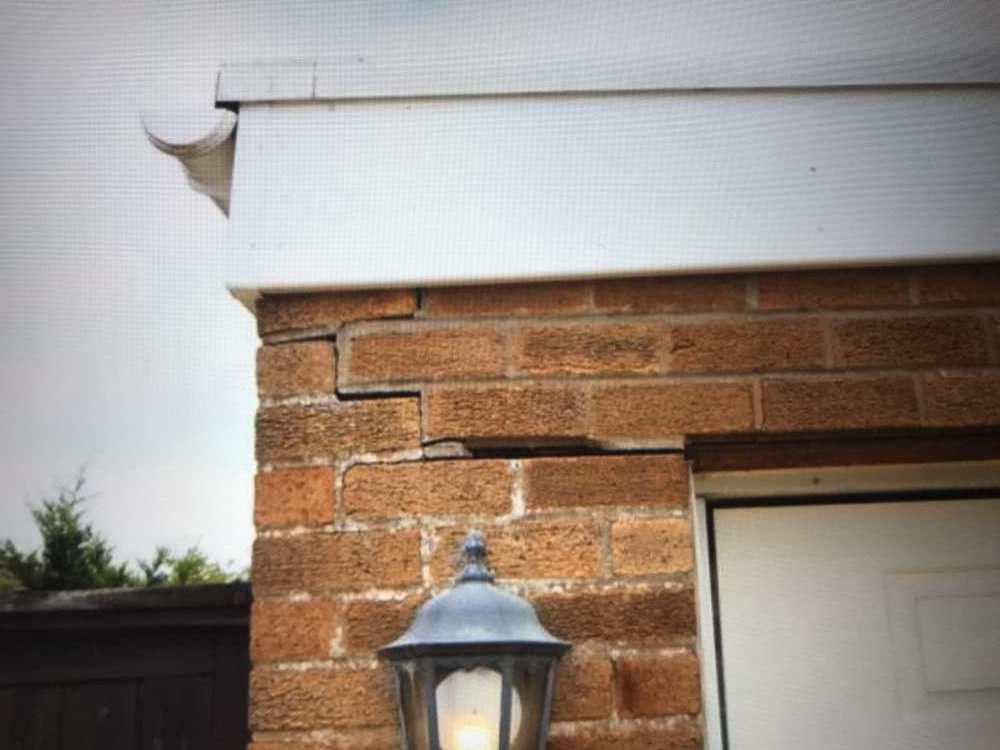
Don't worry, @saveasteading, we are shot of this now, but the issue described pole-axed a sale in 2017! There had been luxuriant ivy and cotoneaster growth all over that elevation till a few years before, despite my attempts to get them removed, so they probably had something to do with it. And like you, I'd have expected some steel in the outer leaf, but believe me, it wasn't there. I do love the concept of 'Structural Chicken Wire', though! The house opposite me (in a different part of the country) appears to be similarly afflicted, judging by the droopy soldier course! (Just realised that your later Qs were probably for the OP, not for me!)
-
Is that the front moving or the side falling off, or both?! As per @saveasteading comment, it does appear awful.
-
I claim no skills whatsoever with digital pic-wrangling, but try this:
-
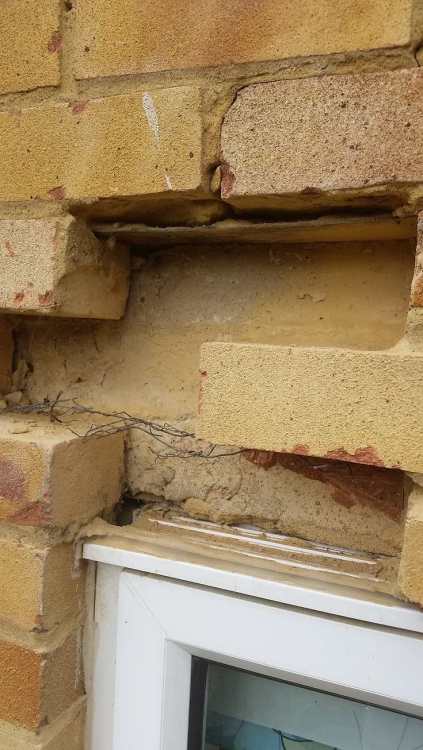
Here's the one I 'unearthed'. Big conc. lintel on the inner skin and chicken-wire on the outer, a course above the window-head. The whole estate was built like this.
-
@saveasteading, for clarification, my first post from further up the thread:
-
Perhaps I can come in on part of that one. I think I was the one who sowed the 'potentially no lintel' seed. I related a relative's situation where a whole estate of 1960s houses were built without lintels to the external skin, an issue which was not an issue until the sturdy timber windows were replaced with uPVC. I think I have somewhere the pics taken when the builder did 'exploratory' work.