


bmj1
-
Posts
343 -
Joined
-
Last visited
-
Days Won
2
Everything posted by bmj1
-
How about this ? https://www.ready2pour.co.uk/liquid-floor-screed/gypsol-ts-15/
-
We will be dry lining our exterior walls with insulated plasterboard, to bring up u values. Can we wet plaster the interior ones, or is that madness and we should use plasterboard throughout ?
-
Hi all, So I'm all pleased with our velux CVU units.. .. But, it's been pointed out to me that we need access to the roof, and they don't open fully. Any recommendations for a rooflight to fill an opening 120cm x 90cm, that opens fully? Ideally not made of plastic, triple glazed and with option for built in motorised black out blinds. Thank you in advance.
-
Vacuum Insulated Panels - any recommendations in the UK
bmj1 replied to bmj1's topic in General Construction Issues
I mean that all the steps are not tall enough. Simply due to the previous builder not following the drawings. We'll lose a little ceiling height on the first floor, but will still have 2470mm or so FFL to FCL, which I think is plenty for a bedroom floor. -
Vacuum Insulated Panels - any recommendations in the UK
bmj1 replied to bmj1's topic in General Construction Issues
Yes! Big sigh of relief ! What about using sand/cement screed to build it up ? -
Vacuum Insulated Panels - any recommendations in the UK
bmj1 replied to bmj1's topic in General Construction Issues
Ok, so spent some more time on site this morning...! Good news mostly. We've got space for 140-150mm or so of PIR. We'll be okay here. But - our staircase was built wrongly. It's solid concrete (cast in-situ), but not enough height on each step, we probably need to add ~80mm to the height of each step. Any thoughts on the best way to build this up ? The staircase will be finished with hardwood treads and risers. I.e. we could cast more concrete in a mesh and build it up that way, just wondering if there is a more sensible solution ? -
Vacuum Insulated Panels - any recommendations in the UK
bmj1 replied to bmj1's topic in General Construction Issues
We've got B&B upstairs, but none of the internal walls are structural, upper floor sits on steel posts at the perimeter, and steel beams running across the floor span. -
Hi all, Our build-up is: 1. Concrete floor (beam/block) 2. PIR 3. Screed / underfloor heating 4. Engineered wood 15mm Please can I ask this forum: what is the very thinnest screed option available? That will be effective and durable.
-
Vacuum Insulated Panels - any recommendations in the UK
bmj1 replied to bmj1's topic in General Construction Issues
I'll need to review the walls above. We've done concrete blocks for the walls above, so might not be totally unnecessary! -
Vacuum Insulated Panels - any recommendations in the UK
bmj1 replied to bmj1's topic in General Construction Issues
Agreed. We will work through it -
Vacuum Insulated Panels - any recommendations in the UK
bmj1 replied to bmj1's topic in General Construction Issues
London. Load bearing walls are all on the perimeter. I wonder if they over ordered the T-Beams and didn't have anything else to do with them.. -
Vacuum Insulated Panels - any recommendations in the UK
bmj1 replied to bmj1's topic in General Construction Issues
Just to add, here is my floor layout (this photo taken 9 months ago when we were at this stage)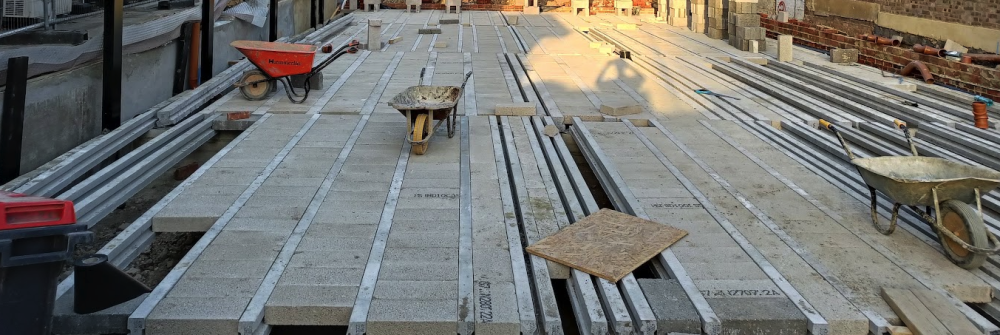
-
Vacuum Insulated Panels - any recommendations in the UK
bmj1 replied to bmj1's topic in General Construction Issues
Honestly, that's a relief to hear ! We're planning underfloor heating, and my preference was liquid screed (I think we can get this down to ~50mm ?). I've got 120mm total to play with above the beam/block floor, minus say 20mm for the floor finish and 50mm for liquid screed.. So room for PIR or some kind of board or potentially both.. -
Vacuum Insulated Panels - any recommendations in the UK
bmj1 replied to bmj1's topic in General Construction Issues
Sounds good to me. Can anyone recommend alternatives to Beamshield ? Planning to hit the phones hard on Monday AM and would be good to have 2 or 3 companies in mind to tap up for this. I did look at Milbank Warmfloor Pro, but they appear to require 75mm of concrete on top, which is self-defeating in terms of minimising floor build-up... Thanks in advance -
Vacuum Insulated Panels - any recommendations in the UK
bmj1 replied to bmj1's topic in General Construction Issues
Wow - thank you all so much. I really like the sound of this solution vs VIPs, both for ease of installation and also durability over lifetime of the house. Yes, I can confirm the walls and upper floor are built. Is removing the concrete blocks from the beam+block floor still doable at this stage ? It looks to me like it is sealed in somehow ? Here is how the floor looks right now...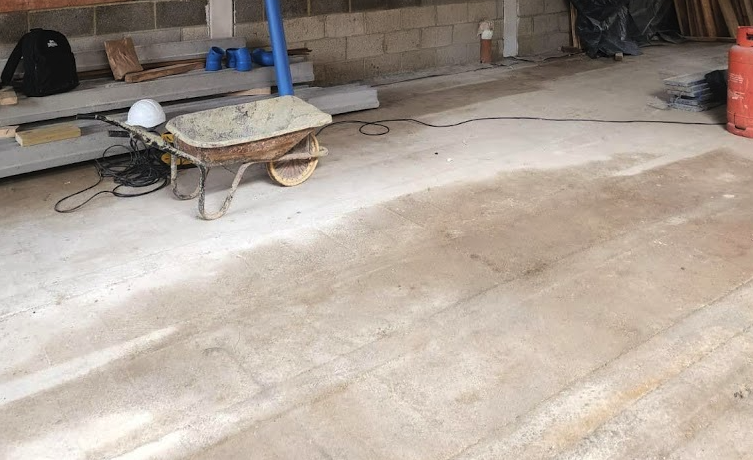
-
Vacuum Insulated Panels - any recommendations in the UK
bmj1 replied to bmj1's topic in General Construction Issues
That's an interesting idea. It actually was designed right, but the implementation was botched... So you are suggesting that we remove the blocks between the beams, and replace with insulated ones. Neat. Any blocks you have in mind ? -
Hi All, I've found myself with just 120mm of floor build up above Ground Floor block and beam solid concrete floor. I'm trying to figure out what our floor build up can look like to enable us to have underfloor heating, here is where I've got to: 50mm - VIPs 50mm - liquid screed / underfloor heating 20mm - floor A) Can this work ? B) Any recommendations in terms of VIP flooring providers ? Thank you in advance !
-
Insulated plasterboard: 15mm PIR + 6mm Magply - any issues
bmj1 replied to bmj1's topic in General Construction Issues
I'll call them in the morning and ask how we skim it. I guess my alternative question is if anyone is aware of a very strong, thin plasterboard / plasterboard alternative ? (that could be bonded to the PIR instead of PB) -
Insulated plasterboard: 15mm PIR + 6mm Magply - any issues
bmj1 replied to bmj1's topic in General Construction Issues
Concrete blocks. So the third party company will bond the PIR onto the Magply for us, and then we do the dot/dab of the combined product and skim. Does that make sense? -
Insulated plasterboard: 15mm PIR + 6mm Magply - any issues
bmj1 replied to bmj1's topic in General Construction Issues
I.e. that's a build up of: 10mm dot+dab + 15mm PIR + 6mm Magply + 3mm skim = 34mm Plasterboard is of course thicker than the Magply -
Insulated plasterboard: 15mm PIR + 6mm Magply - any issues
bmj1 replied to bmj1's topic in General Construction Issues
Hi Conor - my thinking was the Magply is instead of PB. Does that make sense ? -
Hi all, We need to dryline our walls (cavity construction, concrete inner skin, brick outer) to bring up our u-values. I'm trying to keep the wall build-up minimal. I've found a company who can bond 15mm of PIR to 6mm Magply, which we can then dot + dab on. I'm not familiar with plasterboarding / MGO alternatives, has anybody here used Magply? Will I be okay with a 6mm thick magply for my walls ? Any other issues/concerns to flag up ? I guess hanging joinery (e.g. in kitchen) might need to be fixed all the way through to the concrete substrate ? Thank you so much in advance.
-
wow, awesome, thank you. This should be easy enough to specify and explain with your picture and comments
-
Hi all, We've got our shell erected, brick and block cavity wall construction. I'm looking to retroactively bring our wall u values up, and it looks like drylining with insulated plasterboard is the only realistic option. I was previously hoping to use wet plaster for the "easy" air tightness, but this doesn't appear to be feasible... Any recommendations for how we can best ensure we get decent air tightness with insulated plasterboard dot and dabbed onto concrete blocks? Parge coat? Tape applied where? If anyone can give me a bullet proof spec, that would be awesome. Thank you in advance
-
Improving cavity wall insulation (rockwool)
bmj1 replied to bmj1's topic in General Construction Issues
I believe we've got Rockwool 032 in there. I've come across this product, as an option for dry lining. What would be even more ideal would be 15mm of this PIR product, bonded onto 3mm of MGO board. Any thoughts on how I might procure such a thing ? Or ideas for alternatives ?


