Garald
-
Posts
1113 -
Joined
-
Last visited
Everything posted by Garald
-
So, it seems I'll have my bookcases made out of hevea (gumtree wood): I'm told it's extremely stable (important in a large wall-to-wall bookcase system) - in this respect and in appearance, it compares favorably to beech, I am told. I've heard hevea is a pretty eco-friendly choice, in that becoming wood is just the last stage in a life that involves being tapped for latex during many years, and a tree is then generally replanted. However, the wood comes without FSC (Forrest Stewardship Council) certification, or apparently anything like that. Is that a serious sign? Does it matter? FT HEVEA.pdf
-
A friend recommends micathermic heaters - what do you think of them?
-
OK. Well, I have just ordered a 500W heater with good reviews for 14 eur + 4 eur express shipping. That will at least allow me to tell what 500W can do in this space. https://www.amazon.fr/dp/B0CFXXYRR9?psc=1&smid=A3FJ1MS18WO9QM&ref_=chk_typ_imgToDp
-
Well, it's a bit like starting a fire with a very low-powered electric stovetop (in a van?) - I'd think it would require some forethought. (Stick some very flammable and thin material into it, and then use it to light other things?) Would a 500W electric radiator be safer? I suppose yes, but just because it's a larger area and it can't tumble or be put right against the curtains, no?
-
Right, that's the only reason why I'm even considering something installed by an electrician (inevitably expensive). OTOH, can you start a fire with 500W without deliberately trying to? Would 300W be safe? Alternatively, I can just get a 500W heater, turn it on until the temperature is 20C, remove it from the room before guests arrive, and also remove the thermometer.
-
Inexpensive, but is it safe?
-
True. I'll just have an electrician come over and tell me what he would charge for the smallest, simplest radiator (with thermostat) available.
-
I charge it up before they come! Then they will hopefully feel warm and forget about the issue.
-
Oh, I used to get my electricity supply cut out all the time because the previous owners had a 6 kW cap. Took forever to get that changed - it's something done by a private monopoly run by the Three Stooges. I'm finally at 12 kW, and have no issues. 500W (or less) should be OK.
-
All right. A storage radiator it is (I think this is the same thing that gets called an "inertia radiator" in French: you heat a fluid or solid body, and it slowly releases heat) - with a thermostat and so forth. Is fluid or solid better? Some people say (in French) that fluid is better for bedrooms and solid is better for living rooms, but since this is a studio (bedsit) things are confused entirely. Any recommendations as to brands? There's a bunch of things with 4/5 stars on Amazon, but I'd like something reliable and above all safe. I suppose I'm right in thinking that 500W is more than enough? The place is already heated by central heating - it's just a matter of letting self-indulgent paying visitors have some control over the room temperature without changing the temperature of my entire house. (Friends and relatives have always been fine with 18C in bedrooms.) I suppose I'll have to call an electrician (who will charge me as much as the radiator cost) - I need one to look at something else anyhow...
-
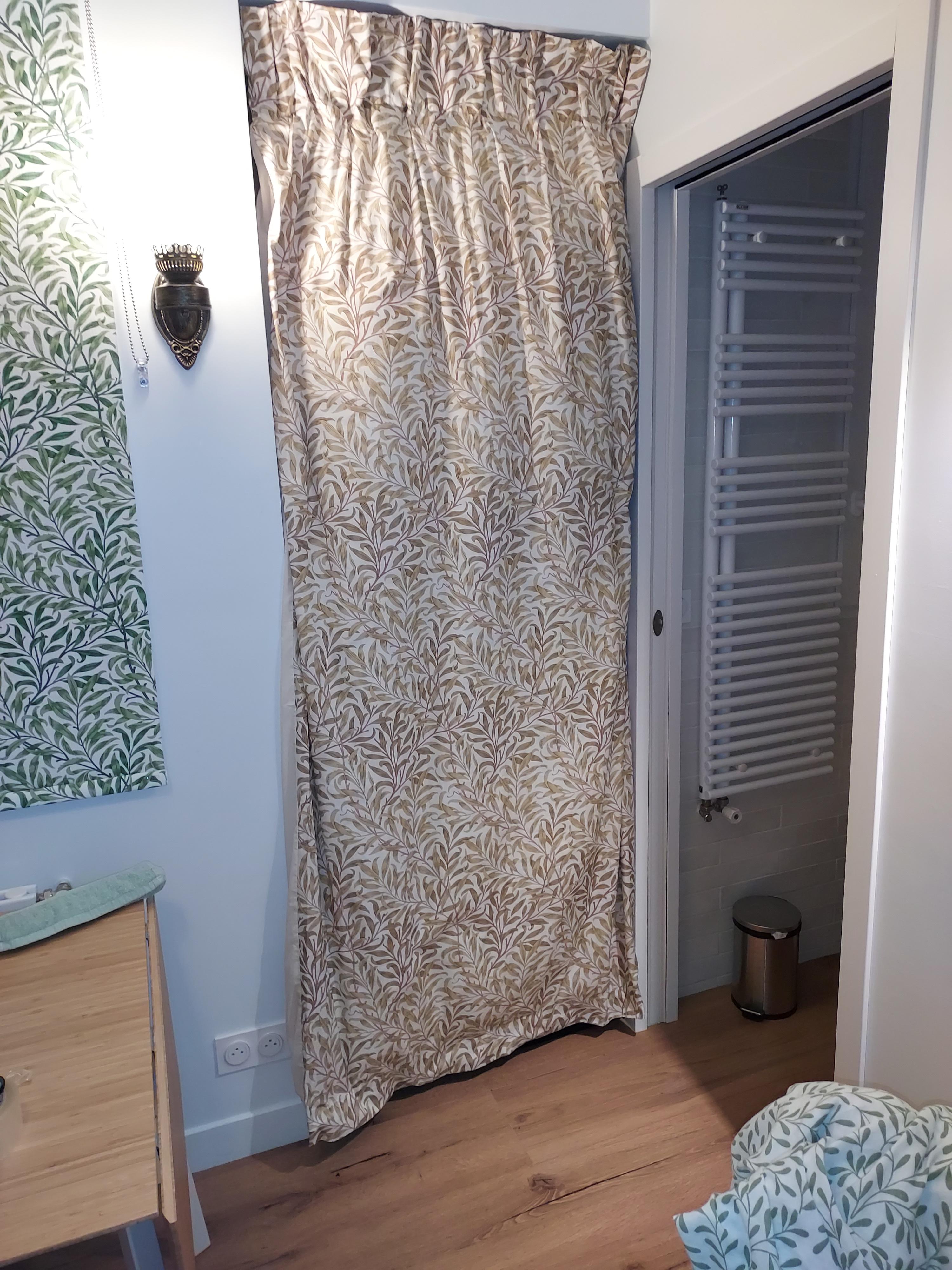
As some of you know, I am happy overall with my heat-pump-powered central heating. Not all rooms heat up to the same temperature, as is natural: I do not have a two-zone setup, and some rooms have southern and others northern exposure. In particular, my setup includes a ground-floor, northern-oriented bedroom/studio that used to be 3 C colder than my living room/library. I've been working on improving the insulation in the studio to the extent I can (there's a metal door and it's unclear how to open it to verify it's insulated) - let us say that the temperature difference is now 2.5C. That's the case whether it's 0C outside or 10C outside. The problem is that I sometimes let the room out as an AirBnB (mostly so as to get good reviews so that I can let it out during the Olympics). Now, there are three kinds of guests: - the kind who like a studio at 18C with warm blankets - the kind who tell me right away they are unhappy with the temperature - I gave one the thermostat, and she cranked it so far up that I was at 24C, but OK, five-star review, - the kind that says nothing but leaves a four-star review (the kiss of death), telling me privately that it was because of the temperature (why not tell me before?). So it seems that, while I will continue to work on the insulation (my girlfriend is horrified at my current plan to line the door with cork and covering it up with wallpaper), I really should install some sort of small electric heater with its own thermostat, to supplement the existing radiators. People like to be in control. My main concerns are (a) safety, (b) efficiency. Because of safety issues, just getting a portable space heater is out. So, please guide me through the existing options. What I have been able to find is: (a) inertia heaters. The strongest claims for them have to be false (a COP of 1 is a COP of 1). Are they appropriate here? Are they safe? Is solid or liquid better in this context? (b) radiators that claim to actually heat mostly by radiation, such as this one: https://fr.hudsonreed.com/radiateur-infrarouge-panneau-chauffant-electrique-intelligent-avec-cadre-blanc-300w-50-5-cm-x-59-5-cm-teplo-123659?_gl=1*15n7xc4*_up*MQ..*_ga*MTgzNTE1OTQ3NS4xNzA5NjAwMDgz*_ga_CTHXFM8H1V*MTcwOTYwMDA4My4xLjAuMTcwOTYwMDA4My4wLjAuMA..*_ga_K0QLN5D9SX*MTcwOTYwMDA4My4xLjEuMTcwOTYwMDA4My4wLjAuMA..&gclid=CjwKCAiA_5WvBhBAEiwAZtCU72oud3KU_3RPq59ciim3UbwEfB3oDoZVdm_C0yrlFbFsgpgVGGBf5BoCqJkQAvD_BwE&gclsrc=aw.ds Well, it makes sense to heat the people before the air - but do these radiators get too hot? Are they safe? Can people get burns? Will they set the room on fire? There's also the question of dimensioning. The space is 12.2m^2, of which 1.9m^2 are the shower and WC. I suppose that, since the question is how to bring the place up from 17.5C to 20C, 500W is actually overkill, and 300W is more than enough? This is just a wild guess; how would I actually do the calculation? (Not sure the heat-loss spreadsheet would help me much (I can dig it out if needed). When the central-heating radiators in the studio turn on, everybody is happy. The problem is that, if it's 20C in my library, the system is happy and turns itself off, and the person in the studio may be unhappy.)
-
I may or may not have told people here of how there used to be a tiny gap between a low side wall and the adjacent longitudinal beam in the attic. (My girlfriend and I discovered it indirectly - young wasps were getting in and failing to get out, thus turning our place effectively into a giant death fig.) The builders acknowledged there was a problem there and put some sealant, so that should be airtight now. However, you may remember how I went about with a thermal camera and saw that the top of that side wall was unusually cold. So, I'm about to attack the problem with a tube of cork (which has the consistency of an extremely viscous liquid, a solid at first sight, thanks to some sort of vicious glue that - the packet warns me - can be abused as a drug) and a manual caulk gun. I know this is too late for me to ask, but can you please tell me right away if this is an extremely stupid idea? It seemed natural, but now that I'm looking online for instructions, I'm only seeing people doing this for other purposes (e.g. joints in flooring). 20240226_224805.mp4
-
It's a roll of William Morris wallpaper produced by Sanderson - apparently it's too highbrow to come with instructions :(.
-
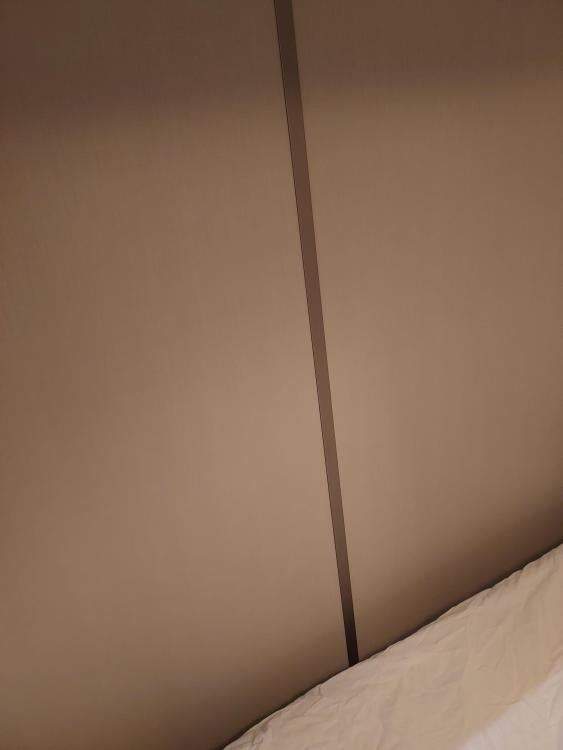
I'd like to wallpaper the "inside back" of a Murphy bed (that is, the part that is visible when it's open and is not the mattress). Problem is, I haven't wallpapered a thing in my life, and I also don't know whether pasting wallpaper on furniture requires any special treatment or glue. Does it? (Apparently I can't hire someone to do it - agencies that send wallpaper-people to your place won't do it if it involves messing about with furniture.) So, what do I need? Paste brush, scissors with extra-long blades, paper-hanging brush, seam roller - anything else? The material is not so different from what you might expect on the back of a kit bookcase.
-
Ah, cool - so that's them case both for electrical energy used and for heat extracted? I'd need to start keeping track on a day when heating and hot water were completely off.
-
I meant that keeping track of heat flow temperature and COP is something you can do through the WiFi adapter but not through the controller, at least not on a day-to-day basis, as opposed to monthly.
-
It allows you to keep track of heat flow temperature and COP.
-
As some of you know, I'm at the end (I hope!) of a major renovation. My place now has two kinds of wall insulation - both of them on the inside. - On the south side and a bit of the west side, I have a thick layer of BioFib Trio (cotton-linen-hemp), with an R>4. Everything should be fine there. There are some thin veils inside het - On the north side and bits of the west and east sides, due to sui generis advice/orders that did not come from here and may be questionable, there's a combination of a reflective insulator (Actis Hybris) and 5cm of BioFib Trio. People here have discussed plenty how well reflective insulation performs. Let me not do so here - suffice it to say that the north-side rooms are a bit colder (but then they would be: it is the north side). If Actis Hybris performs as its manufacturer claims, then the wall does surpass R=4. Let us just say that I am considering the possibility of insulating the north side from the outside, eventually, in the medium-long run, without touching what has been done already, if I can help it. Now, BioFib has the virtue of being a moisture regulator. Actis hybris, on the other hand, is meant to be impermeable to water vapor. What sort of outside insulation should I aim for, then, so as to avoid condensation issues? Porous? Not porous? Or am I neglecting other, more questions here?
-
No, only that installing it would not be that hard (since they ( = sales representative of the company that installed my heat-pump) wanted to sell me a WiFi unit, installation not included; I ended up buying it for less online). I could explicitly ask him.
-
Great. Please do. Did you install it yourself? I take you are still alive?
-
Bah, that's unlikely to kill me, and I wouldn't be any worse at it than an electrician. Would I be voiding any sort of warranty, though? I don't know whether to take these instructions seriously, or more like "wood has been found to cause cancer by the state of California".
-
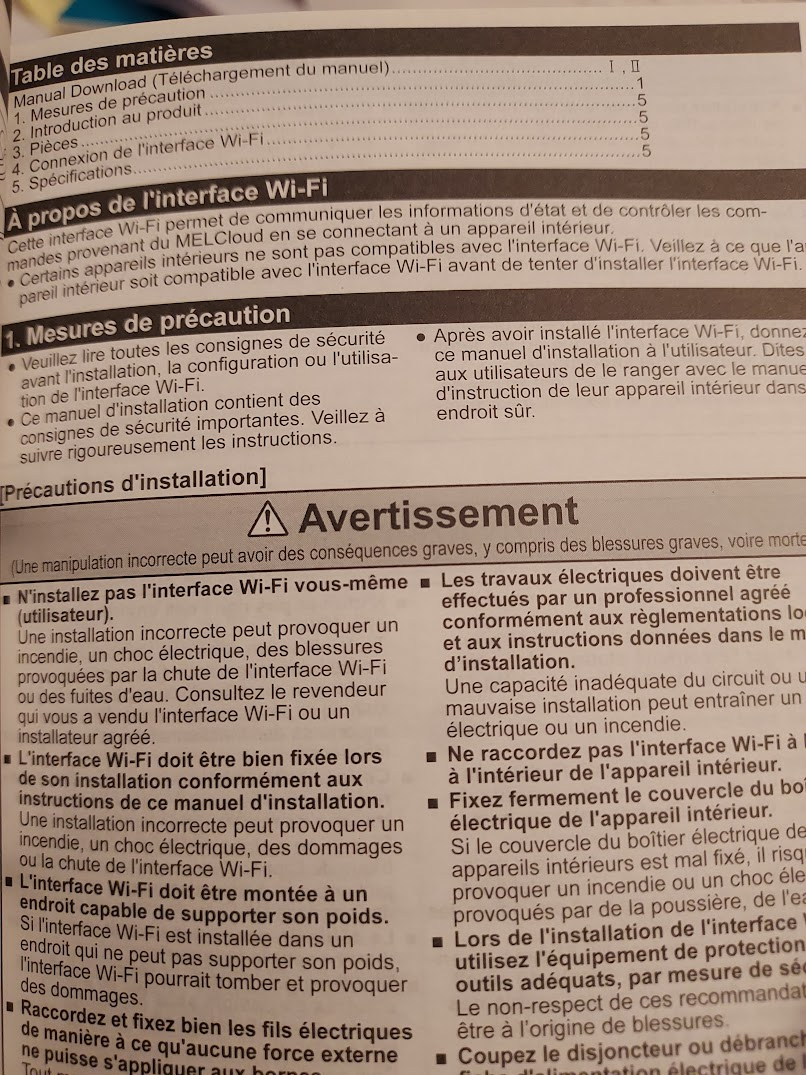
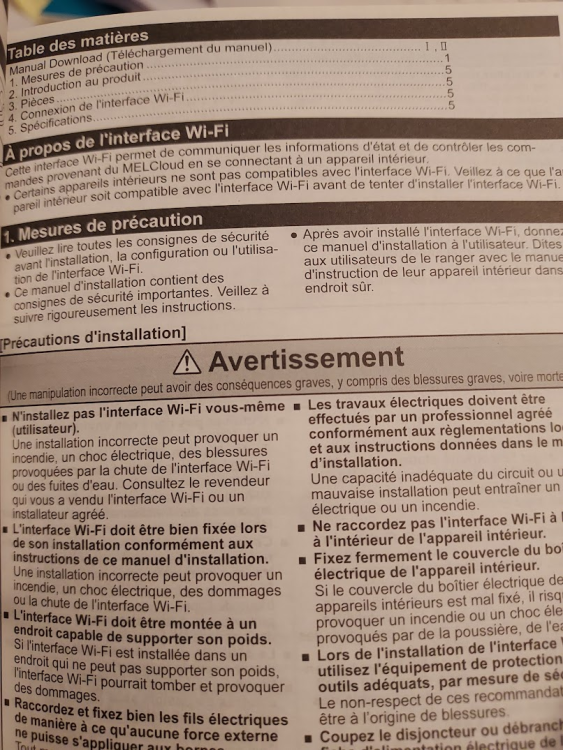
I got a Wifi adapter for my Mitsubishi Ecodan heat pump in the mail the other day. But what do I see at the beginning of the installation notice? Apparently I can't install myself, or I will be executed by my own heat-pump. (Note: contrary to what the note might be taken to imply, the Wi-Fi adapter is a small, light thing.) I contacted the business that sold me the heat-pump and installed it - they'd like to charge me 200 eur for installing the adapter. That's almost twice the price of the adapter. Is this normal? Do I really need an installer? Can every electrician do this?
-
Renovations at my place will soon wind down. If there are no further financial surprises, I may, I said *may*, offer to redo the common courtyard at my expense. (It's about 40m^2, much longer than it is broad, in a small co-op.) This is in the Paris area - a similar range of temperatures as the south of England, only somewhat hotter in summer, and of course with about 2/3 the rainfall. I know next to nothing about outdoor flooring. What I've learned: (a) Terracotta flooring is probably a terrible idea (water seeps in, water freezes, good-bye to the tiles). A seller in a fancy shop selling very expensive Italian tiles puffily asserted the contrary the other day, but I can't afford her tiles anyhow. (b) while outdoors travertine tiles are surprisingly inexpensive at one of the main French chains, and have good reviews (http://tinyurl.com/3d846c47 ), my sister (who lives in a subtropical climate) has just advised me against it - her side of the family bought a place with travertine floors outdoors, and they have cracked. Not sure what people here think. (c) A few months ago, I was speaking to someone experienced-sounding behind the counter at the bookshop of the Compagnons (who are some intermediate form between masons and freemasons, from what I understand - well, they also do carpentry and so forth). He confirmed (a) (energetically) and recommended "beton teinté dans la masse" (coloured concrete). From what I understand, it's a durable material well-adapted to the outdoors, but, while its cost is on the low end, labor costs are significant (more or less than for tile?) - and it may be more of an annoyance to neighbors who have to cross the courtyard while it sets than tile might be, no? (d) I imagine cement tiles get stained too easily for outdoors usage, and stoneware may crack too easily. (One of my neighbors likes to do weights outdoors.) Are porcelain outdoors tiles a thing (and a good idea)? Tiling the garage/bike shed with inexpensive porcelain tiles turned out to be a good idea, but the fact that one can drive a car on them (not that I have one) does not necessarily mean that they will cope well with impact or outdoors conditions. Not sure what to go for, then. Here is the courtyard, in its current, depressing condition.
-
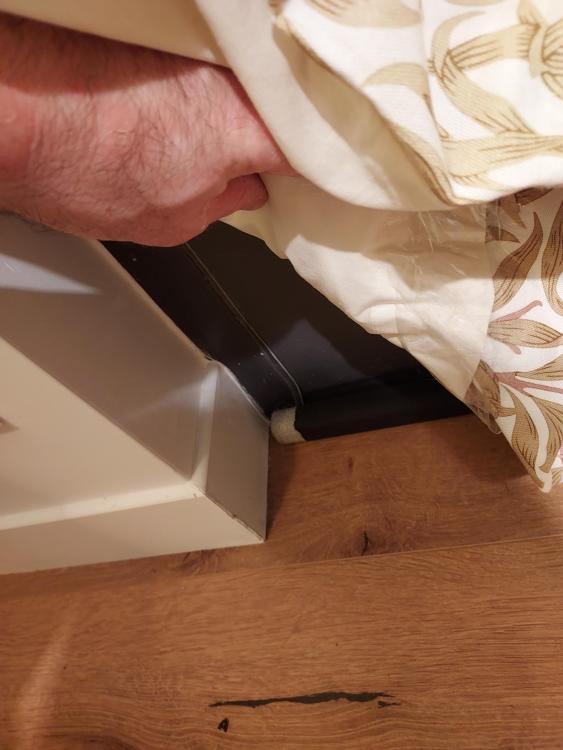
Oh, but there is a draught excluder!
-
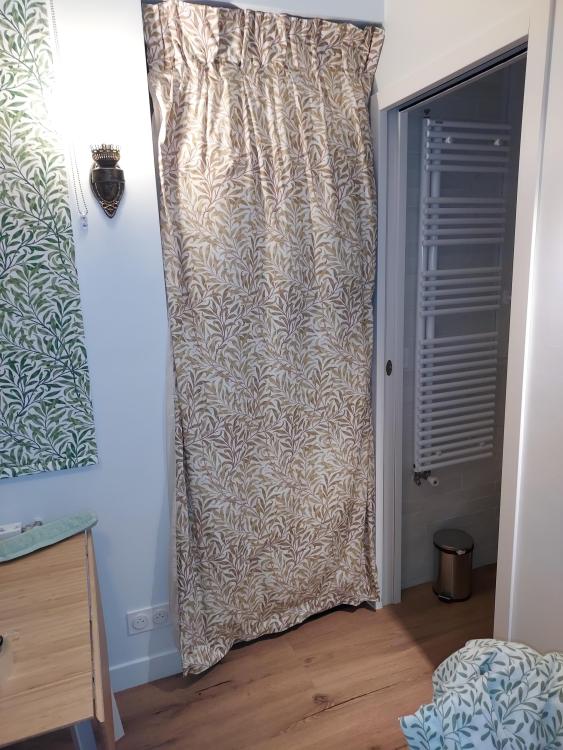
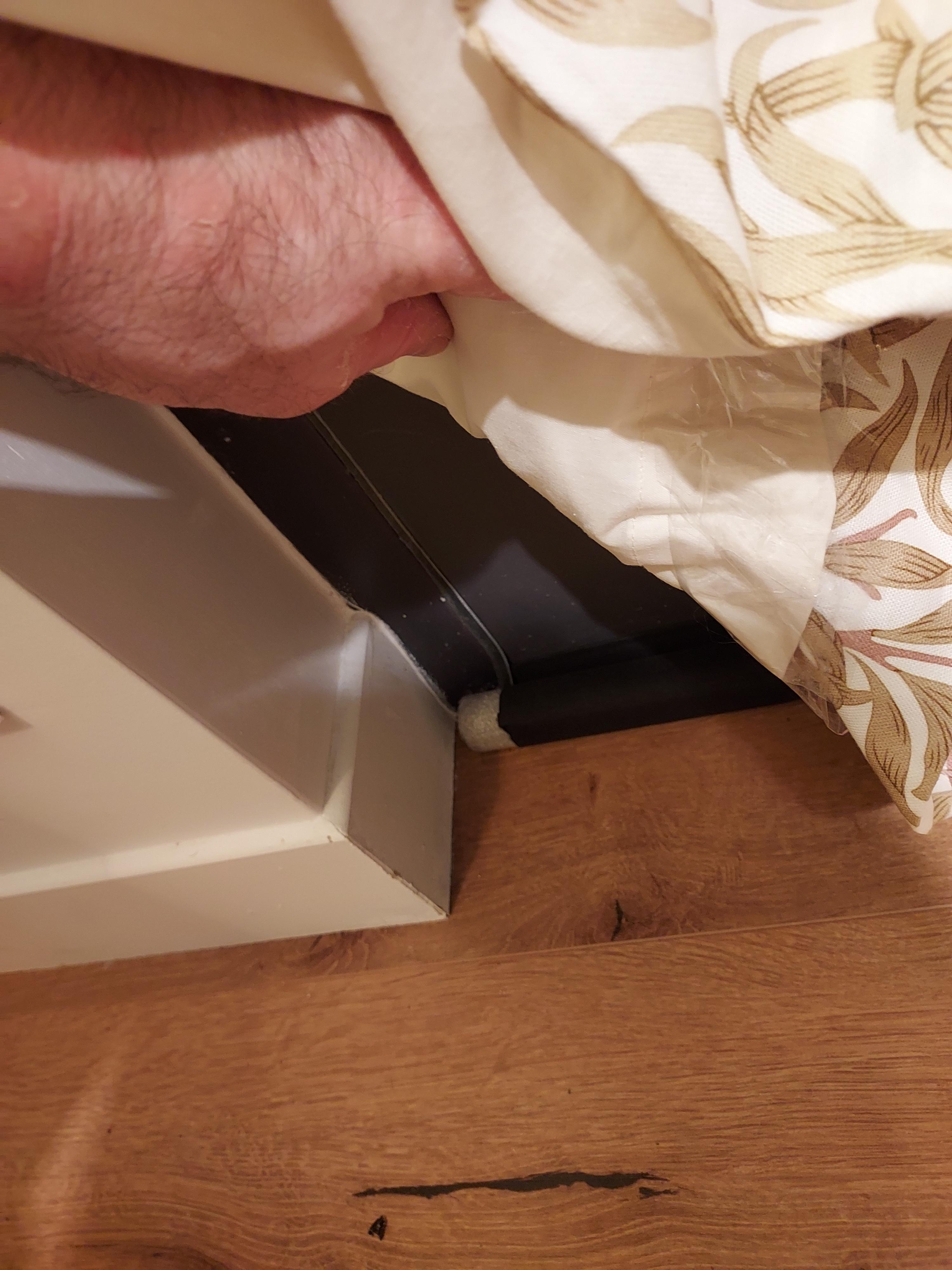
After a lot of scotch tape, here it is. Three layers of Climasheet Apex 133 (R = 0.5R each) sandwiching two layers of reflective I suasion (one space blanket and one overpriced lining from Moondream that essentially amounts to a space blanket. Should I tape the bottom of the curtain to the bottom of the door?