Garald
-
Posts
1113 -
Joined
-
Last visited
Everything posted by Garald
-
Right, that was an applied friend's guess as to how MVHR worked (but it turns out to be much simpler).
-
Sounds interesting, though also noisy (the fan that the builder unnecessarily installed in the laundry room certainly is). Of course one can also try to transport heat without transporting a hot substance (air) though I wonder how that would work in this case.
-
Right. The problem in this case is that the cold room is the downstairs studio (north-facing), and the only other things I have at ground level are the entrance/laundry and an unheated garage. I don't have an issue on the north side of the first floor, in part because of the heat flow from the warm south-facing rooms and also in part because that floor does get more light (on top of not having a thermal bridge where the foundations end - I'll have to deal with that). Not sure what I am supposed to do. (Drive a metallic spike through the ceiling and into my first-floor shower room? Sounds too adventurous.)
-
Not really an insulation issue, but: I can't be the only person here whose place is substantially warmer on the southern than on the northern side, and particularly so if we are talking about a south-facing room with large windows (call it room A) than about a ground-floor north-facing room (call it room B). Initially, room A was about 3 degrees warmer than room B. Now that I've insulated an outside door properly, the difference is just a bit over 2 degrees. I can work more on thermal bridging and the like, but some difference will still remain. You can see what happens then during the heating season, given that I have a one-zone heat pump: the north side gets to 20C, the heat pump says 'very well, I'll stop working', and room B is now stuck at 18C (or 17.8C, etc) which is too cold for some. In April, this is not a big deal: I just turn off the radiators for all rooms except room B. During winter, however, that is not an option, and fine-tuning everything by hand is bothersome. I've been warned here against getting self-adjusting radiator knobs, as they can interfere with the heat-pump's own self-regulation. What to do? No doubt the simplest coping strategy is "turn off a few radiators or install self-adjusting radiator knobs on just a couple of radiators", but surely there has to be a way to distribute heat from one side of the house to the other side. (That would be useful in summer, too.) It's probably too late in my case, as the renovation is essentially finished, but what do people do - install a heat-conducting conduit indoors, perhaps?
-
Just a sanity check: the spreadsheets gives me the following percentage estimates for heat loss - 19% external walls, 14% windows, 25% roof/ceiling, 11% floor, 31% ventilation. I think the percentages of roof/floor loss are a bit higher than typical, but that makes sense, as the roof insulation is basically that put by the previous owners, and the floor insulation is new but thin (should have added a significant floor height, Japanese-style - a missed opportunity). The diagnostician's percentages are: 11% walls, 22% windows and doors, 7% roof/ceiling, 5% floor, 5% thermal bridging, 50% ventilation. This somehow seems odder (except for the thermal bridging, which is actually there, where the foundations end), or am I wrong?
-
Turns out I already calculated the ventilation loss myself a while back, or rather the spreadsheet from here did. It gives me that 31% of the heat is lost through ventilation, not 50%; I'd rather trust that than the diagnostician's software. Here are some links that might be useful (modulo French skills or automatic translation): https://www.fiabitat.com/le-principe-du-puits-canadien/ https://conseils-thermiques.org/contenu/puits-canadien.php - apparently, it is recommended to clean a puits canadien at least once every 2 years (the filters and air intakes must be cleaned much more often). https://passivact.fr/Concepts/files/PuitsClimatique-Limites-PuitsCanadien.html claims that a puits canadien is worth it only in a passive house - but the calculation is based on the assumption that MVHR has been installed. Obviously, as I was saying, the difference can be much greater if it hasn't been (but then one has to double-check that MVHR cannot be installed.
-
Well, the story here is that they *have* been used for centuries, for cooling, by technically minded people in the south of France (hence "puits provençal"). And that folks in some parts of Canada do this routinely. Will have to check on both stories.
-
How do I calculate it myself? I don't think the diagnostician looked at my PIV settings - he was just keying data into his system for a couple of hours. I don't think the house is very leaky either, just well-insulated (R>=3.8 on all walls, new high-spec double-glazing, etc.). I have pre-heating (basically a radiator on the PIV, fed by the heat-pump) but that does nothing for efficiency; the point is that a Canadian well would heat the incoming air in winter (and cool it in summer) using essentially no energy. I have a CO2 monitor and I am currently trying to get an automatic controller for the PIV linked to humidity and CO2 readings.
-
Right - I'll have to get a quote (elsewhere) and learn how to calculate the reward (here). According to the (dumb software of) the diagnostician who came here last summer, 50% of heat losses at my place are through ventilation, so it does seem like ventilation is the right thing to obsess about at this point.
-
I'd have to talk to the co-op to see whether it can be run under our shared courtyard (which is in less than optimal condition, and which I have fantasized about redoing at my cost). Alternatively - can the pipes go under the house? I haven't got a basement, and I have long been curious about what hides under the house (Cthulhu?). (There might be something interesting - I know from a plan from townhall that there is a quarry tunnel under the sidewalk in front of my place; it is connected to the catacombs).
-
Oh, I'd love MVHR, but the contractor says it's too late by now - his opinion is roughly that I'll have to wait for the next major renovation (whenever that is). Right, the difficulty is in the ducting. Not sure he is right; I'll ask a specialist to come and give me his own assessment, but I am not too optimistic. At any rate, if I am stuck with PIV, then a Canadian well makes more sense if anything - the increase of efficiency will be higher (in that there will be more to work on), whereas with MVHR a Canadian well plays just an ancillary role. > But you would be better spending your time getting you your existing system to work more efficiently on an as required basis instead of set speed. True, that should be the first order of business. On the other things - I want to get an idea of how worthwhile they are so that I can ask for quotes and decide what to do in the future.
-
Simple: heat-pump manufacturers have been doing a lot of work on noise reduction in the last few years, and things have improved considerably. Just get the quietest heat pump you can! The dBs are right there in the technical specifications, and you can ask people here or elsewhere if there are heat-pumps that make a low but somewhat annoying noise (I've heard that Atlantic heat pumps are like that - can't confirm). I have a Mitsubishi Zubadan Silence, and both the neighbors and I are happy. From my guest room (which is very close to the external unit) you can notice it only when it's running at full blast and everything else is quiet, and you are paying attention. It's basically the noise of a distant wind. (NB: I did take care to install an anti-noise windowpane in a bathroom window that is basically right next to it.) If all else fails, one can get a cover to reduce noise further, but it hasn't been even remotely necessary in my case - and I am very sensitive to noise.
-
I can take a look at what is done here; a puits canadien/puits provençal is a known quantity in France, with (insured) specialists who install that sort of thing for a living, I take, not something I just dreamed up. Thanks for the heads-up. I take it's not common in the UK except as an apparently ill-fated DIY project? Update: I just came across a place that does the piping in clay, and claims that solves condensation issues - is that plausible? https://lepuitscanadien.fr/
-
As has already been discussed, I have a PIV system. I should probably look seriously into the possibility of getting MVHR, but, according to the contractor, it's now too late: it was a possibility to be considered at the beginning of the renovation (back when I was having poor decisions done for me by someone pretending to be an architect) rather than now. What about what is called a "Canadian well" (puits canadien), though? That would seem to combine well with a PIV (unless there are real arguments in the "PIV is bogus" camp, that is). If I understand correctly, it's just a long pipe that goes in the ground and circles about before going into the ventilation input (MVHR or PIV). Of course that means the air is being heated by the ground during winter and cooled by it during summer, all essentially for free. (Well, running it costs no extra money; the installation costs are not huge but not trivial.) In fact, some people call it a "puits provençal" if the main idea is cooling, but it's the same device playing two roles. What energy efficiency gains should I expect? What experiences do people here have with this sort of system?
-
Insulating from the outside and the inside: short version
Garald replied to Garald's topic in Heat Insulation
What are the downsides of using rockwool outdoors? Cost? Lower R per cm than phenolic? -
Insulating from the outside and the inside: short version
Garald replied to Garald's topic in Heat Insulation
Rockwool is actually good against fire, no? The finish will be whatever we choose it to be, I take - this is a courtyard wall, and whatever I end up with will look better than any of the courtyard walls currently, so the other members of the tiny coop should be happy. The current wall is some mystery masonry from the early 1930s. I can upload a photo if it helps. I don't think the risk of fire is high (though the inside insulation (cotton-linen-hemp) is in principle flammable) but what do I know. Sure, let me try Ubakus. PS. I am currently on a brief trip abroad, but here is a photo of the outside before renovations. The main things that have changed are that the stained glass now has additional windows on top and the asbestos pipe has been removed.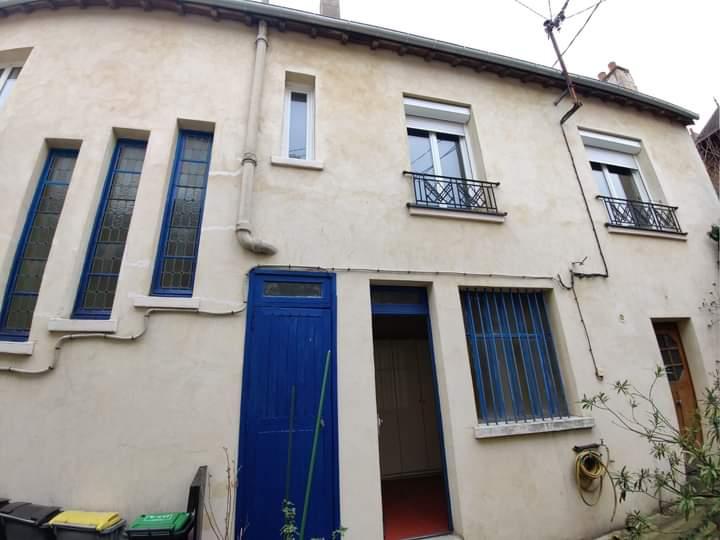
-
I think my post from yesterday on the subject was TL;DR, so here is the short version. A wall that should have been insulated from the outside was insulated from the inside. (Not my decision.) I was already thinking of adding insulation on the outside, and now that I've spotted some mold in a closet (due most likely to thermal bridging) the contractor tells me that he has been thinking along the same lines. The question is what to have in mind when adding insulation on the outside without removing the insulation on the inside. Is the main issue to make sure that one chooses a material that (like the walls and the inside insulation) is permeable to water vapor? Longer version: This is a northern wall, adjacent to a (sometimes humid) courtyard. The insulation on the inside has two layers: ISOLIN HPV reflecting insulation + 45mm BIOFIB. What do you recommend, keeping the budget reasonable - 10 to 15cm PIR perhaps? What are the alternatives? What are their pros and cons?
-
I won't repeat the entire insulation saga. You will know from another post that I'm having some issues in a corner under the staircases, most likely due to a thermal bridge. Bigger picture: I've just finished (or "finished") a renovation where I started being advised by a supposed architect. She made some questionable choices and at least one major blooper (I had strong suspicions and asked here (Nov 2022), people saw laughed out loud - bottom line is, that was caught on time, and she resented enormously from now on). In the end she left the project midway with the money she'd been paid. I finished things with the contractor (who fortunately handled 85% of the money involved) and also with some specialists I found along the way (hardwood, extra windows, etc.) Ah, big twist: she turned out not to be an architect, and most likely never was! No wonder she did not want her contact information to figure on images posted here! At any rate, let us keep our mind on the game. The southern street-side wall was insulated from the inside with 145mm of BIOFIB (R=3.8) - no complaints there. (Plus, it's gradually being filled with books - did I already post pictures of the wall-to-wall bookcase?) According to pictures I took with a thermal camera in January, the northern wall (ISOLIN HPV reflecting insulation + 45mm BIOFIB) is somewhat less satisfactory. Perhaps more to the point, the corners on the ground level on that side seemed very cold, and now I have mold in one of them (under the staircase, as I said). The contractor is of the same opinion as I: it was silly not to insulate from the outside (the only other people at the co-op who ever vote already told me they would have favored it, so no problems from that angle; it's a courtyard wall, so I can't imagine town hall will object), but, rather than undo the inside insulation that we have, we should consider supplementing it with 10 to 15cm worth of insulation from the outside (which I will get done with a different builder - I've seen that this contractor's insurance doesn't cover external insulation). Question: what sort of external insulation can I consider adding, given that I'd keep the ISOLIN HPV + BIOFIB? As long as it's permeable to water vapor, I'm good to go, no? What do you recommend, keeping the budget reasonable - PIR?
-
Wait, no, the other direction, no? Photosynthesis consumes water, breathing releases it?
-
Talked to the contractor - he will come this weekend to see what he can do. There's no pipe that can leak there. He says that the main underlying reason is most likely one of the following: - a thermal bridge (the back wall in the photograph is an outside wall; it is insulated, but there's a thermal bridge where the foundation ends, if I understand correctly) - moisture seeping in from the outside. The fact that the heat-pump's external unit is just outside rubs him the wrong way, but that may not be the reason after all; I've never seen the heat-pump have any condensation. Another thing that makes him suspicious (and here he may be right) is that there's some sort of mysterious gray plug out there. Is it for a hidden drainage tube for the courtyard? - something seeping from under the house. The house sits on a concrete slab, but neither he nor I knows what lies underneath. A condemned basement? Cthulhu? (Note that this part of town is ridden with secret passageways (the part of the Paris catacombs that is open to the public is only a tiny fraction of the total. According to a map I got from townhall, there's one passageway right in front of my door.) Then there's a lack of ventilation as a contributing factor. I already had the bottom of the door sanded; he'll bore a hole in the door so that air has an inlet and an outlet. I'll also put a dehumidifier in there, at least for now. Speaking of which, do these power-free dehumidifiers work? It's a space of less than 3m^3 or so. https://tinyurl.com/3up9veee The downside is that it requires one to get new tablets every few months. The alternative is to get something like this: https://tinyurl.com/2s35c8j3
.thumb.jpg.1fb3810147f7290d02cc7103c20f35b6.jpg)
-
Hah. If I remember correctly, one of the clauses of my job as a French civil servant is that I should not have another career at the same time, with a single exception: writer. More seriously - I've now put the basil plant outside the kitchen window. An alternative would have been to pair it with a plant that thrives in humid conditions - an orchid perhaps?
-
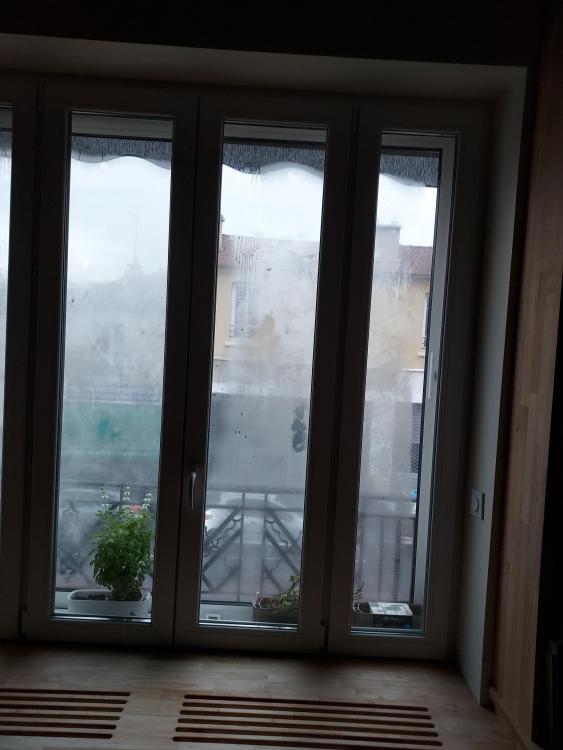
Update: the window that now has the pelargonium has some condensation... and the one that now has the basil (and before had no basil and no condensation) now has a stunning amount of condensation (and a stunning 91% humidity at 21.9C). Basil plants are apparently transpiration monsters.
-
Wow. I left the plants switched overnight, and now the "good" window (which now has the basil plant between the two panes) has condensation, and the "bad" window does not! "Good" window with basil plant and condensation: 27.2C, 83% "Bad" window with pelargonium and no condensation: 32.2C, 51%
-
I am now (on a cloudy day, 17C outside) getting almost identical readings on both windows: "Bad" window: 22.8C, 79% humidity "Good" window: 23.5C, 78% humidity - and yet: fresh condensation has set on the inside of the "bad" outer window, and not on the good window! I can try switching the basil and the pelargonium. Waiting for the more knowledgeable people to chip in
-
OK. I've messaged the contractor who did the renovation and will call him on Monday; I'd like to know what is behind that corner. (Plumbing, surely, but I also want to know where the refrigeration ducts for the heat pump go.) I'll also call a plumber on Monday - even if the contractor offers to fix things, I'll sleep more quietly if I pay for a specialist to fix things, since then I'll effectively get him to double-check on the contractor's work. In the meantime, I'll let the closet air. The humidity inside is a freaky 87%. I better get the wine rack out of there on a day in which I feel particularly well-coordinated (it's past midnight now).
.jpg.d172ecf552448a3d478042985a8b07ad.jpg)