


Garald
-
Posts
1113 -
Joined
-
Last visited
Everything posted by Garald
-
What is Ubakus really doing? And what is that 2/3 - 1/3 rule?
Garald replied to Garald's topic in Heat Insulation
I haven't vanished! At any rate, I take the DIN this-and-that models are very simple 1-D models one can do with pencil and paper? -
Are these things likely to work with efficiency close to what is claimed (88%)? https://www.econology.fr/extracteur-air-double-flux-econoprime-dfd.html?gad_source=1&gclid=CjwKCAjw1emzBhB8EiwAHwZZxUfYNCLDDGeyKXbT61jEQ-mJwDtcp4l_nM0XAGxf3fgPYK3h9JNteRoC4e8QAvD_BwE I imagine installation costs double the price or so, but even then things would remain very reasonable. My situation: a) I'm towards the end of a long renovation. b) I have PIV and I'm rather frustrated that double-flux wasn't offered as a possibility early on. It's most likely too late to install central MVHR. c) I have a habitable (and lived-in) attic that (i) is rather open (one large open space, one room, one bathroom) (ii) most likely doesn't get adequately ventilated by the PIV (there are only skylights, and apparently ventilation exits weren't built into them); the place feels a bit stuffy when hot; d) On the first floor, I have one large library where in fact does have ventilation exits in the window frame (or so I'm told - I haven't been able to find them); I wouldn't mind closing them, as they lead to a noisy road; I might be able to put a ventilation exit on a side wall. I suppose a MVHR in each room in the attic does not enter into conflict with the PIV - it would just makes it more or less superfluous, no? PS. Added advantage if this MVHR-in-the-attic plan works: I'll be able to soundproof the doors in the attic. Right now, there's about 1cm of empty space at the bottom, necessary for the PIV to work (to the extent it works at all). PPS. Are there single-room MVHR units with filters? I live 10 min away from a highway, so pollution is non-trivial, and then there is pollen.
-
I've got a quote for insulating a wall on the outside using rockwool. (I've got similar quotes for polystyrene, but I think there are good reasons to prefer rockwool, one of them being permeability to water vapour.) What is being proposed is 16cm thickness, for an R of 4.55. Is there such a thing as too much rockwool on the outside? If not, why not go up to 18cm, or 20cm? (Sure, there is the matter of cost, but only 1/3 of them are the cost of the insulating material itself. Going from 16 to 18cm should correspond to an increase in price of less than 5%.) I have a further motivation - the wall is already insulated on the inside (I know, I know, not the best decision for a northern wall - the pseudoarchitect overruled both the builder and me on that, back before I knew she was no architect). Now, Ubakus tells me that just a little bit of insulation on the outside will be enough to forestall the risk of condensation, but, until I get WUFI to run and/or understand condensation myself, it's best to work with safety margins. Around here, people go by a "the R on the outside should be at least twice the R on the inside" rule - that seems like an exaggeration, but who knows?
-
I've read Ubakus really uses a very simple model to predict condensation. So, what is it, and where can I read about it? What do more sophisticated models (such as the one used by WUFI, which I can't use, as I don't have Windows - just failed to run it using WINE) really do? TL;DR: I would like to install outside insulation on a wall that is already insulated on the inside. I want to actually understand (the physics behind) how to make choices so as to prevent condensation - I can't just follow rules of thumb such as the "1/3-2/3 rule" and "at least 5 times as much resistance to water vapor on the inside as on the other" as they can't really be simultaneously obeyed in this sort of situation.
-
Insulating from the outside: what is a reasonable cost?
Garald replied to Garald's topic in Heat Insulation
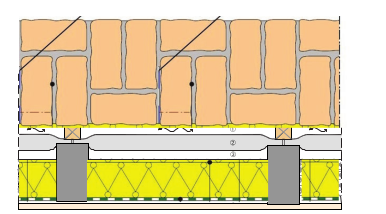
OK, here is the composition of the wall: - wall itself: some sort of masonry from the 1930s (not concrete) - inside insulation: ISOLIN HPV (reflective insulation) + 45mm Biofib Trio + hygrovariable vapor barrier (Proclima) + 13mm fireproof plaster -
Insulating from the outside: what is a reasonable cost?
Garald replied to Garald's topic in Heat Insulation
Important point: the wall is insulated from the inside with materials permeable to water vapor (though I'd think there's also a barrier). Does this nale polystyrene unadvisable? -
Insulating from the outside: what is a reasonable cost?
Garald replied to Garald's topic in Heat Insulation
PS. I repeated one of the attachments by mistake. Here is the correct second quote. Devis_Isolation_de_facade.pdf -
Insulating from the outside: what is a reasonable cost?
Garald replied to Garald's topic in Heat Insulation
Hi Marvin, Oh, the exact material of the existing walls is a mystery to me! It's some sort of early 1930s masonry. I can ask the general builder who did renovation work in my place for more details - but what can it be? Surely it must be *some* sort of brick. > Also identifying all the windows, doors and so on that penetrate the walls and what they are made of and what there thermal resistance is. That's much easier. The ground-floor windows were all replaced during this renovation, and the first-floor windows were replaced during the previous renovation - I have the receipts. The door is a metal security door I've insulated with a 3cm-thick cork panel from the inside. > I think that window reveals should be insulated to help avoid cold spots on the inside window reveals possibly causing surface moisture and mold growth. Right. In the bedroom window, I'm tempted to add a second, sliding window with thick security glass for sound insulation (it's a quiet side, but my girlfriend is somehow bothered by the bell from the elementary school out in the back). Then I could just insulate the space between the windows with cork, possibly topped up with acoustic foam. >Is your building two stories high? Do their quotes include access towers or scaffold if required? Yes and yes. >Rockwool is much cheaper than PIR but less thermally resistant. In basic terms one centimetre of PIR is as resistant as two centimetres of Rockwool. The alternative being offered to Rockwool is not PIR, but polystyrene. (PIR or something like that would be used only for the window reveals.) Sorry for being confusing. We are talking about 16cm Rockwool vs 14cm polystyrene to achieve an R of about 4.5. How eco-friendly/durable/etc. is polystyrene? (It looks just like packing material to me.) -
As some people here know already, I am thinking of insulating a wall from the outside. It is a northern wall that already insulated from the inside, but somewhat suboptimally, and it has become clear that there's thermal bridging (where the foundations end) and that it matters. Now, I've asked for some quotes, and they are all more than I expected (for 72m^2). Can you eyeball them and tell me whether they are reasonable? They are from three different companies, but were all obtained through the same umbrella organization (Maison Saint Gobain). The lowest quote comes from a business that has a rating of just 4.3/5 on Google. The middle quote offers rock wool rather than PIR (so it's fireproof). The higher quote offers some extra stuff (insulation on the sides of the windows) but I don't know whether it's worth it. DE-202406-528.pdf Devis_Harald_Helfgott_0087.pdf Devis_Harald_Helfgott_0087.pdf
-
Here are some examples of tiles outdoors in Madrid (where temperatures are often sub-freezing in winter) - exposed to plenty of humidity but apparently still holding their own. (This is the museum-house of the painter Joaquin Sorolla (1863-1923).)
-
Well, clearly I'm not going for an all-ceramic facade; I'd just have ceramic around the doors and windows, at most, or perhaps in a strip at the bottom.
-
Well, sure whatever decoration gets applied would be on top of a board. Will ask about battening; one of the insulation guys made it sound as if the main structural element were a mesh.
-
I am considering insulating a wall from the outside. (It is already insulated from the inside; long story.) Since I'd have to sink a great deal of money into that, I might as well leave it looking exactly as I want it to. The dominant term, as always, is labor costs - so, the possibility of using fancy tile suggests itself: it shouldn't cost much to lay, and the total cost of the tile itself should be dwarfed by that of the insulation project as a whole. Questions: 1. What kinds of wall tiles survive Paris-area weather (which is basically southern English weather, except for the coldest weeks, which are colder, and the hottest weeks, which are hotter and drier)? 2. We are talking about tile on a not very thick layer of some sort of plaster, on a mesh, on blocks of insulation. Is tile too heavy for this task? Should I not get any tiles beyond a certain minimal thickness (which would be what?)? For the record, I am thinking of something vaguely like this, sans bell: and not something like this, which would be outside my budget: Here is a blurry photograph of the current state of my wall:
-
Hi, I'm trying to model my wall in Ubakus, and I'm stuck because I can't find one of the materials. (Long story short: the wall is already insulated on the inside, with a mixture of traditional and reflective materials; I am considering insulating it on the outside.) 1. This is the wall as it stands now: From inside to outside (and top to bottom, within the diagram): BA18 plaster layer (18mm) 45mm BioFib trio unventilated air layer (R=0.53, supposedly) ATI PRO MULTI HPV (reflecting insulation) (40mm) ventilated air layer masonry wall of unknown composition and thickness, from the 1930s (well, I suppose I could estimate its thickness, but I have no idea of how to get an accurate measurement). The problem is that, while BioFib Trio is in Ubakus's database, ATI PRO MULTI HPV is not. Is there a close substitute? 2. I'm starting to get quotes from different artisans for the possible outside insulation. (My goal is to get an R of about 4 on the outside alone - in part because that way I might be able to get subsidies (finally)). Here are some options, all of which cost more than I expected (for a wall of about 72m^2 excluding windows): Business 1: 17621eur for rockwool (16 cm, R=4.55) Business 2: 14432eur for expanded polystyrene (14 cm , R=4.4) I should have an estimate from Business 3 soon. Are prices in the UK similar? I can provide some links with pictures so that people can tell me whether what these folks do looks like quality installations. (Also, is rock wool really eco-friendlier than polystyrene? What advantages that it pose, other than being fire-proof? Is polystyrene on the outside a hazard?)
-
Insulating from the outside and the inside: short version
Garald replied to Garald's topic in Heat Insulation
How do I specify a reflective insulation (such as ITR HPV/ATI PRO MULTIHPV) in Ubakus? -
So, in the end, what's the verdict? Should I just get old-fashioned TRVs with markings such as 1, 2, 3, etc.? Or are there more modern TRVs that allow finer control, or let their setting be modified remotely by means of an app, yet cost less than Tado? (I'd also need at least some TRVs with the option 'stay completely open' - namely, the ones for the coldest room or two, where I might take the thermostat for the entire ASHP system - but I suppose that "5" is just as good as that.) Can I install TRVs myself? Right now I just have knobs that I can turn left or right but have no markings on them.
-
Exactly; that's what I do. That's what I am suggesting. No need to install a thermostat in the coldest room then - the valve there will be fully open (precisely so that the heat pump will not choose too high a flow temperature).
-
Well, the guest room is downstairs, and the only other spaces downstairs are the entrance, a laundry closet, and an unheated ex-garage. Since hot air naturally flows upwards, downstairs "wants" to be a little colder, and I do not see an obvious reason not to let it be a bit colder when unused (17C? 16C?). At any rate, that's a side issue. Say I do heat everything all the time. Then what makes sense is to 1. have the thermostat (for the heat pump) in the room that tends to be coldest 2. have the valve fully open there 3. have thermostatic valves elsewhere, no?
-
What would seem intuitive to me would be to have the thermostat in the coldest room in the house, *not* install a thermostatic valve there, and install thermostatic valves in all other radiators. Of course this is complicated a bit by the fact that I don't use the coldest room of the house much of the time (it's a guest room; I may find another use for it, but haven't yet). When it's not occupied, it's fine (I think) if on winter days it stays at 17.5C while the other rooms are at 20C. The logical thing to do then may be: - not to install thermostatic valves in either the coldest room or in a room in what is the second coldest space in winter (the attic - the roof insulation is basically that installed 10 years ago), - if the guest room is being used, set its radiator and that in the room in the attic to max, and let the other rooms regulate themselves; put the thermostat in the guest room; turn down the heating in the attic room if the temperature gets too high or if it isn't being used; - if the guest room is not being used, set its radiator to a low level (not zero), set the radiator in the attic room to max, put the thermostat in the attic room, and let the other rooms regulate themselves. I suppose the "interference" between the heat pump and the thermostatic valves comes from the fact that, if the thermostat is placed in a room where the radiator has a thermostatic radiator valve, the radiator valve may (and will) close when the temperature is attained, and then the heat pump will not regulate by lowering flow temperature, and we of course want the heat pump to lower flow temperature. Thoughts? (Any recommendations as to thermostatic valves? Also, can their target temperature be set arbitrarily?)
-
> simplest option is to add thermostatic radiator valves to the warm rooms Right - but, as I said, some here have told me (and it makes some sense) that it interferes with the heat-pump's regulation of its own flow temperature, and so I am confused.
-
Ah, sorry for misunderstanding you. So, what is the role of the Greenwood fan, really? To move air out of wet rooms into the rest of the house?
-
Let me understand - that's not a MVHR system, but rather a moisture-sensitive quiet extract fan without heat recovery? The diagnostics guy recommended something like that. I suppose the idea would be to install that in every room I can, make the envelope airtight (in those rooms) and keep the PIV system (which would now work mainly as an air filter, and to ensure the proper ventilation of every ventilation in which I don't manage to install such a fan)?
-
Ah. So it's similar to what I posted, and also costs a small fortune?
-
Further on unconventional MVHR systems (please tell me if I should make this into a separate thread) - I've just come across this: https://www.vmi-technologies.com/gamme-vmi/double-flux/ Not sure how seriously to take it. If this is what I think (a mass of indoor air is exchanged with a mass of outdoor air of the same volume, and then the process recommences) then the efficiency has to be lower than 50%, no? Yet they claim an efficiency of "up to 94%" (of course 0%<94%, so...).
-
> https://www.ventilationland.co.uk/en_GB/p/brink-indoor-mixfan-co2-controlled--up-to-70-mh/17927/ Wait, this is being sold as genuine MVHR. If that's what it is, then it's not expensive. Is this for real? What is its efficiency? How does it really work? For context: I am at the end of a renovation at the beginning of which I was poorly advised by someone who had no knowledge of physics and no intuition for it either. As a result, I have PIV (with a pre-heating system which of course doesn't help with efficiency; it's just a strategically placed radiator). The contractor says it's too late to switch it for MVHR, as the ducts for MVHR need to go in every room (I have just one PIV exit per floor) and be larger than the ones for PIV. But if this is not snake oil, it could be a solution to my problem.