


JamesPa
-
Posts
1899 -
Joined
-
Last visited
-
Days Won
2
Everything posted by JamesPa
-
I was responding to the previous post of yours starting with 'i am aware' which seemed to be making an argument based on the fact that few boilers are installed with a capacity that match the demand. Your later post was, I acknowledge, more nuanced. I hadn't read this. I apologise or alternatively it may have crossed. The first step (in a design process) is still to establish the maximum steady state demand. Probably a sensible next step is to establish a minimum steady state demand, or if not that a 'most significant low' steady state demand (roughly half the max in the southeast of England). That gives you two design points. Then you have to think about the dynamics, which are dependent on the lifestyle and preferences of the occupants. Then you have to consider whether the system becomes materially less efficient when operated at less than the max, and how to trade this off with the dynamics. Then you choose a system, taking into account various other constraints. By now I suspect that many plumbers have lost interest. Just shove in an oversized unit, turn up the flow temp, and you won't get any call outs! Works fine as long as the boiler modulates down, and even if it doesn't the occupants are warm so can't complain. Unless it's a heat pump where people care a lot about efficiency. It's easy to see why the industry just wants a rule it can follow safely (by which of mean low risk of being sued). This isn't a criticism, it's a reflection of pragmatism.
-
That's interesting and useful. I'm actually a bit surprised they don't use the hhv as it would make their product seem cheaper (assuming that the general public understands energy of course)
-
Sorry but you are conflating two things here. The first is what is the demand? This depends on the house. The second is what is the best way to satisfy that demand given the chosen heating technology. This depends on the answer to the first question and the chosen heating technology. If the chosen heating technology is a heat pump, then it's pretty clear that matching the capacity fairly closely to the demand is the best approach. With resistance electric it doesn't matter too much because it's pretty linear in it's behaviour With a gas boiler the conventional 'wisdom' (or laziness?) is massively to oversize it, but @JohnMo seems to have evidence that the conventional wisdom is as detrimental for gas boilers as it is for heat pumps. Either way the first step is to know the actual demand, and if that is 6-8kW then it's 6-8kW.
-
Makes sense. I am getting the feeling from this and other threads that heating systems struggle with the most efficient houses. Have we reached a point in efficient house construction where, until it can be truly passive, gains in efficiency of the fabric are offset by the losses in efficiency of the heating systems because they can't cope with the low load. Does this point to resistance electric, which suffers from none of these problems, as the eventual 'destination heating' for the most efficient houses? That said, it's a nice problem to have!
-
Ok I think that makes sense. The products of combustion include water vapour, and that condenses thus you can extract the latent heat. The energy was previously embodied in the gas but is not included in the declared calorific value.
-
Its the % degradation that interests me. You suggested its as much as 100% (ie double the consumption). Thats a hell of a lot in percentage terms and the question becomes, where does the excess energy go. If the boiler is outside the insulated envelope then the answer is clear, and if the house demand is only 3.5kW then its not so much heat to dispose of. Im presuming your boiler is outside the insulated envelope? Or could that much go up the flue I wonder?
-
I understand condensing theory (I think). However, to condense, the water must have first evaporated, and that takes energy. Why is it that that energy isn't coming from the boiler? That's the bit I don't understand (not saying there isn't an explanation - I just haven't found one - not that I looked that hard).
-
There is nothing like challenging the 'established' way of doing things when it comes to stimulating debate! Actually this has been discussed before on the heat pump threads in this forum, so many (including me) have formed some views. As I mention upthread I had three full 'spreadsheet' calculations done on my house following 3 hour surveys. Two heating engineers got to 16kW. They ignored the fabric upgrades, assumed 2-3ACH and one even double counted losses (by neglecting to subtract room to room losses). I got to 10.5kW by calculation, using MCS assumptions but the correct fabric. The actual measured is 7.5kW which I can also get to using the spreadsheet method and 0.5ACH. My house is 1930s with about 30% modern extension, and piecemeal fabric improvements to the original building. One heating engineer took notice of the measured consumption and the fabric upgrades, he did some calculations and got to 7.5kW. Which one do I trust? Well this winter I have downrated my boiler to the lowest it will go (which is 8.5kW) and the house is warm even if I switch it off for a few hours at night even during the cold snap. I'm will be sizing my heat pump (assuming my LPA eventually find a way to give me permission) based on an assumed house demand of 7.5 kW.
-
Are you saying you have evidence that short cycling reduces boiler efficiency by a factor of 2. That's even worse than a heat pump - which begs the question - why do we make so much fuss about it in a heat pump system but have ignored it for decades it in a system with a gas boiler? It also begs the question - where does the excess energy go. presumably up the flue?
-
T There is quite a lot of discussion on this on the internet with various estimates, here is one link https://www.theheatinghub.co.uk/boiler-efficiency-guide-and-energy-saving-tips If its a reasonably modern condensing boiler and your FT is such that it is actually condensing (which it may well not be if you left it how it was originally installed) then >90%. I've seen claims that you can get >100% but haven't yet seen an explanation for this which is convincing. Unless you are doing something very inefficient you could do much worse than just assuming its 100% efficient, that will lead to a mild overestimate (so long as you don't then add a further 20% for good luck) but nothing like as bad as it could be!
-
Can you quantify 'massive' in percent and where is the extra energy going? All of which can be adjusted for if you wish to, unlike unknown fabric which cannot be adjusted for. There is no perfect method, but we have gone from the wet finger approach to something complex (perhaps too complex for some)that depends significantly on factors about the fabric that aren't, in many cases, known or even discoverable by inspection. Yet we ignore (in most cases) the obvious piece of data, how much energy does it actually take to heat now? That seems to me unforgivable, particularly as we have it very accurately at half hourly intervals in many houses, which would allow some pretty sophisticated data analysis including adjusting for part time heating and set temperatures other than 21C (or whatever we decide we must design for). Our current approach is analogous to trying to workout the fuel used by a car from calculations of the engine parameters, rather than taking it on a journey and measuring it.
-
I think the suggestion is that a measured solution is based on gas consumption, not existing boiler size (which would obviously be stupid). In your example error boiler will be less efficient it could be, but by how much? That's actually a serious question - how much does short cycling and running at a high temperature reduce boiler efficiency? Is it 10%, 20% or as much as 50%? or more? With the spreadsheet measurement, how do you know that the fabric has been correctly modelled (particularly invisible fabric upgrades) and and the ventilation loss is correctly estimated. In a retrofit which has changed hands these things are not even knowable with any certainty in many cases. At least you can tell by inspection what temperature the boiler has been set to and thus infer an efficiency, you cant actually tell the ventilation loss of a house or the degree of insulation by inspection. I dont doubt that the spreadsheet is an advance, so far as I am aware plumbers haven't bothered sizing systems for decades, they just shove in a well oversized boiler, whack the flow temp up to max, and leave it knowing that this is the best way to guarantee minimum call outs (even though if it does render the 'condensing' feature useless). The question is, is it the right advance, or is there a better way? This is a debate well worth having given the extensive evidence that heat pumps are all to often wrongly sized.
-
... or a nonsense check (in the sense that two out of three of the fully surveyed (3 hr survey) calculations are nonsense. Only the one which took into account actual consumption was sane). All the non-surveyed estimates were also nonsense. Unless of course you are prepared to believe that my gas boiler has a COP of 1.5-2.0
-
My personal view is that whole house sizing should be based on measurement unless this is not possible (which clearly is the case with a new building). In a retrofit there are too many unknowns for the spreadsheet method to be reliable (I think there is ample evidence that this is the case). Obviously existing gas usage is one good measurement point. Even MCS admit that the spreadsheet method isn't good enough (I asked them), but they say they don't currently have an alternative.
-
That's a step too far, once you start on this road dictatorship isn't far away. However I would support accelerated planning for climate infrastructure projects. People can still protest, it doesn't have to hold things up.
-
Exactly. 'Cant fix it' and 'Can't afford it' are simply excuses from rich (or ignorant or mislead) people who want to stay rich, at the expense of poor people who won't have a choice. It's totally unconscionable.
-
Funny you should ask, I was wondering that. The wallbox octopus say they support appears no longer to be available. So unless you happen to have one the offer is currently unavailable to you. Octopus do say that they are 'working on further integrations'.
-
Here is a quote from your post on page 2 of this thread. "The government should be ensuring the infrastructure is capable of the demands placed upon it. Not me. Not sure why i should be covering (and funding) their incompetence?" Nothing political there of course. Anyway I'm happy to leave it and return to the topic of the thread!
-
Better stay clear of climate change then, as it appears to divide politicians and the media along lines which are common with many other aspects of politics.
-
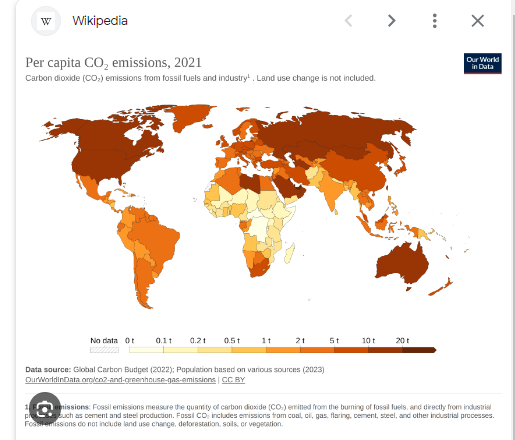
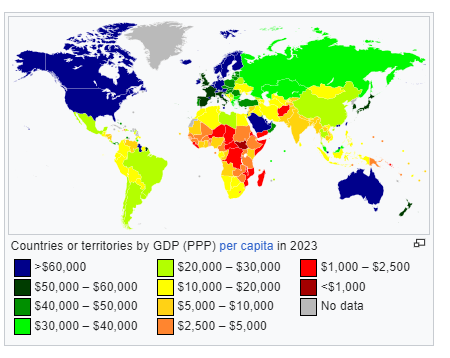
The irony is that those who can afford it least will suffer the most, whilst those who could easily afford to make a contribution (and who contribute most to the problem) will find ways to insulate themselves, at the expense of others of course. In case that is in doubt here is a map of C02 emissions per capita, according to Wikipedia and GDP per capita from the same source the overlap is quite marked! I'm not actually convinced you (or I) will have a choice. (about dictatorship) The right wing is clearly 'on the march' and the conditions are ripe (and getting riper) for it to succeed, just as it did for a while in the 1930s in Germany. The USA stands poised to elect a would-be dictator, several US states have clearly 'gone rogue' and the supreme court in the US is now overtly political. Several European countries are actively toying with right wing extremism, including Germany which has a history that you might think would convince their population otherwise. Our next government may well be left leaning, but its clear that the right wing has taken control of the Tory party. Since, historically, the Tory party has governed the UK most of the time during the last century, we can fairly confidently expect that the right wing of the party, if they continue to hold it, will be back in control in 5, or at most 10, years time. They are already doing quite a good job of dismantling several legal protections and undermining the independence of the judiciary (which, if you study constitutional theory, is one of the three pillars of a functioning democracy); why would anyone think that's going to change? Furthermore they have the ear of the popular media (from which many people get their 'facts', and are trying their best to undermine any significant media outlet that doesn't support the cause Oddly the Chinese might just come to the rescue. Its not in their interest for the current world order to break down, and they have a political structure which can do almost anything within their own country, and a lot outside. They might just exert sufficient influence to keep things relatively sane, albeit they wont care much about democracy. Interestingly COVID showed that, faced with a crisis, democracies will accept extreme curtailment of their lives. In the case of COVID in the UK of course, not until it was too late to avert the worst of the consequences. More bizarrely, we repeated the mistake, see comment above about who is in charge. Notwithstanding the potential pessimistic outlook, I will continue to argue for, and make changes to reduce my personal carbon footprint (in the case of my heating - if my LPA eventually lets me, which at present is looking less not more likely). Not to do so is to surrender, which cedes all control.
-
Actually I would agree we should do this. I think we may also have to prepare for it rapidly getting a lot colder, when the Gulf stream eventually switches off (which they are now saying could be as early as 2025, although that is at the extreme of the estimates). We also need, if we don't succeed in reducing climate change, to prepare for mass immigration on a scale we haven't previously seen, global food shortages (which will affect us badly because we aren't anywhere near self sufficient in food), and quite likely a breakdown in democracy (or a total break down in law and order) and war as governments struggle to deal with it all. Certainly also a massive rise in right wing authoritarianism, which thrives and feeds on division created by hardship, which some politicians ruthlessly exploit for their own gains, relying on the ignorance of the many and their control of (or friends in) certain of the media.. Actually I think we should do both what you suggest and take measures to reduce climate change so that the worst future effects are at least ameliorated. Frankly I don't buy the argument 'we cant afford it', the truth is we choose not to and prioritize instead foreign holidays, vast televisions, swanky cars, holiday homes, space tourism, fancy watches and phones, and many other trappings of capitalism. And we allow billionaires to impoverish millions, whilst making their money out of pandering to these material desires. My personal view is that we cant afford not to do it, because if we don't the cost will eventually be much higher. Had we started 30 years ago (or earlier) when the science was already well known, It would have been a lot less painful than it is now, but we didn't so it isn't. We have only ourselves to blame for that. Of course if none of us care about children or grandchildren, then its a good bet that the best personal strategy is just to do what you say and nothing else, and a fair bet (but a long way from a certainty) that the worst effects will occur after our lifetimes. But if our horizons extend more than about 20-30 years, then I think the science and the way way the world will react to climate stress, says we have to go a lot further. Personally I dont have children, so I could easily adopt the selfish
-
@Roger440 We have heard quite a lot about what you are against, and lets be honest, attacking suggestions made by others without making a counter-suggestion is the easy part of any discussion. However the above comment suggests that you also have views on the harder part of the discussion, ie that you are also for something. Can you enlighten us what it is that we should be doing, in your view, that we are not doing?
-
Be careful with that, the steel will still be consumed and it will therefore have to be produced elsewhere. Hopefully somewhere that uses less polluting technology, but its unlikely at the current time to be pollution free! I don't doubt that UK emissions generally are lower than they would have been as a result of us outsourcing our entire manufacturing to China. Ots easy to ignore what are called 'scope 3' emissions (essentially emissions due to produces/services you consume other than those which directly consume energy), but we shouldn't. Every piece of cr*p we buy (and collectively we buy a lot of cr*p) contributes to these. Im not sure Id describe myself as an optimist, but I guess Id rather spend (most) of the rest of my life living in a not totally unrealistic state of hope, than I would feeling depressed that all was lost, with a small chance I get a kick of positivity towards the end of my life. er - carry on. Why do you think electric cars that can tow caravans are not possible? And since most places you park a caravan have electric hook-ups, the car only needs to do the one way trip. Sure it will, just like projects get delayed... but in most cases ultimately completed er not sure that is actually a target. newbuilds yes - entirely practical, but the timescale for completion (or near completion) for retrofits has not yet been announced so far as I am aware. Can you elaborate what you think we should be doing to 'protect ourselves'.
-
I hope you are wrong, fear you are right, and believe that the outcome will lie somewhere in between. Without a doubt there are many people who can easily afford to change who aren't interested. Equally there are many people who cant afford to change who are interested. Yet somehow governments and individuals are taking action. Its too little, too late, for it to be painless, but that doesn't mean that its too late to have a material effect. If you cast your mind back to the 80s, the ozone hole was going to kill us. It hasn't. Not because the science has changed, because people have changed. In the process some people did die, but nevertheless the expansion of the ozone hole has been stopped, possibly even by now reversed. Humanity is equally capable of dealing with climate change and already has all the engineering/science tools to do so. Along the way some will use the argument that 'its all futile so there is no point in me doing anything'. Others (fewer every year because its now self evidently akin to claiming that the earth is flat) will try to deny that there is a problem. But surely enough will recognise that there is a problem to act if they can (and I accept that many cant without some outside support). Just as they have before. Every single person who tries to argue that doing nothing is acceptable, when its obvious that something needs to be done, is acting either without any shred of conscience, out of ignorance, or because they have been fed lies by those who have self interest at heart and are not discerning enough to separate the lies from the truth. However these things snowball, and the actions and words of every one of us makes a difference to what our friend group think and ultimately how politicians act. So we all have a duty to act in some way.+ I am genuinely sorry that you feel that the situation is hopeless and that you cannot do anything to help; its difficult to imagine a a more depressing way to live ones life. Blissful ignorance is one thing, but it appears you recognise the dangers yet feel powerless to do anything. it would be seriously depressing to be in that situation.
-
On basis do you make that statement? Its not what the climate scientists say. Without a doubt some climate change is inevitable (in fact some has already happened and some more is baked in). That does not mean that we cant still affect the future severity by taking concerted action now.
