Barnboy
-
Posts
181 -
Joined
-
Last visited
Everything posted by Barnboy
-
I take it that hasn't fallen off then @Russell Griffiths? My reveals are about 500/600mm deep so a few screws to give me piece of mind and hold them in place whilst the foam goes off.
-
I've looked for 6mm plasterboard and can only find Gyproc glassroc, which would be ok, but I'd like a tough of insulation from the jackoboard to try and reduce any risk of thermal bridging. I'm just trialling a piece onto some ply to see how it holds with some adhesive foam and a couple of plain screws. When I tried the proper washers the screws started to spin in the ply before pulling the washer dome head in flat.
-
Evening all. I have some marine ply boxes that I've made to frame out my internal window reveals. I don’t have too much depth to play with so am looking at lining the ply with 6mm Jackoboard as a base for plaster. I've searched about and am planning on using a thin layer of tile adhesive and some screws with proper washers to fix the Jackoboard to the ply. In my searching I haven't been able to come up with an answer to whether or not I need ro prime the ply for the adhesive or not, and if so with what exactly and also which adhesive is best to use. Has anyone gone down this route with success that can guid eme please ? Thanks
-
That's how I was planning on laying it out, but thought I'd check as with the staff accommodation only being occupied for 6 months of the year, which is the long straight run towards the treatment plant, I wasn't sure if this would be overuled by our 3 bed that we'll be in all year round.
-
I'm laying the drainage from my barn conversion to my treatment plant. I have to take the sewage from the outlaws farm staff accommodation next door and put with my own sewage through my treatment plant to be able to then send it all into the existing soakaway. The barn is a 3 bed with just the 2 of us living in it at the moment, the staff accommodation consists of 4x twin ensuite rooms which are only occupied for maybe 6 months of the year. My question is, when laying out my inspection chamber before the treatment plant, which run do I class as the main run, barn or staff accommodation? Thanks
-
I hadn't thought about the 1800, 600+1200, 1200+600 sequence, I was just thinking as few joints as possible and horizontally as jayc89 says, to tie my 400c vertical counter battens together a bit more. If I stood and worked each room out then I don't think that it would be too much work to put in extra supports in the right places for the 600/1200 butt joints.
-
As it's into the pitched ceiling, I thought that I could set the laser level up to find how far out the level is and then run from the lowest point of the pitch, router out the coj ter battens to run a piece of ply as a noggin, fix a batten as a base to pack from.amd start with the top board.
-
I'm just counter battening my walls ready for boarding and skimming and wondered if there's any reason that I can't board the walls horizontally. My 1st floor walls are only 1.8mtrs to the eaves so it would save alot of wastage as I'd be using 1½ boards in height as opposed to loosing 600 from the end of a board. I've searched and see that the Americans go horizontally whilst we seem to go vertically . Also from another post recently am I right that my external corners should be made with the tapered edge of the board rather than a cut edge ? Thanks in advance for any help.
-
I was told by my insurers earlier this year that this was my final policy extension. After 4 years of upfront payments and no claims. This was the only company that would cover the Channel Islands so if I'm not done by the time this extension ends then I'm a little in the perverbial .
-
Thank you, My dad is old school and wanting me to leave a plasterboard nail sized gap, I'll make sure it's all tight.
-
I've tried searching about but can't find an answer to my question. Do I leave any gap between the ceiling and wall plasterboard for skimming ? From all I can find the wall and ceiling boarding should be lightly butted with no significan gap, but I can't find an answer to the corner joint between the ceiling and walls, or even the internal wall corners. Can someone in the know, let me know please ?
-
So if I've got a narrower pupe spacing then I'll have a better output ? What about the difference between the Variotherm gypsum panel and Continal insulative composite ? Am.i thing along the right lines that the Continal will reflect the heat more than the Vaiotherm which will act more like an inscreed and heat itself up, dissipating it more evenly ? I've got 90mm of kingspan, and 50mm of Newton fibran below my screed and it looks like I'll have 20mm of Jackon board or similar below the ufh, as the external door manufacturer gave me the wrong dimensions for my sills, so I need to bring the internal levels up.
-
UFH1 Supply the Variotherm in the UK, they've been very helpful, and the only company that I've contacted who haven't then called me every week to "see how I'm doing and if I'm ready to order". I have also been looking at Contnal lately, as I'm on a 2 steps forward, 10 steps backwards project so I'm not a stage to order anything yet. Continal didn't seem that much different in price, I think that they were about £400 more than the Variotherm, which the other quotes that I've had have been about that one way or the other. Please let me know your thoughts on either as it may help.me decide when I eventually get there. Re the W/m², I haven't had the time to sit down and look at how these figures work into everything. My simple thought was that the higher the number, the higher the output. Yes maybe by putting the pipes closer, or running a higher temp, but does this not correspond in simples term to, the higher the output, the quicker that you get heat ? I've got the same insulation levels whichever system I use, apart from any difference in the panels themselves, so surely the same heat loss too. Please explain in simple terms, my brain is fried at the moment.
-
Morning all, I have 2 bathrooms to to plasterboard the ceilings for skimming and put up tile backer on the walls for the tiling. My 1st floor bathroom is slightly in the roof space so the walls are about 1.9mtr vertical section which then go into a 45⁰ undert the rafters My question on this room is, after boarding the flat ceiling, do I fit the plasterboard to the underside of the pitch 1st or the tile backer to the low walls or doesn't it matter to for getting the best finish between plaster and tiles ? My second bathroom is a std square ground floor room, here do I wait until the ceiling is skimmed before fitting th backer board or fit it all at the same time? Thanks
-
I'm down to the choice of 2, Variotherm Gypsum panel at 100mm pipe spacing or Continal tile fix, composite panels at 150mm centres. Can anyone give me an independent view of the benefits or disadvantages of either please as I can't decide on which is best.
-
I like this idea, and if I wouldn't be so far into things I'd have done this, but as it is the windows have been in for a while and it would be major reworking of everything around them to be able to do this. They can't come further in as any further in and the clay/straw filled cavity of the wall would be open and also our heritage people wouldn't have been happy as the appearance of the building would have changed.
-
This is the layering I'm planning on, the problem I have is on how to secure the plasterboard .
-
I'd thought about trying foam, but have never used it before. I've got to get the breather membrane, Insulation and vcl in behind the plasterboard or whatever I use. I'm not sure that foam will bond to the membranes, or if it does will it stay held or will each layer gradually fall away from the next?
-
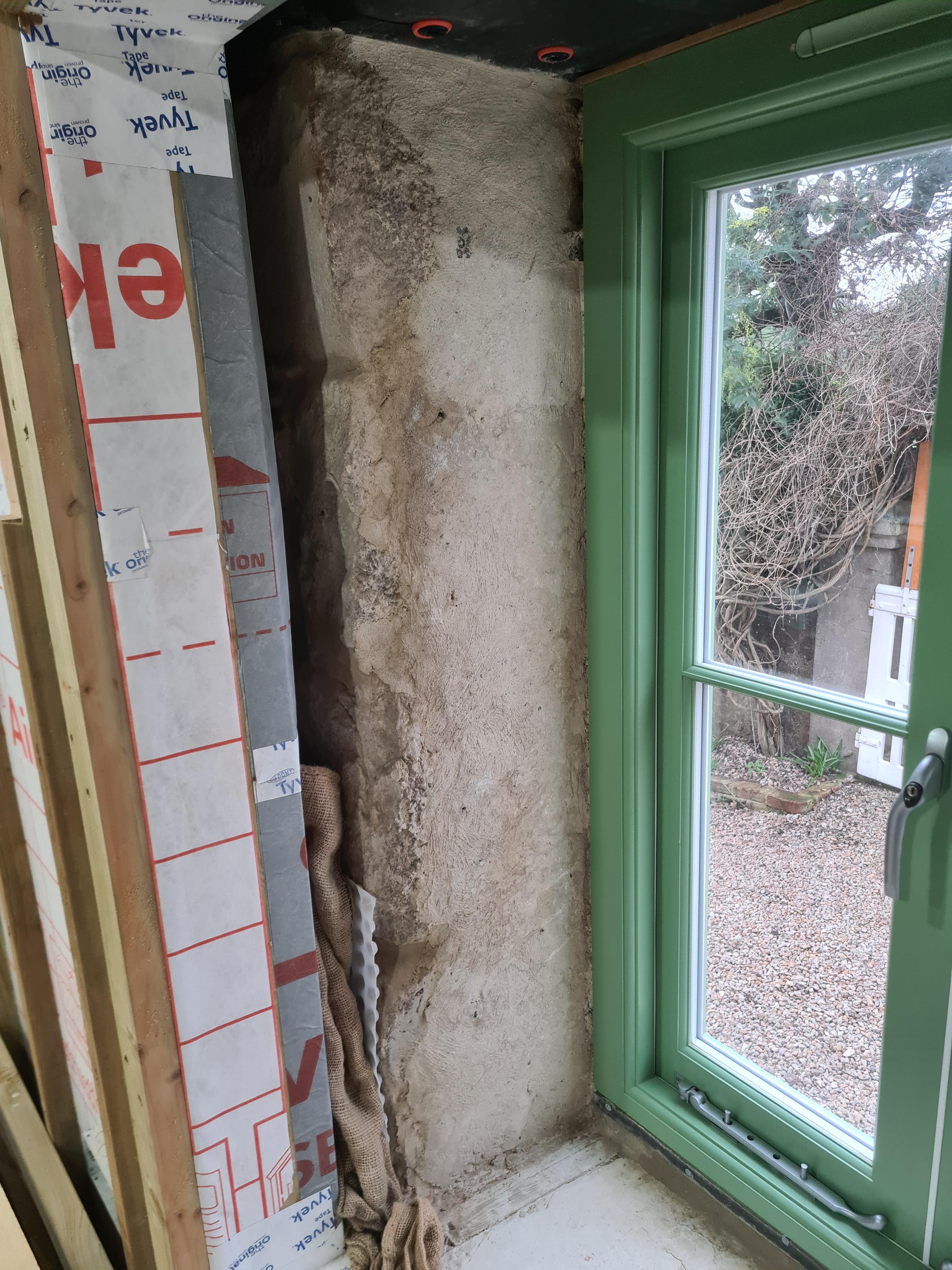
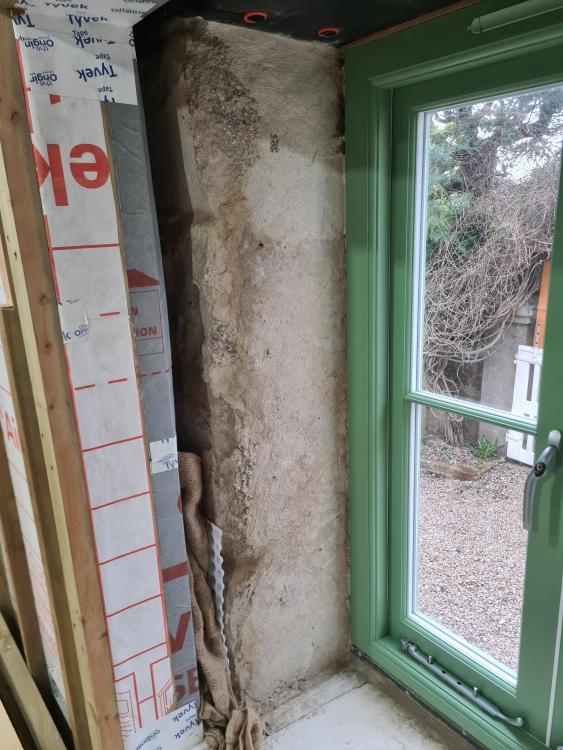
My barn conversion is basically a timber frame inside of a thick stone wall. I'm now looking at how I'm going to finish my plasterboard and insulation back to the windows. I decided and purchased a long time ago some Spacetherm blanket to insulate the reveals with but can't come up with any solutions that I'm happy with for fixing everything in place nicely. Most of the reveals are splayed to some degree which isn't helping. I originally thought of screwing a small angle to the edge of the frame to fix the outer edge of the plasterboard to and then nothing else until it met the timber frame, but the gap is a minimum of 400mm and I'm not sure the angle on the window would be that strong as the back of the plasterboard would only sit around 12mm into the frame, not giving much for screwing the angle into the frame with. The original stone reveals were very uneven so with the original idea, I decided to lime plaster these to build them up to an even surface but this doesn't really give me anything solid to fix into either. My other thought is to build an 18mm marine ply box, maybe pocket screwing the corners and trying to slide this in ontop of the breather membrane and insulation before wrapping the vcl over the front of it and fixing the plasterboard into the ply. I'm not sure how well this idea would work, especially as I've got the reveals to do on 2 doors which are about 2.2mtrs tall and another glazed door surround that goes up into the 1st floor, so is around 2.8mtrs tall. Has anyone any solution or ideas please ?
-
So 50⁰ is a bit hot, that's obviously how they get their specs up to give a high w/m². So if that was ignored and ran at a more reasonable temp, closer to other systems and maybe then giving out a lower but more realistic w/m² would you say the Gypsum panels have any advantage over the eps systems ? Would they act any more like an in screed system, slightly absorbing the heat and holding it longer rather than reflecting it all up to the surface ? I've got about 40/45mm of build up before tiling as my door manufacturer gave me the wrong dimensions for thresholds, so self levelling etc as required for the Variotherm system isn't an issue, apart from the extra cost 😥
-
Has anyone any experience or comments on the Variotherm Varicomp ufh system ? I've priced up a couple of different systems, Nuheat, Wunda, Robbens, Minitec and Variotherm. The Variotherm uses a Gypsum panel with 100mm centres and claims to give out 155w/m² @ 50⁰C flow temp which is the highest I've seen but is it true in real life and worth the extra cost ? My house faces east, west with 2 big glass doors facing east so I'm looking for a decent retrofit system that can be off when the sun's coming up 1st thing but then keep the place warm later in the day.
-
What does a good quality spread, spread for each of the following surfaces in an hour or day then ? I've got ceilings, pitch and walls
-
I wrapped the housewrap around the top and bottoms of the stud so it was protecting the timber and then let the internal vcl do the rest with bitumen tape to the block at the bottom. The housewrap doesn't need to be airtight just the internal vcl.
-
My sole plate isn't sealed down, the internal airtight membrane is sealed to the block with a tyvek bitumen double sided tape, creating the base of the airtight envelope.
-
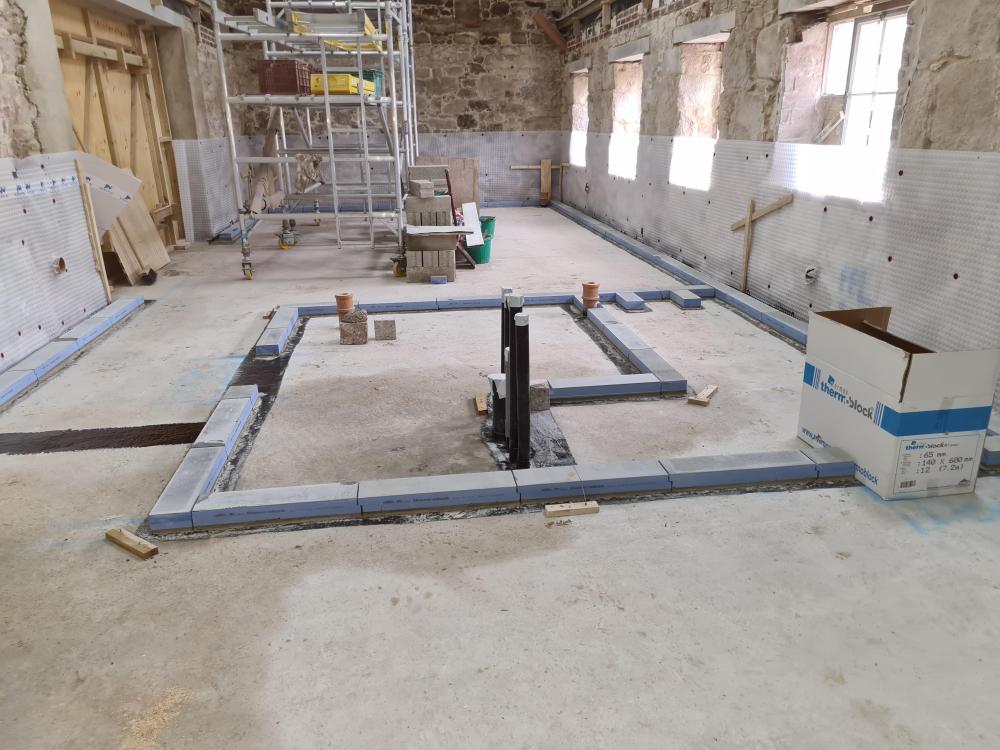
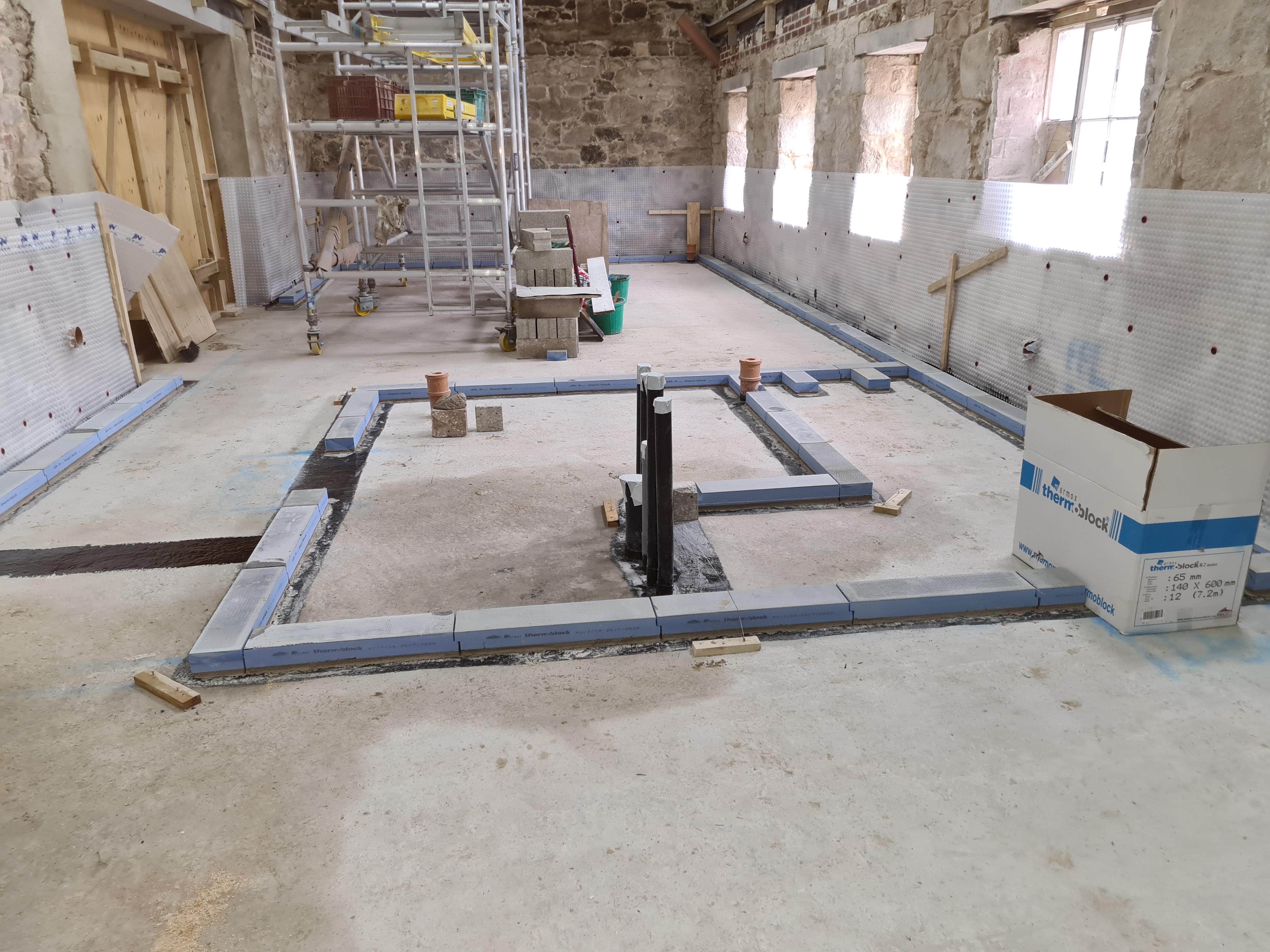
My outer membrane is "tyvek housewrap" brerher membrane It's there more to keep the wool from flopping out of the counter battens if the staples decided to give up. I can't find a picture of my finished dwarfs but the same principle except the bco wanted some kind of a thermal break to the slab. He's favourite subject is thermal bridging, u-values and condensation risk analysis. Every aspect has had to have manufacturers supply u-value calculation and condensation analysis, right down to each window reveal !