


MJNewton
-
Posts
1354 -
Joined
-
Last visited
-
Days Won
1
Everything posted by MJNewton
-

Intumescent paint for protecting beams
MJNewton replied to MJNewton's topic in RSJs, Lintels & Steelwork
Ah okay! Not got one of them; sounds fun though. -
Intumescent paint for protecting beams
MJNewton replied to MJNewton's topic in RSJs, Lintels & Steelwork
Shot fire? Overboarding is a challenge in this house as the ceilings are suspending on resilient bars (for noise reduction) and finding them with screws without finding the joists can be tricky! -
Intumescent paint for protecting beams
MJNewton replied to MJNewton's topic in RSJs, Lintels & Steelwork
I'm not overly worried; as Nick said if there's a beam-twisting fire going on I'll be out of there in a flash and chances are it's a complete rebuild anyway from that point. -
Intumescent paint for protecting beams
MJNewton replied to MJNewton's topic in RSJs, Lintels & Steelwork
The beams are recessed and contained entirely within the ceiling void. It was this from the Application Instructions that made me think otherwise: -
Intumescent paint for protecting beams
MJNewton replied to MJNewton's topic in RSJs, Lintels & Steelwork
It's already primered so I think it can go straight on. It's not really a cost issue; more what was going to be easiest in this particular situation. -
Intumescent paint for protecting beams
MJNewton replied to MJNewton's topic in RSJs, Lintels & Steelwork
If 4.2m is my length I've got roughly 0.7m width of exposed surfaces so that's ~3m². A litre of Envirograf EP/FS/INT should cover 10m². All said and done though I think I'm leaning more towards the boarding now if I can get it sorted without too much of a headache. It feels a bit more predictable in its performance, as is often the case with more conventional methods. -
Intumescent paint for protecting beams
MJNewton replied to MJNewton's topic in RSJs, Lintels & Steelwork
For the amount I'd need it'd only be £20. -
Intumescent paint for protecting beams
MJNewton replied to MJNewton's topic in RSJs, Lintels & Steelwork
I'll see what I can do. Thanks everyone for the ideas. -
Intumescent paint for protecting beams
MJNewton replied to MJNewton's topic in RSJs, Lintels & Steelwork
It does make sense; is it held securely? I think I need to get up close and personal with the beams when I get a chance and see what possibilities there might be. -
Intumescent paint for protecting beams
MJNewton replied to MJNewton's topic in RSJs, Lintels & Steelwork
It's how I attach the fireline that could be the challenge as I am assuming it cannot be stuck in place with adhesive? -
My single-storey extension has got a pair of steel beams over the knockthrough but they are recessed to facilitate a level ceiling throughout. I am now pondering what the best way to fireproof them is. My options identified so far are 1) two layers of plasterboard (can one of these be the ceiling itself?), 2) one layer of fireboard, or 3) intumescent paint. I am leaning towards the latter as there is limited clearance and space for affixing suitable noggins and the boards themselves. Does anyone have any comments/recommendations regarding the paint? I am assuming given the red oxide primer it should be just a case of applying it to all exposed surfaces and that's that?
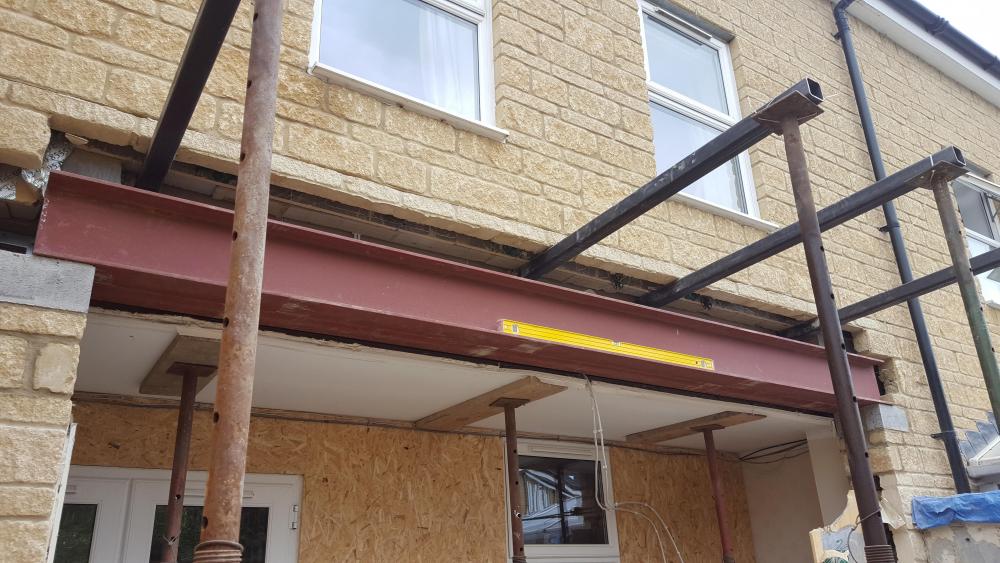
-
It is self-levelling and so I imagine it could be difficult to build up additional layers to create a fall. Besides which, we are upto ~20mm short and so it could cost several thousand to build it up that much... it certainly wouldn't ever leak though! ? There was a bit of a development today; the builder phoned to say he'd spoken to the manufacturer and they said their product can be used even at zero falls and would provide a written guarantee (materials only) to that effect. I got the impression that he's now thinking that whilst he might not have got the normal fall right he's not actually ended up doing any wrong. He gave me their number and they confirmed the same thing, although they did concede that they don't have a BBA certificate that explicitly says this. The BCO is visiting tomorrow and so I will see what he thinks of that - surely BBA certs are important to demonstrate compliance with the regs and if that says a fall of 1:80 (recommended 1:40; it basically seems to be a copy and paste of BS6229) is assumed then surely it's not valid at anything less? I also raised with the manufacturer that there were some runs and what looks like pinholes/bubbling in some areas... The roofer had previously said they were of no concern but the manufacturer didn't brush these off at all; indeed they have asked for photographs as they said this could be a sign of poor installation... When the weather gives me half a chance I'll be taking some and sending them over. Next step BCO (tomorrow) and, somewhat unusual I imagine, I hope they are going to be strict about what is acceptable here!
-
I'm leaning that way (perhaps not the ice cream though, I don't want to be seen to be taking advantage of the situation ?). A restrip and rebuild does at least put me back in the same situation as if nothing had happened, assuming of course that the builder's concerns about damage don't come true. I'm not quite sure what the issue is, perhaps it was a concern over the time it would take to do it carefully but I'm more than happy to get up there with a magnet and find the fixing screws and then remove the liquid membrane myself in those areas ready for unscrewing. Perhaps that's when I'll discover how good this Desmopol is when I fail to strip any of it off!! Perhaps the BCO might say it is the most sensible option (for me) and everything else is a compromise even if they are content with them from a compliance perspective.
-
Yes, refreshing isn't it. It might be easier if I had something to push against though then I would insist on it just all being redone and be done with it! Option 3 does have a whiff of bodge about it, and is the sort of thing that might be expected to be done when reroofing a previously-failed roof. Not really something one would expect of a two-week old example.
-
Good point. I've been so focused on finding the best practical solution (for me) I have forgotten to consider what BC might be happy with. I did ask the builder what he thought and he reckoned BC would likely not be concerned as their focus is mainly driven by aspects of legislative interest e.g. safety, conservation of energy etc. I didn't feel he was wriggling out of anything, just expressing his opinion. I do know there's nothing in the regs about roof falls and all my informal chat with BC (not my BCO as he's on holiday) reveaaled was that there is a general requirement for good workmanship which in turn tends to require compliance with recognised standards. The thing is, BS6229 'Flat Roofs with Continuously Supported Coverings' seems to actually be a 'Code of Practice' which might mean it's not quite so black and white. Upstand and flashing details might however be. I will pin my BCO down and see what he has to say on the matter, whether that is from a formal regs perspective or informal advice, so thanks for the prompt.
-
The builder visited today… He was actually very good about the situation and quickly held his hands up once he’d checked and measured the firring strips himself. Whilst the finished roof does drain, and in his opinion wouldn’t prematurely leak, he acknowledged that its fall was below-spec it was my prerogative to be concerned and to expect a remedy. To this end we came up with a few options; the choice of which is entirely mine and he will pick up the bill: Leave As-Is – He would give me a guarantee in writing that should the roof fail in the next x years (to be agreed) he would repair/replace and make good any consequential damage. To give me greater confidence he could also get the roofer to add another layer of the liquid membrane to the existing. He would also refund the initial £1000 roofer cost. Remove and Rebuild – Rip up the entire roof deck (membrane and trims, top boards, insulation, bottom boards and firring strips) and replace (likely with bought firring strips this time – he had no idea they were available off-the-shelf hence why he always cut his own, normally without making a mistake with the measurements!) Overboard and Recoat – Keep the old roof in place (bar the trims), add a new layer of OSB3 on top of suitable firring strips to give the correct fall and put a new waterproof coating on top. I am not comfortable with option 1 as whilst I trust his word regarding the guarantee (we live in a small town, him and his son just down the road from me; there’s nowhere to hide!) my preference here is to avoid a leak in the first place rather than deal with one if/when it happens. I’d also like to draw a line under the situation rather than leave things hanging over me/us. Option 2 was my initial preference as this gets me back to the position I was in before the mistake happened and therefore not be considered a ‘bodge’ in any way. However, his initial thoughts were that it could cause more problems than it solves. We didn’t get into too much detail about it but his concerns were about the destruction required as with all the fixings now hidden there’d likely be a lot of ‘coercion’ of materials and could lead to damaging other components. Might be worth pushing further though, particularly as I'd be more than happy to help with the removal side. Option 3 sounds like a viable option as not only does it give me the opportunity for a new waterproof coating (I am leaning more towards a single-sheet EPDM membrane rather than another liquid coating - ever since it went on my confidence in it has not been the greatest as it is far from conventional and so seemingly not much information about it) but the extra board/membrane layer may also provide an additional noise and solar barrier? I certainly wouldn’t ever expect a leak through two surfaces either, at least not down into the living space! I am wondering about potential downsides though... It would add ~50mm to the roof height at the rear wall abutment which would eat into the 150mm lead flashing and the roof lantern upstand would require extra timber on top to increase its standoff height. Could there be a risk of interstitial condensation with this extra layer or would it be okay given it is on the cold side of the insulation? Should the gaps between the firring strips be filled with anything? (Note the strips will likely be 40mm to zero over a 3m span so not much volume there). As before I would be grateful for your thoughts. The builder is being completely open and supportive of the situation and keen to make sure I am happy with the outcome – I just need to work out what the best outcome should be!
-
Addendum: Re-reading some of the suggestions I may have misunderstood on my first pass. Will give them some further thought - thanks.
-
There might be alternative fixes but I think they'll all be trading labour for materials and vice versa and so simplest (ie. a straightforward rework) might just be the best. An additional covering of ply and a new membrane might work but it might look a bit of a bodge as a conventional re-roof probably wouldn't even take that approach preferring instead to remove the existing covering. I did wonder about raising the joists and packing underneath but they are notched to fit in a steel beam so likely aren't going anywhere, and I wouldn't trust a membraned roof that had been lifted even as one so it'd need to be replaced either way. It'd also need the upstands removing and so would need a new covering anyway, and the lantern upstand may also need modifying to remain remain true to its original orientation. All food for thought though and I imagine the builder and I will kick the ball around a bit before deciding what best to do.
-
It is a shame, and I feel bad both for the situation and the potential losses for the builder (which I may offer to offset slightly). My assumption at present is that it was a simple mistake; I'd be much more comfortable if it was a result of cutting corners but that's just not his style.
-
Yes, and even fairly steep car panels can hold onto water somewhat. I have decided that whilst the risk of my roof failing might be low the consequences of it doing so are potentially significant. I think it therefore reasonable to want to minimise the risk of this happening and so accepting something that doesn't meet the recognised standard is not an option. Hopefully the builder will reach the same conclusion...
-
A bit of an update: I spoke to Building Control this morning and whilst my inspector is away in holiday one of his colleagues listened to what I had to say. Based on that, and that alone, his view was that the fall was indeed unsatisfactory and could well be considered a violation of the regs. He confirmed there was nothing explicitly stated about falls in them but there is something of a catchall 'quality and workmanship' requirement which generally requires, amongst other things, compliance with relevant standards where appropriate to demonstrate compliance. Hence, the British Standard would be relevant here, not least given how accepted its fall figures are in the industry. He did also say they'd need to see it really as there may well be a good reason why it is the way it is, and if there is then they would always try and take a pragmatic approach towards consideration of accepting it as they don't like to insist on re-work if not absolutely essential. He did echo my concerns though about the fact that the roof lantern is yet to be installed and so any test/acceptance of falls at the moment could be premature if they are borderline. I then spoke to the builder who was, thankfully, very considerate of my concerns. He immediately said he wondered if he might've made a mistake in the calculations but obviously couldn't really comment further without first coming to see what's what. He's away on holiday so next week we are going to meet up. The builder confirmed that the furring strips weren't off-the-shelf and so this in my view might explain how the mistake might've occurred as I'm sure we have all performed a calculation for where/what to cut but then realised once you'd built the damn thing you'd made an error (or indeed not realised until someone else points it out!). So we are on pause until next week but so far so good. As things stand I see no alternative but to strip and re-build as I can't see myself accepting the current construction and it sounds like BC might not either. It is unfortunate but mistakes do happen and I am currently content to consider it as just that.
- 59 replies
-
- 1
-

-
- flat roof fall
- firring
- (and 2 more)
-
Thank you everyone for the input; I knew you'd sympathise with the anxiety side of the issue but also offer impartial advice! In answer to the questions raised: The membrane that's been used is Desmopol PU (an alternative source of similar information also available here). One thing I have noted is that the BBA certificate assumes (in paras 4.5-4.6) a minimum fall of 1:80 (almost twice what I've got). Regarding actual run-off it definitely does drain away from the house but some water is left behind. I don't know whether that's just surface tension that would affect all 'flat' roofs though. Here are some photos from this morning, but I must add the caveat that it is difficult to say how faithful a reproduction they are as some aspects look worse in real life and some better: The sheet is covering a 2.5m x 1.5m opening for the roof lantern. This is expected to weight upto 250kg and so whilst the joists are 170mm x 50mm C24, with headers and trimmers tripled up and bolted together, I may well be expecting some deflection - perhaps over the long(er) term. With a 20mm overall end-to-end fall I am assuming the midspan-to-end is therefore roughly 10mm and I can't help but feel that this doesn't give me much headroom before my flat roof really does become flat. I am feel awful not only about the risk aspect of the situation but also the consequences on the builder having to redo to the point where I am considering offering to contribute to offset at least some of their losses (e.g towards the materials that cannot be reused). Just to add to my concerns the membrane installer was a sub-contractor (to the builder) and so they are something of an innocent victim in all of this.
-
We have just had the shell of an extension built which includes a flat roof. Firring strips have been used to produce a fall for rainwater runoff however this fall is around 20mm over the 3000mm span i.e. 1:150. Everything I am reading (including BS 6229) states that flat roofs should have a minimum fall of 1:80 (i.e. 37.5mm in my case) and really ought to be designed for 1:40 (75mm) to allow for inaccuracies in construction, settlement of materials etc. Unfortunately I have only just spotted that our roof is only 1:150 and yet the roof (a warm roof construction consisting of joists topped with firring strips, OSB sheets, vapour barrier, 125mm solid board insulation, ply and a polyurethane liquid membrane top coating) and all associated cavity trays and flashing etc is all now in place. Bar the roof lantern the roof is complete.Now I'm fretting about possible issues in the future. Am I right to be worried? Should I be seeking this being altered (i.e. deconstructing to joist level to allow steeper firring strips and then rebuilding from there)? I was going to speak to Building Control tomorrow to say what they say but whilst they might agree that the fall is low I can't see anything in the regs that mandates a particular fall and I don't know whether BS6229 is mandatory either (it seems more of a code of practice). For what it's worth I must admit to having a tendency to worry - to the point of anxiety - about detail like this. I also feel really quite sick about the situation as I don't like confrontation and do like the builders; see them most days locally, am friends with a mutual friend of the builder's son etc and so really want to avoid a falling out if at all possible. I also really respect their workmanship. I have previously already make them put a fair bit of effort in to move an airbrick and so they know I'm a one for detail and worry over what someone else might consider to be nothing; they may well see this to be just another case of that but I can't help but feel I should be addressing this now rather than regret doing so in a few year's time once the roof fails due to a fall-related issue. Grateful for your thoughts/advice. P.S. I hope it doesn't come to this but the contract states that should we end up in dispute we agree to jointly fund an independent surveyor and be bound by his view/recommendation. I have yet to pay for completion (the final invoice only arrived today).
-
MVHR with extract only mode
MJNewton replied to MikeGrahamT21's topic in Mechanical Ventilation with Heat Recovery (MVHR)
Have you considered just using an inline extractor fan for this test? It ought to give the same result (I'd say you only need to emulate the supply side) but would do so without the commitment of a full MVHR unit. -
MVHR with extract only mode
MJNewton replied to MikeGrahamT21's topic in Mechanical Ventilation with Heat Recovery (MVHR)
Is the extract-only mode desired because of the potential smoke issue? If so, are you sure it'll work as expected? For any air to be extracted there obviously has to be an equivalent amount of air sucked in hence won't the smoke outside still be a problem? I suppose there will be a difference between air coming in via gaps in the building fabric versus all from a single inlet but whether that will help I am not so sure!
