


jayc89
-
Posts
1389 -
Joined
-
Last visited
-
Days Won
1
Everything posted by jayc89
-
Calculating ducting size
jayc89 replied to jayc89's topic in Mechanical Ventilation with Heat Recovery (MVHR)
Urgh, it's been a long day - that would make more sense I'll tackle crunching the flow velocity numbers tomorrow, I already have brain ache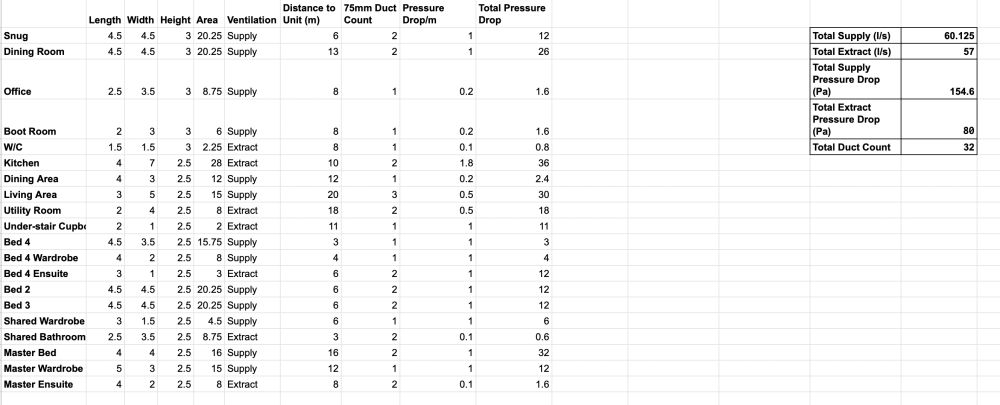
-
Calculating ducting size
jayc89 replied to jayc89's topic in Mechanical Ventilation with Heat Recovery (MVHR)
My last post includes some of the workings out. It doesn't include Supply/Extract ducting to/from the MVHR, just the ducts to/from the rooms. How should parallel runs be accurately accounted for? -
Calculating ducting size
jayc89 replied to jayc89's topic in Mechanical Ventilation with Heat Recovery (MVHR)
Assuming my calcs are correct, that would mean I need 32x duct runs, resulting in a total pressure drop across the system of 234 Pa, which I thought was too high?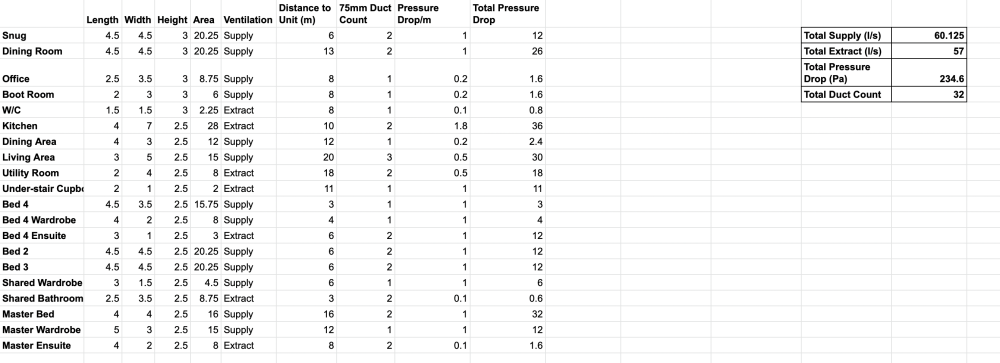
-
Calculating ducting size
jayc89 replied to jayc89's topic in Mechanical Ventilation with Heat Recovery (MVHR)
What would you consider to be the longest run length before you need to start thinking about doubling up? -
Calculating ducting size
jayc89 replied to jayc89's topic in Mechanical Ventilation with Heat Recovery (MVHR)
What was the max run distance? Because mine's a retrofit, my max run is approx. 20m. In terms of pressure drop, the worst looks to be the master bedroom run. 40m3 volume and a run of approx. 16m. -
Calculating ducting size
jayc89 replied to jayc89's topic in Mechanical Ventilation with Heat Recovery (MVHR)
Using 90mm (OD) ducting gives me a total pressure drop of 133 Pa which I assume is too high, meaning some need to be larger ducts. Is there a target max pressure drop per run? -
Given a list of room volumes and distances back to the MVHR unit location, is there a calculation I can use to determine the optimum duct sizing? I'd prefer to use 75mm everywhere, but given the size and distance away from the unit some rooms are, I'm not sure they will be suitable.
-
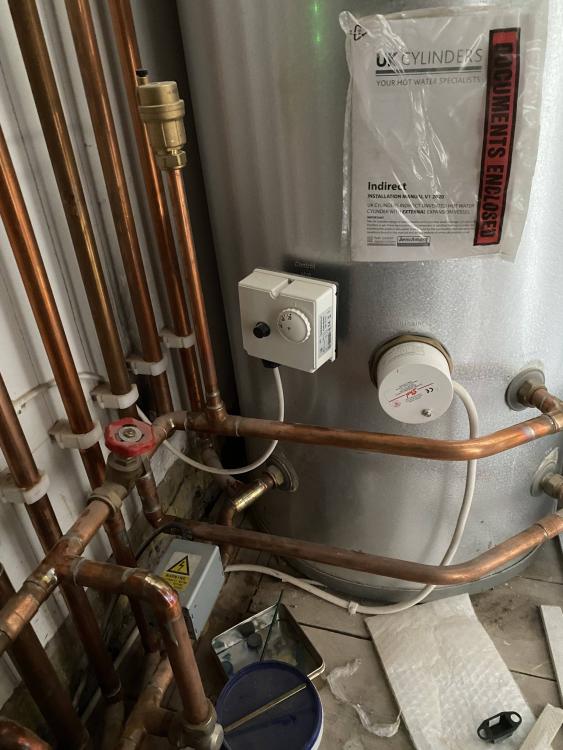
Pretty sure it's the return, not sure why the gate is there though. The 2 port valve is on the flow and you can just see the nut of the auto-bypass valve, towards the bottom of the picture, between the two.
-
Great stuff, thanks for the help, @Nickfromwales! We do have an AAV in the airing cupboard upstairs, I think it's on the return from the DWH coil.
-
An AAV on both the flow and return? I'd seen sets sold where there's an AAV on the flow and pressure gauge on the return.
-
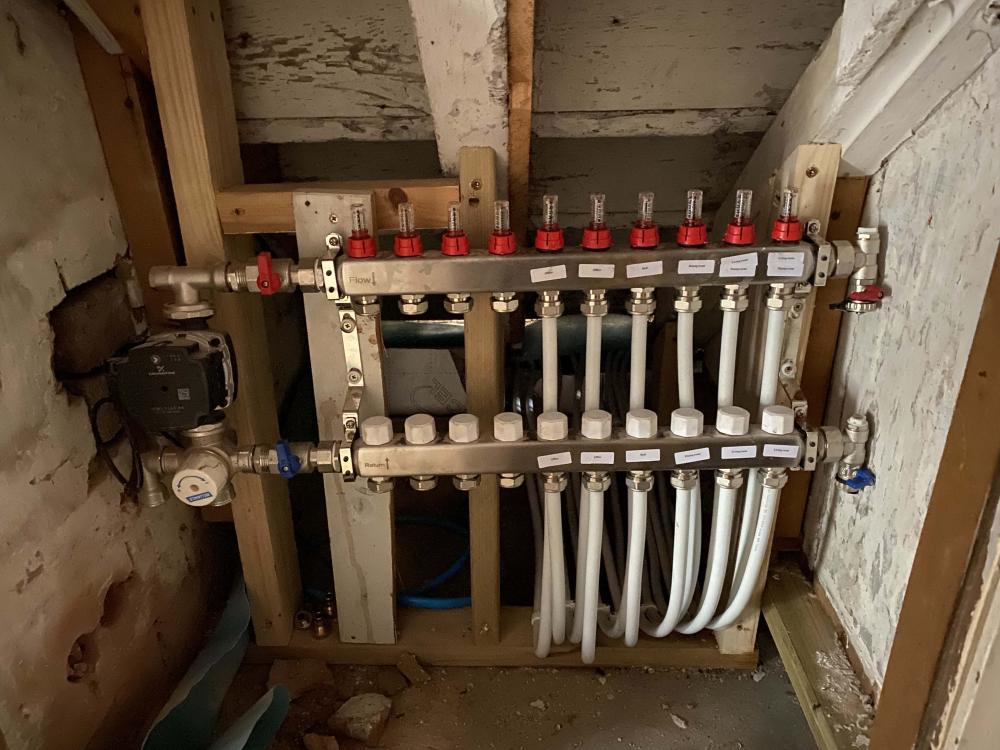
Here's a considerably cleaner shot I've just found on my phone
-
Pub sounds good right now.
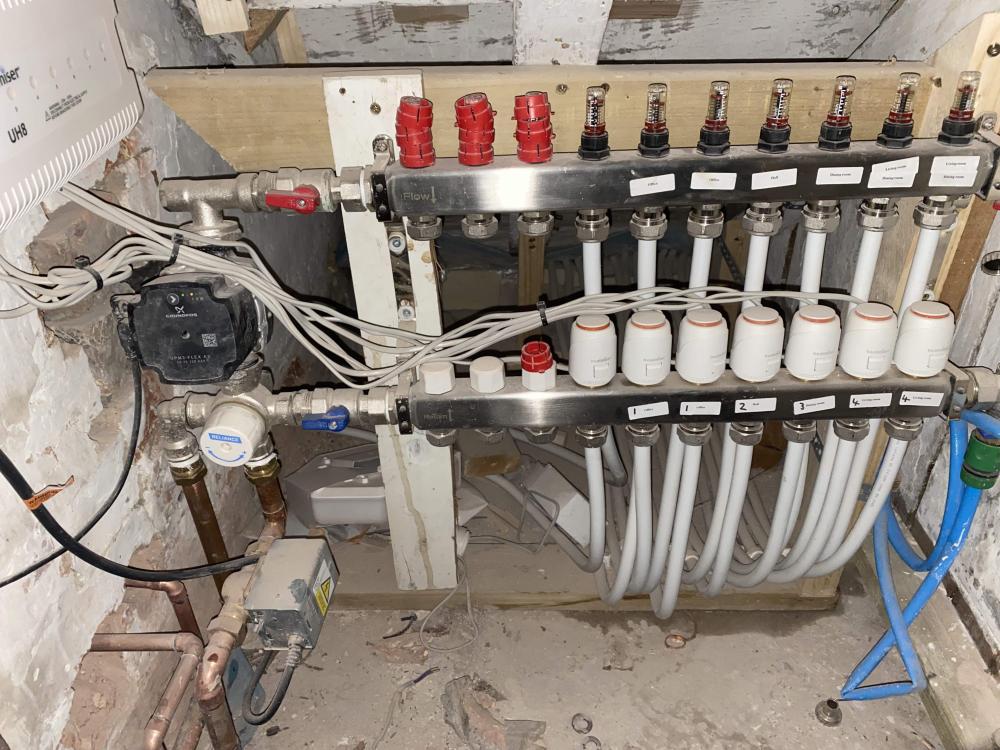
-
My first foray into screeding was a 9m2 room. 60mm deep. Ended up mixing the screed myself as ordering in such a small quantity was cost prohibitive, mixing it was an art in itself, needs to be dry-ish (snowball test) but too dry and it sets crumbly. It's DIYable but not something I fancy doing again in a hurry. Cider went down surprisingly well that night...
-
Unfortunately not. It was a PITA the last time I had to do that. There's no drain near the manifold so I ended up running a hose pipe through the house, which SWMBO loved. Is the boiler fill loop still the best place to top up the inhibitor afterwards?
-
Plumber that moved the boiler reckons it could be air trapped in the pump and is coming back out to take a look.
-
I spec'd mine myself; 70m2, 150mm centres, Heatmiser UH8 Wiring Centre, 4x NeoStats v2, Grundfos pump + ancillaries (actuators, staples, eurocone's etc) £1200 from Underfloor Heating Direct. If I was to do it again, I wouldn't have so many zones and therefore stats, and I'd probably go with Salus Auto Balancing Actuators to better compliment the variable flow temp caused by the boiler's weather comp.
-
Should/could the service void span multiple floors - I'm thinking so new cables could be dropped from the loft space to the ground floor without disturbing the first floor room? I assume doing so would increase the risk of noise travelling between ground and first floor rooms?
-
Mobile Phone Reception issue?
jayc89 replied to ashthekid's topic in Networks, AV, Security & Automation
I read this on an old buildings forum being touted as another reason not to use PIR and didn't think much of it. Seems like it's a growing problem given the majority of mass built housing is insulated with PIR? Perhaps it's less of a problem given the (lack of) care given to installing insulation by these mass builders - I bet the signal can still get through all the gaps in the cavity -
AFAIK, wood fibre covered with lime plaster doesn't need a VCL as the wood fibre itself is hygroscopic. Of course you need to consider the finer details, around junctions etc. Surely heat can only reduce the risk of condensation and indeed damp showing on the external face, if that heat is allowed to pass through the wall, negating the purpose of insulation? Damp walls are generally a symptom of a problem, the root cause needs addressing (reducing ground levels, fixing gutters, removing that external paint (assuming it's non-permeable)) etc.
-
The plaster around the lathes was around 25mm thick, it was rock solid and so no signs of water damage. I have no idea how long it's been up for, but it took some budging. They don't make 'em like the used to!
-
Put this weekend aside to make a start on insulating and making the house wind/airtight. Started by cutting back some of the ceiling to access the joist ends to seal around them (in lime) and discovered the ceiling was wet. Bath in the bathroom directly above has a leak Luckily the bath just needed resealing but that was a task I wasn't expecting to do today. It's probably quite a good (?) advert for lime plaster. The lathe was sopping wet but you couldn't tell at all from looking up at the ceiling, I suspect it would have probably dried out quite well on its own. Whereas I suspect gypsum would have stained within a couple of days of the leak.
-
No vibration on the pump at all. Slight vibration on the 2 port valve. It does, attached pic. The noise gets worse as I increase the pump speed, but it doesn't appear to be noise coming from the pump itself... I'm wondering if we've just not noticed this before because previously the pipework was HEP and ran below the block/beam floor rather than through a room. Both switching to copper and routing internally has made this worse?
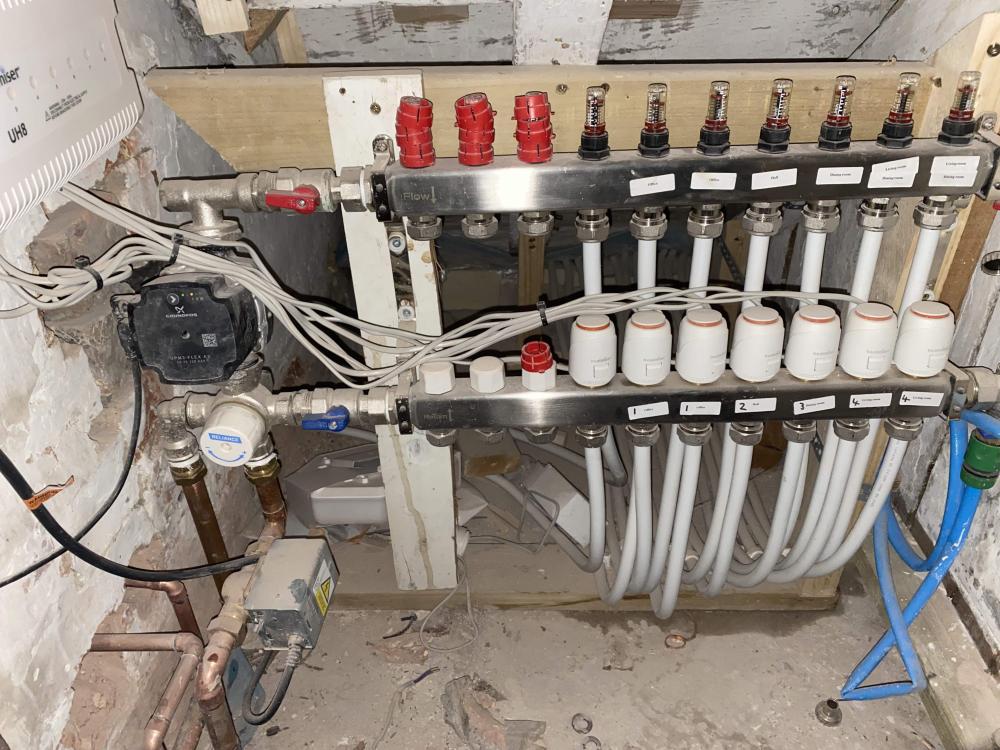
-
Pictures of the pipes dropping down from the airing cupboard and around to the UFH manifold. It's the latter part, where it runs along the stud wall that seems to be noisy. For context - the pipework is purposefully stud off the external wall to allow insulation behind it. The room height is approx 3.5m so the plan is to install a suspended one at some point
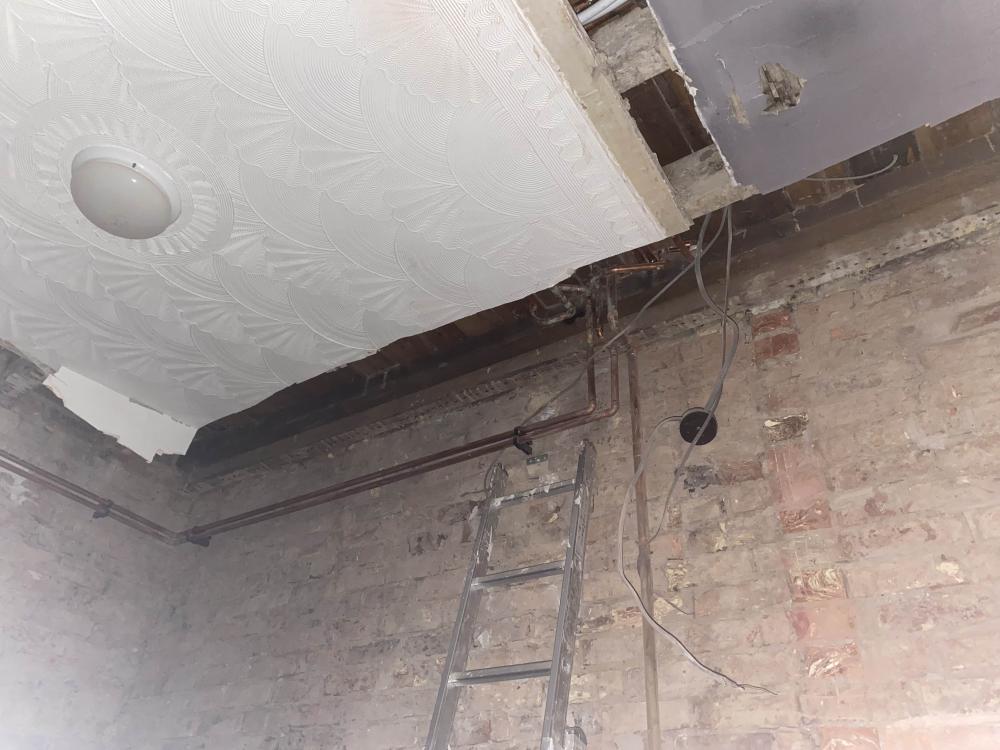
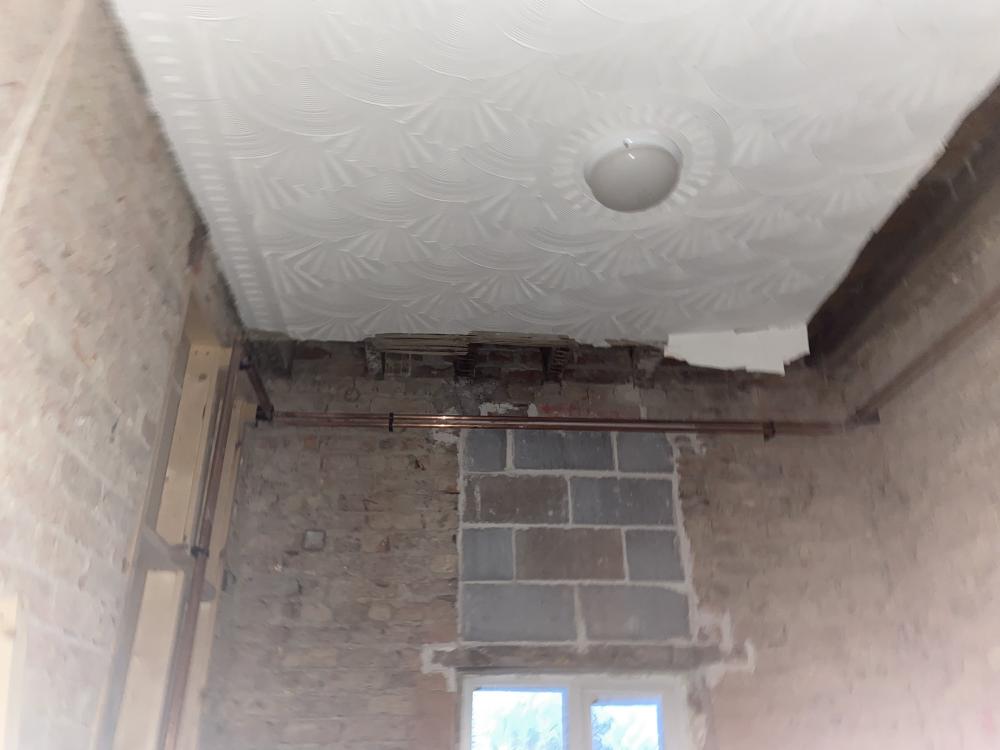
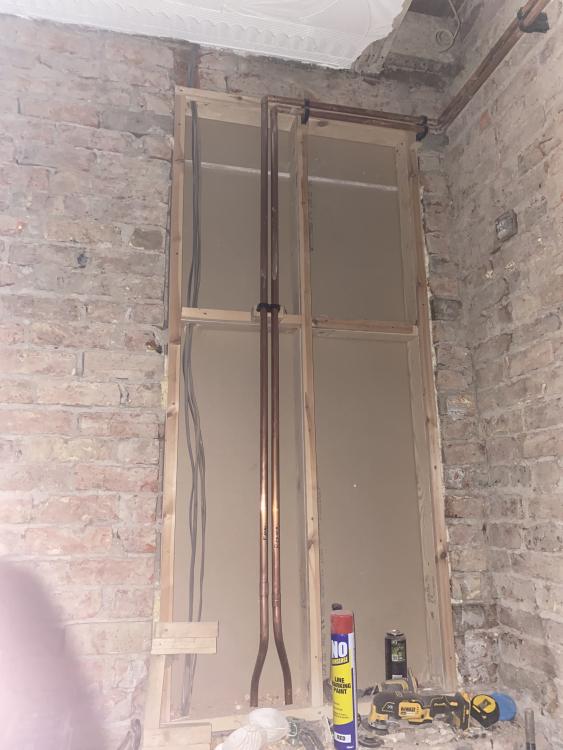
-
The boiler itself has an integrated pump, it's in now in an airing cupboard in our bathroom and is almost silent, you can't hear it at all with the cupboard door shut. The Pump connected to our UFH manifold is also near silent. The noise certainly seems to be coming from the pipework in-between. If I put my ear to the stud wall where the pipework's running, it's quite notably louder. I've checked the UFH pump to be sure and it's running at the lowest speed. It's not so much random/intermittent noise but a constant "hum" when the UFH is calling for heat.
-
Recently had the boiler moved, as part of the move the UFH flow/return pipework was moved, clipped within a stud wall using some of these - https://www.toolstation.com/black-pipe-clip/p72829 - the wall backs onto the stair case in a quite large hallway/landing resulting in an even louder, reverberation. Previously the flow/return to was a pair of HEP pipes running under our block and beam floor (lagged) which is why they were replaced, whilst inefficient, they didn't make any noise. Are their any rubber-backed clips, or similar, I could use to dry deaden some of this sound?







