


Strak
-
Posts
43 -
Joined
-
Last visited
Everything posted by Strak
-
Nope ... Good point - I'll do that!
-
180m borehole cost per metre for ground source heat pump
Strak replied to Strak's topic in Other Heating Systems
Thanks - useful to see those figures, looks pretty good really. If your ASHP is behind the shed, how far away is that from the house? I could potentially locate it a bit further down the garden I suppose, although may have problems doing that and keeping away from the boundary. -
180m borehole cost per metre for ground source heat pump
Strak replied to Strak's topic in Other Heating Systems
I'm unsure on the consistent bills bit, that's why I was asking really - I find that there is a lot of conflicting information online about any form of heat pump, so it's hard to know what is factual. Regarding passive cooling - I'm referring to circulating the liquid underground to cool it to the ambient 15 ish degrees with no energy used other than to pump the liquid, then supply at 17-20 degrees inside the house, essentially for free. I (perhaps mistakenly) thought that air source wasn't capable of this because the ambient temperature is warmer, so cooling would be active - using energy. It's good to know your experience is good with the noise level - it's not a huge concern - I think the likely installation point for an ASHP in our side alley would be far enough away from any windows and doors to be noticed. May I ask why you made this decision even with a borehole already available? -
180m borehole cost per metre for ground source heat pump
Strak replied to Strak's topic in Other Heating Systems
I have no experience with this type of thing to know how much it is likely to vary in a small area, but the closest deep BGS hole I can find is about half a mile from me. The hole is 102 metres with this makeup: Built up ground: 1 metre Grey/white soft chalk: 14 metres Green clay: 37 metres Green sands: 2 metres Gritty black/grey mudstone: 19 metres Gritty clay some hard horizons: 29 metres Survey scan link: (removed as it shares personal information) There are some 50m holes in the opposite direction but they are much older and the scans are harder to read, but they also mention clay, chalk and green sands. -
180m borehole cost per metre for ground source heat pump
Strak replied to Strak's topic in Other Heating Systems
Mainly for the more consistent energy bill, and passive cooling in the summer. I am looking at ASHP as an option too though. Did you notice a significant drop in efficiency at -10, and did it get noisy at all? -
Hi all, I've had a heat loss survey done for my house which is undergoing renovation. Heat loss is estimated at approximately 6kw. Looking at ground source heat pump as a heating option, but we only have space to drill straight down rather than lay horizontally. The different vendors I've spoken to so far have estimated a 180m borehole for this and I'm trying to figure out how much this is likely to cost. Any ideas on cost per metre for drilling a borehole to help with budgeting? Would there likely be any cost advantage to me shopping around and arranging the drilling of the borehole separately to the heating company? Thanks!
-
Thanks all for your replies on this. I think the DIY route is most likely for me. For info, the two quotes I've had back so far are £695 - it seems steep given the simplicity of the work, but then again I don't know what commercial rates they pay for disposal. I've also sent of a sample of the roof for analysis just do double check that it's definitely asbestos - a friend round the corner recently did the same job on his garage, but the roof looked a lot older than on mine, so a glimmer of optimism remains. However, given my general luck so far on this project, it's safe to assume that it will come back as a positive 😃
-
Hey all, just wanted to say thanks for your replies on this - currently working with the architect to try to get around 2.3 of height, but this thread has been really helpful to make sure we don't accidentally build something which would not be classified as a bedroom should we sell the house in the future.
-
@FarmerN I think the comments above say it's very likely to contain asbestos because of the age, just that it's a relatively low risk type of asbestos.
-
Thanks a lot for the tips everyone 🙂 I am considering doing it myself as you recommend, I guess I've just been ultra paranoid about anything where asbestos is mentioned. Under all of our carpets we also have vinyl tiles containing asbestos which need to go at some point as we're redoing our floors. I've just been looking into my council and they also do Biffa collection at £90ish for 50kg. Do you remember how many sheets made up that 22kg, and how big they were @FuerteStu?
-
Hi all, We have a concrete garage with an asbestos roof which needs to be taken down before building our extension. My plan is to have the roof removed by an asbestos removal company, then stick the concrete part on eBay for someone to come and take away. The roof is 6 metres x 3 metres, 9 panels - photos attached. I've contacted a company to ask for a quote - just wondering if someone here could guide me on what a reasonable price for removal and disposal of this size of asbestos roof would be? Thanks!
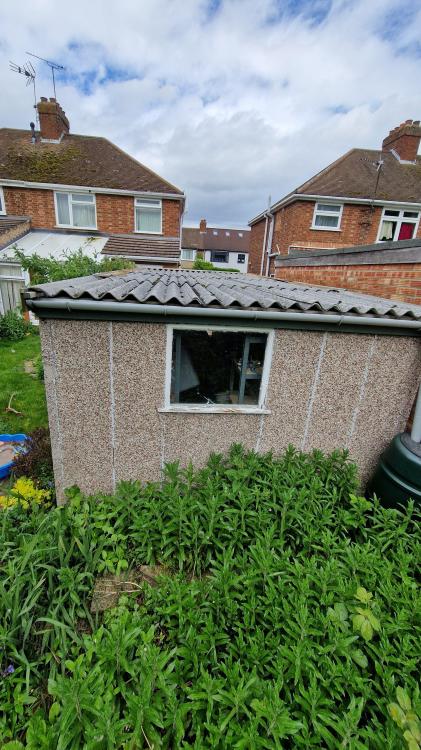
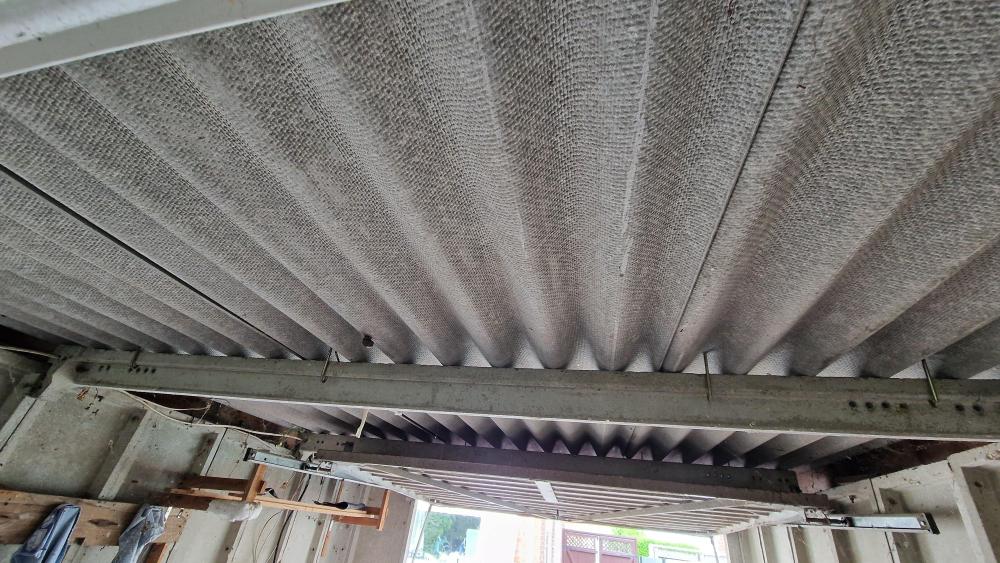
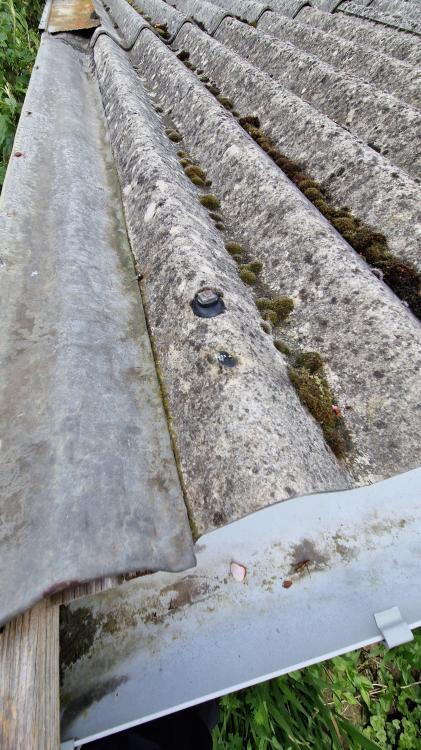
-
Hello all, We're currently finalising some extension plans for our house, and I'm a little confused over the official requirements under UK building regs for minimum ceiling height in loft spaces. The loft area will consist of bedroom, bathroom and stairwell - stairwell clearance height is 2 metres, and the ceiling height under the roof ridge will be approx 2.15 metres. I know the minimum height over the stairwell is 2 metres, but have read conflicting information over the minimum ceiling height for the rest of the loft. Many websites I found state that building regs require a minimum of 2.2 metre head clearance in the loft bedroom, but I can't find any official reference to a building regs approved document where anything other than height over the stairs is a requirement. I'm coming round to understanding that the 2.2 metres comes from a recommendation somewhere, rather than an official requirement, but am writing this post to double check. I believe that this website ( What’s the UK’s standard ceiling height for houses, extensions and loft conversions? (designsindetail.com) describes the actual situation: Again, as far as I understand, the last part mentioning 'no lower than 2.1 metres over half of the floor area' is not an official regulation. I'd really appreciate it if somebody could help to confirm the above, or if incorrect point me to the approved building regs doc and section that I need to look at. Many thanks!
-
@markc @Dudda thanks. I actually also asked a basement specialist to look at the plans in detail to give an estimation. They came back with the following proposed approach, estimating around 125k (which as you said, is a lot of money!? In the absence of any structural drawings and on the assumption that the anticipated soils (as above) are realised I have assumed underpinning the rear of the existing dwelling and a ring beam and underpin approach as the most cost effective form of construction as it combines basement retaining walls and temporary stabilisation works into a single construction operation. For the avoidance of doubt no sheet piles or pile bracing systems are required with this form of construction. Pricing assumes a reinforced concrete sub-structure with an internal cavity drainage system and we will design the structural waterproofing (covered under our PI) which we will guarantee, will comply with current NHBC and LABC requirements for a dual waterproofing system and will deliver a watertight specification to a BS8102 Grade 3 “Dry” environment suitable for habitable space. The attached budgets include structural design, structural waterproofing design, excavation and disposal, temporary works de-watering, the RC basement build, temporary works and associated propping (per design assumptions), structural waterproofing and temporary access requirements only. Full details of inclusions and exclusions are shown in the attached breakdown Revision 0 however we have assumed that you/others will undertake architectural design, basement internal steel work and lintels, basement internal walls, ground floor, under-build above our RC retaining walls, staircases, insulation, all fit out and all drainage.
-
@Dudda @markc here's a side elevation of the property which shows the new living area with both basement and loft conversion options: side elevation.pdf
-
@markcYes, I realised that the way I wrote it was a bit confusing this morning! I meant the depth on the plan rather than the vertical depth, I just wasn't sure how to say it ? @Dudda - the daylight analysis sounds like a good suggestion - I will look into it as we're also a bit worried about the kitchen. it's actually one of the things we're hoping to improve on from the current house layout, as the existing room isn't super dark, but definitely is not light. We're hoping that taking out one of the internal walls will help quite a bit with that but hopefully the light survey will confirm that. I quite like the stepping idea too, I'll have a think about that.
-
Thanks for the reply @George - this is actually not under an existing building, it is under part of what is currently the garden which will have a ground floor extension build on top of it. But I know that some of the risks are still there so it could be that we end up with the loft conversion in the end. The main issue is that we can't really get the space that we want from that option.
-
@tonyshouse thanks for your reply. So based on what you said it means that I could quite comfortably reduce the light well to closer to 1 metre wide, assuming that I could fit the stairs in? I assumed that the ventilation would be from the light well too, and there will also be a corridor and staircase into the main building too. Is there a need for more ventilation than that?
-
Hi there, just joined the forum and hoping to get some advice for the extension I'm currently planning. I’m having some plans drawn up for a ground floor extension, with a basement built underneath. We're comparing the basement option with a loft conversion, the main advantage of the basement being that it would give us more space and be cooler in the summer. The main disadvantages are of course cost and light. The basement will have 2 bedrooms and a bathroom with a staircase to get upstairs to the living room and kitchen area, and a shared light well for the two bedrooms with an external staircase to get into the garden. I’m struggling to know how deep the light well needs to be to let in enough light to make the two bedrooms a pleasant space. Currently on the designs it is 1800mm deep, spanning the width of the house. However, I would like to make the ground floor extension bigger without taking much more out of our back garden, so I'm thinking of making the lightwell smaller and adding some adjustable LED daylight panels (Lindby Kjetil LED ceiling panel 120 x 30 cm | Lights.co.uk) into the basement bedrooms. I have attached the first design draft, although internal things will move it gives a good idea of what we’re looking at. On the front/rear elevation page you can also see the loft conversion which we are considering. Some changes of note that we will make compared to this first draft: basement will be under the living area, dining area will be removed to create a bigger utility and we want to make the living area a little bigger to comfortably have a dining table in the living area. Does anyone have some experience of how deep a light well should be to let in a nice amount of light? Would the LED panels on daylight setting be good enough to compliment the natural light to make the basement rooms feel light? The rear garden (and therefore light well) are south facing. Also considering adding a shower en suite to one of the bedrooms by using the end of the light well which would reduce the size even further (approx 1.2m on one side). plans.pdf Thanks!



