Ed21
-
Posts
77 -
Joined
-
Last visited
Everything posted by Ed21
-
That's what I thought Seems a lot better to just do the whole roof, then doesn't matter what happens underneath, but wondered if I was missing something. Plan A it is then. Thanks
-
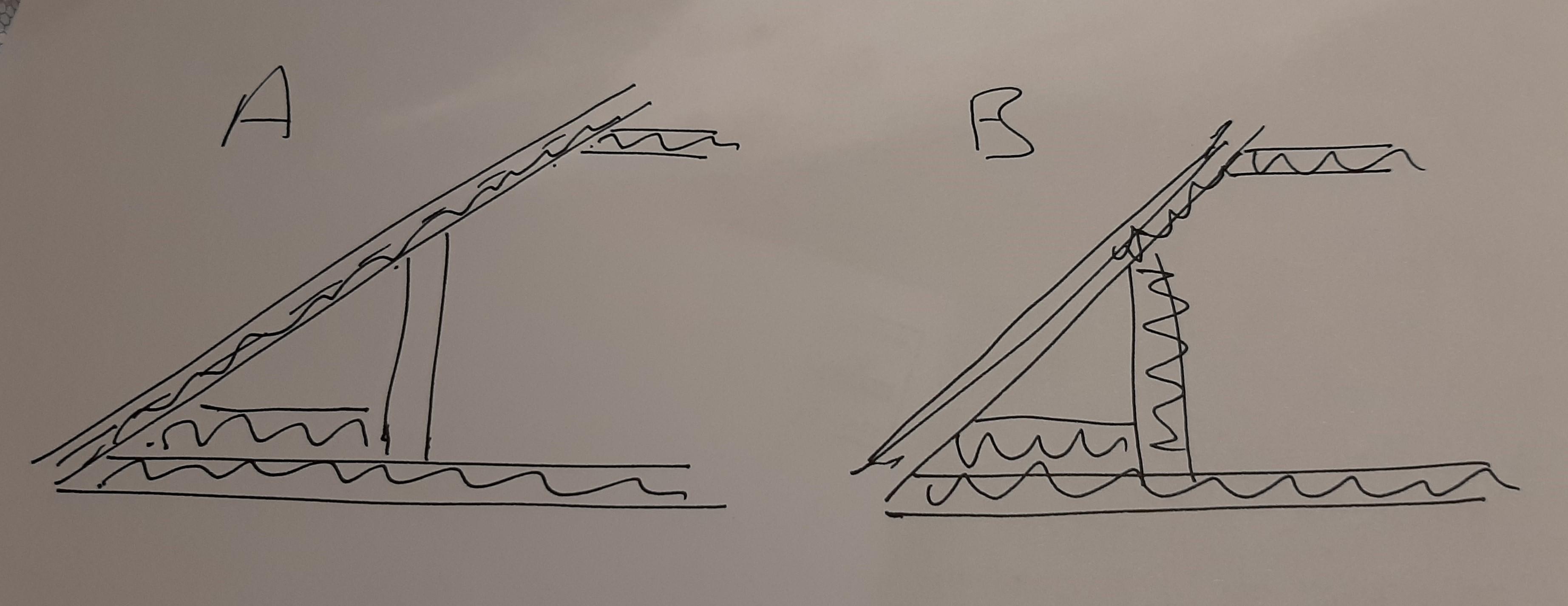
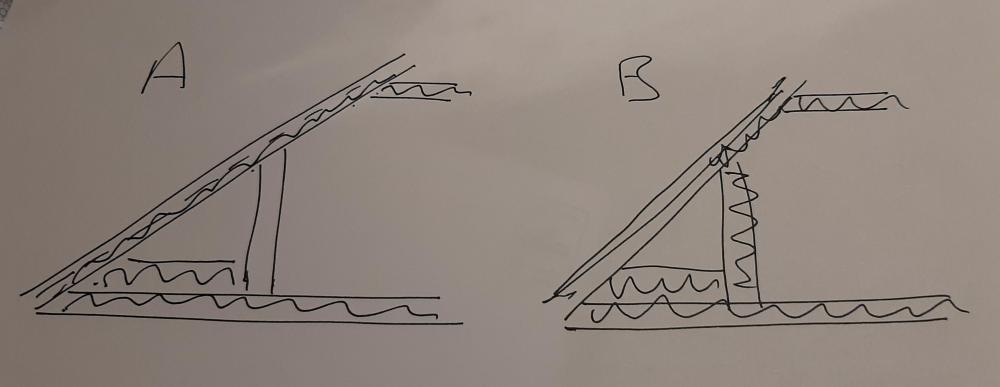
Trying to figure out the most cost-effective insulation config for a small loft room. Which one do you guys reckon A or B? .
-
Hi Everybody ? Got a loft with the central part boarded out upto the uprights of the ashlaring wall. Above this area the rafters look like they've been stuffed tight with glass wool, then a vapour barrier over the lot followed by some wooden cladding. Beyond the ashlaring and to the eaves, the ceiling has a hefty layer of glass wool both between and on top of the beams. The rafters above this has NO insulation. I'm going to remove all the cladding and glass wool on the main ceiling and add PIR instead to ensure a gap between felt and board > plasterboard etc. Then I was going to just put PIR between the uprights of the ashlaring wall and again plasterboard it over, but what of the rafters upto the eves with no insulation? So my question is, instead of insulating the part surely it be better to use that same insulation over the entire roof instead? Am I missing something here? Ed
-
AFAIK (the owner is quite elderly and details not always accurate) , the combi was supplied by a charity. It was professionally installed and I believe this is standard practice so as not to get too involved with the owners main CU. It all seems ok, just wanted a second opinion as to what's there.
-
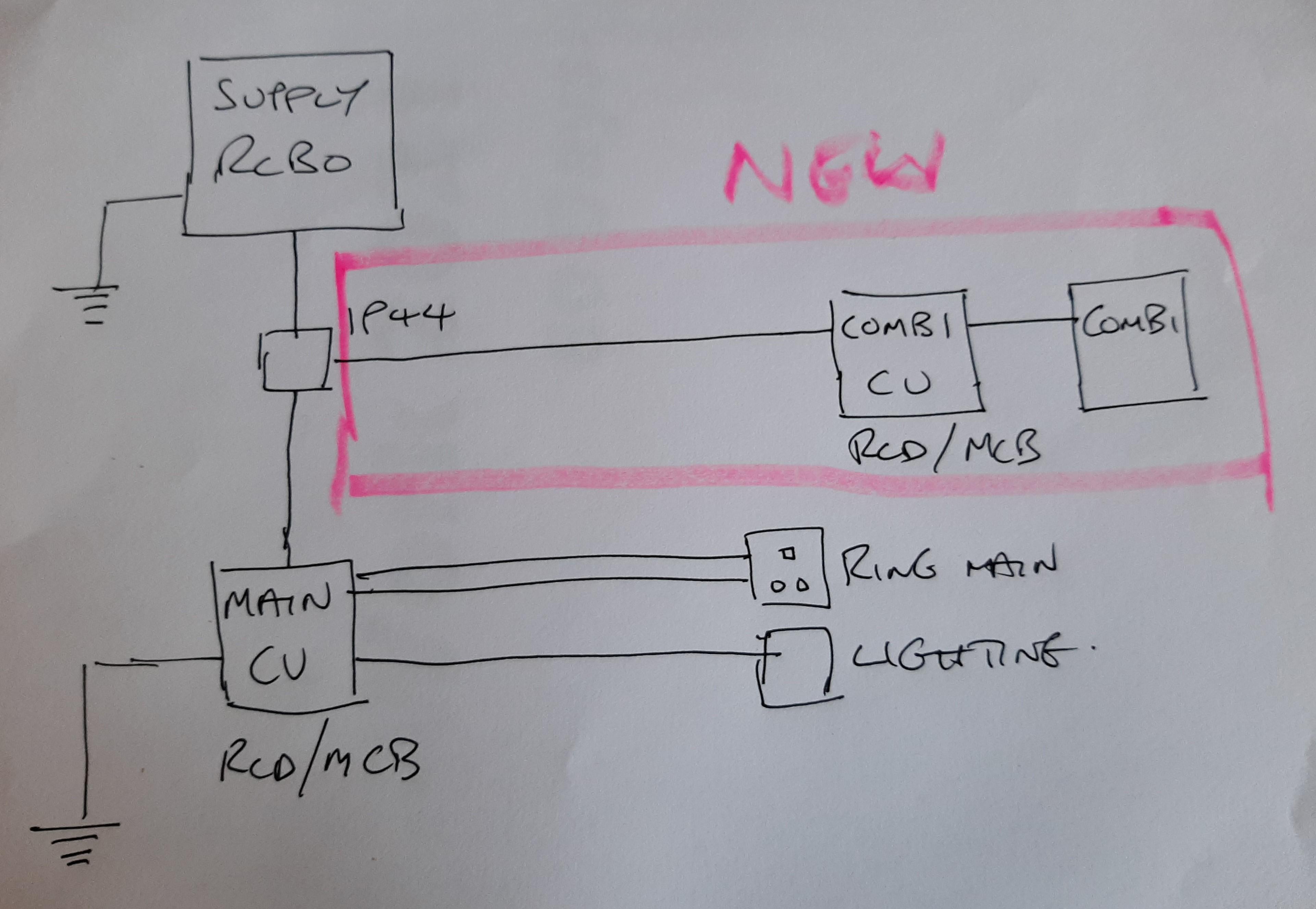
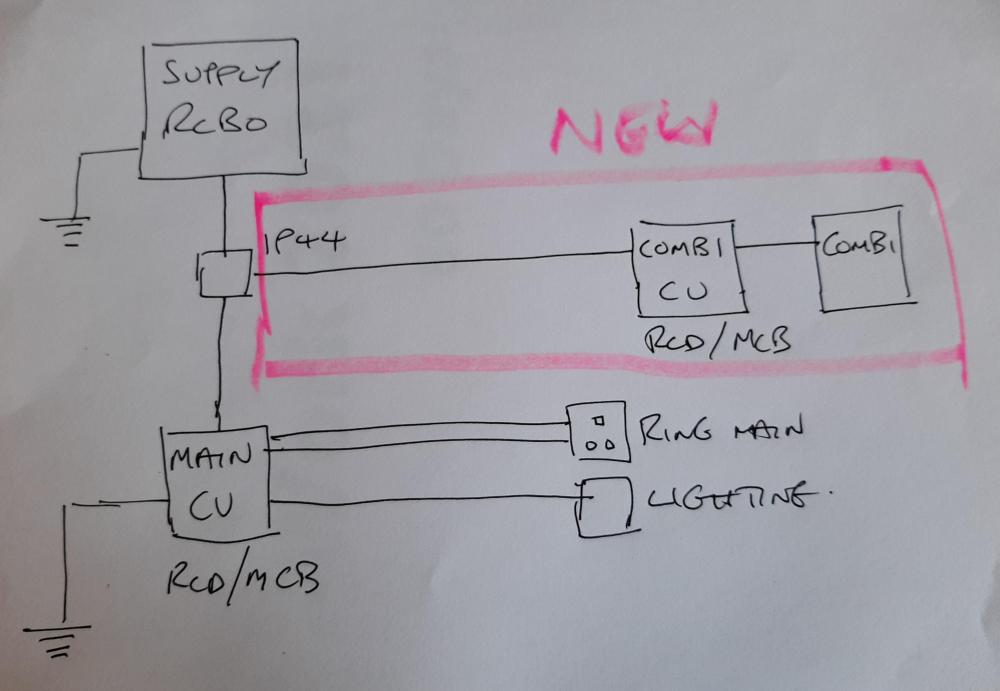
It has two earth rods, one for the supply box and one for the caravan. Here's a quick and dirty pic.
-
Yes the combi supply is new. The feed from the plugin has been split using an IP44 junction box underneath and the new connection to the combi goes to it's own consumer unit with RCD & MCB The original wiring is untouched. The singular main switch for the whole lot is on the main supply of the plugin box.
-
Static caravan of well under 100m2 is supplied from an external 16amp RCBO plugin box. This goes to the untouched, original consumer unit which has 1x 63A 30mA RCD and 2x MCB's (1 x 6A & 1x 16A). That lot running a simple ring main (2.5 cable) of 5 sockets (4 singles, one double) and a lighting circuit (1.5 cable) with LED lights and all works fine. Cooker/hob is gas and heating/water is via a newly installed gas combi. The power supply to this was fitted by adding a junction box under the trailer and splitting the plugin supply to the boiler's own CU. As the load on the combi is very low and it's a minimal drain on the supply can't see it makes any difference, but what do you reckon, does all the above sound ok?
-
Thanks for the replies guys Ok looking at it again wall has been cement rendered above a bath (coming out), but not below. It's got two layers of tiles and window is coming out + it's needs an extractor & will have one big shower instead. Think best to take the lot off back to brick/flat screed and that saves 15/20mm. With render and tiles gone that means can boost the thickness and use 50mm Marmox or cheaper Q Board. So XP thicker than was going for with a 6mm board/25mm PIR sandwich and should rum out at about the same. Can stick this on so no breakthrough ? Ed
-
HIya, Got a fully tiled small bathroom and want to add some insulation on the inside of the outer wall which is cavity. It will have an extractor, but going to be a lot of warm water and condensation. Plan was to use thicker foam cement tile board of around 30mm*, but as these are XP was thinking if it would i be better to go for 25mm PIR on the wall and use 6mm or 10mm backing boards on top. Same thickness just better insulation. Any issues with the second approach? Rgds Ed *About the thickest I can get away with
-
Think I've (hopefully) exhausted all the asks about insulation after this one. After good advice on here I'm using what I believe is the warm batten method. As the Kingspan is being pinned to the wall by the mechanical fixings of the battens is there any need to glue it prior to battening? Ed
-
Cheers tony, logic said that was the way, but been burnt before, so worth an ask
-
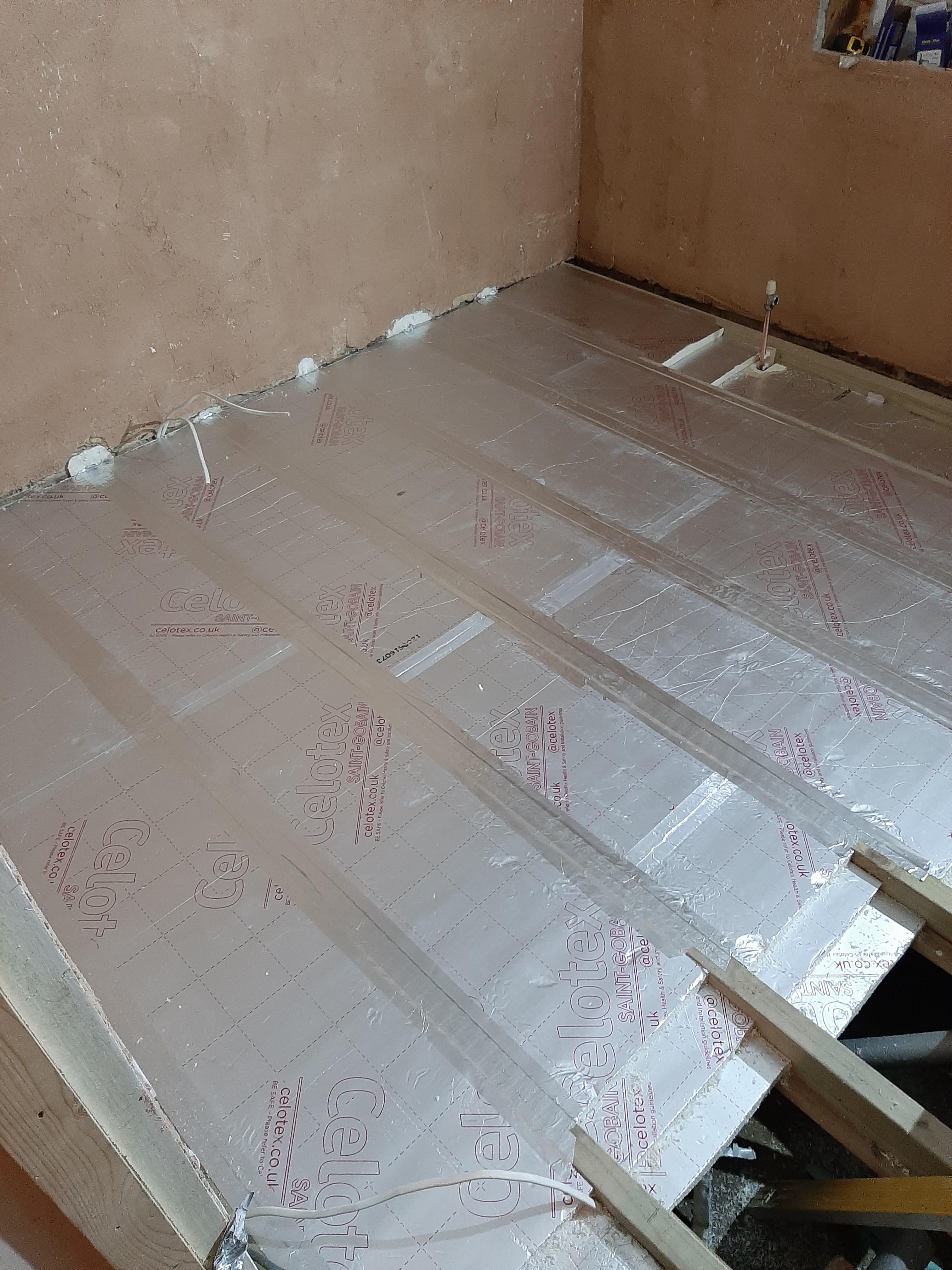
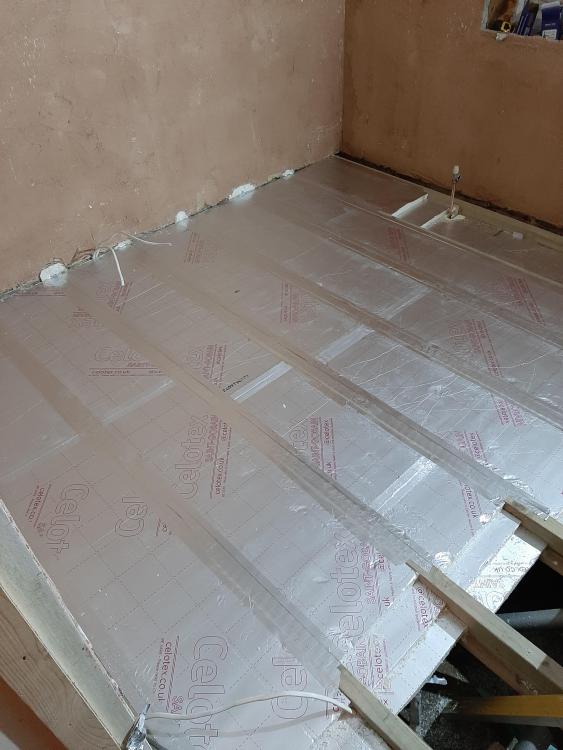
Hi everybody, Quick question, might seem obvious, but thought I'd check ? This is one of two rooms with new floor that is not far off ready for 50mm wall Insulation. The gaps round the side have now been foamed since this pick was taken, so the question is what's best? Put the 50mm direct on top of the beams/insulation or same, but leave a gap with a bit of foam. Or Stick the chipboard floor down and insulation on top of that, with foam or sealant in any gaps. Ed
-
Easy, wait until screwfix have the Stanley organizer deals on and buy a couple, got two for the price of one. Make sure it's the solid stackable ones that clip together. https://www.screwfix.com/p/stanley-fatmax-deep-pro-organiser-14-x-18/22910 With two you swap the insert trays over, so the bigger bulk stuff is in one and the smaller in the other. Trays are deep so the smaller ones get swamped. Can leave screws in smaller boxes, or I bought few small food containers in Tesco. These are clear with plastic lid and cost about a £1 for 5. They happily sit on top of the others in the same tray and you double the capacity for small stuff. Stanley also do a shallow version, but these almost never get reduced in price and TBH being able to swap boxes around makes a lot of sense.
-
Ok cheers for that Mark ?
-
I understand that wires covered in insulation means reducing the load, but what if it's through the insulation? Got some wires that need to go through 50mm or 75mm Celotex. What's the SOP? Is it ok to seal the gap around the wires? Ed
-
Yeah won't be buying insulated, all separates. As the floor had to come up, new rad and rewiring sockets anyway, that's not an issue. Suppose what's confusing me is why Xtratherm don't have a gap in the video.
-
Hi All, Back at end of January I asked on here about what method of internal insulation to use on a bungalow with cavity walls and got some good advice. Turned out the joists in the room were shot so had to replace all the floor first ? The consensus at the time was 50 mm fixed to the wall, battens on top of that followed by plasterboard making a sandwich of 50+25+12.5 = 87.5mm. Now had a spanner thrown in the works from another local builder who said fix battens to the wall, fill voids and cover the lot with insulated plasterboard. This is very close to what I had planned originally with the exception of being separate insulation/plasterboard. This version would be 62.5mm He also sent me a link https://www.youtube.com/watch?v=X4QWdw5vmok Ceiling and Floor is done, walls are prepped ready and have the materials to do both, so as this sets the precedent, which version would you choose? Ed
-
Ok got another variant in the next room ? Timber battens straight onto wall with plaster removed and PB pinned onto battens. Don't really want to remove the battens or add new on top at the risk of yet more holes drilled etc in a wall with part hand-made soft brick, so what do you lot think of this? 1. Remove old PB, fit 25mm insulation into batten voids, then tape/seal, before adding 25mm insulation over the lot including covering over the battens. Add a second layer of battens fixing through the top insulation layer into the original battens. PB over the lot. So I end up with 50mm Insulation over most and a 25mm gap behind the PB. Not quite as continuous as 50mm + batten + PB, but close.. 2. Possibly cover original battens with 50mm + new battens + PB or leave alone and cover old PB and battens with 50mm and batten/PB on top. So: Old batten + 50mm + new batten + PB or Old batten + Old PB + 50mm + batten + PB. Both of which leaves a 25mm void on the inside wall as well as behind the new PB. Does also have the disadvantage of being 25mm or 37.5mm deeper. Any thoughts?
-
Yes and that's pretty much what I'm doing.
-
Mostly bridging causing internal damp. In an area with a lot of bungalows that were heavily targeted for cavity insulation, it seems to be quite a common problem. As I said the internal walls are rubbish and so this will happen anyway. Even if I had cavity Insulation I probably would have insulated the internal walls anyway, so if it's not enough I can still go down that route at a later date.
-
Ok all taking onboard all the comments here's the plan, what do you think? ? 1. Remove the plaster and stabilize what's left. 2. Add 50mm insulation (2x 25mm) and seal all joints etc. twice (at each level). 3. Batten 25mm fixed through insulation into wall. 4. PB mechanically fixed to battens.
-
Supported beam, so the joist doesn't go through the inner cavity.
-
Two reasons, the rooms need to be re-boarded anyway, so the only additional cost is the insulation, which has been sourced at a very good price. Besides that had some nightmare stories from neighbors about failed cavity insulation or failure to honor guarantee in my street, so even if technology has moved on, not that happy with taking the risk.
-
If it's a tanking slurry yes, but in this case it was more to bind/stabilize the bricks, so would still be porous.
-
Thanks for the reply. Trouble is that makes it 75mm + PB, however if I removed the plaster that would be about the same. Is there any option to have just 50mm if a VPC barrier was added, either against the wall or PB?