


DeanAlan
-
Posts
94 -
Joined
-
Last visited
Everything posted by DeanAlan
-
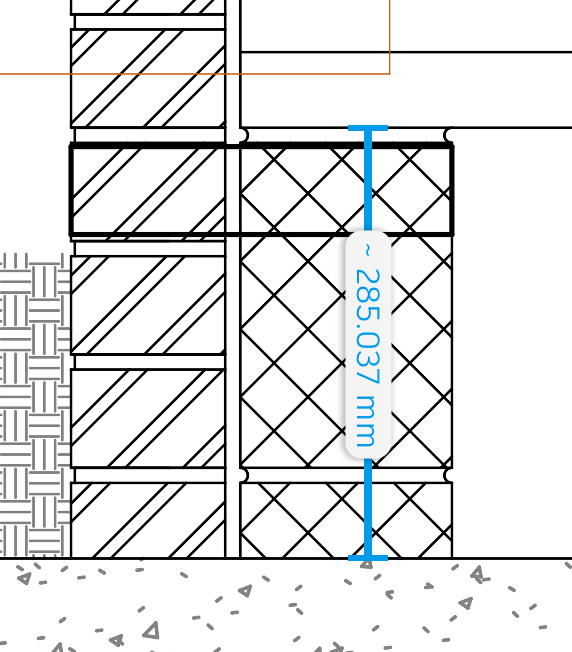
Thanks all - I think I have been over thinking it. This is my first (I think I will recover and it hopefully will not be my last) time doing this and I'm taking the role of main contractor and principle designer between my architect / engineer and trades. We do have a particular complicated build in the foundation area due to this public sewer we are building over. Anyway, think it is as simple as 215mm high blocks (aircrete or concrete) and 65mm bricks and the 2 mortar beds will allow me to my bricklayer to make up the level to 290 min / 314 max. cheers, -Dean
-
Thanks @Declan52 and @Russell griffiths Noted re beams not bearing on mortar. So something like https://www.forterra.co.uk/product/thermalite-aircrete-hi-strength-7/ blocks which come in a variety of widths could be laid on their side making that width their height in that orientation. One example would be a 100mm width block, 3 of them laid on their side with 3 x5m mortar beds comes in at 315mm. Where the concrete is at its highest (10mm below plan) that would put the top at 305mm against 285 so 20mm higher than plan. Where the concrete is lowest we we need to make up about 19mm height difference which would take the mortar beds in those areas to around 11mm - is that too much? The 20mm above plan might cause some other problems though given steels and other things that are already under fabrication. Thermalite blocks are quite easy to cut aren't they? Would it not be better - although I can see there being quite a bit of waste - to put these block in their normal orientation and cut blocks to the size required to hone in on the planned heigh of 285mm and not call for too much or too little mortar? If there are 2 courses that would be 10mm in total of mortar leaving 295-10 (as min) to 314-10 (as max) to make out of 2 blocks. That would be a combination of a normal block of 215 + (70 to 98) cut block. Is it reasonable to cut these blocks to 70mm or better to cut 2 blocks at 142mm (for min build up) and 156 (for max). Am I making this harder than it needs to be? Thanks for your patience ? cheers, - Dean
-
Good morning all. Due to a shallow public sewer I have to build over and a planning restriction on height of our first story I have a need for a relatively low foundation masonry build up over the mass concrete that has been poured and I'm concerned about how to get this both level and close enough to the required height. Build regs drawings show 285mm to bottom of beam bearing for block and beam floor. That is based on a perfect concrete level and I've established that the concrete is 10mm to 29mm lower than specified so I need to build up between 295mm and 314mm. What is the right way to build up to that height? A trench-block is 215mm high. A brick is 65mm high. Excluding 2 mortar courses (based and intermediate) that is 280mm. Splitting 15mm over 2 courses (to reach the min of 295mm) seems fine. Getting to 314mm would need the two mortar courses to have 34mm of depth between them which is too much - isn't it? I don't plan on doing this brickwork myself but the bricklayer I am talking to keeps sucking in air between his teeth so looking for advice on how best to do this. Should, for example, we cut the trench block in half (height wise) to create to trench-blocks that are roughly 215/2 (107.5)mm high to introduce another mortar course and that would mean that the 34mm would be split over three so 11mm (ish) each which seems ok. And/or - can you get trench blocks that are less that 215mm high - haven't found any yet. Appreciate your help. cheers, -Dean
-
@PeterW does the 45 degree rule kick in when < 3M from their foundation - my reading of the Party Wall Act was that this was for foundations >3 m but <6 m away, If their foundations are 1m (as they themselves say) then at 2.2m away a 45 degree line would require our foundation to be 2.1m deep in order to intersect. Interesting line of thinking - I'll pursue that with my SE and Building Control and get their feedback. I don't want to jeopardise my neighbour. I'm happy with a schedule of condition and any liability for damage I might cause relative to that but by serving a party wall notice and giving them control of party wall surveyors at my cost and only being able to appeal - at my cost and at risk of subjective judgment worries me. Thanks for your thoughts Peter. cheers, -Dean PS - still working the wine cellar design ?
-
Good afternoon, Context We own a semi detached in Cambridge and have been granted planning permission for an extension. I have served notices to both neighbours. Attached neighbour - for a couple of reasons (chimney breast removal on existing party wall & we are putting new foundations v.close to their own extension (that was built up to the property boundary). Structural Engineer has described a foundation method that protects our attached side neighbours extension foundation. Attached neighbour is very cool about it all and has agreed to a schedule of condition being drawn up between us. The unattached neighbour - the PWA says excavations within 3m and lower than your neighbour. We're doing trench fill foundations to no more than 1.2m (according to soil sample and SE advice). I wasn't going to do a PW notice to this neighbour on the basis our foundations are 'standard' depth. The elderly lady that lives there is a little ... nervous (ok) cantankerous (not so ok) and kicked up a fuss during planning application (done by previous owner of our property). They spoke with a friend of their family who is in the construction and they come back with their extension are only 1m but no need for a PW Award just a schedule of condition but now they have changed their mind and want a Party Wall Aware and have gone as far as disagree with my suggestion of a PW Surveyor and appointed their own. We are now technically in a PWA dispute but I don't know why. It isn't 'no response', they have actively refused my notice but I don't know what their issue is beyond a) they have said my foundations are in close proximity and b) complexity of drainage. Questions Re drainage. I have a public sewer (lateral drain) crossing my property and I have a build over application in with the local water authority which (in discussion with them) they are about to accept with a few minor details added to the design. This is all about my obligations regarding the local water authority and their asset. Has nothing to do with my neighbour - not in a party wall sense. Nothing about Party Wall Act has anything to do with sewer/drainage systems. What Party Wall issues exist here and what might an award contain relative to drainage related works? Surely this is outside the scope of PW Act or any associated Award? If it turns out my foundations are no deeper than my neighbours (their ground level is actually slightly lower than mine and maybe we don't need to go to 1.2m and sit at the same level as next door) then what? If an award was made, is it null and void? Can I dig small foundation and get building control to agree on the foundation depth at 1m and then inform my neighbour that act and award is not applicable? Lastly, I can find no details of what governs the content of an award. What might it contain and is it only limited to the building work that triggered the Part Wall Act - the foundations that are within 3m of their foundations, or can it apply to to any and all associated works and how is that defined? Appreciate advice, good or bad stories (less of that bad please) from the group here. Thanks - Dean
-
@Roger440in a prefect world, I am looking to improve the airtightness of this property as a I renovate. The extension (150% additional size) will have reasonable (beyond building regs) attention in this area and would like to bring the older part of the property up to similar level (the original 86sqm property will be basically taken back to its external walls and roof structure with replacement ground floor structure etc). If my current DPC is badly compromised (still a question really) and I am having EWI installed (which will reduce the external breathability of the solid walls to a point you made earlier) then feels like my options are narrowing in that I'm going to need to let the walls breath internally more (lime plaster?). It could be the DPC is fine (I did notice, for example, that the DPC had been mortared over externally in a few places and plastered over internally and these are therefore both moisture bridges - i'll get the external ones fixed before EWI goes on) and that the dampness originated from condensation. cheers, -Dean
-
So I've found plenty of tank options for this project and my preference is for an outer tank with 600m+ greater radius and to put one inside the other and use it to form the concrete and give double the waterproofing. One concern I have is displacement pressure - not sure if this is the same as heave/hydrostatic pressure. If I used the single tank approach and poor concrete then I think there is a great chance that the outer concrete will gradually leak water and cause the inner tank to be pushed up - float. Whilst it will have bottles of wine in, it is not going to weigh more than the body of water (1m of it would be below water table) it is displacing. With the double tank approach then the weight of the concrete is within the boat (so to say). Concrete is about 2.5 (little less I think) denser than water so (in pure tank terms) if half the tank is below the water table then the bottom half(ish) of that (quarter of the tanks depth) would need to be filled with concrete. Does that sounds right? So a 2m deep tank sitting flush with ground level where water table (it is very high at the moment) is 1m bellow ground would require 1/2.5 of the that 1m height displacement to be concrete to counter the displacement upward pressure. The maths is more complicate for the double tank approach (I can work it out) but whilst the outer tank is bigger (more displacement, more upthrust) the full height of the concrete wall (300m ish thick) adds to the weight of the boat trying to avoid floating. If the cellar wall was part of the house structure then the weight of the house would bare down on it as well which would be massive but at the moment I had it sitting below, and unbound, block and beam floor. I feel my cellar is floating but the idea is sinking a little. If my outer tank is a 6000ltr tank and the inner one is 5000ltr then I have (in ltr) 1000ltr of water volume to replace with concrete in the walls so at 2.5 density ratio is 2500ltr. The water table is half way up the 6000ltr tank so 3000ltr of water displaced by 2500ltr of concrete - that boat is floating, not resting on the sea bed. I need another 500ltr of weight and at .75ltr per bottle of wine I would need to keep 666 bottles of wine permanently stored there. Maths has never been so much fun ? My SE is going to love me. cheers, - Dean PS just find this SE design workup for spiral wine cellar. Beyond me but it talk about the stuff above in a LOT more detail https://www.rbkc.gov.uk/idoxWAM/doc/Other-1973973.pdf?extension=.pdf&id=1973973&location=Volume2&contentType=application/pdf&pageCount=1
-
@Gus Potter up for spending £15 to say £1k. @Roger440 yes, EWI outside (with its own member) and then DPM lapping up the wall 600mm of so is just going to create a wall of brick tanked either side so the capillary action will suck up the water and it will not have opportunity to evaporate away given the membranes. When you say treat the building as if it doesn't have a DPC, what would that be? @Adsibob hope we solve our floor lowering and damp problems. Our water table (as off two days ago and the heavy rain) about 1m below ground level but our current floor is 600m above that. I have another thread on here where I'm looking at digging a cellar below the water table which is generating some cool ideas. cheers, -Dean
-
Looks like we (and I do mean "we" ) have a plan here. I'm going to run the (second hand) tank idea, filled with water and cast around idea past my SE and watch his expression. I was almost wondering whether two tanks would be better. If I could find inner one of 2m and outer one of 2.6+. Cut end of outer one, drop it in, drop in some block to make sure there is a gap, pour bottom slab to the level of the blocks, drop in the inner one, start filling inner one with water and then start pumping concrete into the gap between them (maybe with steel mesh I would have had to preformed to 2.25m diameter. When concrete has started to go off, cut top of inner one and (actually, why would I fill with water when it is a wine cellar, I could make it a wine tank ? ) I'll let you all know my SE feedback and then share progress. Likely not until March. cheers, -Dean Much thanks @PeterW and @MortarThePoint
-
If I dropped a in tank like that one @PeterW (nice find - as an example) I wonder whether I would need a concrete base (externally) suspect not. Then pour concrete around the outside (a waterproof concrete mixture I guess, or at least one that will set underwater - you can get that can't you - probably called marine concrete or something, I can't google and type at the same time.). Concrete floor internally but more for weight and solidity under foot. The external concrete would be for strength - retaining wall effectively. This is sounds cheaper by the minute - can't be right! Might even have some money left buy a bottle of wine to put in the middle. [aside: these wine cellars can hold circa 1000 bottles, I can't afford that much good wine] - Dean
-
Some great ideas here @PeterW and @MortarThePoint Water in the tank before pouring concrete - if that was the approach I took rather than formed (square) from blocks. Might have to get the Firebrigade out to fill it and empty it. Was looking at products and likely over 4000ltr (https://www.kingfisherdirect.co.uk/underground-water-tanks/3400-litre-underground-water-tank-2). Ideas - keep'n'coming cheers, - Dean
-
@MortarThePoint yes that reminds me, that is why I had thought that it was probably better to build the structure square. My initial idea was those inspection rings but less keen now. On the topic of the block and bean - thinking that actually maybe the right thing to do is (for the half that has solid ceiling) bridge the beams over - to the expected supporting walls either side - so that the cellar walls aren't structurally connected to the floor above so that there is controlled movement opportunity (a vertical expansion gap if you will). As you can tell (and why I am here) very much in the inception phase of this idea. Plastic tank - like a large water butt (or even a cheap septic tank) upended and cut - as the impermeable membrane instead of a butyl liner - and then put structural blockwork (STEPOC?) inside? Would this be cheaper? I assume idea would be to get as close to a guarantee of waterproof as possible. I assume you can get square plastic tanks to this dimension. Good idea - have me thinking outside the box about a box ? cheers, -Dean
-
Hi All, Walking my wife through the NSBRC centre back in Oct we walked past the Spiral Cellar company display and I couldn't block her view ?. A conversation was had along the lines of "while you are digging the foundations, can't you just dig a bit deeper". Anyway, having initially said "no way we can afford to do that" I then found myself Googling and stumbled across https://community.thewinesociety.com/t/build-your-own-spiral-wine-cellar/4457 Just about to enter the Build Reg design stage and have SE engaged on the main renovation and extension design. Will certainly needs my SEs input (he has already given a little). Looking at building a 2m x 2m x 2m square basement structurally and then fitting it out as a circle and putting in one of the http://www.stonecellar.co.uk/cellar-doors/ semi-circular doors. Basic structure would be a Butyl liner, STEPOC blocks walls (probably the 300s) reinforcement bars and concrete. My questions at this stage are: Q1: From a trial hole we know the water table is currently at 1m below ground and we're looking to the cellar to be 2m head height. How would you keep it dry enough to lay the butyl and pour the concrete floor slab. Would we need to drive in some heavy duty steel shuttering but even then will the hole just not fill to the water table level. Is it a race - ie lay the butyl and poor the slab to create some weight to counter the hydroscopic pressure? Q2: related to the above, keep it stable enough (with lower half being below water table) to put the blocks in to then concrete fill them? Would I need to put in internal bracing (horizontal Acroprops or just plain timber bracing) I had actually thought about dropping in some large (2.4m wide) precast, waterproof, concrete inspection chamber units (like these https://www.drainagesuperstore.co.uk/product/stanton-bonna-concrete-manhole-ring.html) instead of build in STEPC or other labour intensive work. These are expensive and would need craning in but will need a crane for the block and beam units anyway so might be able to coordinate. Dampness and coolness is obviously the objective here (and it is uninhabitable from a building regs perspective which obviously makes it a lot easier/cheaper to build as basements go). As always, thoughts from this group really appreciated. cheers, -Dean
-
@Roger440 and @Gus Potter thanks so much. I clearly need to read more and bounce ideas of the people here. I'll be back. cheers, -Dean
-
@PeterW I like the idea of looking at a website called "heritage house" makes me sound like Lord of the Manor. Opening sentence: Ta, -Dean
-
@Dreadnaught, @Ferdinand and @rh2205 thanks for your comments - although a little scary. Certainly seen the impact of GHG getting in my way re ASHP and EWI that I need. I have good structural local structural engineer and 3C local building control are really helpful. I have a general builder, brickworker and groundworker lined up and access to roofers and first/second fix services (on paper anyway). I'm not doing any of the 'build' myself beyond possibly replacement of existing ground floor rotten timber floor with solid floor and then other demolishing work. Understanding, organising and scheduling is sure to be a challenge. My head is already spinning. I'll keep you all posted. cheers, - Dean
-
@PeterW - thanks for your reply. EWI - yes, I had considered a french drain myself - a belt and braces approach. Injected DPC a waste of time. Ah ok. Not required as part of mortgage (already have that). Walls are very damp to 1m ish up. By 'internal DPC' do you mean the DPM going up the wall? If this is the case then there would be no real DPC in place - beyond the current compromised one Expansion gap - got you. For concrete you have (if I understand correctly) popped the insulation above the MOT/DPM and below the 'self compacting' and of Self Levelling Screed (SLC?) to level across all sections. Helpful feedback. The Chemical DPC being a waste of time is interesting comment, wonder if that is a general feeling amongst others here. I have no basis for an opinion so all ears. cheers, - Dean
-
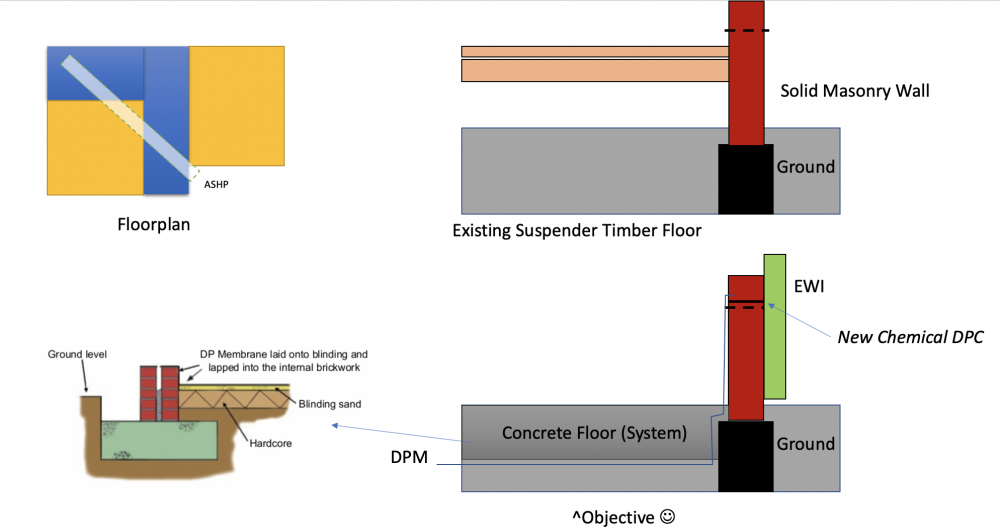
Hi All, My first post here - be gentle with me ? I am about to embark on a significant renovation and extension project. I have used an online architect (which are so so but not full service .. but anyway) and a great structural engineer on board. I'm going to managed the trades myself and do a little of the work myself. One of my first tasks and the question here is around removed an existing rotten timber floor, that is 600mm above ground level) and replacing it with a solid floor at ground level. Solid so I can get good UFH system in (and consistent with the extension) and lower so that it is consistent with the intended floor level of the extension. Structural engineer has looked at foundations (1930s semi) and says they have enough depth for me to do that on the basis that a concrete slab would be circa 300mm (50mm hardcore, 100mm slab, 100mm insulation, 50mm screed, blinding and DPM). I'll need to break up the existing oversite concrete that I know is there and excavate out another 250mm say. I'm not going below the level of the existing footings obviously. I'm attaching some diagrams. Q1: any issue with this 'logically' and is my 'circa 300mm' right for current building regs on concrete floor? Q2: current DPC is a badly compromised slate DPC (was checked by a damp specialist and visual inspection tells you all you need to know) and 600mm or so above ground level. I will need to bring the new DPM from under the new concrete slab up the walls to lap into the wall above or below a new chemical DPC? When they say 'lap in' does that mean a shallow horizontal trench (10mm?) cut into the masonry (or mortar) Q3: as the new floor level will be inline with ground level (and below original DPC) are there any other 'damp' concerns and how would I protect against them? The concrete floor will be below ground level - finishing at ground level. You could consider what I am doing as a shallow basement - but water table is a good 1m below where I am. Do I need to 'tank' this more substantially, at least up to 1m above ground level or something? Q4: from the diagram you will see there are 4 sections to the house. The two yellow are timber. The blue are concrete and I need to break that up and replace (lower, insulated, UFH etc). I would ideally like to do them one at a time. I assume this is ok but i need to make sure the DPM of one segment then overlaps (150mm I believe) the next segment. Any issues with segments of concrete? Do I need to tie them together (reinforcement bars?) Finally (thanks for reading this far) Q5: I hope to put in ASHP and will need to run power and flow/return/control cables from what will become a plant room/cupboard. What trunking products would I use to give watertight, airtight solution? Thanks in advance for any advice. cheers, -Dean
-
Hello BuildHub community, We've just taken on a significant remodel and extension project in central Cambridge and wondering what on earth we've done! Nothing good comes easy I keep reminding myself ? It is a 1930s semi detached house with a large garden. We bought it with full planning approval for a large extension taking it from its small 86sqm to a good size 210sqm. We didn't intend to mess with the approved plans but the more we looked at them while the purchase went through the more we decided on a few small changes and before you know it we had to put in for a full application. We're pending that decision (should be mid Jan 2020) and are confident given it is actually slightly smaller overall and we've built up relationship with the neighbours and believe they have no objections. At the moment I plan on taking main contractor and project manager responsibilities bringing in the trades myself. I also plan on doing some of the demolition and dogs body work myself. I'm a software engineer by trade so hoping I'll be able to handle the home automation and become a source of advice in that domain going forward. Nice to meet you all, thanks in advance for any advice you offer and good luck with any projects you are currently working on. cheers, -Dean

