DeanAlan
-
Posts
94 -
Joined
-
Last visited
Everything posted by DeanAlan
-
Soon to have this built. It is adjacent to main reception room so really don't want the low hum of MVHR unit creeping in if possible). What is best construction technique to start with, blockwork or timber stud, filled with acoustic fluff and then with acounstic boards on both sides? cheers, -Dean
-
Compensation curve - compensating against what?
DeanAlan replied to DeanAlan's topic in Air Source Heat Pumps (ASHP)
Nice! Thanks @HughFI can see more 2023 project (to complete before winter 2023 kicks in). I'm a SW Engineer by trade so this is the only part of the build that I can truly help with beyond demolition work and cutting bits of Celotex. -
Compensation curve - compensating against what?
DeanAlan replied to DeanAlan's topic in Air Source Heat Pumps (ASHP)
Thanks for the articles @billtand @ReedRichards Fully integrated - with the ASHP controller understanding the target and actual room temperatures and outside temperature I can see what it is trying to do. Think it breaks down when there are multiple zones and simple Call 4 Heat request to the ASHP controller from the UFH wiring centre and stats. In my case the UFH controller is my own Home Automation prototype based on Raspberry Pi, Zigbee room temperature sensors and relays to control the UFH actuators and call 4 heat request. If I could find out how to talk to the ASHP controller in a more advanced way to work with its compensation curve then I think there is room for improvement but getting the details for that are unlikely. I guess if I could find the inputs to the ASHP controller for its dormant room temperature sensors (I think it can handle 2 zones) then I could manipulate what the ASHP is perceiving as its idea of zone temperature based on what my controller is doing with the ASHP manifold and the more zones it control (my manifold has 12 zones but I don't in anyway see them being operated independently - has that size due to loop length limitations) -
Compensation curve - compensating against what?
DeanAlan replied to DeanAlan's topic in Air Source Heat Pumps (ASHP)
Thanks We have 50mm anhydride screed so little faster reacting that yours I imagine @JohnMo. @ReedRichardsyes that is what I am thinking re the ASHP being able to turn itself down as it approaches the room setpoint but to do that a) it needs to know the room temperature - which in my case it isn't being given b) it needs it for individual zones that are on and calling for heat - once again not in my house. I don't know if the Ecodan is doing Weather Compensation or Load Compensation. Just "Compensation Curve" -
Compensation curve - compensating against what?
DeanAlan replied to DeanAlan's topic in Air Source Heat Pumps (ASHP)
Thanks @JohnMo still a little confused (bare with me, I'm smart honest 🙂 What would it mean for the curve to be set correctly and what temperatures is it comparing and compensating against as it has no idea about my room temps, just the flow and return temps (plus outside temp). Is the flow return temperature the temp being used to govern the ASHO when in compensation mode? For example if room temp target is 21 degrees and I have stat at 22 degrees should the cold end of the compensation curve be the flow return temp at say 30 degrees? Seems hard to get chapter and verse on this stuff - is it written down somewhere in general and then in Ecodan speak? Thanks for any and all assistance! cheers, -Dean -
Context: I have an Ecodan R32 8kw ASHP installed. Installer (Mitibushi platinum installer) set it up. Wet UFH installed by others. UFH control system by me - zigbee temperature sensors, home assistance, raspberry pi and 12 relays to control the 12 port manifold actuators and Call 4 Heat and UFH manifold pump. I have the UFH set up as a single zone at the moment - to start with- with a daytime temperature target and night time a couple of degrees lower. Question: The installer had the ASHP heating on its compensation curve which from my reading looks to be as efficient as possible in use of energy given outside temperature and inside temperature BUT the ASHP isn't sensing room temperature at all - just responding to Call 4 Heat. It has flow and return temperature sensors but that's it. Is this correct? Should I have it set in the other mode of fixed temperature (and what would that be)?
-
Thanks for all the feedback. Solid brick wall from 1920's build - lime mortar. There is slate DPC. Outside also had roughcast (O M G) layer appplied decades ago. I have filled any major gaps in bricks and then used blowerproof paint to make the wall as airtight as possible. I did want to passive purple spray but budget wouldn't allow. @Radianthanks for the suggestion around monitoring the low temperature at the cold bridge and trying to warm to above dew point.
-
If we are agreed that in my case the planned EWI will be the major factor in keep the exterior sold brick walls warm (enough) then my primary concern is how do I get from here (no EWI for another 3 months, MVHR to be commissioned in similar time frame)? Taking that pboard off and battening out or using insulated board will eat up space in the rooms - which I would like to avoid. Options I see to get me through might include: - Dehumidifier - Direct warming (something like IR panels) of the offending walls internally - Cranking up the UFH & making using summer fans to ensure good airflow across the offending walls The aren't being skimmed yet - this gives me an opportunity to monitor the situation on the walls closely. I've wiped a couple of the patches down with mild bleach solution. If I have to then I will remove them but want to know what to replace them with. Insulated board adds depth and (whilst more insulation is good) might be going above and beyond given the EWI is coming (which we have to do anyway to refurbish the outside to good quality). Moisture resistent board?
-
@Roger440 Should we have wet plastered? D&D insulated plasterboard (35mm)? Battened out and then boarded to the batons? I D&D because the builder said so. Now - he's a regular builder and didn't get the potential issue - or - he knows we are going to EWI and thinks that will be fine. While I'm on the topic, why would D&D have an issue when wet plaster might not? Wet plaster is in contact with the cold wall completely rather than in the dabs. It it that plasterboard is loved by mould spores and wet plaster material isn't? If so, why isn't plasterboard made of same stuff. So many questions... Appreciate any input. I don't think I've made any major mistakes on this project. This is a mistake but I hope a minor one that we can correct.
-
If they were wet plastered would that make a difference? I've also been reading that maybe I should use insulated plasterboard and that can be dot and dabbed and not suffer the same problem.
-
That that wall does need external wall insulation (as to others that aren't showing the problem). We also have MVHR yet to be commissioned which will lower the relative humidity. If it is cold bridging causing moisture to condense there, what can we do in the interim prior to EWI and MVHR commissioning? Both of those are 3 or so month out. Cheers @Radian PS... Shocked! Just had a closer look at some other walls. The one in the picture is now 3 weeks since being boarded, the others were done a week later and they are showing early signs of the same problem. There are three external wall of original property. Solid walls that need EWI put on them. They account for maybe 1/6th of the total wall area with the rest being a new (relatively massive) SIPS extension ground and partial first. We've got skim coat to go on those and EWI but now wondering if we've made a big mistake and we're going to have to redo those walls and if so how! Input appreciated.
-
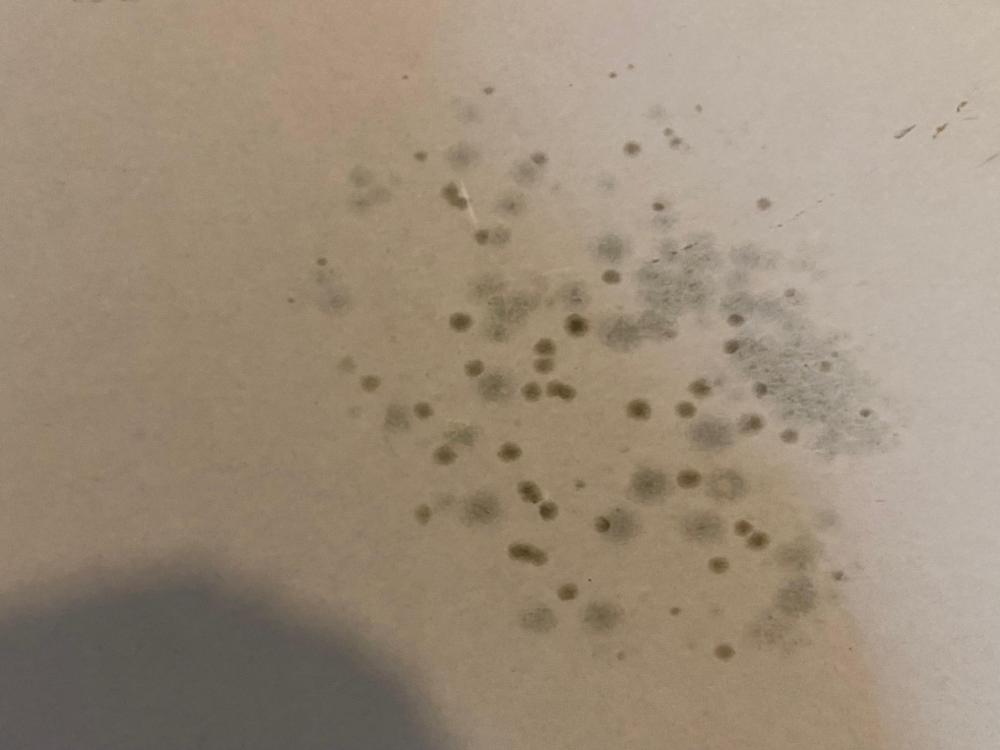
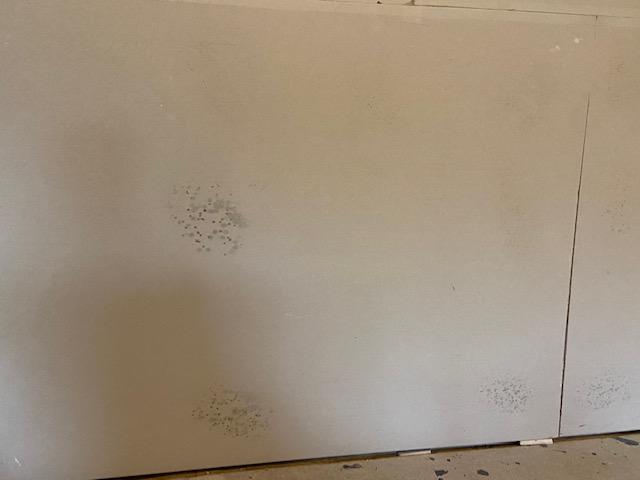
Morning folks, Wanted to get an opinion on what looks like some mould spores on new plasterboard . Whole house is being re-boarded after massive renovation. There are a couple of boards that have been put up and within a couple of weeks the seem to be showing a mould/damp problem. However, the wall beneath has been exposed brick (line mortar) for over 6 months and bone dry. The is first floor so not rising damp. I actually blowerproofed the whole wall before hand and it was super dry. Not a hint of any moisture that I could see. The mould areas seem to be where I think the dabs are. No other issues in the boarding elsewhere. The boarded were stored outside during heavy rain but keep below large DPM sheet and on pallets. Has some moisture got to them that way? If so, why just these boarded - maybe based on the location in the pack. Any ideas on what this could be?
-
The SE designed the steels to accommodate up to 3 of these holes in the centre of the beams (worst location). In 2 of the beams I do need need to put 3 of these holes but they will be far apart from each other and not need and connection points. As to economical designed - I think the general consensus is that SE don't do that. Tendency is to go to other way! I'll let you know how things shape up (round and full of holes hopefully)
-
Thanks all. My steel fabricator came around today to take a look. He also says a hole saw will do it, it will take time, access might be awkward and I have 11 of them to do. I told him to do the first one and I'll do the rest with his kit! I'll let you know. cheers, - Dean
-
I sense your obsession 🙂 Well Markc - you make is sound too easy. I hope you are right. I'll let you know how I fair. Speaking with my fabricator tomorrow to see what he is thinking.
-
@markcthanks - been looking at hole saw or annular cutter as a step up. Not sure there is enough space to get a mag drill so would need some other bracing. Doubt I could apply enough pressure. You are based in west yorkshire 🙂 fancy a trip down to Cambridge. The SE designed the beams for max of 3 90mm holes in centre of beam and we are less than than and off to the edge which is better. Challenge is just making the cuts. @Moonshinerectangular cuts would be bad for the steel at the corners so I'll steer away from that but keep um coming. I was wondering about drilling needle holes and then hacksaw them connections. Labour intensive.
-
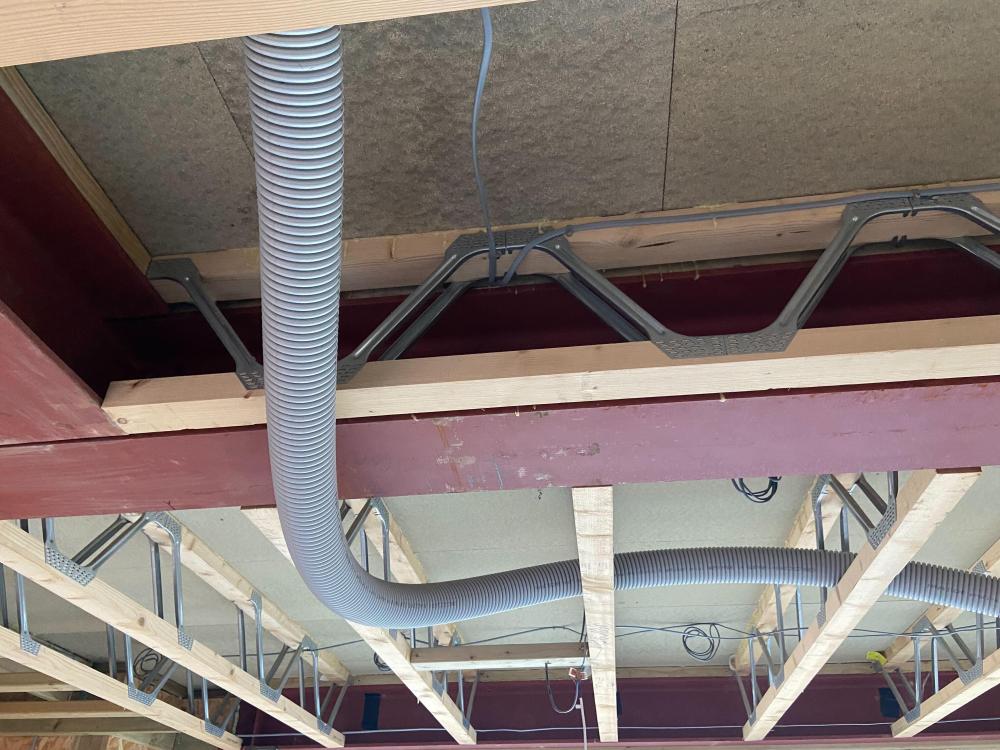
So, my mistake. When working with the SE, SIPs designer and steel worker, and MVHR designer it was just looking too complicated to core the holes in the steel during fabrication to line them up with posi joists so, when I asked could that be cut on site to "yes", I deferred to gut those cores down in place. Here I am and people sucking air between their teeth all over the place. Any thoughts on how these can be cut? We don't have the height to run the ducts under the beams and there are 3 places where there are no stud walls to hide them in. Some folks have said torch cutting would be possible but dangerous. Some have said a mag drill might fit. Really appreciate some help here on suggestions. Thanks
-
How to make improve older brick walls airtightness
DeanAlan replied to DeanAlan's topic in Heat Insulation
Expectation is to dot and dab @jayc89. Already have INTELLO ceiling membrane in for first floor ceiling/roof. Have laid new concrete floors - need to get the walls airtight themselves and then seal against the screed floor and the ceiling membrane as well as penetration points (SVP etc). Intemediate floor joists are new web joists on bolted wall plates. Was probably going to passive purple over those and seal to the wall membrane (parge, plaster, airtight paint, whatever I go with). I had thought about wet plaster but very hard to find plasters that will do that these days. -
Hi all, This forum continues to be of amazing help. I hope one day I can give something back here beyond the comedy value of my questions 😀 Our renovation and extension project is now at the stage where we are about to dryline. But first I need to get the MVHR installed and do what I can to up the airtightness of the whole structure. We are likely going to use something like Blowerproof of Passive Purple on the SIPs extension. I want to do something for the original house which is solid brick wall construction. We've taken all the plaster off and down to the bricks (Cambridge hand made whites I am told they are) circa 1920. Very dusty, and mortar is quite crumbly. Questions: 1. Before I do anything for airtightness do you think I should look to get the physical structure of these bricks/mortar in better shape? Maybe something like a parge coat? 2. Would a parge coat (if done well) bring the airtightness up to a good level? 3. Should I then passive purple or blowerproof over that or maybe the same but directly onto the bricks as they are (which I don't think I could do with a brush, would need a spray version)? alternative ideas? cheers, - Dean PS just searched this forum on parge and airtightness and think I might have resurfaced a massive debate. I think the key difference in my question though is the starting point - an older brick wall / mortar, not nice new blockwork. We'll be dot & dab drylining over that.
-
Great suggestions @dpmiller @Ralph. Was wondering about sealing with primer as we'll need to do that anyway. The Propolex might be the way to go. We have about 140sqm to cover downstairs and we're on cabredeck upstairs for another 100sqm. Trying to get the balance of spending for temporary works that is ultimately replaced v splinters and raw feet 🙂
-
Yeh we have some carpet tiles and we might grab some lino offcuts somewhere to use in the kitchen area and around the dining table. - Dean
-
We're forced to move into our renovation project prior to being able to complete many things - and frankly, I think we can make better decorating decisions by living in the space for a while as well. We have a liquid screed based floor and wanted to know if there were cheap options for a temporary covering that would offer more wear and hygiene (washable). Ultimately we'll need to prime it and then think we are micro-cementing and Amtico or Karndeen but ahead of that any ideas? We might lay all our moving boxes down with gaffa tape (good for wear - for a few months - not good for hygiene). was thinking about cheap lino just taped down. I'm sure there are some bright ideas our there. Appreciate all (most 🙂 ) suggestions cheers, -Dean
-
Actually, the schedule for all of these windows (from the supplier/installer) - including the offending one - is "A"rates toughened 4-20-4 Argon-filled double glazed units. That certainly reads good and maybe I just need to tell BC "Yes". That would be one weight off my mind - assuming there aren't different grades of toughened? cheers, _DEan
-
Thanks @MikeSharp01 and @Conor I see they are members of Assure, and others. - I don't see FENSA and they don't seem to be on FENSA web site either. As a Platinum Partner of Global Origin I had made some assumptions. The order form doesn't have 'toughened' specified - that would be easy. We already have them replacing that very same window with clear glass rather than frosted as it turned up frosted against our spec of clear. Unfortunately the replacement glass has been prepared (angled, not standard) and is due to be replaced but BC just picked up this other point.

-
We just had BC inspection and they have picked up on an issue regarding the large window we have at the half landing of the stairs - apparently this needs to be toughened glass incase someone falls down the top half of the stairs, hits the full height window, breaking it and then falls out/over the cut class. I am principle designer / main contractor. The BC plans were put together by our architect., BC approved the plans which includes the window schedule/location/stairs, and our window supplier/installer (premium partner of Origin Global manufacturer) took those plans and supplied/installed those windows. I've got a horrible (expensive) feeling it is going to come down to me even though I paid professionals to do their job and provide appropriate advice. We haven't spoken to architect, BC or the window installer yet. cheers, - Dean