climbinggeorge
-
Posts
51 -
Joined
-
Last visited
Everything posted by climbinggeorge
-
I've got a little conflicting info on the appropriate layers for our ground floor so I wanted to check in with the buildhubmind. We have a builder that is completing our house to shell, they are handing it over to us with a beam and block floor with a membrane on it (all pressure tested at this point) I had planned, and the architect's spec had said to put insulation, then clip UFH to it and pour the screed. The screed supplier had suggested another membrane over the top of insulation to stop any reaction between screed and foil, and stop any extra screed pouring down cracks. A potential UFH installer had said putting a layer of sand and another membrane on the existing one. The logic being that the single membrane is our only defence against damp so it adds redudancy wither another layer and the sand protects from any sharp bits from the beam and block floor. Just looking for an idea on usual practise, if such a thing exists
-
That makes sense, thanks. My partner took out the insurance a few months ago I'm just trying to play catch up as we are (finally!) reaching the next stage of the build
-
I've just been reading through our site insurance and saw the below: My reading of that is that we are covered, except that the insurers would not pay out anything greater than zero for anything related to site huts etc? The main item - the actual build is covered but a lot of the extras around site are not.
-

Pressurising UFH for screed pour
climbinggeorge replied to climbinggeorge's topic in Underfloor Heating
Thanks, that seems a common sense of doing it. I may have been overthinking it a little -
I've got a bit of a dilemma I'm trying to think through and wanted to see if my solution is viable. There have been delays connecting up the site to mains water (an organisation holding access on a road to ransom, a work in progress but not fixed ETA ). We are just about watertight to shell now and I wanted to crack on with the fit out where I can. For the ground floor the plan is: Beam and block floor (laid) Membrane 130mm insulation (due to arrive next month) Membrane Wunda cliptrack UFH 50mm liquid screed 20mm Floor finishes I can get the UFH piping laid out and clipped down before the screed arrives. For my own peace of mind I'd like to pressure test it before the pour, I've also been advised there should be water in the pipes and pressurised during the pour to prevent rising and stop cracks appearing later. Which leads me to trying to pressure test the piping without access to mains water. I think I should be able to manually file the pipes through the manifold and then use a pipe pressure tester to check (something like this https://www.hss.com/hire/p/pipe-pressure-tester ? ) but would welcome advise if that's the best way or if I'm missing another better solution? The only other work around I've considered is using the wundatherm product and sitting that on top of the screed, effectively raising the floor level.
-
Are you still able to claim VAT back at the end of the self build if the invoices were made out to Joe Bloggs home improvements?
-
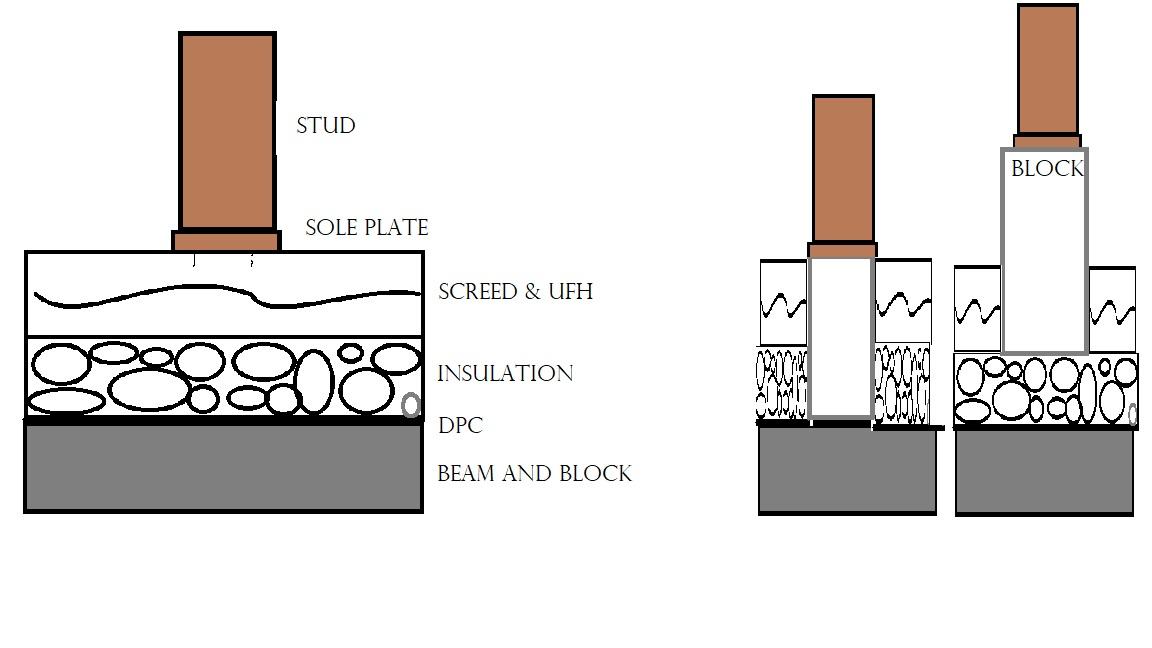
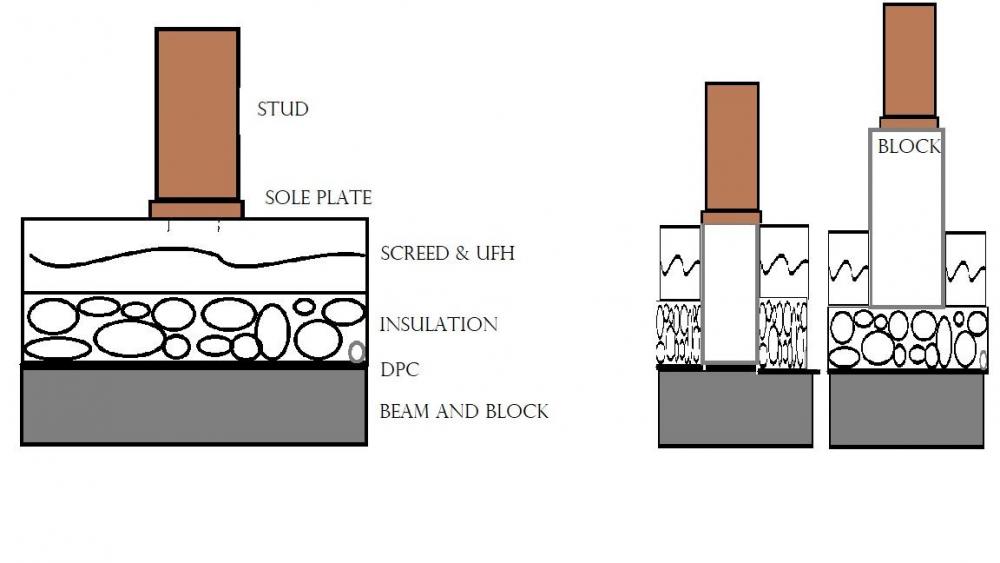
I had planned to get screed down, then build studs directly on top. This was possibly because I was just thinking in layers. However due to delays its now looking more likely to try and crack on with stud walls then pour the screed around them. For this a friend had suggested doing a layer of blockwork then pouring screed and then building the studwork on top of that. I wasn't sure if the blockwork can sit directly on the insulation or if it needed to go to the beam/block but thought this would have a cold bridging risk? Have attached a very technical drawing, with my original thinking on the left and the 2 alternatives on the right if anyone can advise
-
Calculating UFH requirements?
climbinggeorge replied to climbinggeorge's topic in Underfloor Heating
Apologies for the delayed reply. The package is Stroma FSAP 2012 from https://www.stroma.com/software/fsap I think at that point I'd reached the end of my tether with it, will sit down and try and go through it again Based on this I believe its the kWh/month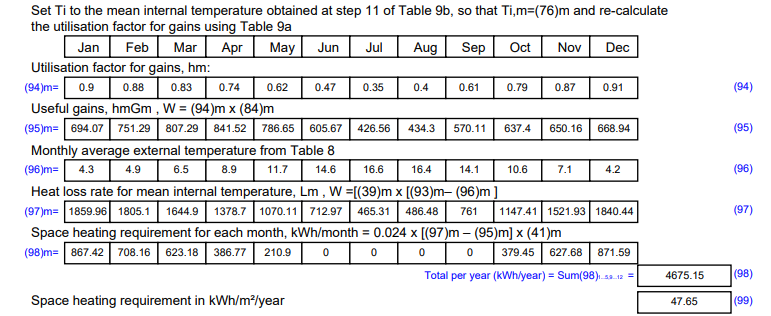
-
In a similar vein to others I'm having a bit of difficulty trying to work out if we need UFH upstairs and downstairs or just downstairs. I'm trying to work it out based on the SAPs and what heat the systems can produce, however I think I'm getting my numbers muddled if anyone can help with pointers. We've got approx 49m2 downstairs (tiled) and 49m2 upstairs (wood) on a detached timber frame property in the South West, I've plugged my figures into Stroma FSAP 2012 and have the below: But I'm struggling to match that to what the ASHP (4kW ecodan) and UFH (wunda are frontrunners, 15mm in screed) produce and how to make sure we're ok day to day in winter.

-
Hi all I'm struggling a little on trying to plan ahead for when we get the shell handed over and start on the first fix. Whilst I'm getting to grips with what needs to happen, I'm not sure in which order particularly when they are separate (but possibly dependent on each other) Has anyone got advice on how they have approached this or resources used? I've got a growing spreadsheet of items to be addressed but ordering them is the next step
-
Evening courses?
climbinggeorge replied to climbinggeorge's topic in General Self Build & DIY Discussion
Thanks all, it looks like prep work and smart buying will be the way forward -
After (a very long feeling) couple of years back and forward we should start building in the new year. It's a 2 storey detached timber frame house, we're getting it built to shell then handed over for 1st fix towards the end of 2020. So my question is if anyone has taken evening courses and if so what they felt they gained/any recommendations? For context this is the 1st house so renting has limited my DIY experience, and whilst I like to think I'm relatively practical I work in IT using databases all day For budget reasons I'd like help with as much as possible in weekends/evenings/holiday but I need to be realistic
-
House energy use
climbinggeorge replied to climbinggeorge's topic in Energy Efficient & Sustainable Design Concepts
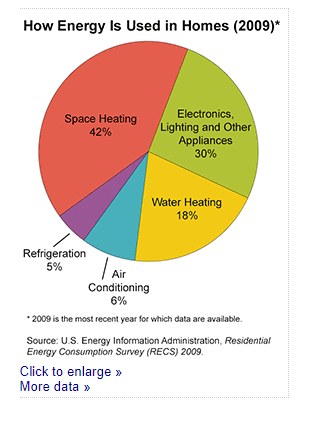
For further interest this breakdown was provided on the sunamp website (excuse sizing):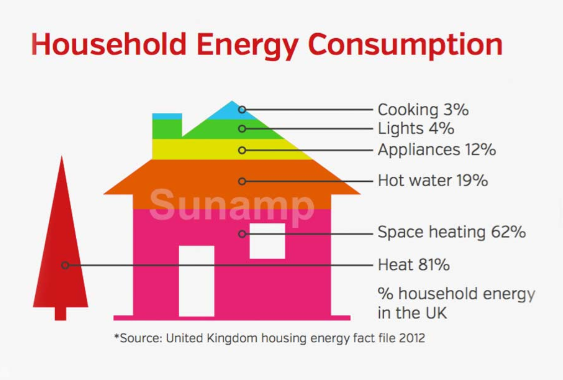
-
House energy use
climbinggeorge replied to climbinggeorge's topic in Energy Efficient & Sustainable Design Concepts
Thanks all, will follow the links and take a look. Although the houses are all of similar construction we're trying to consider how they will be used in future as owners change as well as the best choices for the those involved now so looking at general usage should give a basis -
So at the risk of this being too broad, I'm looking for info on how a modern self build in the Uk will use energy with a similar sort of breakdown to this: Does anyone have any sources they can point me towards? We aren't building to passivehous standards but above uk mandatory regs, meeting uk regs would be the ideal basis for this though The context of this is that as a development (33 units) we are discussing different options regarding energy including the below: PV and heat storage battery (individual or communal?) PV and a microgrid PV and batteries (individual or communal?)
-
A bit late but I'm also in Bristol and am part of a group that is self building although organised a slightly different way, this is a touch further south down the motorway at Lawrence Weston. There is plenty of appetite and interesting talks/workshops in the area
-
I think we'll be doing a lot of the work ourselves Time of year might also be a factor but that seems to be dictated by waiting for planning currently so just speculating for the next steps
-
Some useful info on this thread. I can understand it makes a lot of sense to be on site for getting jobs done, keeping an eye on things and for budget reasons. However both my girlfriend and I work full time and will be during the build, whilst I can 'escape' to the office she works from home and it seems that it might be bit full on to be on site 24/7 in a caravan. Anyone had any experience like this? working from home whilst home is being built?
-
It's bounced back and forward due to other restrictions (without trying to go off topic) but now looking at timber frame and board with a different lender, thanks for advice
-
Had it confirmed with the broker that only timber frame and block is ok with the lender. Which in a way makes it easier, that becomes a fixed problem and now I can work out how what the best method within those parametres is
-
This had been through a broker, also restricted by needing 85% advance Good point on the cavity being required, maybe I need to look at a better alternative to rockwool on the inside then or for that to be thicker
-
Cool thank you, I assumed I'd need some further insulation but hoped there was some super-duper blocks that might do it. Other options include not using rockwool but that choice was driven by it being easier to fit. Only based on the restriction of lenders, it was down to 1 if we use board or 4 options for block work
-
There are a few restrictions around our design due to budget, skill and lenders. Before I meet with an architect I'm trying to work out the most info I can and some trying to gain some opinions on blockwork outer skin. The plan is for myself and my dad to lay the blocks then have someone more skilled render them So we are looking at a 150mm timber frame stuffed with rockwool at the moment with a blockwork skin, the best block summary I've found are here: http://www.greenspec.co.uk/building-design/blocks/ Currently a product called Fibolite seems to tick a lot of boxes for being light enough to lay and ok to render on? Are there any other options I should know about?
-
A first time builder making a timber frame home
climbinggeorge replied to climbinggeorge's topic in Introduce Yourself
Thanks both, some of my questions are more things that are up in the air whilst being considered, rest assured I'll be back with questions once my research is a bit more complete. The blockwork and render are actually some of the more fixed things, insulated render 1 of a few points included in the agreement for the project and after a chat with buildstore it seems that more lenders were comfortable with blocks rather than board which is what has us swaying in that direction. I had not spotted the Blogs, currently investigating them (and googling ridge beams) -
Hi all, I've been scouring these forums for a few months but thought I'd introduce myself and give an overview of what I'm thinking instead of a million posts in a thousand threads before we are further down the line, apologies if I'm not up to scratch fully on forum etiquette. As part of a community self build I'm building an approx 98m2 2-storey 3 bed house with the intention of my girlfriend and I doing a lot of the work but bringing in contractors and family favours (former bricklayer dad and site manager uncles) when needed. This will be the first step on the property ladder and budget comes into play there, a budget £1100 per square meter is our basis and efficiency and eco friendly as feasible the goal. There is a set plot, not met the architect yet and the imagined build plan is as follows, any advice, hints or links welcomed Groundworks/foundations - heaps of insulation, possibly done with a contractor? Timber Frame - house size is fixed so a kit unlikely, simple rectangle shape Layout - upside down house with open plan kitchen/lounge upstairs Blockwork - a job my dad and I can do but aggregate? aircrete? hempcrete? breezeblocks? no idea yet Insulated Render exterior Vaulted roof - we'd like a small mezzanine over 1 end of the lounge, may restrict insulation options and trusses, a contractor and crane may be required? Tiled floor downstairs, wooden upstairs? ufh for both? powered by air source heap pump Thanks in advance for responses from now and over the next few years