Hilldes
-
Posts
375 -
Joined
-
Last visited
Everything posted by Hilldes
-
Thanks @PeterW, For sign off, I think in this case the designer/specifier is me. Got separate SEs for the timber frame and the foundations, but the insulated B&B floor is me. The chairs was my next item to look into. Milbank do specify 75mm concrete above "services" so I've asked if that applies to UFH pipes.
-
Thanks @Mr Punter and @Russell griffiths. The minimum depth of the structural concrete topping is 75mm as specified by Milbank - with various options for reinforcement. I'm planning a 100mm concrete topping with A142 mesh and 16mm UFH pipes embedded and clipped to the steel mesh. I've asked Milbank to help refine the specification for the concrete based on the above. Any views on lack of BBA cert?
-
A coupe of questions on this one if anyone can help please... Data sheet: Specification of structural concrete toppings - "For standard concrete, the concrete sump should be class S3 (100 to 150mm) or S4 (for spot samples from initial discharge, 140 to 230mm)" - what does this mean? What do I actually specify for the groundworkers and order from the ready mixed concrete supplier? Can't see that WarmFloor Pro is BBA certified - not a show stopper if Building Control and warranty provider are OK?
-
I'm seeking quotes for insulated beam and block floor systems. I've received a quote from Milbank for their WarmFloor Pro system. For a 146m2 ground floor, been quoted approx £5K ex VAT for the system. Includes the prestressed concrete 'T' beams (155mm), EPS infill blocks, closure blocks and 150mm EPS top sheet (for a floor U value of 0.12). I'd costed just a conventional B&B floor from Travis Perkins (albeit the un-discounted Ex VAT price), so the T beams and 7N concrete infill blocks. No insulation. At almost £6K. Am I missing something or is that very good value from Milbank?
-
The one I went with @£2k sounds similar to your first option. Will post the work that was actually done when I get the report.
-
Thanks both, if there was an explanation I thought it would be something like the breather membrane or foil on the insulation. This was not the first quote I've seen that seemed to good to be true. P.S. I assumed PIR, the supplier just specified "rigid insulation".
-
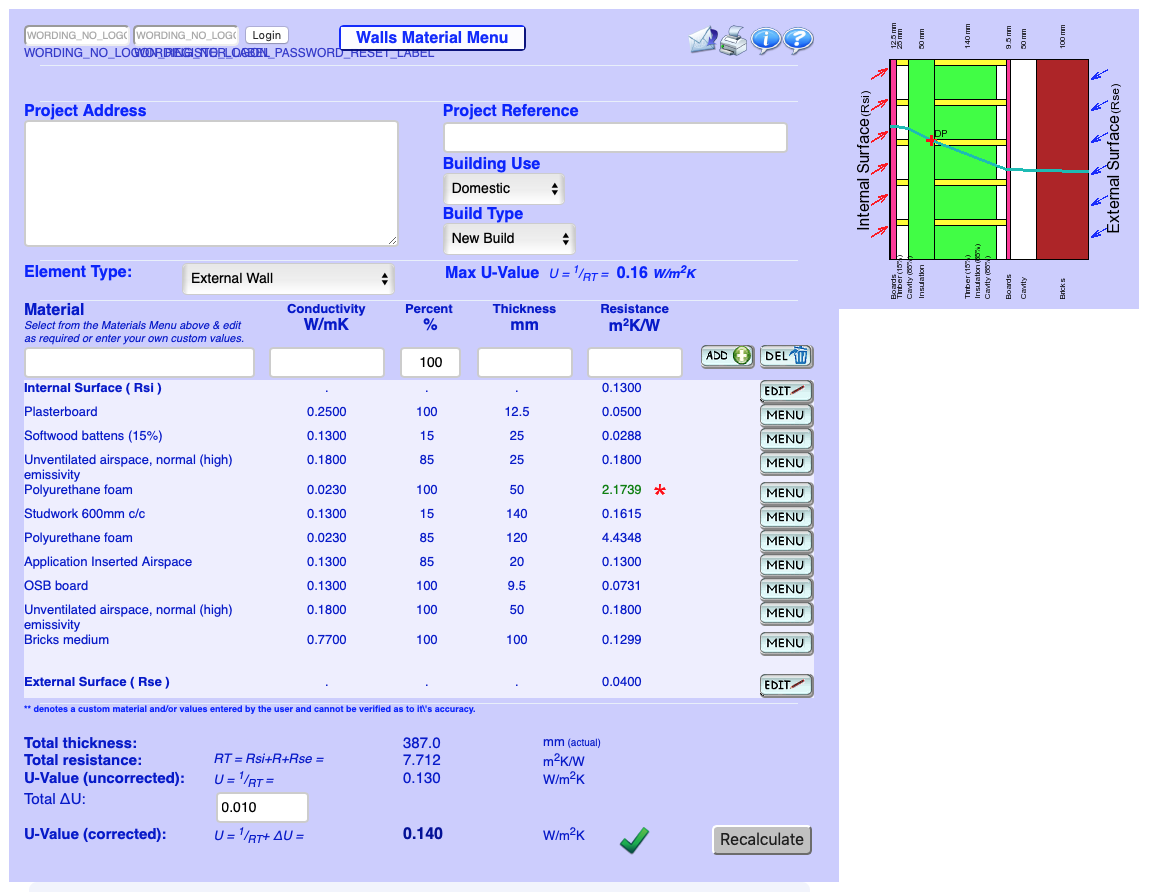
Got a number of quotes from timber frame suppliers. I have been checking a few of the claimed U values. One reason being my current spec is for render board external skin as opposed to brick or block. When I check the U values quoted by the supplier I get a higher figure than they state. Here is an example for an external wall... Supplier offers a 140mm stud filled with 120mm of PIR (so about 85% PIR, 15% timber stud, plus a 20mm air gap). Across the inner face of the stud is 50mm PIR. Supplier claims overall U value for the wall will be 0.11 - but did not caveat this. I did a rough calc on just the elements mentioned and get approx U 0.16. I queried this disparity, the answer was "All our u-values quoted are all calculated based on a masonry external cladding". So I model a more complete, build up with brick outer skin and get U0.14. Is this a common problem? Here are the details of the caluation of U0.14...

-
Thanks @Dreadnaught. Would be great to see a diagram when your design is complete. I'll see if my SE could design such a thing (I would guess not).
-
Thanks, @AnonymousBosch got multiple quotes, going with the one at £2K inc VAT which includes the lab analysis.
-
Thanks @Dreadnaught. So it looks like a ground bearing slab. The piles support what - not a conventional reinforced concrete ring beam? Do you have any examples of completed projects please?
-
From the Kore Design guide: "Suitable for all ground conditions..." "Great care also needs to be taken when building on shrink- able clays (prevalent in parts of the UK). These clays also expand and shrink with changing moisture contents (not to the same extent as top soils) and are greatly influenced by the presence of trees in the vicinity of the building. Foun- dations in these clays generally need to be taken to greater depths than normal to minimise variations in moisture con- tent over time that will cause clays to shrink and expand, thus causing the foundations and building to move, possibly causing damage. In some circumstances, piled foundations may be required or be the most economical way to avoid ex- cessive movement in the foundations. Piles for lightweight structures such as houses, do not need to be large, but they transfer the superimposed loads to a much greater depth, where moisture contents are practically constant and thus shrinkage and expansion of the clays is not an issue. An al- ternative to piling that is also worth considering is the use of Vibro Stone Columns. These are columns of stone that are vibrated into the ground, consolidating the ground around them and providing columns of highly compacted stone that transfer the superimposed loads to greater depths, as with piles. Each option outlined above is compatible with the KORE Passive Slab. In shrinkable clays, a suitably qualified engineer should be consulted to advice on the most appro- priate foundation solution. Further information on shrink- able clays can be found in Building Research Establishment (BRE) Digests No’s 240, 241 and 242." Thanks @Dreadnaught I was kind of hoping that an insulated raft would remove the need for piles, but perhaps not.
-
@PeterW From Touchwood website, pros and cons of insulated rafts: "Not suitable for certain ground types – shrinkable clay for example" I can see no mention of such limitations on other sites. MBC state this, so looks like the soil investigation will be required for all foundation types...

-
@PeterW Smaller Oak tree is 6m for corner of new wall, larger Oak tree is 10m from same corner. Thanks, I'll do some more reading on insulated rafts.
-
Thanks @Herbie costs look similar. Thanks for the image @Declan52 - just how I pictured it.
-
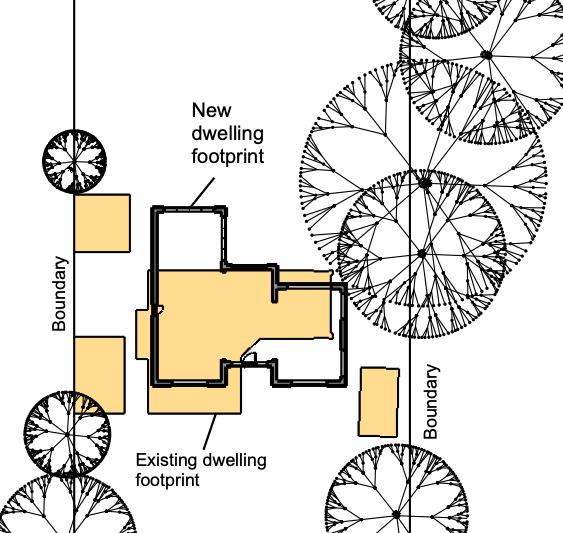
Thanks @PeterW Here is a plan showing proximity of trees.. Most of the larger trees are 20m high. Canopy diameter is approx 18m for the larger tree shown to the right who's canopy extends to the existing house corner. Would an insulated raft be an option even with the 'worst' type of clay?
-
This was what the £2K (Inc VAT) quote included: "Drilling of 1No. Windowess Sampler Borehole to 10.00m bgl at front of property and 4No. Hand- Held Window Sampler Boreholes to 4.00m bgl across other areas of site. SPTs at 1.00m intervals, SHDP to depth if refused. Geotechnical testing to determine volume change potential and concrete class." ...but that was before I spooked the SE with the alleged NHBC requirement for 20m depth. I'm going to go back to the SE and say forget the warranty provider requirement for 20m as we have no evidence this will be a constraint. The mind boggles at what a "Hand- Held Window Sampler Boreholes to 4.00m bgl" might be. Got this picture of a man with an SDS drill and a 4m long drill bit ?
-
Thanks a useful app - especially the foundation design graphic and heave protection required. It can even measure the high of the tree and distance from foundation. I had previously calculated manually from the NHBC web site, both basically need the soil Volume Change Potential Med = 2.5m trench fill, High="specific assessment by engineer required". Based on 20m Oak tree 6m from foundation. I did leave a voicemail earlier this week for local BC for some advice, but the've not got back to me ?
-
Here is what one of the piling contractors stated: " we require a geotechnical bore hole investigation report for all piled projects to provide factual data of the soil strata to depths exceeding the deepest pile toe depth. The bore hole investigation report will provide the design line criteria for our engineers to correctly design the piles based on the loads required for your project. Our offer is based upon information taken from The British Geological Survey website and our local knowledge of the ground conditions. " Maybe I have the Rolls Royce contractors where I just need a Ford? Will PM you for the piling contractor - thanks.
-
This £4K is just the soil investigation. Got a couple of tentative quotes for the piling, both assuming 27 piles: Piling only, 450mm diameter CFA bearing pile, Avg depth 12m = £13.5K Piling plus ring beam, 300mm diameter SFA piles, Avg depth 9m = £32K (includes beam shuttering and heave protection) Both quotes are provided in advance of the soil analysis (although 1 above did piles for a new build diagonally opposite ours).
-
Not selected the warranty provider yet. I did some research that I shared with the SE because he'd not heard of any soil investigation requirements from warranty providers... From a quick look at NHBC requirements I could see no mention of specific depth of trial holes. They appeared to reference BS EN 1997-1:2004 EN 1997-1:2004 (Eurocode 7: Geotechnical design - Part 1: General rules), and from that (a very quick browse), it gives this for piled foundations: "7.5.2.2 Trial piles (1)P The number of trial piles required to verify the design shall depend on the following: - the ground conditions and their variability across the - the Geotechnical Category of the structure, if appropriate; - previous documented evidence of the performance of the same type of pile in similar ground conditions; the total number and types of pile in the foundation design. (2)P The ground conditions at the test site shall be investigated thoroughly. The depth of borings or field tests shall be sufficient to ascertain the nature of the ground both around and beneath the pile tip. All strata likely to contribute significantly to pile behaviour shall be investigated. (3)P The method used for the installation of the trial piles shall be fully documented in accordance with 7.9. "
-
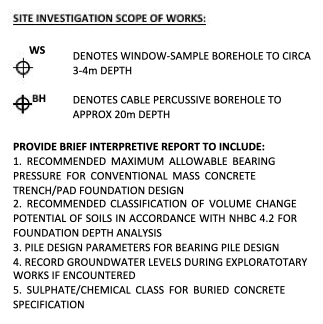
Background is the site has clay of some form and Oak tress in close proximity, so we need a soil investigation. The SE has given this spec to two soil investigation contractors: 4 No. WS. 1 No. BH. One company came in £2K cheaper originally. Until I told the SE that a piling company had mentioned to me that NHBC would require soil investigation for piles to be "around 20m deep". Hence I now have two quotes at £4K+ ☹️ Any views on how I can get what I need from the soil investigation at a reasonable cost?
-
Permitted Development Trade - how it works
Hilldes replied to Hilldes's topic in Planning Permission
I'd call it more a 'tactical negotiation'. I do empathise with the planners - I know it is really challenging to reconcile the desires of home owners with the constraints of policy. For me there is a substantial inconsistency in policy that makes it extra hard for the planners in this case. If you look at the floor area uplift possible (again in the green belt): PD extensions: Large uplift (assuming the original house has had minimal extensions already as was the case with our 1950s chalet bungalow) Non-PD Extension: Medium uplift Demolish and rebuild: small uplift. We made a strong case that the approved PD extensions were ''bungalow sprawl' (we didn't call it that) and a replacement 1.5 story dwelling with much the same footprint as existing house will cause less "harm to the countryside". -
Thanks all. I'll see what I get back from other suppliers' quotes. P.S. The quote in this post is from a very well known brand featuring their own insulation products. The U 0.19 variant features 25mm rigid insulation across the internal face of the studs as far as I can tell from the quote only.
-
Thanks @ProDave, there is additional insulation across the inside of the studs. Allegedly achieves U-values between 0.19 and 0.13 (assumes a brickwork external skin).
-
Got a quote for timber frame. The supplier appears to have a standard sized stud for exterior walls: 38mm x 89mm (C16 structural softwood). While I don't doubt this is adequate to take the loads, a couple of questions please: From my research, most other suppliers have studs 140mm or more deep. Is that correct? In my specific case, with no brick or block outer skin (render on board), the 89mm stud appears 'insubstantial'. Should that be a concern?