jpadie
-
Posts
184 -
Joined
-
Last visited
Everything posted by jpadie
-
Hello and greetings to all for the festive season On a garden room project I've got a flat cold roof (75mm slope across 3.5m). For soffits there is an overhang on the high side of 500mm and on the low side about 100mm. The joinery is 2x7s stuffed with 140mm of PIR. Providing quite a bit of air space under the osb which sits atop the furring. What's the normal way of providing ventilation to the roof cavity? Soffit vents on the low side and fascia vents on the fascia of the high side? Or are soffit vents either side ok? Or can I reverse so that I have soffit vents on the high side and fascia vents on the low? Aesthetically venting on the fascia of the high side would be least good. Is it normal to have mesh on the inside of the vents to protect against critters? If so what's the advised density for the mesh? Those I've seen would definitely let through wasps who seem to like to nest everywhere. And the soffit vents that I see on typical pvc boards look big enough to accept hornets. Thanks in advance! Justin
-
well that's a perfect explanation! thanks!
-
Hi I've been living in France for the last 20 odd years and am just back in the UK. One thing that has surprised me is that the MCBs in the screwfix catalogue seem predominantly to be single pole. By implication this means that it's ok in the UK just to switch the live; no need to throw the neutral too. Is this really the case? thanks justin
-
The MDPE is already in place and 20mm. No choice there as it's been in the ground for a decade (I made a mistake typing 22mm in the first post) So convert down to 15mm for the transition. Then into a manifold to feed the immersion, shower and low demand separately?
-
So do all in 15mm incl the shower? Or is the suggestion to go from MDPE 20 to PEX 15 then back up to 22mm? Wouldn't that throttle the flow to the shower?
-
Hi all I've got buried 22mm mdpe running to a garden room. To serve a shower, basin and loo. I'm planning to use 15mm PEX to the shower and loo and 22mm for the shower (and immersion). Is there a good way to transition from the MDPE to 22mm PEX or copper? Ideally pushfit or solder. Thanks Justin
-
Thanks. I'd taken off the anti lift nubbin but your comment got me looking again and I saw that a piece of trim itself was also acting as an anti-lift feature. V grateful for the pointer @Russell griffiths!
-
Morning all I've been struggling for a couple of hours to fit the sliding sash back into the frame of a patio door. The frame is plumb and square and secured and the fixed sash goes back in neatly. The sliding sash will not cooperate though. Like it's 6mm too tall. Any hints please? Thanks Justin
-
It's quite wide, at 2m40. Roof is 2x7s, sheathed with 18mm osb and covered with epdm. Studs and rim joists are 2x6s. There is about 5mm of sag in the middle of the 2m40 rough opening. Fingers crossed that it will be ok as the sliding door arrives weds...
-
Mornin' all a PVC sliding door will be arriving in a couple of days and I am scratching my head about a few niggles. here goes: 1. do I fold the housewrap back under and around the door frame? I've seen many people do this on yt videos but I wonder whether the UK style door frames are the same construction as the US. I've also seen people use stretch-wrap. is this interchangeable with standard housewrap? 2. i've seen that packers are essential both around the frame and around the glazed panel. do I fasten _through_ the packer or silicon the packer in place and fasten immediately adjacent? any other tips of the trade for a DIY sliding door install in a timber frame please? it's v wide (2m40) so I'm already thinking that I can't do this one on my own! cheers Justin
-
Thanks both Have written to building control about sign off on the sparks. No reply yet. So far as I interpret the regulations for electrical wiring, under the cladding on the external side of walls is fine providing it is in one of the safe zones. The safe zone in question is 50mm depth. I'm not planning a service void but that may be a good solution for one particularly 'busy' wall.
-
Dear hive mind I'm building a garden office with shower room and loo. The timber frame is up, the subfloor insulated and closed, the roof on. The frame is clad externally in osb3 and tyvec. The sliding doors will go in on 16/11. To dos include insulating the walls and roof, building the internal partition for the wet room, electrics, plumbing, ashp (arriving this week), plasterboard, decor and flooring. I'm planning to run electrics down the external wall under the cladding and across the top of the roof rafters. There should be enough depth for regs. Am I right in thinking that I should put the insulation in the walls and roof space, and install the vapour barrier before pulling cables for first fix electrics? Ditto plumbing (wall penetration already done for the waste pipe and connection to soil stack and sewer lines is in place, but I've not plumbed the water lines yet. I'm also thinking I could plumb the water ingress now. Insulation is PIR but I wonder whether the areas around the pipe penetrations should be rockwool to avoid too much cut out. Alternative is cut out and then fill with expanding foam. Basically I'd appreciate a little guidance on the best order for the remaining tasks! Last q is on plasterboard: the timber frame is a little wavy in the sense of there being valleys and hills in the joists. And sometimes the edges at the rim joists are perhaps creating a 3mm lip. How much play can plasterboard absorb? Should I plane down all the proud areas? Thanks in advance! Justin
-
What do people use for battens to hold weatherboard or metal siding please? I've been working on using 50*38mm to give enough depth to run cables down the outside of buildings to comply with 50mm depth rules. But seemingly very few yards have lumber at this size. 25x38 is common (tile batten) but feels too thin to nail into reliably without splitting. Doubling up is an unattractive solution! Looking forward to receiving your wisdom here.
-
very grateful for the advice and reassurance! rubber is on and the sub-floor drying out (slowly) ...
-
Hello all I've just got the osb sheeting on to the flat roof and the epdm arrived today. I've realised that I think I need to have the fascia board in place before I put the rubber on. I.e. the various trims go over/on top of the fascia board. Is that correct? Or does the fascia board butt up to the epdm trims? There is 11mm osb board there at the moment, acting as a sub-board. Eventually there will be fascia board that will match the other trim elements. If it is correct that the epdm needs to go over the fascia board is it ok still to glue it down nowish and leave the edges flapping (or lightly tacked to the osb)? Then finish off when the fascia arrives. Reasons are tomorrow is the last non-rain day for a couple of weeks and I'd like to get some weatherproofing on. Thanks in advance Justin
-
huge thanks for the reassurance! none of the nails are directly exposed to the environment and are protected from water ingress from above so fingers-crossed! off to do the rest of the wall frames now, and the roof. after a quick trip to paris in a clapped out skoda fabia to help my eldest move flat. again.
-
I don't think paslode do ring nails in 90mm unfortunately
-
they are the bright nails ...

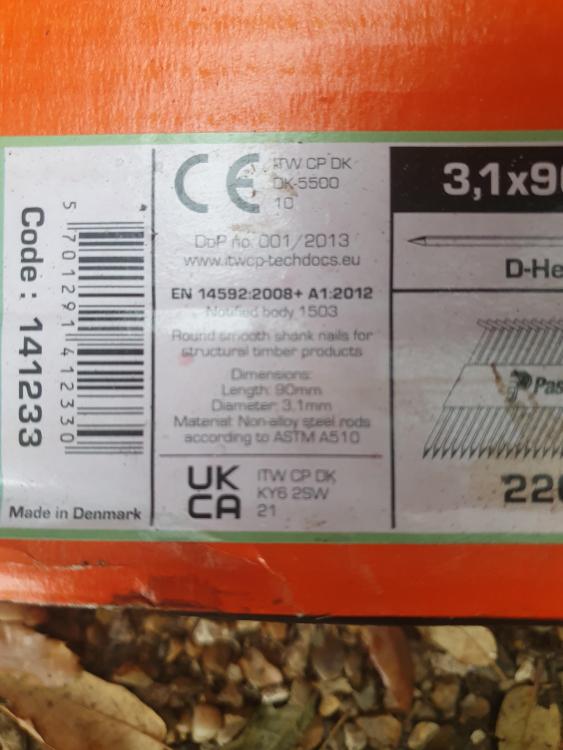
-
thanks for the response! i can double nail all the joist ends that are still exposed but the wall frames (for example) are obviously not nailable into the sole plate (except by toe-nailing. and the sub-floor is in four sections and joined together. so one side of the joists are not accessible. screwfix website says these nails are galvanised and "won't rot or deteriorate". Paslode website makes no mention of that! how serious is this (yes of course I will go forward with the right type of nails and will renail where I can).
-
I've just realised I have used interior grade paslode nails on the subfloor and one wall of a timber framed garden room. the wall frame will be clad with osb and the osb will also skirt the sub-floor. Is this sufficient or should I double nail with galvplus nails as well? wood putty over the nail holes? unfortunately it's not credible to start again!
-
how to plumb/frame toilet waste in a timber frame base layer
jpadie replied to jpadie's topic in Waste & Sewerage
please ignore. i've had to move on and used some plastic brackets to support with no extra framing. -
hi all I'm thinking of allowing for a shower room and loo in a garden room project I'm in the middle of. the loo will be in the second bay from the bottom left. the waste will exit just behind the bottom left foundation block below the floor joists. that's a good position for the soil stack and easy access to existing pipe work to the main waste. the insulation goes between the joists here. I've currently left this bay uninsulated as I am unsure how to frame the area to receive the waste pipe and stop it physically dropping in the void below. is there any standard practice here? thanks in advance!
-
Dear hive mind. I'm looking for guidance on timber framing for a sliding door that will be nearly the full height of the wall studs (within 70mm) Would this entail 1. cutting away the sill plate, 2. Doubling up on studs left and right; and 3. Bunging perhaps a third piece of 2x6 across the top 4. Packing the rest of the gaps as needed. or am I missing something?
-
Thanks @Marvin I'd not considered another layer _below_ the joists. currently below the joists is just dirt. I could dig down further to create the space. the joists were going to be 4x2 but I've realised that they won't span the distance (3m). so the choice was either to go to 8x2 or to put a couple of foundation blocks down the centre line and build four separate floor assemblies. feels like scenario 2 (the 4x2s) is better. I can see how to make this work by building the floor upside down and then installing the panels (would glue be good enough to secure the boards to each other? I'd lose the areas of insulation that would have to be cut out for the foundation blocks but gain the u-value of the concrete in lieu. quick thought: i'd assumed that e.g. celotex 100mm would not fit into a 4x2 joist (95mm) as it was not compressible enough to be secured in that space. is that correct?
-
I know that it will often be the case that a garden room will be exempt from the u-value requirements but I'm interested in seeing how I might be able to comply. The construction will be a timber frame and suspended floor. When I use the calculators supplied by celotex and the like the results come back that there is no product capable of meeting a u-value of 0.13; and that's using joists that are almost double the depth that I need. I could insulate over the floor-joists as well but they don't provide a calculator for that but working around the problem isn't really the purpose of the question here ... which is: is there any practical product that meets the regs for suspended timber floors? if not are we in a world where all new construction will be on a solid slab (my house is 100% suspended timber flooring)?