jpadie
-
Posts
184 -
Joined
-
Last visited
Everything posted by jpadie
-
So what I'm hearing is that the underlay will not absorb any imperfections in the subfloor. Is planing and overboarding a preferred method to adding a self levelling screed?
-
Under the osb are 2x6 joists and 140mm PIR. The osb goes under the wall studs and sill plate. So not easily removed. It's also glued to the joists as well as screwed every 150mm. I could lay ply but with the bamboo and underlay i would lose 28mm of head height. I had to stay under the 2.5m height rule so I'm very constrained and trying to get away with the absolute minimum head height loss possible. Also would not ply just repeat the contours from the subfloor?
-
Hello all I've nearly finished a garden room which has a sub floor in 18mm osb. It got wet during the build and the joints have swelled. I've managed to plane them down but there is still about a 6mm tilt on a 1200mm level. I want to lay bamboo 14mm uniclic boards on 3mm foil underlay. My question is whether the unevenness in the subfloor is significant enough in your experience to warrant a self levelling screed? And if so what do you recommend (my experience of self leveling mortars has been that they are rather guilty of misadvertising their self levelling nature....) Thanks Justin
-
problems getting SWA into a CU mounted on plasterboard.
jpadie replied to jpadie's topic in Consumer Units, RCDs, MCBOs
Thank you. That worked well and I may also use the same solution to mount a mini split unit whose rear mounting bracket is only 350mm wide. The instructions say to use wall plugs but I suspect it expects to be mounted on masonry. -
Hi all Can I ask for guidance on the regs for earth bonding please? This is for a garden room. HDPE piping from the main water supply to the garden room. Copper going from the outside to the inside (150mm). Then copper running in the shower room and utility cupboard using a mix of plastic push fit and soldered connections. Total length of all the copper end to end is about 5m. If earth bonding is a requirement then do the regs allow the large 10mm bond to the copper to be anywhere along it's length and then bridge the push fit with shorter spans? This would make life a lot easier. Thanks Justin
-
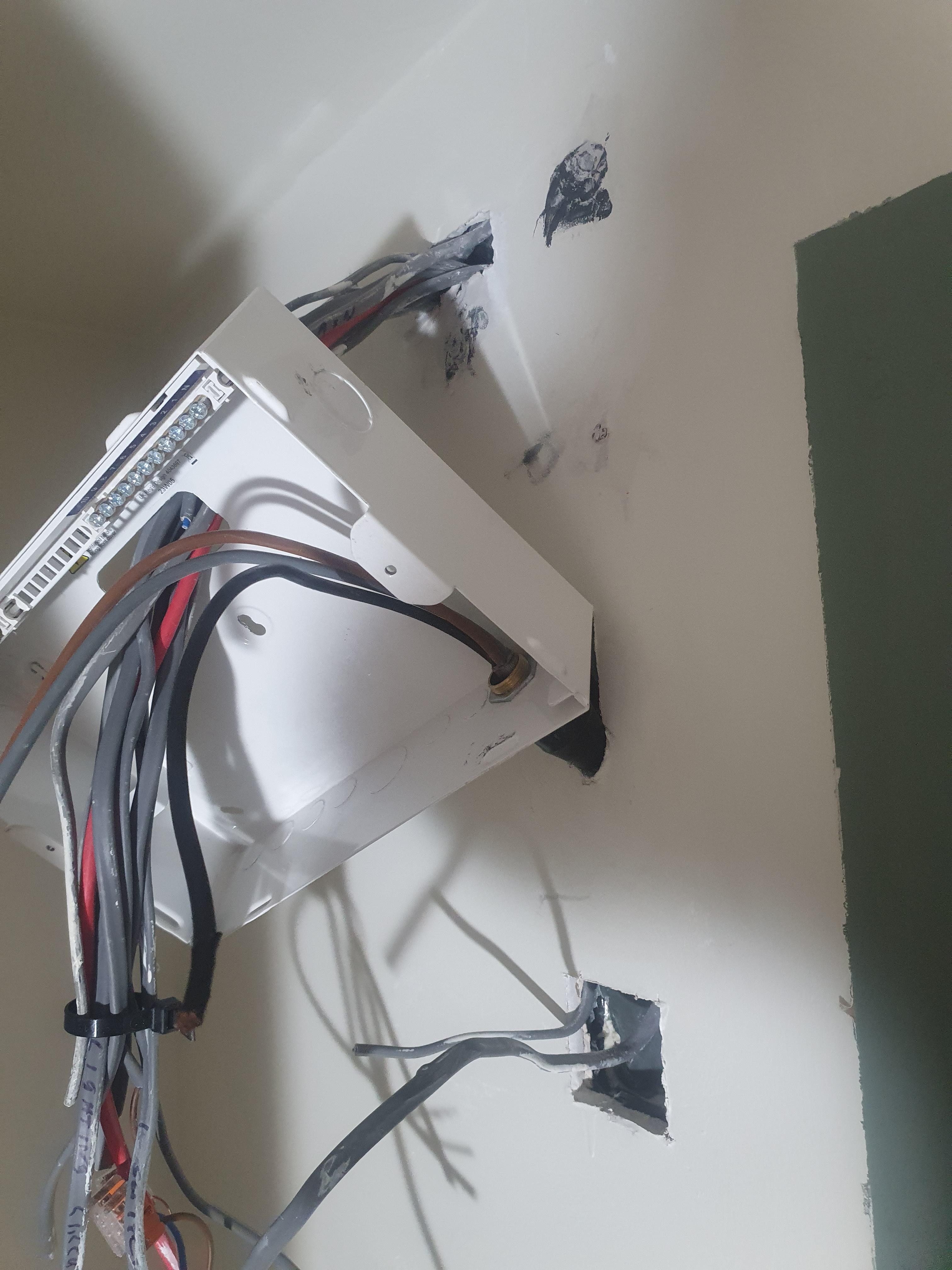
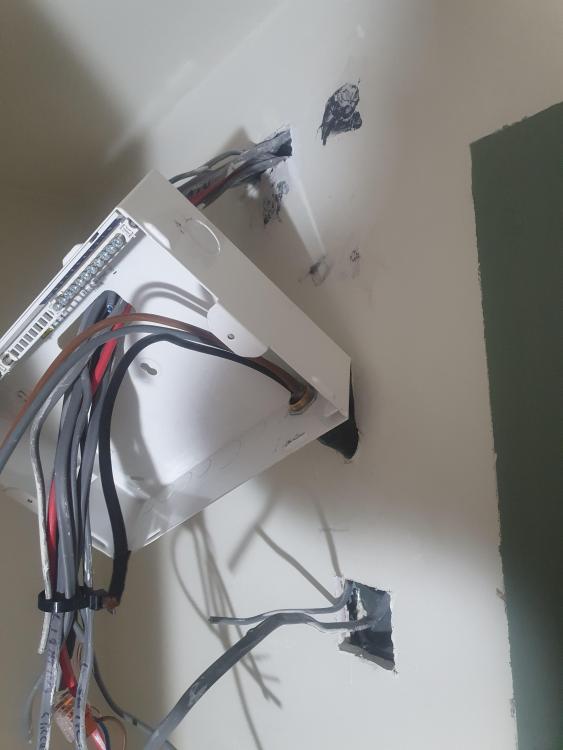
Happy Easter to the lot of you! I come in search of some more collective wisdom to solve a problem in the "proper way".... I'm installing 16mm2 SWA to a garden room. I've gone through the outer wall at a very steep angle to try to minimise the bend radius. But even then the rigidity of the SWA is such that as soon as I put the CU on to the wall the CU gets ripped off the plaster, drywall anchors and all. What's worse is that the area is already decorated... Pic below. for the drywall anchors I've used standard rawlplugs and the easyfix type. I have some constraints that have to be observed: (a) I cannot bring the cable in much lower as I need to leave width to get an immersion heater in/out. (b) I cannot get the CU to match up to any installed battens. My thoughts so far have been: 1. give up. take the swa to an adaptable box on the outside of the garden room and use the hole to take some 16mm t+e through a conduit and up the inner surface of the plaster board. I might be able to fish the cable up and bring it through the main cable pass although I'm not holding my breath that it would be any easier. 2. use really heavy duty drywall anchors and try again. 3. it's _just_ possible that I might be able to get some 19mm batten material horizontally through on either side of the cable channel hole. Could do this and try again. overall, I'm leaning towards solution 1 as I can't, in honesty, see how I can make it work reliably. feels like this gauge of SWA is better suited for bricks than plasterboard! thanks in advance for your thoughts. justin
-
cable through to exterior- conduit required?
jpadie replied to jpadie's topic in Consumer Units, RCDs, MCBOs
thank you. it will either run through the soffit and be protected from UV or in PVC conduit. it's the 30cm through the wall thickness that I'm focussed on. no UV concern there but I was concerned that there may be regulations specifying a requirement for conduit. the challenge goes to how big the hole through the wall must be and how to anchor the conduit at either end (there is _no way_ to anchor a perpendicular conduit to the CU aesthetically in my situation). I'll attack this tomorrow! SWA is a PITA. It's inflexible and a b***er to work with imo, even disregarding the price. i'd also need to gland the SWA which means taking it out of the side of the CU, which i don't want to do when there are perfectly serviceable routes through the back. Lastly, I don't see the need for SWA since there is no chance of the cable being damaged or otherwise outside of a safe zone without being in a visible conduit. -
cable through to exterior- conduit required?
jpadie replied to jpadie's topic in Consumer Units, RCDs, MCBOs
thank you. it would not chafe on PIR but possibly on the OSB -
cable through to exterior- conduit required?
jpadie replied to jpadie's topic in Consumer Units, RCDs, MCBOs
let's ignore what the appliance might be. Let's assume for the moment that it is an outside light. Conductors must pass from the CU (directly or indirectly) to the outside. Do those conductors need to run through conduit if they are not armoured? -
cable through to exterior- conduit required?
jpadie replied to jpadie's topic in Consumer Units, RCDs, MCBOs
this isn't a brick wall so not a cavity in the sense of a cavity wall. the building is timber framed and the cable will be run either in conduit on the outside of the cladding or in the soffits more than 50mm from the base to make a "safe zone"). The cable will be for exterior appliances (a car charger perhaps, outdoor sockets). so it does need to be on the exterior of the building. -
hi all i need to get a 10mm2 t+e cable from a CU through the wall and to the outside of the building. It's not armoured cable. my plan is to drill through the wall behind the CU. the hole will be in the safe zone. on the outside there is 25mm battening and then fibre cement cladding. Either I will take the cable up into the soffit and along through the roof beams until it arrives where I need it or I will bring it out through the cladding and take it around the building in conduit. most likely the second route. my question is about how to bring the cable through the wall (PIR and OSB). Do the regs require there to be a conduit or can the wire be run through without separate protection? thanks in advance, justin
-
I was asking generally. But for the sake of argument we could say 70Amps. The thread stemmed from wanting to export earth from the consumer unit and to earth the adaptable box and gland so that the SWA armour also shared the earth. The SWA connects to a delayed trigger RCD at the CU. Rather than fight to get two conductors into the CU for earth I wanted to take a 16mm2 fine strand conductor from the earth busbar to the adaptable box and securely join it to the adaptable box and cut down the third conductor in the SWA and join it to the earth. I was going to use two lugs (one on each conductor) and bolt or screw them to the adaptable box. The MET looks neater.
-
Thanks. That should work well for the earth. Out of interest, what's the best way of joining three large x-section live/phase or neutral conductors?
-
Dear hive mind Can anyone point me to a Screwfix/Toolstation/CES product that is suitable for joining three 16mm2 conductors in an adaptable box? If it makes a difference, these are earth cables that will also be bolted to the box (metal) or attached via one of the fixing screws. I was hoping that the wago lever style connectors might exist for high current large connectors but I've not been able to find any. Thanks Justin
-
I recall dimly there being a regulatory change on limiting conductors in mcbs to one only (not sure how a ring main would work then...). Does this hold true for the main manual breaker in a CU? I'm adding a third RCD to a CU and can just about squeeze in 3 16mm2 cables to the main switch. Before today there have always been two. Is this allowed these days? What's the usual solution if not (joining these thicker cables seems non-trivial).
-
thanks both. conductor is not damaged - i've had trouble with tape staying on for more than a year in the past. somehow the adhesive seems to age and then the slightest bump knocks it off or loosens it. maybe the quality of the tape I tend to use? grey core for earth and the black for neutral. I will sleeve both in the CUs. do they need sleeving in the junction box too for reg-compliance?
-
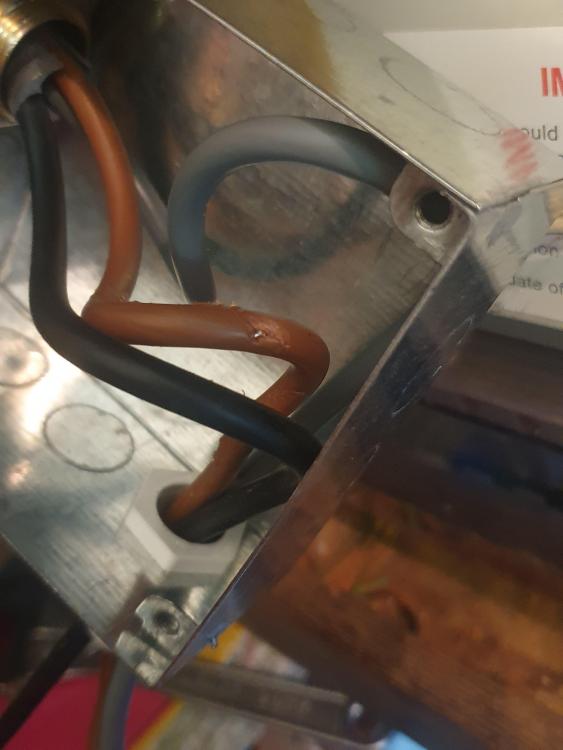
hello all annoyingly, after a morning of struggle with getting a long length of 16mm2 three core SWA into a junction box, just at the end in despair I used some grips to help bend a conductor and this removed some of the insulation. Is there an approved way of repairing this (tape or heatshrink) or so I need to splice and mechanically join a new length? second question is whether these conductors need earth and neutral sleeving in the CU and in the junction box (existing CU at one end, new remote CU at the other)? thanks Justin
-
Good plan!
-
Thanks I've not come across fuses like that but I've only been back in the UK for a year. In France (as of the last 24 years anyway) there is no switch nor visible fuse before the meter. So two things to keep in mind 1. I need to contact the electricity board to have the meter swapped out and 2. I need to find out the dimensions of the new meter to ensure I leave enough space for it to be fitted (although assumedly the Teleswitch, existing meter and cut-out will go.
-
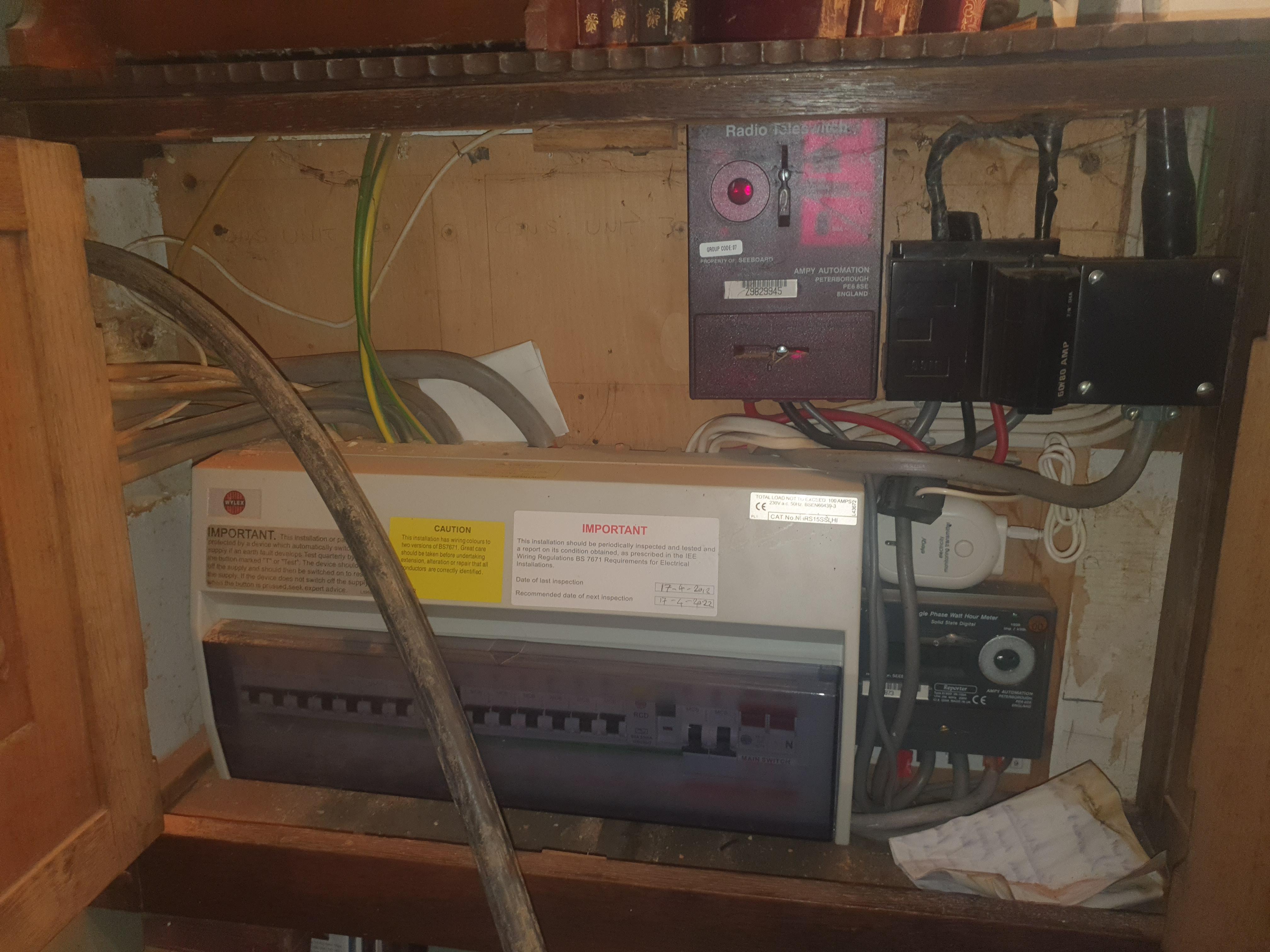
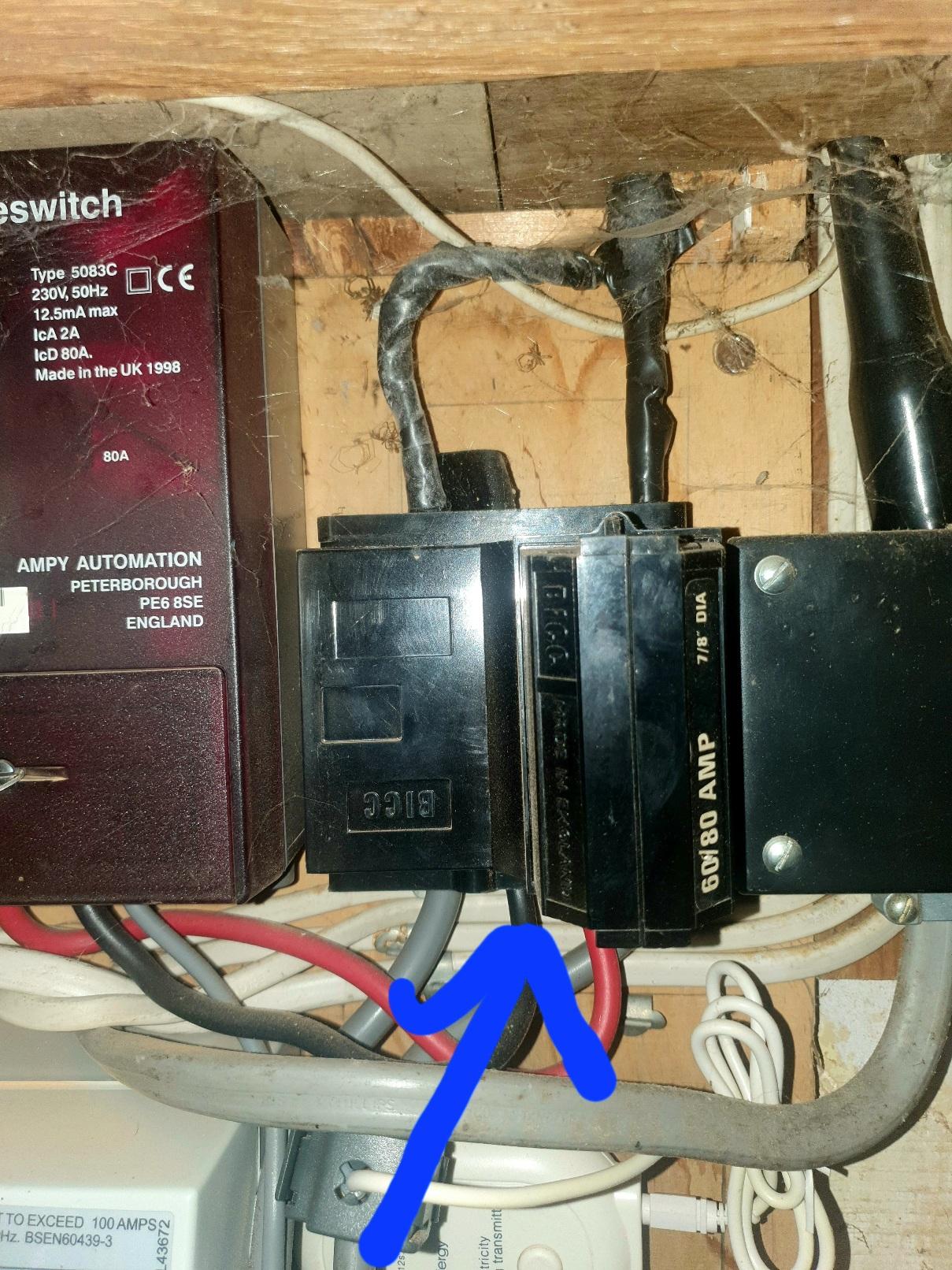
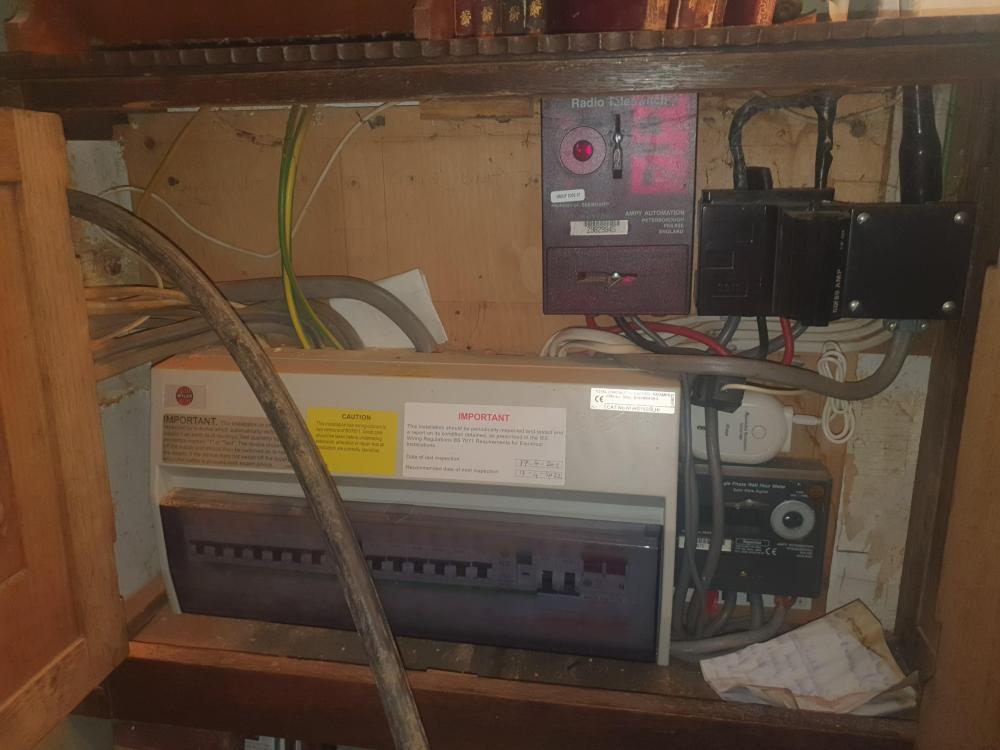
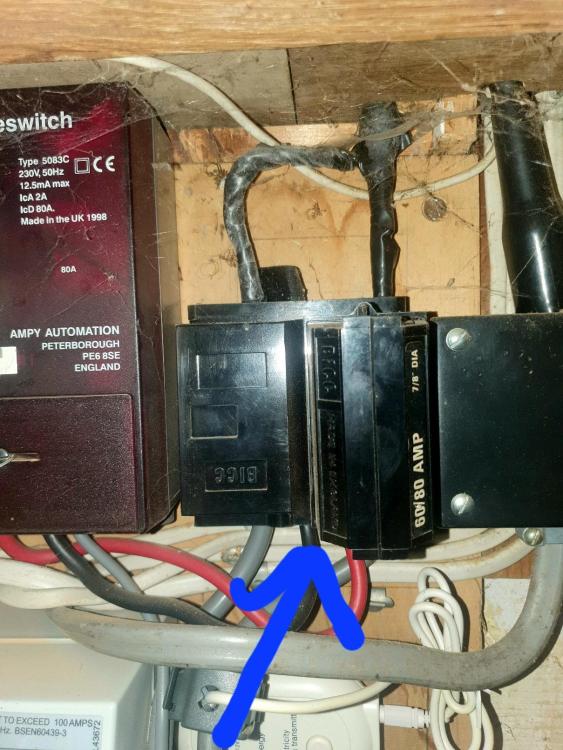
Thanks for the info We are still on economy 7 or the equivalent. No idea what the Teleswitch does any more if ever. I thought it was the equivalent of a linky in France. Can I remove it? What about the big black thing with the arrow pointing at it above?
-
Not enough space to be touching the consumer unit but I can mount a 150mm adaptable box a few inches above and will keep searching for a smaller version (like the one on the right). If there is a distance will a small length of flex conduit to carry the conductors be sufficient for the regs? Also does anyone know that this is? Seems to be on the main feed into the transmitter box, pre-meter.
-
Thanks. I had a look but the plastic looks too weak to resist the tortional stress of 16mm^2 SWA. It's very easily bendable.
-
Hello all I am bringing 16mm2 SWA into a wylex distribution board that was installed about 12 years ago. It's plastic and has no knockouts for glanded connections. What's best practice here please? Should I mount an enclosure that can take a gland and then continue the insulated conductors through some conduit? I can see in the past an electrician has terminated another SWA cable in a plastic enclosure and then carried on with normal flat t+e. thanks in advance Justin
-
Thank you all. I will give the water company a call and see what's what. They only started charging last year after fitting the new meter 6 years ago. So the first bill was huge but seemed to represent more than two baths per day when typically there's only one person in the house most of the year. Will post back when I hear from southern water.
-
Hello all I found I'd lost 17litres of water overnight between the meter and the stopcock over night (stopcock shut off). I'm thinking the best place to start looking for issues is at the meter since the MDPE comes in directly to the house and does not appear to be compromised at the house end. The meter is just outside the curtilage of my land. Are there any regs on whether I can dig it out to inspect? The meter box is always full of clear water so there is a second reason for starting at that end. Thanks Justin