Shaun McD
-
Posts
98 -
Joined
-
Last visited
Everything posted by Shaun McD
-
Thank you very much for the guidance, greatly appreciated!
-
Ok sounds good, so use the like of a kooltherm K12 as the benchmark and forget about pur v pir?
-
Thanks for this, is there a reputable 70mm board that I could reference as an acceptable benchmark, that i can compare the board used by the TF company against?
-
Haha, Im guessing that like myself, you spoke to a few trade "professionals" and realized that winging it yourself may be more informed that some of the pros!
-
Had me worried too, it seems much more normal to be adding the VCL (Pro Clima Intello etc.) between the stud and the PUR/PIR layer. However, to their credit, our TF company has spent considerable time talking to me on this point. They do not use an OSB racking board for example, instead its a breathable board, the specific one escapes me but something like Elka Strong board. The logic is all around interstitial condensation, and that in their view, the VCL inside the insulation is incorrectly used, or at least not required. TBH the science, or potential lack of, goes over my head but I have some level of confidence that the TF company AT LEAST believe what they are doing is best, i am just not the person to know if its wrong! Looking forward to having the forum either support the idea, or have me now thinking il need a new TF company ha
-
Yeah I would think this is a sound idea, any heat lost from the 100l buffer is ultimately still inside the envelope so its not like it is lost. Only consideration is the heat pump "ideal" volume of water size, which I have yet to try to figure out so. Either way, I am sure the buffer is valved, so in theory it could be cut out of the loop if needed, or have it paired with only specific zones etc.
-
I was thinking on a room by room approach too, would reduce the volume of air to move through the fan, and would think it be more manageable sizes for a novice tester? My better half reminds me my time is not worth much so...
-
So depressurize instead of pressurize? The previous one I seen done must have been pressurized as we walked around with the candles and you could see the junctions in which air was getting forced out as that is where the smoke was pulled to. I suppose in a depressurized test you do the same thing but the air will be blowing away from the leakage point, so maybe its no difference. A door makes sense yeah, fan needs to be securely mounted for obvious reasons. I am a few months away from having rooms to test but for sure this will be something to do, provided i dont get a great result from the TF company first time ha!
-
Can you help me understand what the different properties would be for my application and what the impact of choosing either would be? It will be fixed to the inside of the stud, with joints taped to act as vapor and airtight layer, batten added for service cavity before plasterboard. This is super interesting and seems right up my street ha! I was only ever involved in a test once, and the tester was more keen to get job done and out rather than answer any questions. I remember he had smoke candles to see leakage points, is this still the method? Im guessing it is easiest to pressurize the room to test on this kind of level? Pretty sure I have an old radiator fan and a washing machine motor kicking about to rig something up!
-
That seems like a solid approach, i will be going with a diy home automation setup through home assistant so will have room sensors also, but yeah slab sensors can be an additional data point and seem pretty economical. Likewise, I am a bit conflicted on zones as we have some north facing rooms which will get no solar gain, and other southern facing which will get loads of gain. I feel pretty stupid now thinking that I would need to have zones decided when we install ha, as long as we know which manifold loops go to which rooms then we can add one or many actuators at any time in the future and map them via home assistant to the room sensor! Keep it simple stupid ha! I did have an open dilemma around buffer tank for UFH, which i think could be beneficial if we end up with zones, less so if we live with one open zone. Have you made a decision on that?
-
That is a good idea, I am sure I can connect with the AT company the TF company uses, and agree to pay for some time beyond the test paid for by the TF company. Thanks for the tip! What type of DIY rig are you thinking? Your own blower?
-
Yeah they provide for a test and its in the contract to be under 2.5, but we have a gentleman's agreement that the target is 1.5! It will be done before floor insulation, finished floor, plaster-boarding, and plaster so will be scope to DIY improve on our result from there too.
-
Interesting, I take it you will still have room sensors too? Do you have the zones valved to be able to turn them on/off based on the slab temp?
-
It actually calls out PUR (polyurethane) rather than PIR in the quotes. I had not noticed this detail so thanks for calling out. Not sure if its an issue but my understanding was PIR is better for fire so prob would be the one to go with? Likewise, I have not seen or known of this done before and sounds like my hunch was right that it would not be the way to go about it. Agreed, the only services I was assuming within the slab was UFH, first fix plumbing (deepest part of slab) and odd conduits for mid floor electrical, again likely in deepest part of slab. Sounds like we are on same page here, I was curious if what I was told by this particular installer was valid, but sounds like it is not a real risk. Yeah TF company would be installing both cellulose and the 70mm PUR/PIR onto studs. Ceilings will also have blown cellulose, so dont think there is any area to cut PUR/PIR. Twin wall system would be nice to have, but have we are very limited with installers in our region, and anyone who is willing to travel has been out of budget. 31 days sure sounds like a dream! As you say, maybe the next time.. Good to know, I had toyed with the idea of running MHRV pipework inlets in the floor but decided against it due to the complexity it would bring in impacting either insulation or concrete depth
-
New Build - UFH Zones, Buffer and Active Cooling?
Shaun McD replied to Shaun McD's topic in Underfloor Heating
Thanks John, I have rooms with quite a bit of glazing that will get loads of sun, and a couple of rooms on the north side that will get very little so the concern would be in having balanced heating in both. Potentially adding a buffer would allow the north facing rooms to get heat while the south dont need it without cycling, which I can discuss with the installer -
Great read, whats the logic of the temp probes in the slab? How will they be used and how do you decide how many to put in and where?
-
Hi all, Couple of quick questions and looking for advise on UFH setup for a ASHP new build. For UFH zoning; My basic assumption is to try create individual zones for specific rooms, and leaving a large open zone something like as follows; Bedrooms and Home office - All individual zones, i.e. an actuator on the UFH manifold attached to a adjustable temp sensor in the specific room. Utility, Laundry, Bathroom, Ensuite, open plan kitchen/living and all hall areas setup as open loops, with their heat output controlled by the ASHP output setting? Does this logic make sense or should I be planning to be able to control the larger space too, i.e. be able to shut it off while still supplying heat to one or multiple individual rooms? Buffer tank; With the above assumption, how do I go about figuring if a buffer tank is a good idea and how would I calculate the best size? Again by basic assumption is that the buffer tank is intended to basically increase the volume of the UFH loop as a whole, and be used to provide heat to a zone and reduce ASHP cycling? Is this correct or is there more to it? Active cooling; I have no practical experience with this, but have a very vague memory of dew points from a building services class many moons ago, so guessing that this should be a real slow burner and you would not want to actually be pumping cold water around. My basic assumption on how something like this would work; I am guessing I need to over ride normal room stats function, so rather than a loop which stays open until a zone hits 21c, I need the loop to stay open only when zone is above 19c for example? I guess then the machine is set to cooling mode and set the stop pumping when the return temp is 19c? Can anyone confirm how they work in practise and if my understanding is in the ballpark? TIA for any input/feedback, and please feel free to steer me on anything that I am well of the mark on!
-
Hi all, My name is Shaun and I am a second time self builder from Donegal! Almost through planning for a new build to hopefully get started mid summer. 268m2 single floor layout with large living/kitchen block, flanked by two adjoining perpendicular blocks for bedrooms, home office, utility etc. and a covered outdoor living area from the kitchen. 3 pitched roof sections connected by 2 flat roof sections, with covered area outside also flat roof. Detached garage and carport. What we know so far (not much some would say); Foundation type tbd - most likely strip but open to insulated slab as may be cost beneficial, but we are trade experience limited in this part of Ireland. MICA is also a concern for blocks in this part of the world. Structure will be TF - supplied and installed by Kudos External skin tbd - most likely block with acrylic render (again with a MICA concern), but exploring (if possible) using cement board and render. Windows - getting quotes at the min, leaning towards Internorm upvc/alu option, otherwise save big and go budget. Heating - Likely ASHP, with separate 300l+ hot water cylinder. Open to buffer tank but not sure if suitable (thread incoming). Will also try opt for a ASHP with an active cooling function to help with any over heating. MHRV - Self designed and will install, will split house into two zones and most likely have BPC supply materials and machines. PV - Bit of a noob on this, plan to reach out to myenergi this week to talk through a proposal for PV, eddi (hence large cylinder above), car charger and battery. Home automation - Will diy home network, wifi mesh, room sensors, security etc. via home assistant. I think that covers most of it, happy to share plans if anyone is interested and thanks in advance for the official help and input (been reading this site for years but only recently created an account) ALL INPUT WELCOME on ideas, best practises, tips, tricks etc on all things!
-
Good to know!! More than a few things to be remembering ha
-
TF external wall make up is proposed; Breathable racking board (forget thickness) 140 stud, pumped with cellulose 70mm polyurethane insulation layer which doubles as airtight layer. Proposed U value = 0.15 W/m2K Agreed that there are options to remove cold bridging. Heard horror stories around thermal blocks cracking/breaking when sole fixings are installed but no idea if thats a real concern. I am guessing we can use them for both external and internal rising block for TF
-
Thanks Iceverge, Not hugely concerned tbh, was more interested in the validity of what I was told. Our TF company has told us they typically carry the internal insulation board, 70mm, down below the sole plate to subfloor level, which in itself should do a lot, if not solve, the cold bridging issue. Once insulation is then added on top of the subfloor, it is basically encased within the extended internal wall insulation. Most likely will be our route, but I think insulated slabs are for sure an improvement. We also have the cost consideration, our large single story footprint (270m2) will call for much more than average linear meter of dead work strips, and cost a bomb to lay two sheets of floor insulation on the sub floor. I have a suspicion that an insulated method my be as cost effective, if not actually cheaper, based on how its made. Would love if anyone had any figures of costings that we could gauge this on...
-
Thanks Jack, I think we are on the same page, but is new to me that it was the "old" way, at least it indicates it is not a new thing which is unproven, instead just more complex than needs be! I would have assumed that other plumbing service pipes to sinks, showers etc. would run through the slab? And also any electrical conduit to island etc? Re loops near walls, I would expect to have loops 100-150mm from wall based on loop, but I think the fear is more that large stays needing to be anchored at distances greater then a meter is where the concern would be from. I would also question anchor depth and if that would really trouble ufh pipes in a 150mm slab, but only relaying the info I was given.
-
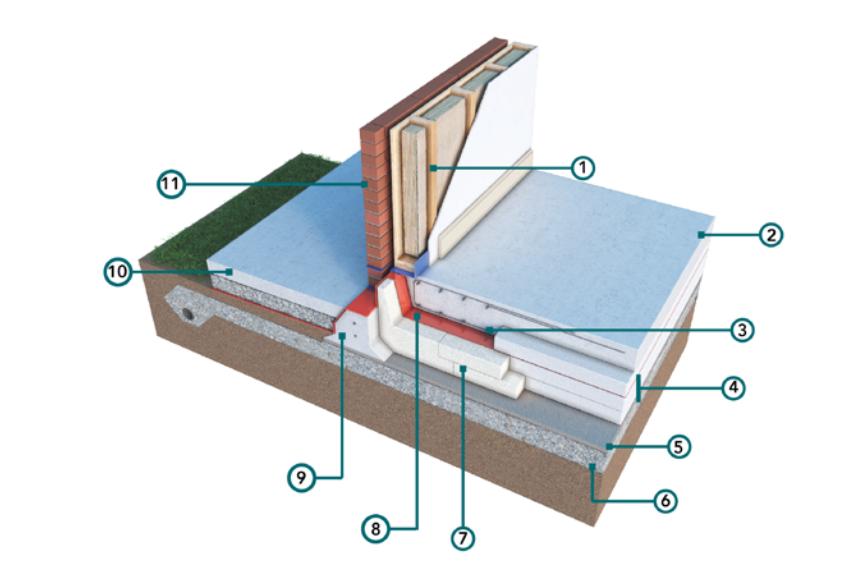
Hi all, We are starting to get into the working details on our new build, and have yet to make a firm decision on traditional strip V insulated slab foundations. I have only ever known of insulated slabs detailed like below for TF, (stolen from a Kore manual) This detail calls for services to be within this slab, plumbing, underfloor etc. I have been recently told of another approach, not sure how common, which has the same as above, but opposed to embedding underfloor and other first fix services within the slab, calls for a 20mm insulation board to be placed on top of the slab, then a finished floor to be poured, containing the underfloor etc. The reasons I was told that this approach was preferred; 1) This allows the wall installers to place anchors/stays etc. on top of the primary slab without concern of hitting services within the slab, 2) The introduced layer of insulation, while thin at 20mm, provides sufficient assistance to heat up times AND thermal store of the primary slab, i.e. allows to heat up quicker, and cool down quicker. I am pretty conflicted on this logic, while in part I see some merit, I can also see how the primary slab will always get some heat, which will never be encouraged to transmit into the house. Would love any feedback/advice, is this approach common, new etc. and what people perception is?