kandgmitchell
-
Posts
771 -
Joined
-
Last visited
-
Days Won
2
Everything posted by kandgmitchell
-
Approved Inspector gone bust - what next?
kandgmitchell replied to LnP's topic in Building Regulations
There was an initial notice served by PWC on the LA which suspends their involvement. The LA may now accept a simple change over to a new AI (it's a lot less hassle for them) with everyone pretending you hadn't actually done any work, otherwise you will need to go through the transfer process. Working under the later regulations will involve; high speed broadband, electric vehicle charging plus as you say enhanced thermal insulation requirements with photo's of various stages so the EPC supplier can confirm you've done what you are meant to. Part O is also a consideration, perhaps get your architect to assess the design against the new regs before you make up your mind. -
Approved Inspector gone bust - what next?
kandgmitchell replied to LnP's topic in Building Regulations
I'm not certain that's correct. There are provisions for "transfer notices" within the Approved Inspector Regulations which allow for the transfer of a project from one approved inspector to another. However, in this situation you may have to issue a cancellation notice yourself to the LA, you can then appoint a new Approved Inspector who issues a new Initial Notice. Have you had a cancellation notice from the LA at all? This stuff is very complicated so you need to discuss this with any new AI (who may not be keen anyway) and/or the LA to find a legal way forward. From my recollection the operation of the version of the regulations any work is subject to, is relevant to when the work started rather than when any notices are served so the regulations should be the same for either LA or new AI. -
External door access to comply with building regs
kandgmitchell replied to MarkH395's topic in England
Under English Regs Part M doesn't apply to a change of use from a building that was not previously a dwelling to a dwelling (Reg 5 (a) then Reg 6 (i)). Thus you are not obliged to, but consider would it be useful to you at a later date or to a friend or neighbour 'cos it's easier to do now rather than later. -
What colour to use where on interior face of dormer
kandgmitchell replied to Queenie's topic in Decorating
Whilst the F&B colours are certainly interesting, I found their paint awful to use - it's so thin. Had to use three coats of estate emulsion "Stifkey Blue" to get the effect. Now we use a Johnstones paint centre to match the colour as close as possible and use their trade emulsion which is much nicer to use. -
Steel upright in inner block work
kandgmitchell replied to Super_Paulie's topic in House Extensions & Conservatories
I can't see that post being a significant issue for fire, it's heated perimeter related to it's section size is small. The other faces are protected by the blockwork either side and the cavity and external leaf. It's also well stabilised so if heated to a point of failure it'll be held in position. The beam is at far more risk from failure in a fire and will tend to pull the post away from the wall as it sags. I would have thought a strip of fire resistant board against the post itself and then a panel of board across it in the plane of the plasterboard would be plenty. If there's room for some aerogel as well it'll help the cold bridge effect. -
Not unless you're building a very tall self build. Basically higher risk buildings will be dealt with by a different regulator under the HSE rather than the normal LA/private BC system. The other educational bit will probably be good practice guidance notes. Talking to a private BCO a few days ago she told me that she is no longer allowed to offer any advice on site and must refer any queries back to the designers. She's not too happy about it as it has taken a lot of the interest out of the job - "I'm just a policeman now" she moans. That's a highly experienced professional who now is considering taking the retirement option.
-
Planning Appeals - Statement of Case Examples
kandgmitchell replied to phykell's topic in Planning Permission
Loved that bit in the officer's report which stated that outbuildings are built to a lower standard and contain few windows..... and where they are required for lighting purposes are provided by small windows.... That person needs to get out more. As to a statement of case it is what it says: it states the arguement that you use to show why the Council's decision was wrong. Usually you would state the law and then show how the Council's interpretation of that law was incorrect using but not necessarily restricted to the officer's report. A "concise" statement that gets to the nub of the matter is far better than some wordy flowery thing. In this Cheshire case the consultants dismissed the quality bit but managed to make the Council look poor for raising it, they attacked the floor area pointing out the Council's use of footprint rather than floor area, they showed each individual use was reasonable in scale etc etc. If specific court cases or other appeal decisions are available to support your case then those would be added along with how they relate to the situation. In most situations a planning consultant will have more access to that sort of information and can usually present a better case. -
Neighbour not responding to PWA notices
kandgmitchell replied to Muhammad's topic in Party Wall & Property Legal Issues
Sorry if it appears pedantic but are the walls either side of your plot actually "party walls" i.e they sit astride the boundary of your land (perhaps a situation where the house on your plot was part of a whole terrace and has since been taken down) or do they sit wholly inside the land owned by each neighbour (so there are two separate terraces you are now going to link). -
Neighbour not responding to PWA notices
kandgmitchell replied to Muhammad's topic in Party Wall & Property Legal Issues
So to clarify, you intend to build a new house attached to an existing neighbour's house to create/extend a terrace ? -
Building Control Statatory 3 month inspections
kandgmitchell replied to RC28's topic in Building Regulations
This sounds about right, the regulator clamped down hard on private BC companies and they are all now into this chase, chase, progess, progress approach. I think they have to report how many jobs are outstanding for over 12 months as well now. Not good for self builders who tend to have a "in my own time" approach. Perhaps this ought to be brought to a wider BH audience just to make people aware of what they may face. -
Well the air tightness test has been done and comes out at 1.1. So it's time to fit the cat flap. I know, I know that cat flaps let in draughts as well as cats. But we're not going back to trays etc, they'll be able to come and go into the utility room until we're ready to open that door into the rest of the house. So, I need a really decent cat flap - I am aware of the really fancy electric passive house type but that's hundreds of pounds, works by proximity detection and so will be forever opening when we use the side door. No, I need a suggestion for a normal, well made, relatively draught proof cat flap that others have experience of. We've used CatMate in the past on older houses but they tend to swing in the wind. It's got to go into a door and not bothered about checking for microchips or collars. Thanks in anticipation.
-
Building Control Statatory 3 month inspections
kandgmitchell replied to RC28's topic in Building Regulations
3 month visits are probably not statutory per se but part of the performance standard required of private BCO's by their regulator. Things were tightened up a few years ago and now the private sector don't like lengthy projects as they reflect on their statistics. Bit late now but if you expect a project to last a long time then choose LA BC because they don't really care. As to fees you are in the realm of private contracts for a supply of services. You'll need to query this charge as you would with any surprise charge from any other supplier. -
Opinions please on this quote for substructure & drains.
kandgmitchell replied to Tony L's topic in Foundations
My brother works for Anglian Water maintaining the sort of small sewerage works that service lots of the small towns and villages. The flow rates through some of these during the increasingly heavy rain falls are well above the capacity of the works to cope with.The rain water is getting in to the system from somewhere and as he put it, if we don't discharge in an orderly manner the works will just flood and you'll be stepping in it anyway..... That's not to say nothing is being done, he was telling me about an enormous underground holding tank AW is building at one of his town works, to act as a buffer when heavy rain occurs but the moral of the story is not to connect your rainwater discharge to the foul system. -
Opinions please on this quote for substructure & drains.
kandgmitchell replied to Tony L's topic in Foundations
and then everyone complains when water companies discharge overflows from sewerage works into waterways when it rains.... (I know they do it other times but you know what I'm getting at). -
I guess this is a 100mm dia taking drainage from some fittings in the bathroom. You can certainly change it's direction above the "wet" part and put an elbow out through the wall. It's to avoid pressure build up in the pipework so it just needs to vent to the external air. The termination should be a minimum of 900mm above any opening within 3m into your dwelling. So the neighbour being 4m away isn't going to be affected. On a totally blank wall and no dormer window above, you could just leave it where it exits the wall. However, be aware it vents the foul drains and having a direct 100mm pipe venting below head height may not be nice particularly in the summer. I'd turn it up the wall and vent it at the same height as originally. Oh and remember to put a cage on it to keep birds off.
-
Ours is 1750mm x 2000mm and has the MHVR kit, hot water cylinder, buffer cylinder, two pressure vessels, the CU and the internet hub. There's enough room to swing the door inwards with enough spare to be shelved for overflow stuff like toilet rolls, washing powder and cat food etc etc.... No batteries but like others - not so keen to have them indoors.
-
Brick on end?
-
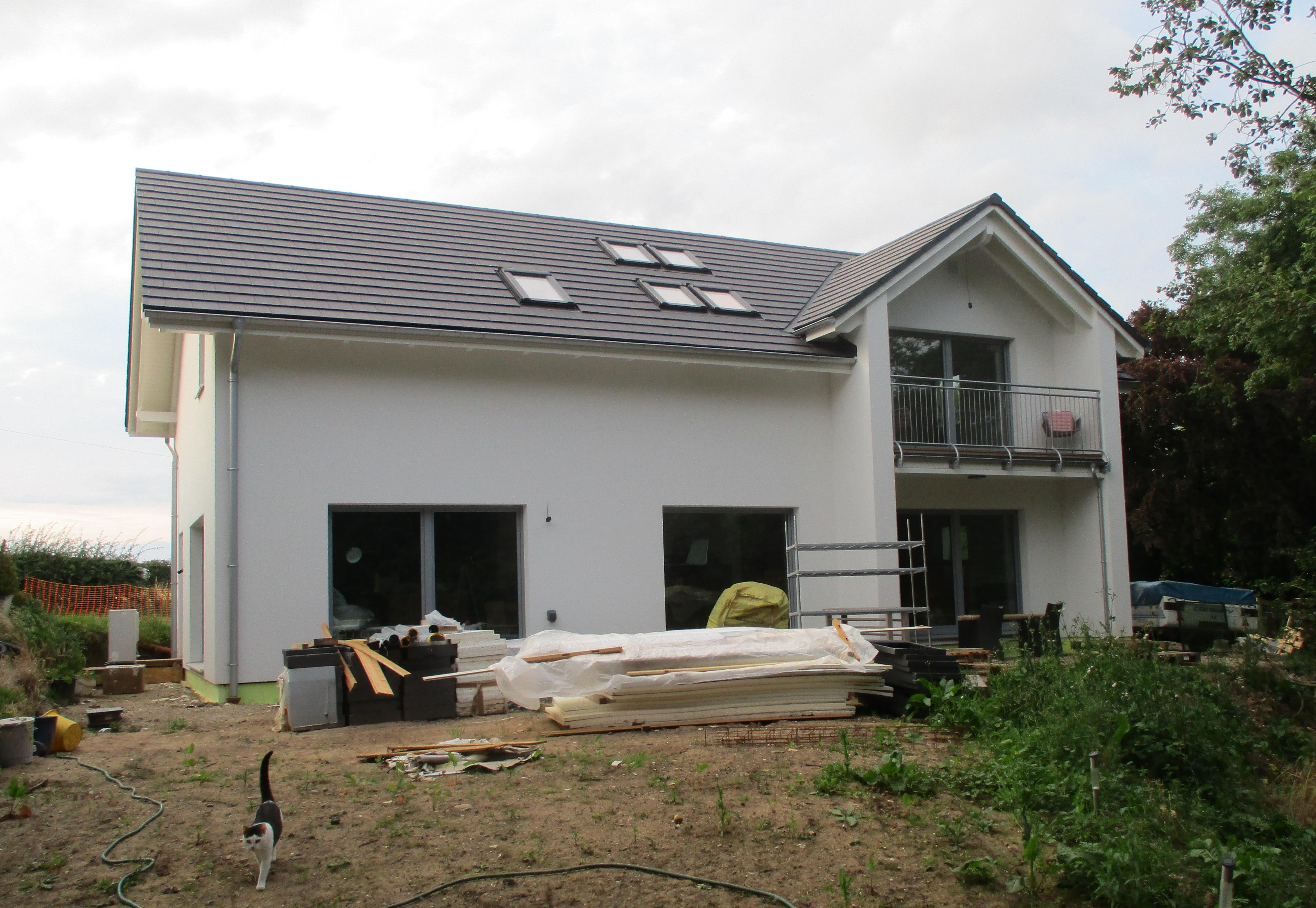
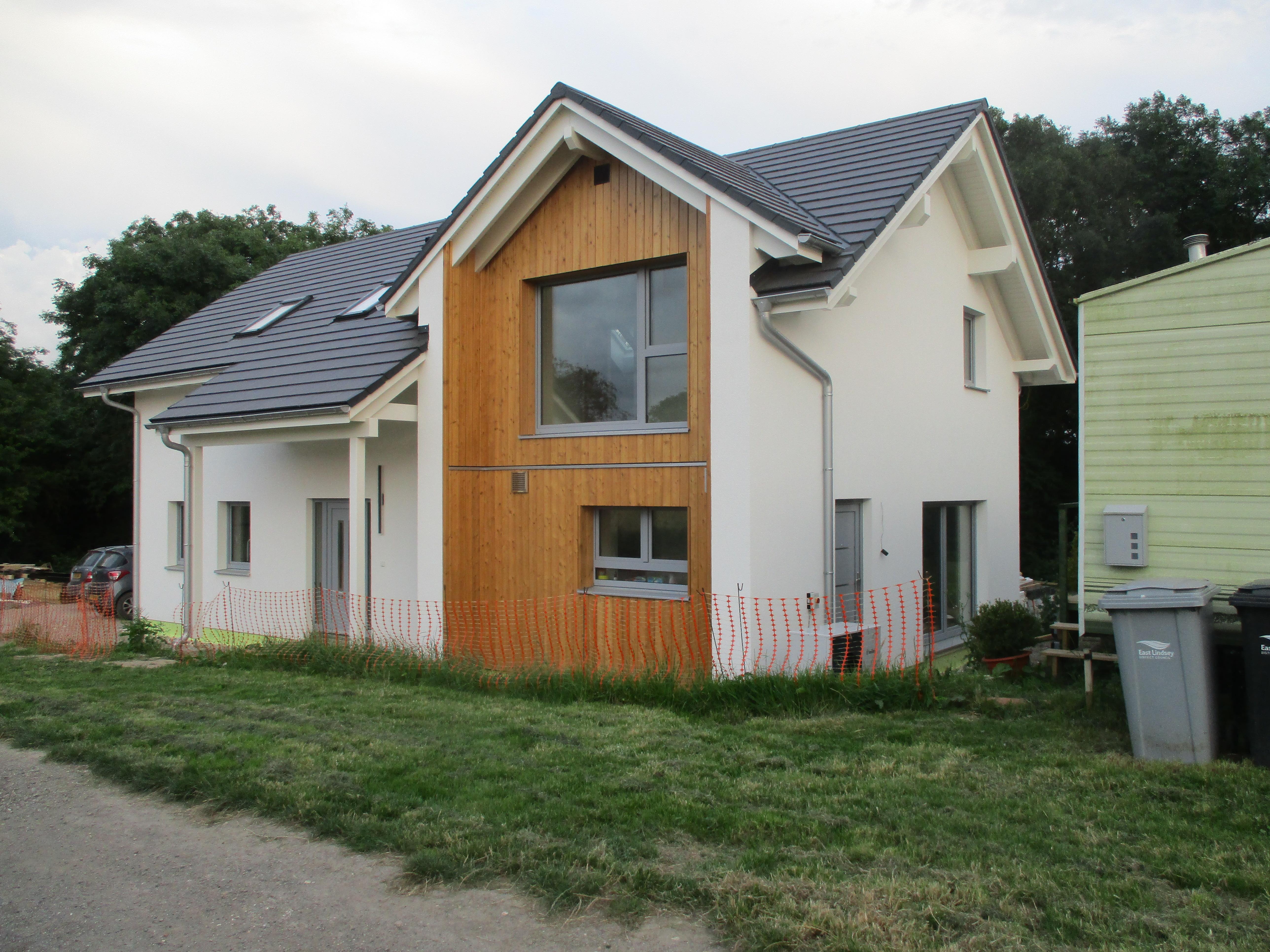
This was 8 weeks from slab to hand over, with all services done and bathrooms tiled. We wanted our stair for space purposes and decided to fit our doors and skirtings. It's taken almost as long using local labour to do that as the poles took to put the thing up!
-
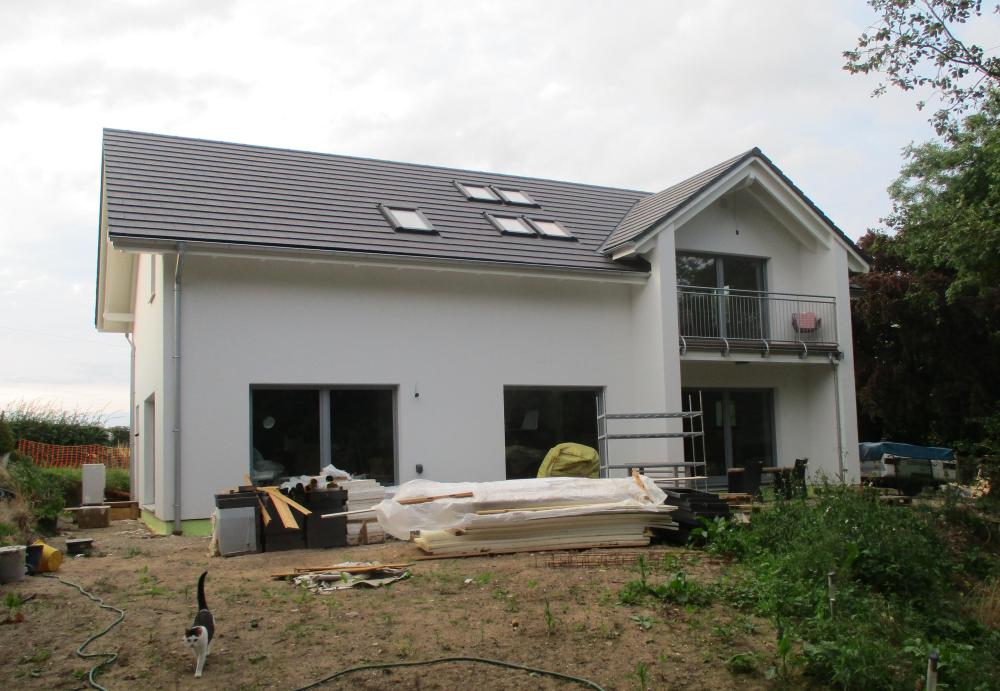
with this as the rear
-
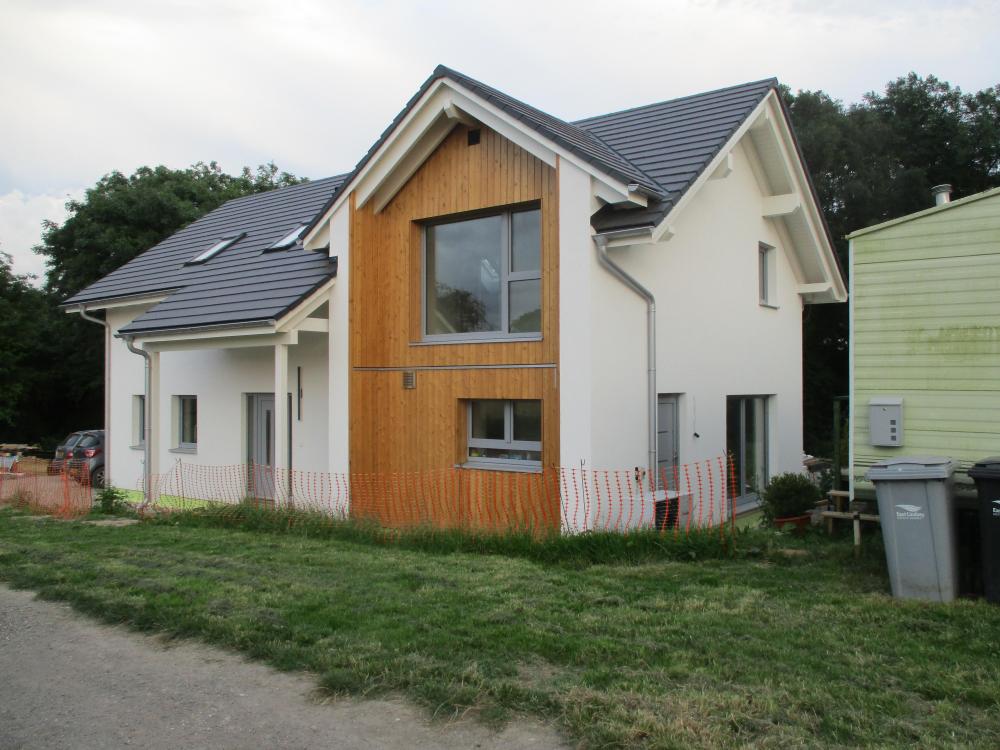
Well this is entirely our original design but adapted for the DW system so they can do it (if you alter any of their standard designs by say moving a window it becomes "bespoke"). We omitted additional cladding due to cost and didn't do the glazed gable and fancy aluminium glazing as their system couldn't handle it. The interior is however exactly as we wanted. Sure there were compromises to make but we should be in, carpets laid and sitting on the sofa watching TV within 12 months of clearing the site and bringing on the static. We are both in our later 60's so didn't want a prolonged build on site, been there, done that. Garden to sort but can enjoy a warm modern house this winter after the last couple of renovations of old, cold "characterful" houses.
-
Can minimum u-values be averaged across all flat roofs?
kandgmitchell replied to miike's topic in Heat Insulation
The pre-2022 Approved Document for new build L1A had the limiting fabric U value for roofs as 0.20W/m2K with the caveat that in creating the target CO2 emission rate and the target fabric energy efficiency rate (the SAP calcs) a U value higher than this would be necessary - this was a "bottom line" so to speak, to avoid a really high U value compensating for a really poor one. The latest post June 2022 Approved Document has that bottom limit as 0.16W/m2K. Not sure where 0.13W/m2K you mention comes from. However, should you be able to achieve 0.13 and 0.15 on different roofs then the SAP calcs done under the pre-2022 regime will take account of what were for then, very good U values and ought to show a compliant set of SAP results. -
Well the Caravan Act 1960 says: Cases where a Caravan Site Licence is not required Use within curtilage of a dwellinghouse A site licence shall not be required for the use of land as a caravan site if the use is incidental to the enjoyment as such of a dwellinghouse within the curtilage of which the land is situated. So during the house build it is incidental to the site operations (i.e the house) and is permitted development under one class and after, it becomes an outbuilding used within the residential curtilage and is permitted development under another class. Comply with the rules for those and as @joe90 says don't use it as a fully self contained dwelling for others then you'll be ok.
-
Window return query for flat roof extension
kandgmitchell replied to pkn's topic in Building Regulations
Well how does that work then? If the door head is at ceiling level as per the elevation, the lintel must be in the depth of the joists. That throws up two queries. 1) I doubt if a 150mm deep lintel will span the enlarged opening and 2) how do the bits of joist on the outside of the lintel and the fascia get fixed? I suspect the roof isn't at door head head and there is enough depth to get the lintel in over the door and for the joists to sit ontop of it. Someone needs to take responsibility for chosing the lintel though. -
Window return query for flat roof extension
kandgmitchell replied to pkn's topic in Building Regulations
Intrigued to see the detail of how the roof joists interact with a Keylite lintel. Who is going to choose the correct lintel for the situation? -
Window return query for flat roof extension
kandgmitchell replied to pkn's topic in Building Regulations
Can't see an issue subject to changing the lintel due to the wider opening - is the flat roof at window/door head height? If so what was the original design lintel?