


Tony K
-
Posts
545 -
Joined
-
Last visited
-
Days Won
1
Everything posted by Tony K
-
Hi all. I am about to build a bathroom in our SB. One wall of the bathroom, where the shower will go, is block work with waste pipes etc mounted on it. I intend to fix timber battons to the block, then fix tile backer boards over the top before tiling. As there is a cavity between the timber battons I am considering exposing a section, thereby creating a niche. I have seen lots of ready-made shower niche kits that slot into stud walls, but they are not to the size I want. Am I OK to simply create a niche space between timber battons, mount tile backer board around the inside, and tile the area? I would find some way to create a tiny fall into the shower area at the base of the niche, but otherwise see no reason not to proceed. Am I missing anything? Thanks
-
Afternoon all I am considering buying a cistern in a metal frame like this: https://www.victorianplumbing.co.uk/geberit-duofix-980-mm-install-frame-with-delta-120-mm-concealed-cistern?campaign=googlebase&gclid=Cj0KCQjwy4KqBhD0ARIsAEbCt6go7M3j5fzeD-8RRIlC_FsjeHMS8S53_NE4TwnVmytdR9X8wQ5vCMQaApK5EALw_wcB&gclsrc=aw.ds Can anyone tell me what I am getting for £200 that I would not get if I bought something like this instead: https://www.wickes.co.uk/Fluidmaster-6L-Concealed-Cistern---Black-337-x-135-x-310mm/p/138313# I will be using a floor-mounted w/c and building a cabinet around the cistern. Thanks
-
Evening all I am thinking of opting for this (or similar) off-the-shelf worktop: https://www.worktop-express.co.uk/black-american-walnut-wooden-worktops/#product-detail-items It will need to be cut to size and shape. The firm in question offers such a service, though with a slight disclaimer somewhere that the newly exposed part of the worktop may be a different colour/shade to the rest. Has anyone experienced this? Is it solvable with oiling, staining etc? Thanks
-
Evening all I have a 4.5m x 7.5m open plan room floor to tile. From the top, the floor comprises: 45mm poured liquid screed encasing UFH - (poured months ago and no sign of cracking anywhere). DPM 50mm PIR Tanking 50mm waterproof insulation Concrete slab Void underneath I will be using standard 9mm tiles. I am not familiar with DITRA matting, but have had a recommendation to use it. The tech specs on their website do not exactly tell me whether my (slightly unusual) floor composition renders the matting unnecessary, or crucial! Any advice gratefully received! Thanks
-
VAT reclaim pitfalls?
Tony K replied to Tony K's topic in Self Build VAT, Community Infrastructure Levy (CIL), S106 & Tax
Thanks, everyone, much appreciated. -
Hi All I am getting close to seeking Building Regs sign-off for my SB, which in turn will allow me to submit my VAT reclaim. I would be very grateful for guidance.. 1. I understand I can submit till receipts from Wickes, B&Q etc. How do I distinguish between items on a particular receipt which I am claiming for, and those I am not? 2. If I accidentally claim for something I should not, will it foul the whole claim? If so, what happens then? 3. I know have three months from BRegs sign off to make my claim, but getting BR sign-off and actually finishing the house are not the same thing (or will not be in my case). If I get BRegs signoff on 1st November, then buy further SB materials on the 2nd Nov, can I still claim the VAT back on those materials on the 3rd Nov? Or am I limited to items purchased before the BRegs sign-off date? 4. Has anyone had any serious problems with their reclaims? If so, what caused them? Thanks!
-
@markocosic In your set up, how does one access the cistern / mechanism etc in future to repair it?
-
Hi all. I am thinking of using a wall-hung WC, requiring a 'wall frame with cistern' kit, or a 'concealed cistern and frame' kit, like so: The wall the w/c will hang from is an internal partition wall, made using metal studs and plasterboard (photo attached). Plainly, the cistern frame cannot be attached to the metal studs, but various manufacturers tell me that if I build a reasonable timber frame behind it, the cistern frame unit can be attached to the timber and will then take the weight of the wall-hung w/c. Plus me sitting on it. Which is a fair bit of weight. Has anyone any experience of fitting such a unit to a timber frame, and if so, is that actually sufficient for a wall hung w/c? Thanks
.thumb.jpg.e2e02e458018a4bcd8211523bc979c08.jpg)
-
That's interesting. As far as I can see, the bulk of available second-hand doors do not come with a frame so I presume the chippy would be making one. @markc, What sort of time do you think you'd spend doing a job like this? I ask so that I have some sense of how expensive it will be, based on a day rate. @ProDave, would you expect that, by having a chippy make a new frame, I would be providing the necessary seals, airtightness etc?
-
Evening. I am considering buying a second hand front door for my SB. I am aware that the door must comply with the various relevant building regulations, but I can work that out. The great unknown for me is what is involved in getting the door fitted in the opening. The doors rarely come with frames. Is this a simple job for a chippy, or is it more complicated than that?! Thanks
-
I was thinking of something like this @Crofter from champion timber... 50x25mm pressure treated.
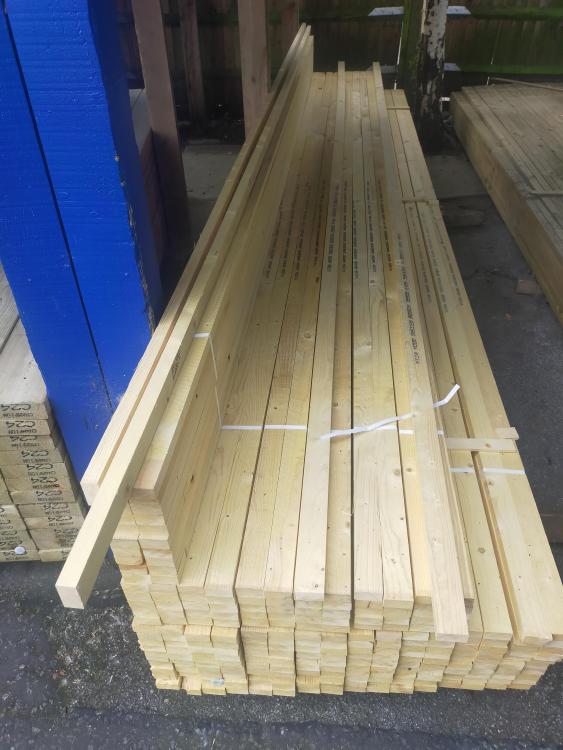
-
Great stuff @Dave Jones, exactly the sort of thing I am hoping to do. I hadn't thought of putting the battens through a planer, good idea.
-
Evening. I am considering fitting external timber cladding to look a bit like this.. I appreciate the benefit of something expensive like larch or cedar for the natural colour of the timber, but I want it black. In light of the colour choice, my thinking is that I can buy something cheap like 25mm x 50mm pressure treated batten, paint it black, and away I go. Am I missing something?! Thanks
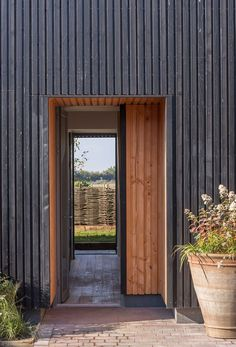
-
Hi all I have a self build mortgage, released to me in stages. I have two more draw downs left. The house is watertight, first fix services are in, and I am moving on to plastering soon. It would be useful if I could ditch my SBM and look around for a normal mortgage at a better rate. Does anyone know what stage the self build house must reach before I can get a standard mortgage on it? Thanks
-
Thanks very much for this. Regarding the timber piles idea, I could even go one better and use a load of rebar rods I've got lying about. Then I'll lay patio slabs, then repeat with joints crossed. Cheers!
-
I'm sure you're right, but I just wonder if I have any options. My original idea was to build a patio with freestanding garden furniture (hence the subbase etc) but then I changed my preference to a brickwork seating area, and now I'm really keen on the idea! I've seen garden steps etc built on existing patio slabs, but never understood if it was really OK. I wonder if I'd get away with something similar here if I laid 40mm slabs and built on top?
-
I do, though its not quite a wall, more like this, with corners etc..
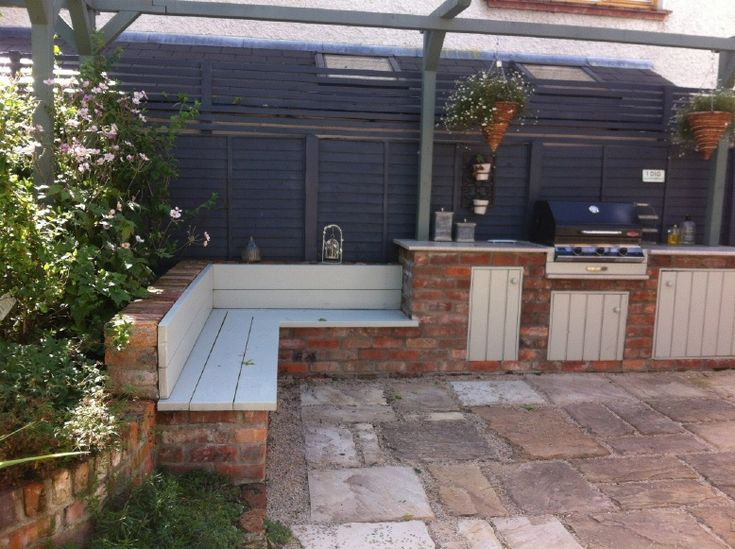
-
Afternoon. In preparation for the construction of an L shaped seating corner I have compacted hardcore and type 1 to a combined depth of 100mm min, as shown in the attached photo. The soil underneath is exposed clay (i.e the topsoil has been stripped away) but the area benefits from a French drain. I was thinking of laying brick straight on to the compacted base, but I'm concerned the brickwork will crack over time. What's my best option here? 1. Lay brickwork on the compacted base. 2. Cast a small (70mm deep) slab for the brickwork to go on. 3. I've got some old 40mm solid concrete slabs. I could lay them on a thin bed of cement, then build the brickwork on top of the slabs. Any advice greatfully received!
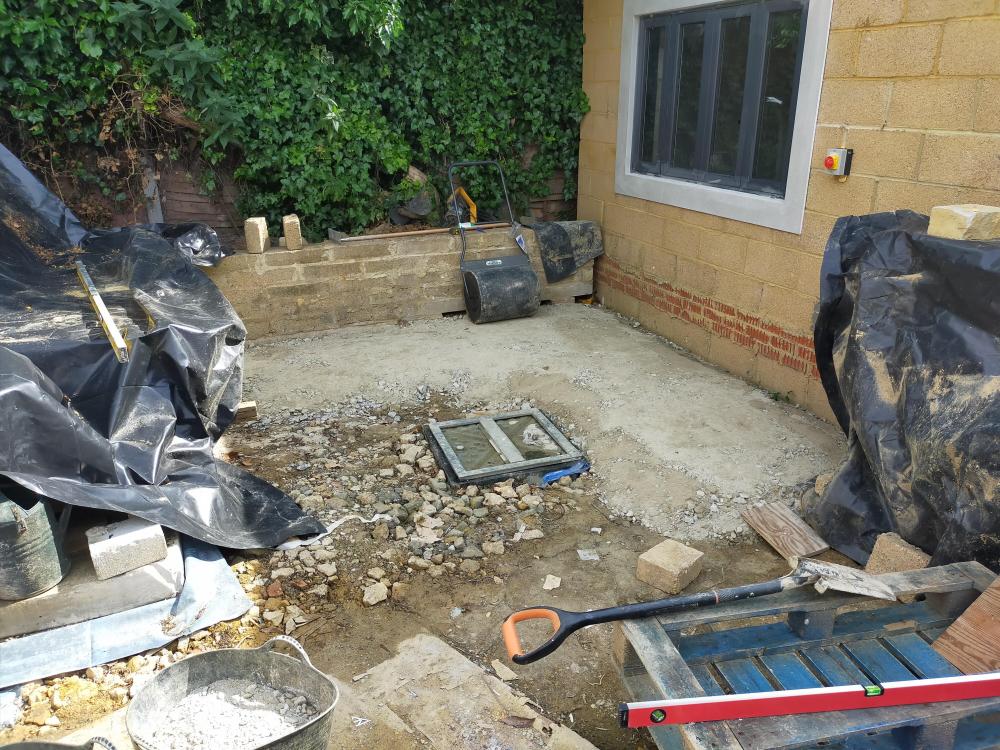
-
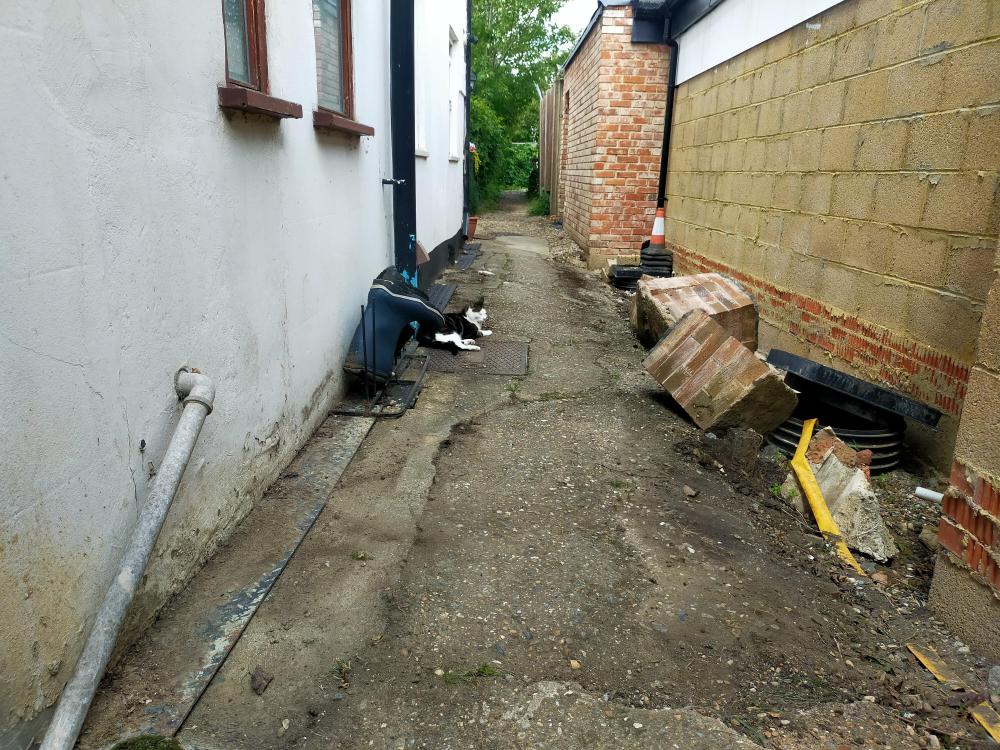
Hi all. I want to renovate the existing concrete footpath shown in the attached photo by laying tiles or thin slabs on top of it. The existing path is made of concrete 60mm to 180mm deep without reinforcement. The path is generally sound, though it has no sub-base. The path currently slopes far too much for tiles to be laid on it, falling away by up to 80mm over 1.6m, and it stops short in several places where I want to lay tiles. My plan is to expand the existing path outward by adding 100mm compacted sub base and cement until the path is wide enough, then build up the level of the existing path until it is level with it's current highest point. I can then lay tiles or thin slabs on it. I imagine I will use new concrete laid on top of the existing path to do this. The new concrete will be 80mm deep at its deepest, feathered down to zero where it meets the highest point of the existing path. Thing is, how should I adhere the new concrete to the existing?
-
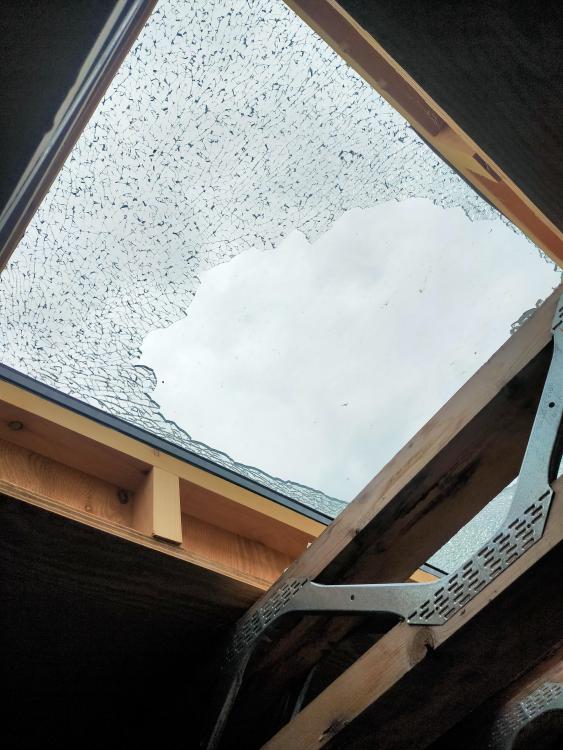
Anyone experienced this before?! I bought double glazed skylights from a local supplier and installed them myself around Xmas time. They rest on a standard timber upstand, are not screwed in place but do have two continuous beads of mastic around the top of the upstand. This morning I discovered that the inner glazing panel of one of the skylights had shattered. The outer panel is fine, which rules out impact from outside, and nobody was in the building yesterday, ruling out impact from below. On Saturday I used a hole cutter to create a vent in a vertical surface about three metres away from the skylight in question. That might have sent a vibration through the roof structure and cracked the glass perhaps. Timber does of course expand and contract, but timber upstands are standard practice and mine are perfectly ordinary. Any ideas on how I can go about replacing the unit? If I have to force it up and off I'm concerned I will damage the upstand.
- 1 reply
-
- 2
-

-
Are all metal stud wall systems created equally?
Tony K replied to Tony K's topic in General Joinery
I have thought about that, but the chock of wood would need to be cut to shape to fit inside the slight lip on either side of the mouth of the C stud, plus I'd need a lot of them (one for every stud). I have also thought about hiring a speed gun or maybe a nail gun, but I'm not sure why either would address the tendency of the stud to deflect inwards. I should think I will end up doing it slowly, cursing a lot, and making a few unnecessary scuffs in the boards. Initiating though as there must be a way that pros avoid the problem. As others have said, perhaps a combination of skill, different tools, a second set of hands, different screws, etc. Of the above, I will try different screws and see how I get on. -
Are all metal stud wall systems created equally?
Tony K replied to Tony K's topic in General Joinery
Yeah, that's a good point and something others can learn from if considering undertaking the task themselves. Based on my experience, MF stud walling and boarding yourself can be done, and to a reasonable enough standard (he says), but it has taken me ages to do. Partly that is working alone, but partly it is inexperience and inefficiency on my part compared to a tradesman. -
Are all metal stud wall systems created equally?
Tony K replied to Tony K's topic in General Joinery
Damn it. It's always a problem when I have to rely on skill....! -
Are all metal stud wall systems created equally?
Tony K replied to Tony K's topic in General Joinery
Thanks. I can't see any difference between the two sides of the MF studs that I've got. Wouldn't I just run into the same problem in the end either way though? The issue is not that the studs are sliding left and right inside the ceiling and floor channels. They are staying still but just bending away when the screw comes into contact with them. I have been using standard drywall plasterboard screws (the black ones). Do you use something like these: https://whiterosetools.com/products/timco-drywall-screws-self-drilling-tapping-screw-countersunk-bugle-head-zinc-phillips?utm_source=google.com&utm_medium=referral&utm_campaign=Google+SF+PMax&variant=42448585294018&sfdr_ptcid=20300_100_692063436&sfdr_hash=a02cc0be0789231c2d233329db42e7a2&gclid=CjwKCAjw04yjBhApEiwAJcvNoRNr3teWlDOHc0vbvwPAAqL7McS08e8MZC4cQxx_MsxAhOwnUviqYhoCDzgQAvD_BwE Cheers! -
Are all metal stud wall systems created equally?
Tony K replied to Tony K's topic in General Joinery
Since creating this thread I have now built all the metal stud walls, plus one wall from timber, and half-boarded the lot ahead of first-fix services. My experience, which may help others considering whether to use metal or timber studs has been that the metal stud system is easy to install (even though I'm working alone) and a bit more forgiving than timber. It's quite quick therefore. One big problem has been trying to screw plasterboard to the metal 'C' studs. Far too often the tip of the screw passes through the plasterboard, meets the metal stud but then, rather than penetrating into the stud, pushes it away. This will often damage the plasterboard, and is extremely frustrating. Once the first screw is in properly the metal stud tends to stay still thereafter, but I have needed someone to go to the other side and push the side part of the stud up against the plasterboard to hold it still while I drill. That is possible when fixing the first side of plasterboards in place as you can still access the studs, but will not be possible when I close off the walls. Is there a solution to this?! Cheers
.jpg.b09591349ca61658b1fbb69deb4f04a6.jpg)



