

DamonHD
-
Posts
435 -
Joined
-
Last visited
Everything posted by DamonHD
-
@JamesPa I hear what you say and I shall think about it: thank you for tussling with this. But where you say "I think the latter results prove that the saving in the former is really attributable to the reduced temperature of the inhabited rooms, not to the setback in the uninhabited ones!" taken literally and simplistically is untrue: it is a simple matter of physics that all internal spaces that are at a lower temperature than they otherwise would be lose heat to outside more slowly than they otherwise would, and thus reduce heat demand, and where WC is in use that reduces electricity demand and thus cost. Note that the initial HG claim being countered was that reduced heat demand could cause increased electricity demand, which is again simply not true with use of plain open loop WC. Whether that arrangement is acceptable for other reasons, some of which we have discussed in this thread, is a separate issue.
-
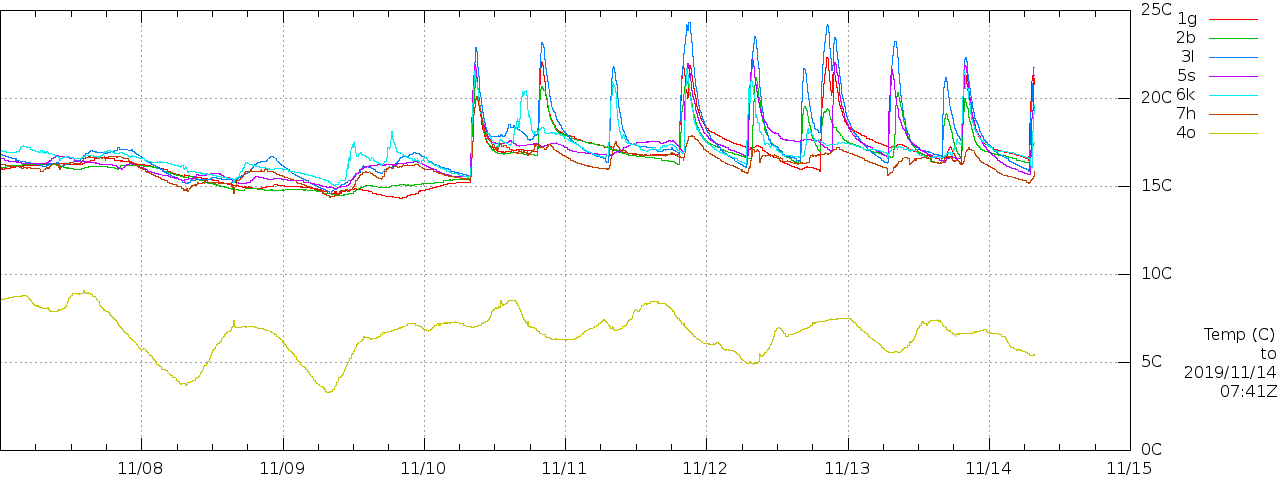
FWIW my own live-ish TRV percentage-open chart (for most of the rads): and call for space heat: Note that there is currently a problem with this system and it hasn't been fully commissioned (or paid for!) yet, and I am continuing to tweak as householder and researcher. So have a good laugh! B^>
-
I agree, which is why I'm doing my research, to see if there are any wheels that I can find to grease...
-
"Eating your own dogfood" is a standard term in the start up world and beyond, meaning that you actually use (and understand and stand by) your own product, which is IMHO the right thing to do. Far from petulant. I estimate ~100M rads in UK homes, ~1B in European homes, and about the same again in commercial properties. There are ways of misusing all tools. Most UK home heating systems are vastly oversized and fairly poorly installed and understood and used I believe. The minimum power output of my gas combi was more than double the maximum heating demand on the coldest days, so it spent all its time cycling regardless of TRVs. And the expansion vessel failure rate was only beaten by the diverter valve. My new heat pump seems somewhat better matched to heat demand, though was the smallest one that Octopus could do AFAIK.
-
AND if you are running open loop weather compensation yes. But I also point out that a small degree of feedback and loop closing may retain the electricity savings that you'd expect from the heat savings, and mitigate sag somewhat - I did not attempt to calculate how much.
-
I say in the paper that I spent a decade inventing a smart TRV (and bringing a commercial version to market). There are now ~500k Radbots out there. I have views on TRVs, and I am eating my own dogfood at home, but I have no commerical involvement with Radbot any more. AND I am hoping during my PhD to fill some (huge) gaps in the academic literature about TRVs and in particular interactions with heat pumps, and some of that research may be funded by manufacturers because everyone would really like to know! My aim and thesis working title is "Improving UK home heating decarbonisation". I suspect that that will involve TRVs for reasons that I have laboured in this thread and elsewhere, but if TRVs aren't part of the answer then no problem. I shall find out what else is. My PhD research plans: https://www.earth.org.uk/img/research/20240917-PhD-confirmation/confirmation.pdf
-
I calculate the grid CO2 intensity and log it here: https://www.earth.org.uk/data/FUELINST/log/live/ and then combine it with exports/imports for each hour to compute the total. See the end of the page.
-
Yearly CO2 calcs for electricity and gas, about +225kgCO2 for the year. I now hope to see this drift back to slightly negative as the grid gets greener, etc. https://www.earth.org.uk/saving-electricity-2024.html
-
Just finished my yearly CO2 calcs for electricity and gas, about +225kgCO2 for the year. I now hope to see this drift back to slightly negative as the grid gets greener, etc. https://www.earth.org.uk/saving-electricity-2024.html
-
1) The static calcs I did in the model in my paper suggested very significant energy savings by doing TRVs right, which back up my experience. 2) Dynamic response to occupancy is another significant saving, eg heating unoccupied bedrooms during the day even if people are home all day. Again, reinforces what I saw in substantial trials. 3) Given how cheap and easy to use TRVs are (~1% of the rest of the heating system ish) and can save 10--30% of consumption and footprint for <2Y financial payback, never mind comfort, why NOT put them in by default, even if you leave them a bit high if in doubt and lean on WC as much as possible?
-
Because one curve for the whole home is clearly insufficient at some level when the heat losses and gains of rooms relative to one another is changing.
-
Whoops, I borked that image by moving it and I can't edit my post. Here's a newer and betterer one for the whole of December:
-
Yes, these things are debatable, but a core issue for me is that no one WC curve (with static balancing however good) is perfect for all combinations of variable occupancy, solar gain, wind, etc. And comfort suggests wanting to maintain some differentials anyway where possible. Note that I am primarily concerned with retrofits into relatively thermally leaky existing UK stock which may skew things. Note also that I did reduce (~10x) some inter-room uncontrolled heat transfer in my house between the living room and a bedroom above while doing other works, so that option helps and is available too, if one knows about it and why it might help.
-
Data Science is a thing (though has a newer more fashionable name this week I think) and all the data scientists that I know are amazing multitalented people... I have a pile of EOM and EOY data capture / munging lined up for tomorrow too...
-
Note that the bad setback effect applies if rads are only just large enough AND pure weather comp is not used. That would not in general be allowed for an MCS install as I understand it, so I don't think it is a real problem if thought about. (Maybe an installer noticing that a user is zoning and wants to carry on doing it should suggest upsizing rads a bit more than they would otherwise.) Also note that the maximum temperature sag occurs when it's warm enough outside that you barely need heating - it's usually less. See the end of https://github.com/DamonHD/TRVmodel/blob/main/SampleComputationsOutput.txt I don't know of any paper dealing with your last para (I would be keen to read it too) but the research strand that I'm currently on may look at that and test it in a physical model too. I really have to get up to speed on EnergyPlus and heat pump simulation in a hurry!
-
You are indeed not most people. For gas heating, relationship is typically linear above a baseline temperature and baseline (non-heating) consumption, eg per https://www.degreedays.net/ For HP changing CoP with exterior temperature will complicate things, which I haven't entirely worked through in my head yet.
-
@ProDave I absolutely think that that is part of the deal. I went back to check whether the circulation pump counts within the SCoP value or not, and have a relevant paper open, but have not convinced myself yet... If I only need 4kWh of heat pumping in a day but my circulation pump runs continuously at ~40W, I just severely dented overall real efficiency. Exclusively chasing CoP, particularly a version that excludes these ancillary but significant items, and assuming that comfort can only be rock steady higher temperatures, may be a mistake. (I take that 40W as ultimately adding to the space heat at a CoP of 1.)
-
Please read my paper: it explores exactly this. https://www.mdpi.com/2071-1050/16/11/4710 Demanding overly tight temperature control WILL waste a lot of energy. If running pure weather comp as I am the flow temperature is only determined by external temperature.
-
Don't get me started on the condensing boiler issue: I took a cheap (~£1/home) solution to both Ofgem and Lord Callanan and neither were interested (or understood)... https://www.earth.org.uk/OperationTuneup/ The https://moneysavingboilerchallenge.com/ thing showed it could be done!
-
I realise that I have now hijacked this thread. Mods, if you wish to spilt off these posts into a new one, fine by me!
-
@JohnMoI can't share the 60% figure as that wasn't published, but the second one is from https://www.mdpi.com/2071-1050/16/11/4710
-
Note also that we have room temps set ranging from 17C up to ~20C for comfort, not too outlandishly 1C below CIBSE/etc norms. Having those maintained with open circuits while sunshine and wind (and people) come and go is hard. But we also (c/o OpenTRV) set back automatically when rooms are vacant. No one WC setting is going to magic all of those!
-
The WC curve is based on (1) Octopus heat loss calcs at design temperature at the low end and (2) my observation of best fit HDD base temperature over many years at the top end. In other words I'm pretty much going by the book here. I suspect that it *is* a bit too high but we haven't been anything like cold enough to calibrate (1) yet. But in any case my own experiments (eg at Energy House) suggest that it is a silly waste of energy to heat unoccupied areas except in a very air tight modern (PH-ish) home where maintaining temperature differentials on purpose would be hard. Eg ~60% waste heating bedrooms during the day in EH1 on a 'working family' occupancy pattern, ~15% whole house in my recent paper.
-
IMHO (and the opinions of several plausible studies) insisting that comfort is all about very steady and uniform temperatures is overblown. I spent some years living in a farmhouse partly heated with open fires for which neither is the case and yet many people see them as some sort of comfort ideal. These things are partly a matter of (learned) personal preference, but overselling them will result in excess emissions and climate damage and ultimately will hurt us all. Because I'm working around a problem with our shiny new heat pump install I have been trying several modes of operation and was probably not doing things optimally, but continuously on, even with a flow-temperature setback at night, felt stifling and oppressive and used *double* the electricity (kWh/d) of the intermittent (OpenTRV driven) call for heat that I am now back on. Note: electricity in, not CoP or any other intermediate measure. Intermittent, albeit in a house with reasonably good fabric, is *more* comfortable and much lower footprint and cost, in this instance at least.
-
Can’t get Daikin Althema to be controlled by LWT
DamonHD replied to MechanicalBuilder's topic in Air Source Heat Pumps (ASHP)
Note that the antifrost feature will run the circulation pump and possibly the compressor if outside temperatures are at/below 7C. I'm also seeing my Altherma eat a lot more energy that I exepct when running it open loop with a weather-comp LWT target, cf running it when needed with an external call for heat.

