Bemak
-
Posts
176 -
Joined
-
Last visited
Everything posted by Bemak
-
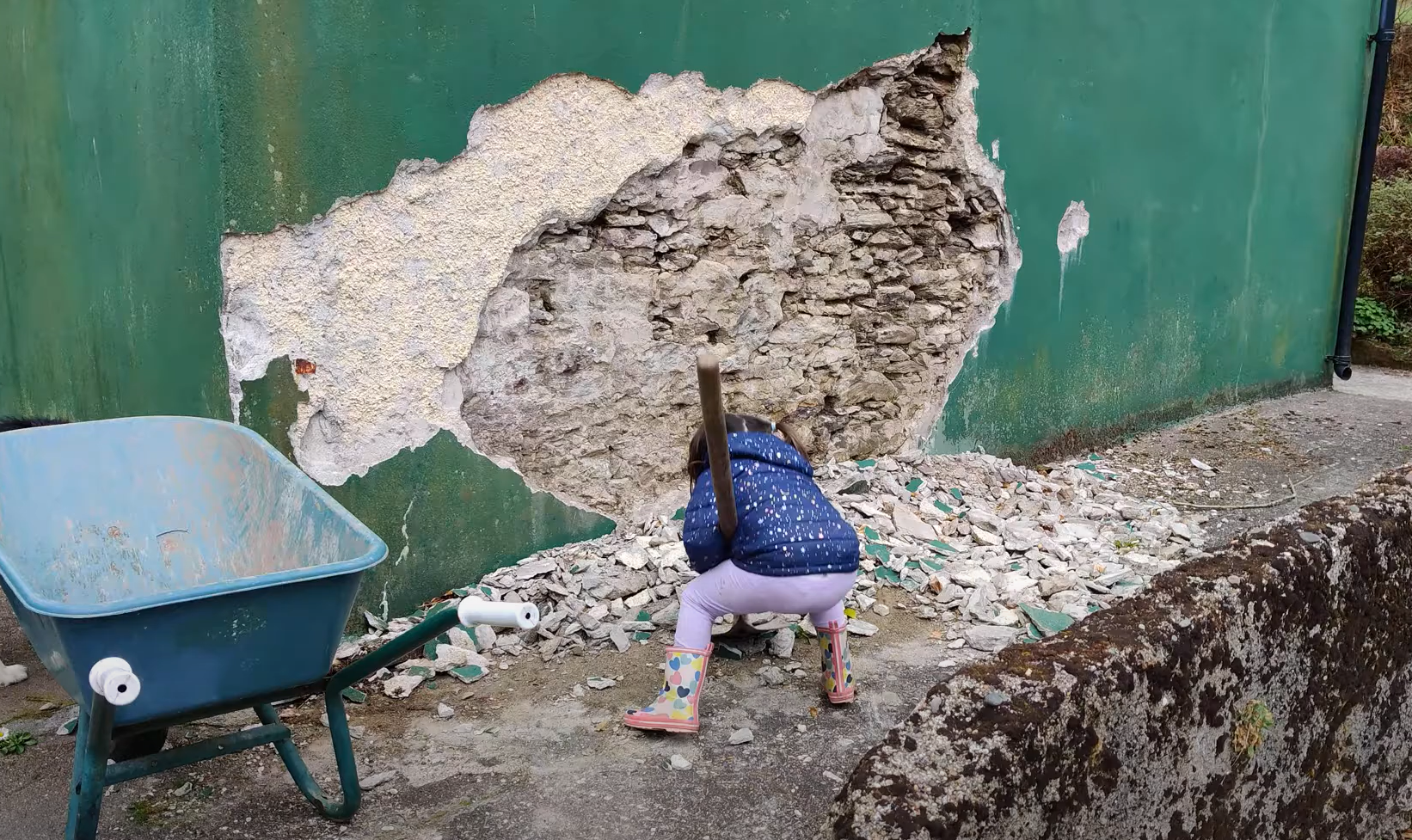
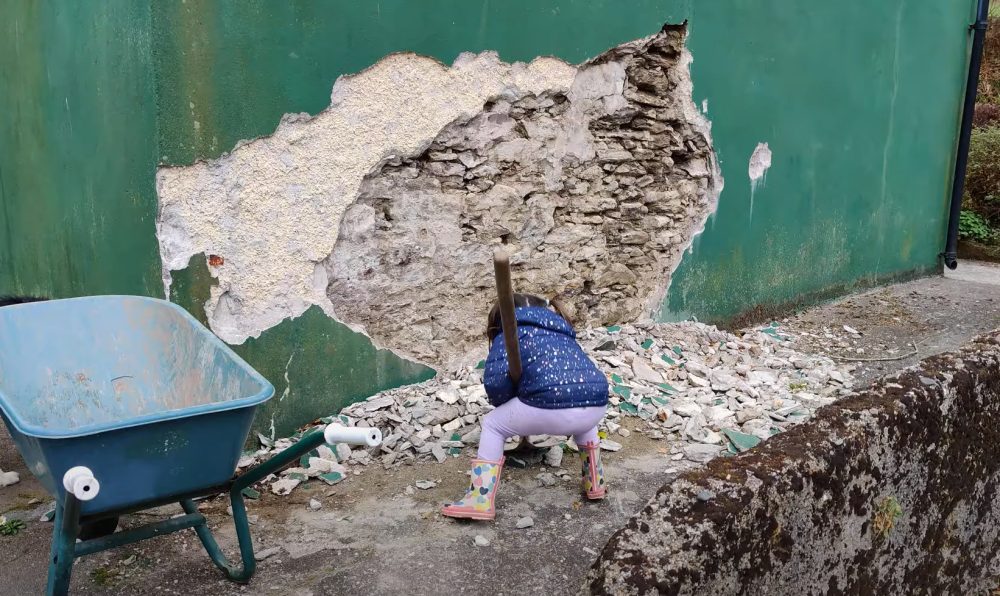
I should have added that the external render consists of at least 3 separate layers of sand and cement render. Approximately 40mm thick overall. Pic below of my initial investigation works (with a great helper) shows the state of the wall behind the render.
-
the walls of the house are currently rendered with sand and cement, not lime. I wouldn't dream of sealing them up externally if they were rendered with lime. I'd probably have no problem if they were! is there anything to be said for insulating the walls externally and removing the render internally to allow the walls to dry to the inside?
-
I'm planning a refurb on an old farmhouse. i've posted elsewhere about it but one part i'm curious about is the external render. the house is 2-storey and of stone construction (600mm) with sand & cement render internally and externally. the external render is in very sound condition for the most part so i've moved away from the idea of hacking it all off and replacing it with lime as doing so would blow the budget. instead i'm planning to leave the render in place, patch up any cracks and rerender the entire house to seal it up. i will install french drains around the perimeter to help reduce rising damp etc. i'll do something internally to allow the walls to dry out to the inside but that is a detail for another day. i've been speaking to a few manufacturers and contractors and one approch to the external render that i'm starting to cling to is the idea of rendering the house with a silicone render as i'm told it is moisture resistant but also breathable which will allow some drying out to the outside. sounds like an ideal solution for this particular application but i'd be curious to hear thoughts on this approach in case there's something i'm missing.
-

Air Source Heat Pump in Stone House
Bemak replied to Bemak's topic in Ground Source Heat Pumps (GSHP)
It's not my first choice but I have to work with a budget and be realistic as to what I can do. -
Air Source Heat Pump in Stone House
Bemak replied to Bemak's topic in Ground Source Heat Pumps (GSHP)
I need to trawl through more of these threads because I'm sure a lot of what I'm asking has been well discussed -
Air Source Heat Pump in Stone House
Bemak replied to Bemak's topic in Ground Source Heat Pumps (GSHP)
They're based in NI. They were saying the cost per sqm including the wood fibre infill worked out at about £25, which I don't think is too bad considering. Considering the walls are surprising dry, I could just use treated timber battens, maybe with a dpc backing and retain the rest of the spec. If moisture is allowed to escape the build-up, the battens themselves should be low risk? -
Air Source Heat Pump in Stone House
Bemak replied to Bemak's topic in Ground Source Heat Pumps (GSHP)
didn't touch the figure (as I didn't understand what way it should go!) ya it's a pity there's nothing there to go on. I was speaking to a few manufacturers yesterday about what remedial works I can do to the external walls to improve performance. I appreciate its a minefield out there and there are a lot of ways to skin this cat, each with their own critics and supports etc but it sounds ok to me. So it was suggested that I rerender the house externally with a silicone render to help seal up any imperfections in the wall where water might be entering. The silicone render will let moisture evaporate while preventing further water ingress. Sounds good in theory. Internally then they were proposing an aerogel backed stud which would be fixed directly to the existing sand and cement render on the internal walls - and would then be infilled with 40mm fibre wood boards. then you apply a vapour control membrane (reverse diffusion) and complete with normal plasterboard. In theory that wall buildup will also allow moisture to escape the wall but not be drawn back in. The manufacturer stated that this would improve the u-value of the wall to around 0.5 - which they said is probably as high as you should go for a stone wall as anything beyond that would be super-insulating the wall (their words not mine) which they said would reduce the walls ability to dry out through the new lining etc. Interesting approach, and one I need to look into more but the application is a lot more straightforward than the full blown approach of removing the existing render etc. -
Air Source Heat Pump in Stone House
Bemak replied to Bemak's topic in Ground Source Heat Pumps (GSHP)
ah i just thought the pv might offset some of the electrical loading is all. i wouldn't say it could be used for space heating. see the house never had heating - so i'm finding it hard to gauge it -
Air Source Heat Pump in Stone House
Bemak replied to Bemak's topic in Ground Source Heat Pumps (GSHP)
Quick calculation would suggest it could cost in the region of €200 a month to heat the house in the depth of winter. However this figure doesn't take the potential for zoned heating into account or any offset from PV. -
Air Source Heat Pump in Stone House
Bemak replied to Bemak's topic in Ground Source Heat Pumps (GSHP)
Thanks - this is really useful! -
Air Source Heat Pump in Stone House
Bemak replied to Bemak's topic in Ground Source Heat Pumps (GSHP)
hopefully thats legible. around 3600 kWh in Jan. The house is only 120sqm in size. I would agree with going for a larger unit just to have it rather than be looking for it. I'm thinking of an electric shower upstairs and then a normal shower downstairs to avail of hot water provided by the diverter from PV panels.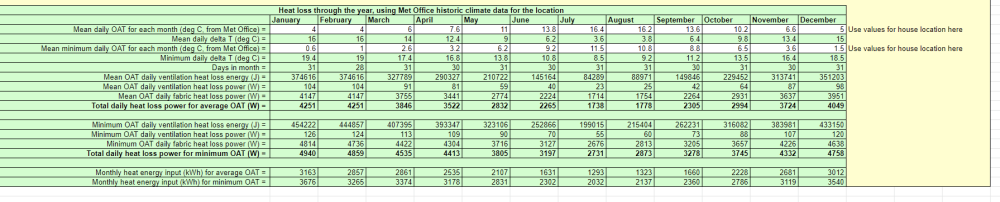
-
Air Source Heat Pump in Stone House
Bemak replied to Bemak's topic in Ground Source Heat Pumps (GSHP)
went through the calculator there myself - pretty quickly adding areas and volumes etc. End result, if I'm reading it correctly, is an average monthly heat energy input of circa 2300 kWh. what would a figure like that mean in terms of choosing the correct heating system? -
Air Source Heat Pump in Stone House
Bemak replied to Bemak's topic in Ground Source Heat Pumps (GSHP)
Thanks for that. I have no doubt it will require 3-4 times what a new build would need. At this point I'm only realistically going to get the attic insulated 300-400mm. The walls and floors will have to stay as is. The windows will be upgraded though and I might insulate the reveals around the windows to prevent that short route out for heat but other than that it will be what it will be. The floors are in good shape - so much so I can't justify the cost of new slabs etc. The low temperature rads are probably the way I'll go - fan assisted where possible in the bedrooms as mentioned previously. Regardless of whether its oil or heat pump - it's going to be 3-4 times more costly to heat the house than a new house. I suppose I just want to try and figure out what the most cost effective would between the two systems for this particular scenario. -
Air Source Heat Pump in Stone House
Bemak replied to Bemak's topic in Ground Source Heat Pumps (GSHP)
would you recommend using that heat loss calculator that was circulated around previously? think i have it. is it easy to work out? -
Air Source Heat Pump in Stone House
Bemak replied to Bemak's topic in Ground Source Heat Pumps (GSHP)
nah - about 70mm between the fins, its actually quite easy to rub down -
Air Source Heat Pump in Stone House
Bemak replied to Bemak's topic in Ground Source Heat Pumps (GSHP)
parents have one in the kitchen - they're decent alright but I think I'd rather a tall rad. I put one in my own kitchen recently, a merriott profile and I'm delighted with it.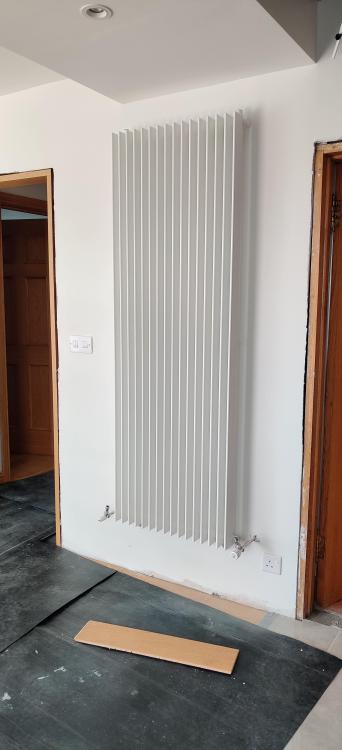
-
Air Source Heat Pump in Stone House
Bemak replied to Bemak's topic in Ground Source Heat Pumps (GSHP)
Definitely pricey but I'd probably only be looking for 4 or 5 for bedrooms and corridors. The bathrooms will have towel rads and I don't mind the idea of larger rads in sitting room (behind couch, room will have a stove too) and a vertical rad in the kitchen. -
Air Source Heat Pump in Stone House
Bemak replied to Bemak's topic in Ground Source Heat Pumps (GSHP)
something like this https://www.dimplex.co.uk/smartrad -
Air Source Heat Pump in Stone House
Bemak replied to Bemak's topic in Ground Source Heat Pumps (GSHP)
I wouldn't go ducted, but rather those fan assisted radiators. I hadn't come across them before. Must look back over other recent threads as you suggest - it's been well covered -
Air Source Heat Pump in Stone House
Bemak replied to Bemak's topic in Ground Source Heat Pumps (GSHP)
Whether I go heat pump or oil boiler, the heat loss is going to be the same so it will be more expensive to heat regardless. I assume that the heat pump would still be cheaper to run than a kerosene boiler in this context particularly if I marry the former with PV? -
Air Source Heat Pump in Stone House
Bemak replied to Bemak's topic in Ground Source Heat Pumps (GSHP)
For reference we currently live in a 70s house of solid block construction. Previous owners lined the walls with insulated PB (30mm insulation). We have the temp set to 19 degrees in winter. That's what we consider comfortable. -
Air Source Heat Pump in Stone House
Bemak replied to Bemak's topic in Ground Source Heat Pumps (GSHP)
Fan assisted rads are interesting - they'd probably provide a better sense of immediate heat within the room too rather than standard rads. Plus the space saving is nice too -
Air Source Heat Pump in Stone House
Bemak replied to Bemak's topic in Ground Source Heat Pumps (GSHP)
That's interesting - what are you doing in terms of insulating the walls? I'm reluctant to dry line with an insulated PB because that will just cause me more issues down the line. I'm also reluctant to hack off the internal sand and cement render and replacing with hemp/insulating lime render because the cost is prohibitive and would kill the project for us. The internal render is actually very good and dry for the most part. -
Air Source Heat Pump in Stone House
Bemak replied to Bemak's topic in Ground Source Heat Pumps (GSHP)
Very good point. If I pair the HP with solar it's not a bad setup -
Air Source Heat Pump in Stone House
Bemak replied to Bemak's topic in Ground Source Heat Pumps (GSHP)
Ya I've looked into all this. I actually really like the idea of hemp etc. Having thought long and hard about it, and considered the significant cost associated with same, I've decided to leave the external render alone. It's in very good shape apart from a few isolated issues - so I'm going to try and resolve them and see how it goes. Internally the house is pretty dry considering it's rarely used. I'm going to remove some of the internal render on the gable side at ground floor level which has always been damp to see what's what. Will make a call on it then. I'll probably patch internally and see how it goes. I'm hoping that a french drain or some form of perimeter drainage will resolve a lot of the damp issues at GF level. I'll replace the flashings around the chimneys and replace the existing concrete barges and possibly reroof as well. Needs to be done regardless but I've a funny feeling it will resolve a lot of the dampness issues. In an ideal world of course I'd remove the render internally and externally; dry line internally with hemp and rerender with inside and out with lime but my budget would be spent at that and there's plenty of other things that need doing.