JamesPa
-
Posts
1899 -
Joined
-
Last visited
-
Days Won
2
Everything posted by JamesPa
-
I did mine in twin & earth (in conduit where the route was outside). Armoured cable is a PITA.
-
Maximum permitted flow temperatures?
JamesPa replied to sharpener's topic in Air Source Heat Pumps (ASHP)
I'm not sure what you are looking for. It seems you have concluded that building regs don't apply and know the MCS position. I don't think that anything else regulates flow temperatures, so doesn't the answer boil down to the MCS rules. -
Do you wonder? Really? I think we all know. @BotusBuild if your experience turns out anything like mine, expect several more quotes of this nature. Private monopolies are almost always bad news. It's sad we have so many.
-
Off-peak energy storage for cheaper heating
JamesPa replied to Originaltwist's topic in Other Heating Systems
This is all rather interesting. Even if you don't have an oversized heat pump, your heat pump is oversized (relative to the load) most of the time, typically by a factor of 2. So given that storage volume is likely to be the limiting factor, perhaps this has legs even in more modest implementation. For example an 8kW heat pump for an 8kW design load will have 4kW to spare for most of the year. If the cheap electricity period is 6hrs that's 24kWhrs, about 400 l of water heated through 50C I think Thats as much volume as many people can accommodate. Not sure however how to use the stored heat once it gets below the flow temperature for the heating, at this point you need a water to water heat pump to extract the energy. Nevertheless there would seem to be milage in sacrificing energy efficiency for energy cost which, as you point out, is likely to be environmentally friendly given that low cost energy is offered when there is spare capacity. -
I thought ecodans came without a pump (which seems to be the concern) in which case it's surely just a case of picking a sufficiently high capacity pwm pump for the plumbing (working out the flow requirement based either on dt5 or what it says in the hp manual) and letting the hp sort it out. That isn't anything that the plumber should be too worried about as it's the same as in any ufh system sofaik. Or am I missing something? Plus perhaps some valves allowing balance between the three manifolds to be adjusted)again surely necessary on any ufh system with multiple manifolds - although I admit to knowing nothing about ufh systems, but logic says some balancing must be needed)) Whilst I agree with the advice that the 'proper' way to do it is to work it all out, if the plumber is onsite there may be not much choice in which case perhaps following @ProDave s suggestion is not such a bad idea in the situation in which op finds him/herself
-
Mitsubishi vs Samsung Heat pump
JamesPa replied to Slippin Jimmy's topic in Air Source Heat Pumps (ASHP)
The technical data book is here https://www.pasaz24cdn.pl/web5699/files/EHS Mono R290 [TDB].pdf The refrigerant plumbing diagram does show hot gas bypass. -
And that's their decision, you are lucky. My lpa on the other hand has rejected a proposal that would result in a sound pressure of 33dBA at the neighbouring residence (that's 4dB below the PD standard), also with no direct line of sight, and wants me to demonstrate that I can achieve 25dBA (which I can't) and is why I am appealing the decision. The 25dBA requirement is based on an internal policy, the actual text of, or rationale for, which they will not release even under FOI, but which they admit has been not been subject to scrutiny either by elected councillors or by the public. Those who think they can make assumptions that LPAs will be reasonable, or even logical, when interpreting the PD rules run the risk that their LPA is like mine not like yours! Oh, I should add that my lpa is run by the 'Green' party! I put green in inverted commas for reasons I am sure all can deduce.
-
For installation under permitted development the noise calculation is done by the MCS installer, yes. Basically he/she must survey the immediate vicinity and do a calculation based on what he/she finds. The resulting calculation must meet a noise criterion set out in mcs-020 and the installation as a whole must meet several other criteria specified in law for it to be 'permitted development' (IE for it not to require express planning consent). To be clear the criteria to be met are set out in law and mcs-020, the role of the MCS installer is to do the noise calculation and compare it with the noise criterion. They are probably supposed to check the other criteria as well (as part of their professional standards requirement, not as a matter of law), I have no idea whether they do. Where express planning consent is sought, it's for the lpa to decide what criteria (noise and other) to apply, based on the 'local plan' (a set of planning rules created by the LPA) and 'other material considerations'. The two sets of rules may be quite different, although if an lpa imposes rules which are significantly more onerous than the pd rules it may be possible to argue that 'fallback' is a material consideration (basically an argument that if the lpa refuses express consent, a worse development could legally take place under pd, and thus the lpa would be wrong to refuse). I'm currently testing the 'fallback' argument for my own installation, which has been refused by the lpa and I am appealing. It's sometimes used, with success, for major developments, I have as yet no idea whether it will work for a heat pump.
-
Indeed so. Although to make things confusing both are frequently expressed in dB (relative to separate reference levels established by convention - 20uPa sound pressure, 1pW sound power I believe.).
-
Sorry perhaps I truncated the explanation too much. The noise power, which is the starting point for the calculation, is independent of the surroundings. The calculation results in a noise pressure, which is dependent on the surroundings. The noise pressure is derived from the noise power by including adjustments for distance, reflective surfaces and obstructions all of which are known in advance of installation (for any given installation). It's all set out in mcs-020
-
Those figures ('noise pressure') are generally pretty meaningless because they assume ideal conditions. The MCS calculation starts from 'noise power' which is the total noise energy emitted from the unit and is independent of the surroundings, and then takes account (fairly crudely) of obstructions, reflective surfaces and distance to give a situation specific noise pressure.
-
I think they will be motivated to show to the complainant that they were doing something, whilst doing as little as possible. So most likely they will check if there is express consent then, when they find there isn't, ask for the MCS certificate and/or noise calculation. If you can't produce this they may go immediately to a threat of enforcement action. That then puts you on the defensive and puts them in a position that they can tell the complainant they are taking robust action. At this point it becomes your problem to prove that the development is legal, not the other way round (because the starting point is that development without consent is unlawful). For the LPA that's a lot easier than trying to enforce under eh law, where they have to show that you are unreasonably causing a nuisance. That's the risk, quite severe if your LPA is determined because there are a couple of additional gotchas in the PD rules that they could invoke. My experience with my lpa is that the planning people apply much more restrictive rules than eh could possibly get away with, but that will differ from LPA to LPA. The point is that if the LPA can claim it's not PD because you haven't got MCS then you are immediately on the defensive. You will either need to prove them wrong or seek express consent, to which they may apply much more stringent rules
-
Better still if the noise standard, which is the only thing relevant to planning, were written expressly into the legislation. Sadly the government took the lazy way out in a way that gave a private closed shop an opportunity to clean up.
-
It can be an eh matter but the local authority can also choose to pursue it as a planning matter, which is likely to be easier for them so is actually quite probable. It's in fact almost certainly the first thing they will check!
-
No. That's retrospective planning consent. A certificate of lawful development is a means to ask the LPA to confirm formally that the proposed development can be carried out under permitted development rules.
-
They can just say 'no' to this question and with some justification on the basis that the starting point is that development requires consent (and is otherwise unlawful) and thus it's for the developer to show compliance not the other way round.
-
Thinking further about this, there is a low risk way to resolve it, namely to apply for a certificate of lawful development stating the methods to be used. If it's approved then that's that, if it's refused you can appeal to the planning inspectorate (or Scottish equivalent). In some ways the latter would be helpful because a planning inspector decision in one case is strong evidence for future cases. That's the 'safe' way to proceed without MCS. If I weren't already locked in battle with my lpa I'd be tempted!
-
There are plenty of legal private monopolies for example water companies, power distribution companies. The point though is that, even if you are right (which it would take a court to decide), the burden of proof lies with the developer because the starting point is that development without consent is unlawful. Most people aren't going to be willing to take the risk that they have to go to court over what is functionally a boiler replacement, they will simply fit a new gas boiler, or use MCS. So whether or not you are right it's a closed shop monopoly in practice. I am far from convinced a lower court would rule in favour of the developer. The law is pretty clear and MCS will be there arguing every single detail of their requirements, which the developer will not have met (albeit that most are irrelevant, but the judge won't understand that). They will also argue that for a standard to be equivalent it must be recognised by a standards body. A lower court may well take this at face value and rule in favour of the LPA. Perhaps your argument would stand a chance on appeal, but by that point most punters will be too stressed to bother.
-
...Until your neighbour complains and your lpa takes the path of least resistance (see my iimmediately previous post). Of course if your neighbour isn't likely to complain it's irrelevant, but so is every planning rule if nobody is going to complain. Basically what I'm saying is, if planning rules are likely to matter in your specific circumstances (because there is someone who might complain), them the mcs closed shop matters, and ignoring it is a major risk. On the other hand if planning rules are unlikely to matter then of course the mcs closed shop doesn't matter. Most UK houses/flats are sufficiently close to their neighbours that someone might complain. So in practice, as a part of a policy aimed at encouraging the general roll out of heat pumps, the mcs closed shop does matter (even if it doesn't in your specific case). It's important to hear in mind that the starting point is that development is unlawful without consent (express or by pd). So the burden of proof is on the developer not the LPA.
-
Of course you are right but...who is going to go to that much trouble and risk to replace a boiler. Almost nobody is the answer. The problem is that it says what it says and the government has allowed, probably encouraged this closed shop. The possibility of breaking the closed shop in the courts is there, but nobody so far has bothered to do that, and I'd be willing to bet nobody will. If a neighbour complains (eg about noise) then the path of least resistance for your local authority to placate the neighbour is to threaten enforcement under planning legislation not environmental health legislation. So by default that is what they will do whether or not there is a genuine case. That puts you on the defensive and if the install isn't under MCS in a position where you have to take the matter to court to avoid an enforcement notice. That's sufficient disincentive that most will cave in to the closed shop.
-
How to predict heat pump size from your EPC
JamesPa replied to sharpener's topic in Air Source Heat Pumps (ASHP)
Its about a 3.5C drop from 20.5 to 17. The average house temp in winter is thus very roughly 9*20.5 +15*(20.5-1.75) = 19.4C. The correction factor is therefore 20.5--2.3)(19.4--2.3), about 5% suggesting your design temperature load is about 5.8kW. You will need bigger than this if you plan to heat part time when its at its coldest. 5.8kW and 6.5kW are not that far apart! Thinking about it I realise that the calculation of the 'correction factor' for part time heating is wrong. Since it is effectively being applied to the whole season consumption, it should be calculated with reference to the average OAT not the extreme OAT. I don't know what the average OAT in the heating season is, but its probably around 7C https://www.statista.com/statistics/322658/monthly-average-daily-temperatures-in-the-united-kingdom-uk/. Thus the 'correction factor' is 20.5-7)(19.4-7), about 8% instead of 5%. This means that the estimated load based on the annual consumption is suggesting your design temperature load is about 6kW. This doesn't make much deference but does increase the level of confidence that the 7kW Vaillant should do the job (see calculations in this post) -
How to predict heat pump size from your EPC
JamesPa replied to sharpener's topic in Air Source Heat Pumps (ASHP)
Thats the same Czech document as on the OpenEnergyMonitor thread I posted earlier. I have not seen this document in English (and presumably neither has @sharpener), I wonder why not. Vaillant are a German company but perhaps they design their heat pumps in the Czech republic, Alternatively perhaps they think that Czech heating engineers are more likely to understand it. According to the document the 5kW model can do about 6.5kW at FT45/-2 and modulate down to 2.5kW at FT35/+12 the 7kW model can do about 9kW at FT45/-2 and modulate down to 3.2kW at FT35/+12 I have chosen FT35/12 as a representative 'mild weather' scenario assuming weather comp The document also seems to list a 6kW model which does about the same as the 5kW model, which may be why its not available in the UK sofaik. According to the spreadsheet OP's loss is 7698. This, is likely to translate to about 4kW most of the time According to the 'total energy' method OPs loss is 5.8kW. This is likely to translate to about 3kW most of the time. That, in all probability, bounds the uncertainty. Ideally therefore we want a machine that can do 8kW and can modulate down to 3kW. If OP could verify the actual loss eg from smart meter measurements is closer to the 'total energy' figure than it is to the 'spreadsheet' figure then it might be possible to show that the 5kW model is adequate. Otherwise I would agree with @sharpener that it is not a safe choice. The 7kW model should, based on what we have heard, have adequate capacity. At a min output of 3.2kW it might struggle to achieve the 'most of the time' requirement without cycling if, in fact, the house demand is only 5.89kW. However as OP is likely to do an element of batch heating (based on current patterns) this should, with a bit of luck, compensate. Thus I would tend to agree with @sharpener that the 7kW model is likely the one to choose unless the actual demand can be shown to be closer to the 'total energy' figure. There is a risk of cycling in the shoulder season, but mild batch heating, which appears likely to be the desired pattern anyway, will probably overcome this. If I were OP I would look at whether I could bring any more evidence to bear on the question, but if I couldn't I wouldn't sweat about it and would run with the 7kW. That's of course if OP can persuade anybody to fit it! Fir what its worth here are the performance tables for the '8.5kW' R32 Mitsubishi Ecodan. Given the uncertainties I would describe these as not markedly different to the Vaillant ones as regards capacity and modulation.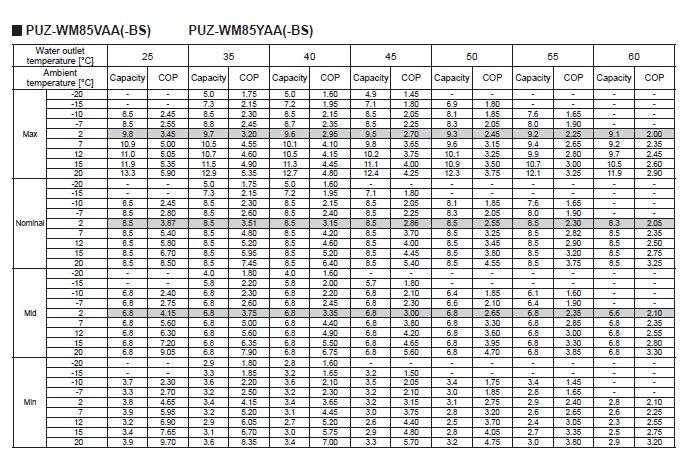
-
How to predict heat pump size from your EPC
JamesPa replied to sharpener's topic in Air Source Heat Pumps (ASHP)
Attached is the table of max outputs as a function of FT and OAT. If you felt like being adventurous you might just get away with the 5kW model which is actually just over 6kW at your design parameters. Unfortunately I don't have min outputs to hand (perhaps @sharpener (or someone else) does. Postscript, I found the detailed specs on another forum here https://community.openenergymonitor.org/t/vaillant-arotherm-owners-thread/21891. They are in Czech, but the graphs are easy to read. arotherm-plus-spec-DB outside.pdf -
How to predict heat pump size from your EPC
JamesPa replied to sharpener's topic in Air Source Heat Pumps (ASHP)
The extra loft insulation is going to be worth 1kW or possibly more (somewhere you should be able to change the assumption about loft insulation!), which reduces your spreadsheet calculation to perhaps 6.6kW. Its about a 3.5C drop from 20.5 to 17. The average house temp in winter is thus very roughly 9*20.5 +15*(20.5-1.75) = 19.4C. The correction factor is therefore 20.5--2.3)(19.4--2.3), about 5% suggesting your design temperature load is about 5.8kW. You will need bigger than this if you plan to heat part time when its at its coldest. 5.8kW and 6.5kW are not that far apart! Based on this my guess, and it is only an (educated) guess, is that you would get away with a 6kW unit or an 8kW unit. The latter, unless it has a particularly good modulation depth, will likely cycle a bit at mild temperatures (when you are likely to be running at 2.5kW or thereabouts), but you are probably in practice going to continue turning it off at night anyway just for comfort, which will tend to counter that because you need to deliver more heat during the day to compensate for the energy lost from the fabric at night. I would be very wary of any suggestion from an installer that you need bigger than 8kW, and if you went for 6kW then you may need a bit of supplementary heating in an extended very cold spell, which happens rarely in Hertfordshire. Note sticker capacity and actual capacity at design conditions may differ, either way! Quite a few people argue, contrary to the practice of most installers, that mild undersizing is better than oversizing. From an efficiency perspective this is true and, if you are prepared to put up with occasionally needing a bit of supplementary heating it is likely a good way to go. Others will argue that you should always oversize if in doubt. Its a trade off of efficiency vs the inconvenience of occasionally needing supplementary heating. Note that some heat pumps have poor modulation capability (ration of max to min output). This includes some 'big names'. Some manufacturers produce fewer distinct hardware variants than the number of different models they advertise, basically 'range rating' them by clamping the max output in the firmware. The downside of this is that, in a 'clamped' variant, the min output is still the same as it was when the same hardware was not 'clamped', so the modulation ratio is degraded. The more transparent manufacturers don't do this and are more 'honest' about the number of distinct hardware variants they actually produce. Hope that helps. -
How to predict heat pump size from your EPC
JamesPa replied to sharpener's topic in Air Source Heat Pumps (ASHP)
All good stuff and no surprises. One more question, by how much does it cool during the night time off period (Im trying to get an estimate of the average house temp to correct for that). For example if it cools by say 5C then the average house temperature is very, very roughly 9*20.5 +15*(20.5-2.55) = 19C. So any figure calculated from annual consumption should be uplifted by (20.5--2.3)(19--2.3), about 7%. That's assuming you plan to heat 24x7 with the ASHP when the OAT is at -2.3. If you can download your half hourly readings then you can look back at the consumption to be even more sure. I averaged over 3 hours to iron out, but with your short heating periods the averaging time would arguably need to be longer. The reason to do these calculations, IMHO, is to sense check what prospective suppliers tell you. If you can get close to the same answer using two or more independent methods, then its probably near enough right. With a 1996, ie fairly modern, house the default assumptions should be fairly close, unless you have done fabric upgrades (eg thicker loft insulation or better windows). Have you?.