Ed_
-
Posts
68 -
Joined
-
Last visited
Everything posted by Ed_
-
Never stated, just drawings of panels, but only 4-5kw ish. If finances allow at the end of the build I likely will do as you suggest and try to semi DIY it, I'd just rather not have to do it as I want to keep options open.
-
I have a planning condition that I must submit a sap which includes solar PV in accordance with my climate questionnaire. Climate questionnaire says PV as per drawings. Drawings show quite a large array. I would rather not fit panels now, due to budget. The development one side never mentioned solar and has no conditions to have solar. The other side has the same drawings and climate questionnaire but no condition to have PV. All approved within a year of each other, so I don't believe that solar PV is a necessary condition of approval, just that I have messed up by promising more than necessary. A compromise would be to fit solar to my shed roof, much smaller array, easier and cheaper. AI suggests I do a NMA to alter the roof plans to reduce and reposition the array, then seek to discharge my condition using these new drawings and smaller PV array. My question is whether this is really a good strategy and whether it is even necessary. If I submit a SAP with a small array to the council will they really compare to the drawings and say it is not big enough? And will they really care if they are not on the roof as per the drawings? It all seems a bit trivial but I have no experience. Many thanks.
-
sliding door threshold detail with external wall insulation?
Ed_ replied to Ed_'s topic in Doors & Door Frames
Thanks @Russdl that is great, it looks like a sensible detail and I'll probably tweak mine to copy it. That GRP angle will hopefully also deal with the issue identified by @craig. Thanks everyone, really appreciated. -
sliding door threshold detail with external wall insulation?
Ed_ replied to Ed_'s topic in Doors & Door Frames
No, I haven't selected a manufacturer yet, but thanks for the tip. -
sliding door threshold detail with external wall insulation?
Ed_ replied to Ed_'s topic in Doors & Door Frames
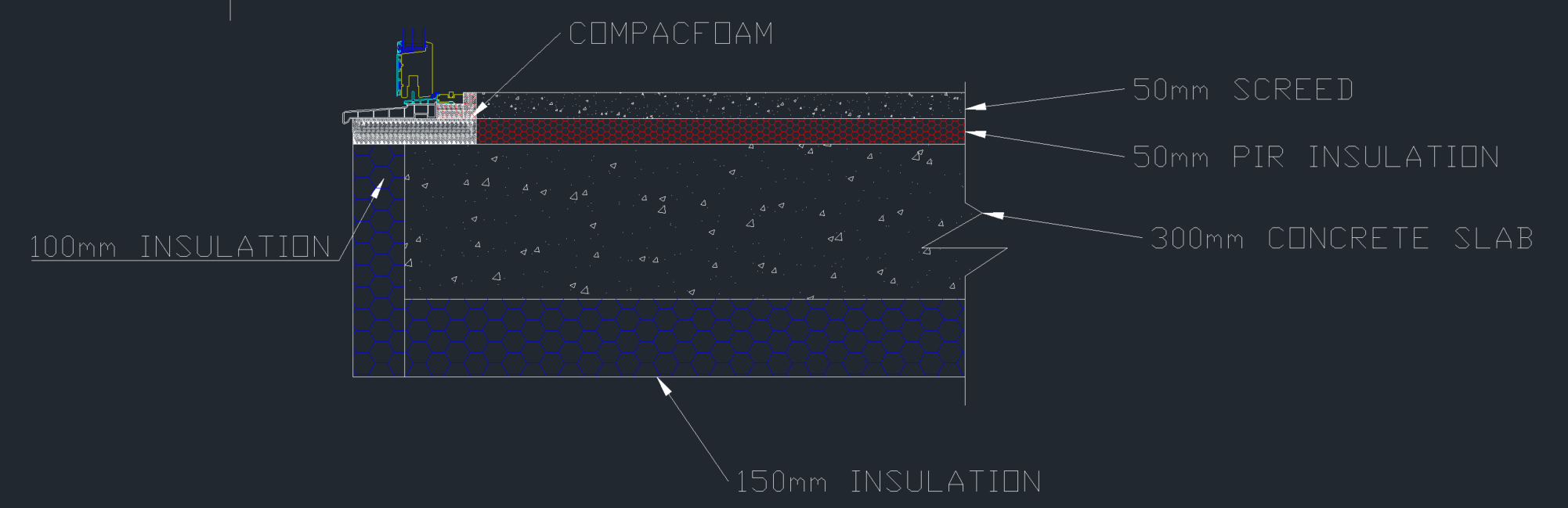
It is not finalised, but it is a combination of me and my structural engineer. The rationale is that it is a walkout basement and the detail between the basement and the timber frame that makes up the top two floors means I can only have 100mm of external insulation on my basement walls (unless I step it out below the plinth, which I don't like the idea of), which is probably not quite enough, so I'm bulking it up a bit with 50mm internal Insulation (it would be enough if it was all basement, but it's not enough for the sections which are above ground- about 50% of the wall area). Under the slab will be 150mm, just because, so there is probably no need for the 50mm internal insulation there except I'd rather thermally isolate the screed a bit more from the concrete slab as the walls will be colder than the floor. Does that make sense? All thoughts appreciated, it seems like the best compromise of quite a few aspects to me but I'm not an expert... -
sliding door threshold detail with external wall insulation?
Ed_ replied to Ed_'s topic in Doors & Door Frames
Thanks everyone for your thoughts, only just catching up. @craig whilst the compacfoam does rest on the EPS and concrete, the track of the sliding door is above only the concrete so the load path will be directly down through the compacfoam Into the concrete, the compacfoam will see no bending and the EPS will see essentially zero load from the slider. I could adjust the compacfoam so it is only on the concrete but I see no advantage to doing thay- the compacfoam should help spread any point loads from the sill. Or at least that's what I'm thinking, maybe I'm wrong? @Nickfromwales is the EPS the frame rests on integral with the slab Insulation? My concern is that mine probably will not be, and therefore may move somewhat Independently of the slab. And then I worry about the DPC, probably because I don't understand the detailing. @Russdl I'd love to see any more details of the GRP and it's fitting if possible. -
I'm struggling to find a good way of mounting my sliding doors, given I will have 100mm of external wall insulation as the outermost part of my wall buildup: I think the door track needs to go over the concrete slab, for strength, which leaves me struggling to protect the 100mm of external insulation. An extended sill seams like the best idea, but I can't really find any of these being offered, perhaps i'm not looking in the right places? As drawn i'm envisaging a wide sill that bridges the concrete to over the insulation, sat on compacfoam for a bit of strength to spread point loads, with the sliding door track set ontop of that. However I can't find suitable sills and i'm not sure if this arrangement would still put undesirable forces through the external insulation, for example when someone steps on the sill. Are there any other ways that don't introduce big thermal bridges?
-
Target U-values… Cost/benefit sense check… What am I missing? 🤷🏻♂️
Ed_ replied to fatgus's topic in Heat Insulation
Having similar debates myself. My main concern is that door/window u values are, at best, much worse than walls. Given a heat source like UFH, which is uniformly distributed, it is inevitable that close to the doors/windows will be colder than the rest of the room, more so with large expanses of glass. So it seems to me that saving money on the u value of doors/windows might be economic in cost terms but possibly has a significant effect on comfort. -
I can't raise the parking area unfortunately, right next to the house. I can probably just make it work with 1/80 fall, but it's very marginal, i'm having to design junctions very precisely and always wary that the consequence of an error anywhere is that it won't work. Does anyone have any experience of using ductile iron pipe? I've found a few things saying it can be buried shallow as strong enough to take the load, haven't found much detail and not sure how BCO will view it. Mesh bridging - do you mean to reinforce the concrete?
-
Demolish and rebuild. The levels to my existing sewer connection are marginal, and due to excavation I will have around 200mm cover over the pipe under a parking area. I think it might be possible to make this work with ductile iron pipe? Or I can make a new connection, that's £5k. Or I can put in a pumping station and that's £1k. Struggling to decide. Pumping station seems most cost effective but is it wise to lock in a pumping station long term? Interesting in everyone's thoughts/experience. Thanks.
-
Totally agree. It is not fair that the same areas get all the pain.
-
10 times as much land is used for golf courses as solar, yet it is solar that gets the bad press for "taking up prime agricultural land". Domestic cats probably kill 1,000-10,000 times as many birds as wind turbines, but we rarely hear that context. Most things we do are bad for nature, but some things are less bad than others. I wonder how much of the reluctance for renewables is simple NIMBY-ism. No one has tried to build a new fossil fuelled plant that recently, somehow I imagine it wouldn't go down too well with the locals unless replacing an existing one, which is probably not a viable strategy given our growing power demands.
-
Do you think ad hominem attacks help convince the undecided of your arguments?
-
Not one single Chinese offshore wind turbine has yet been installed in European waters. I suspect you must have seen the foundations, which are just welded steel. China produces some of what we use, but most are produced in Europe, or the Middle East. Unfortunately, like ship building, we struggle to produce major offshore steelwork in this country. Not just at a competitve price but just to fabricate it full stop There is however a new facility being built at Teesworks - https://www.seahwind.com/ - proper heavy industry. I pray it is successful.
-
It's not just the guaranteed minimum price, it is the price. If electricity prices are higher than the strike price the difference is paid back to (effectively) the government, if lower the government tops up. The owner gets exactly the price, no more or less, per MWh generated. It is the only way projects with huge upfront capital cost and low returns can be built. The cost of finance without certainty over return would kill them, its not at all like oil and gas projects which are generally far more profitable so can stomach higher project finance rates. That and oil companies can often fund off balance sheet rather than finance due to huge historic profits. It is the whatever the capacity entered into the agreement generates, for 20 years. Usually it will be an exact number of turbines' output.
-
Pre and post pandemic is a different universe for large construction projects, cost inflation has been brutal. There is, unfortunately, a lot of fake news around, like the recent loud protests in certain newspapers that the cost of net zero is £7tn. A figure that is deceitfully incorrect - the cost of net zero in the paper from which the £7tn is dishonestly derived is £380bn. Not trivial, but very different. The question is which generation source is the cheapest going forwards, given we need new generation, and it is probably pretty similar for renewables and gas taken as a system. What is not included in that cost and is arguably the most important factor is the uncosted effects - polution, climate change, funding of dictators and wars, volatility. Pick your poison. Oh, and an interesting point that is usually ignored is that given the highest cost generator sets the price for that slot, when considering the system costs of renewables you should account for the fact that if we didn't have renewables the electricity price every day would be much higher as it is the most expensive generators that it is kicking out of the mix. When you look at "gas prices" https://eciu.net/analysis/reports/2025/marginal-gains-how-wind-is-pushing-gas-out-of-the-power-market-and-cutting-costs I don't believe this is correct. Wholesale prices yesterday were around £100, that price will have been set by gas generation. I think you might be quoting the price of gas as being around £55/MWh. CCGT efficiency in converting energy in the form of gas to electricity is around 60% so that gives a price of £92, then there is the cost of the plant doing the conversion so that probably takes you up to the £100. This is an easy mistake to make because it is a favourite technique employed by media commentators who know better but for some unknown reason choose to mislead.
-
Percolation test on made ground - how deep?
Ed_ replied to Ed_'s topic in Rainwater, Guttering & SuDS
I dug the hole 8 weeks ago, so it wasn't oozing then, it was dry. Now it has 20cm of water which seems to be an equilibrium. Whilst i'm generally unconcerned about it not working perfectly, as overflow will run off safely down the gentle slope, I dont want to create problems I don't understand. SI report found perched water at around this depth, but the boreholes were quite far away. I think you are suggesting 200mm crate with 400mm of cover? This makes sense to me - thanks. -
Percolation test on made ground - how deep?
Ed_ replied to Ed_'s topic in Rainwater, Guttering & SuDS
So i dug a hole, it drained away quite nicely - 40cm in <4 hours. All good I thought. Just been back to check and record it more officially and there was 20cm of water in the hole. Scooped a bit of soil out in case it was clay settling at the bottom but made no difference. I suspect I have perched water, as it hasn't rained much recently and it drained away in November, plus it is higher than surounding ground so unlikley to be the water table. If this is the perched water table, at a depth of 60cm, a soakaway seems unlikely to pass, as the minimum depth crate I can find is 40cm which if placed at 60cm depth only gives 20cm of cover which is probably a bit low. Does anyone know? My next plan is to cast around a bit to see if there is a better spot, where either the soil drains better or the perched water is lower. Would another option be to make the soakaway larger so it has enough volume even with 15cm of water in the bottom from the perched water table? Or has anyone done a rain garden with no overflow? -
Percolation test on made ground - how deep?
Ed_ replied to Ed_'s topic in Rainwater, Guttering & SuDS
It seems to go away. No signs of flooding or waterlogging. The gradient is minor but still that would prevent any sort of flooding, the water would just run off. In the end there is a road at the lowest point, and if it gets that far it will enter the drains. -
Percolation test on made ground - how deep?
Ed_ replied to Ed_'s topic in Rainwater, Guttering & SuDS
Houses. This is an urban area. All the houses up the hill, so far as I can tell, drain to back garden soakaways. -
Percolation test on made ground - how deep?
Ed_ replied to Ed_'s topic in Rainwater, Guttering & SuDS
The foundations will be down to the clay, it's a basement so will be a sort of raft. Soakaway can be downhill and I could put it 15m-20m away I think. You are right, best to dig a hole and see what happens first. -
Percolation test on made ground - how deep?
Ed_ replied to Ed_'s topic in Rainwater, Guttering & SuDS
It says to a depth of 300mm below the invert pipe. That will be fairly shallow, within my made ground layer. From part H the depth seems quite clear, but when I read about soakaways and percolation tests, a lot of the Information suggests I should conduct the test in the undisturbed layer, ie the clay below the made ground. I feel reasonably content that doing the test in the made ground will give me a representative result, and if successful a working system like the existing one, but I am hardly an expert. -
Percolation test on made ground - how deep?
Ed_ replied to Ed_'s topic in Rainwater, Guttering & SuDS
No... -
Percolation test on made ground - how deep?
Ed_ replied to Ed_'s topic in Rainwater, Guttering & SuDS
100mm. Attenuated to 2l/s, I think. -
Doing a demolish and rebuild. Existing rainwater went to a soakaway, which unfortunately had to be removed. I have 1-2m of made ground over clay. Clay is, apparently, essentially impermeable. Don't bother with a percolation test they say. All well and good but I've been quoted £25-30k for connection to the surface water drain - 8m away across a quiet residential road! I'm sure I can find a cheaper quote, but got me back to thinking about soakaways. Clearly the existing soakaway worked, I'm on a very slight slope and I guess the water percolates through the topsoil/made ground downhill, slowly adsorbing, evaporating and eventually ending in the river. The advice on a percolation test seems to be to dig it at the level of the soakaway. If I choose a broad flat soakaway design, I'm sure I could bring this above the top of the clay layer and reasonably expect it to drain adequately. Is there anything wrong with this logic? It seems percolation tests aren't exactly very well controlled.