jayc89
-
Posts
1389 -
Joined
-
Last visited
-
Days Won
1
Everything posted by jayc89
-
Net zero retrofit requirements
jayc89 replied to ColdHouse's topic in Energy Efficient & Sustainable Design Concepts
Do you live in it? To do it properly it will need totally gutting. It will allow you to run a continuous airtight layer, route MVHR ducts appropriately etc etc. We retrofitted a concrete slab in our current house, managed to get a micro digger and dumper in through the front door to make things easier but it was a messy job. With something like this, I'd start with a plan for AIM (Airtightness, Insulation and Mechanical Ventilation) to reduce your energy usage as much as possible, which will then help drive your APE (ASHP, PV, EV) plans to reach net zero. -
Looking for some pipe clips to secure a 28mm copper pipe that is already in place. I've seen ones like this for up to 22mm pipes - https://www.bes.co.uk/fliptop-wrap-over-pipe-clip-with-end-fixing-22mm-9617 - but can't find anything large enough for 28mm. Any one any ideas?
-
How long should that take? That's what I did, for about 10 minutes, and the volume of air in the gauge didn't noticeably reduce. Loop is approx 58m in length/7 litres in water volume.
-
If I shut all the other flow gauges off and just open that loop it’s making almost a scratching noise, possibly air flowing through it?
-
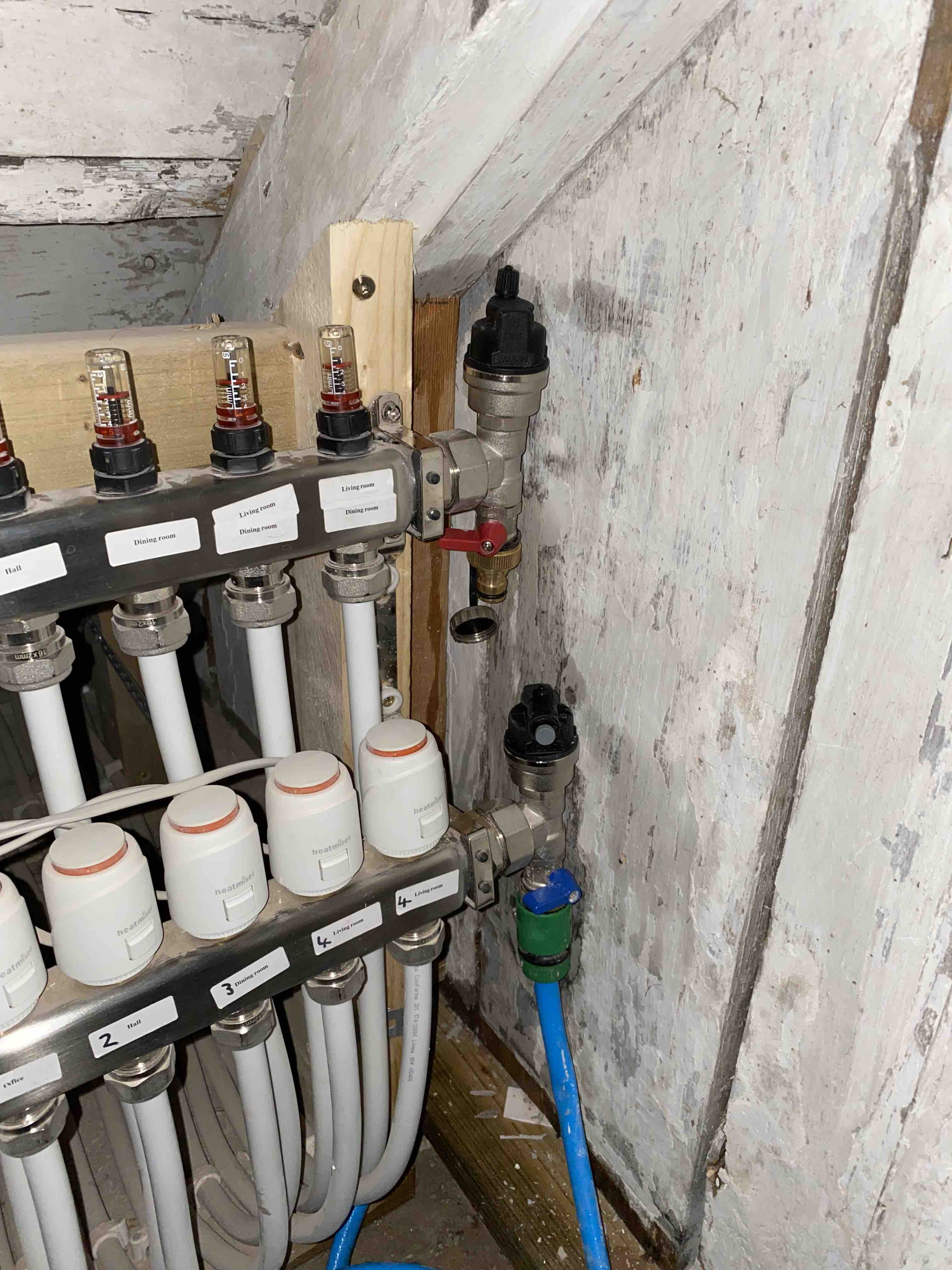
Any ideas why, especially now there are 2x AAVs on the manifold? Best option to fully flush that loop?
-
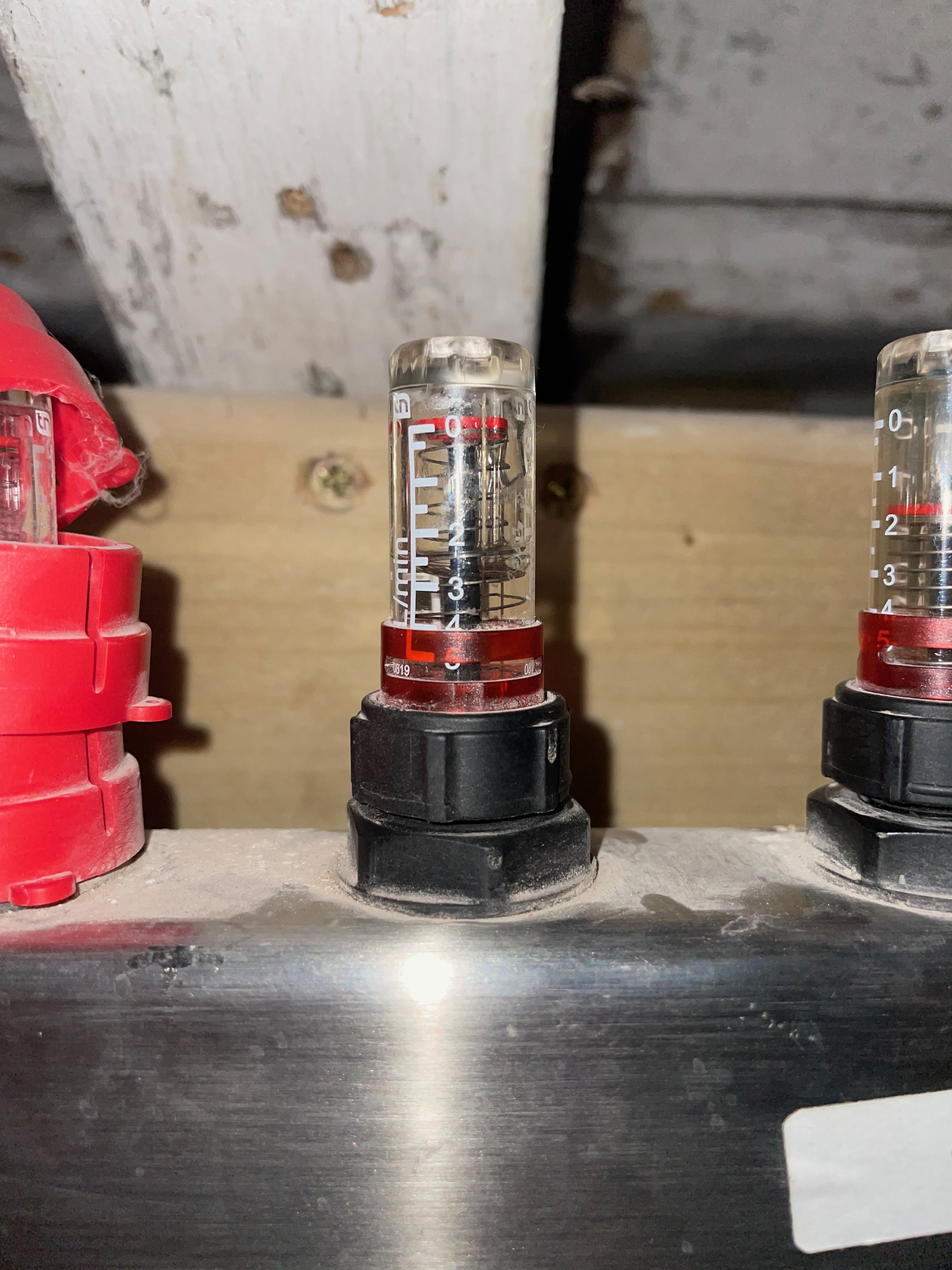
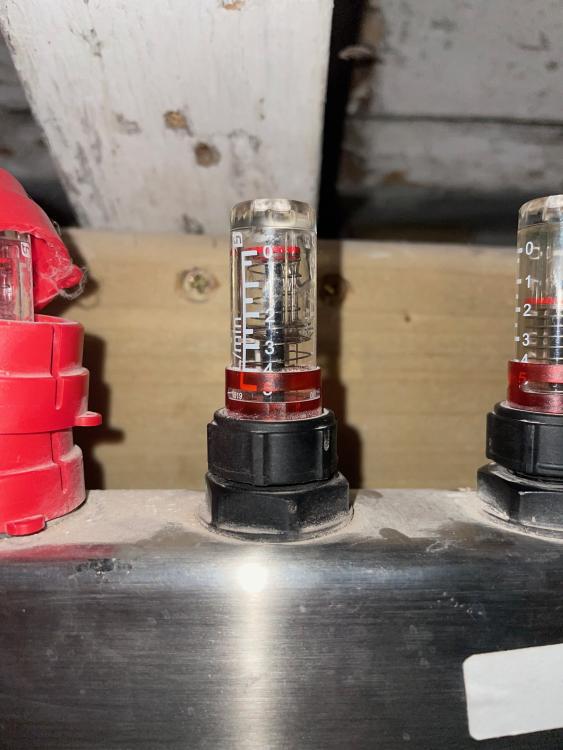
Just checked back and the flows across all loops has dropped again. Interestingly, one of the flow valves is half empty - the water stops around 2.5 l/m, whereas all others are pretty much full. I've turned that loop off to see if the other ones continue to lose flow. If they don't I'll flush this loop out tomorrow and see if it helps.
-
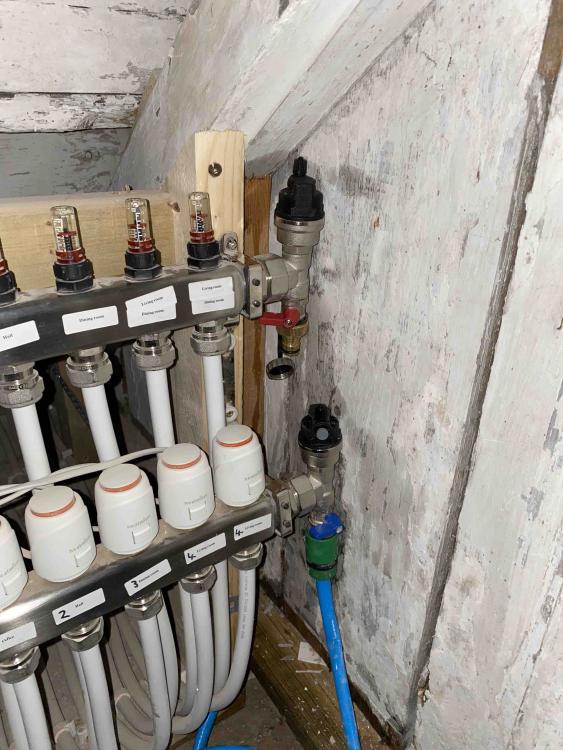
All done. Not sure if they've made much difference alone but I fiddled with the mixer valve which let off a big gurgle too so I suspect there might have been air trapped in there. Flow rates are currently stable so I'll keep an eye on them. Thanks @Nickfromwales!
-
We had a section blown on an internal wall, I suspect it was down to the suction not being controlled properly. We have quite old, porous walls, and the plasterer used bonding and a couple of coats of multi-finish. He did have PVA with him, but I don't know if he used it on the areas we had problems. I suspect it needed something like hardwall rather than bonding to get the suction under control before the finish coats. All needs knocking off and doing again.
-
Looking for the tradesmen
jayc89 replied to Post and beam's topic in Bricklaying, Blockwork & Mortar
Could be quite area specific. We have a similar group and whenever someone asks for recommendations it's just friends/wives/sisters/cousins touting their relatives business every time. You reach the point of losing any trust in those so called recommendations, unfortunately. -
I'm looking for a Weather Comp kit form system boiler. I understand I need part number #7225851. However it appears out-of-stock everywhere I've looked, some suggesting it's been discontinued, with no suitable alternative for my boiler. IFOS seems to be their replacement, Does anyone know where I might be able to find some old stock?
-
Yeah, pipework will be in the void. No idea why they were ran so low, but it does give me enough room between them and the joists above to re-route the drainage for the bathroom above as currently it's all boxed in. So every cloud...
-
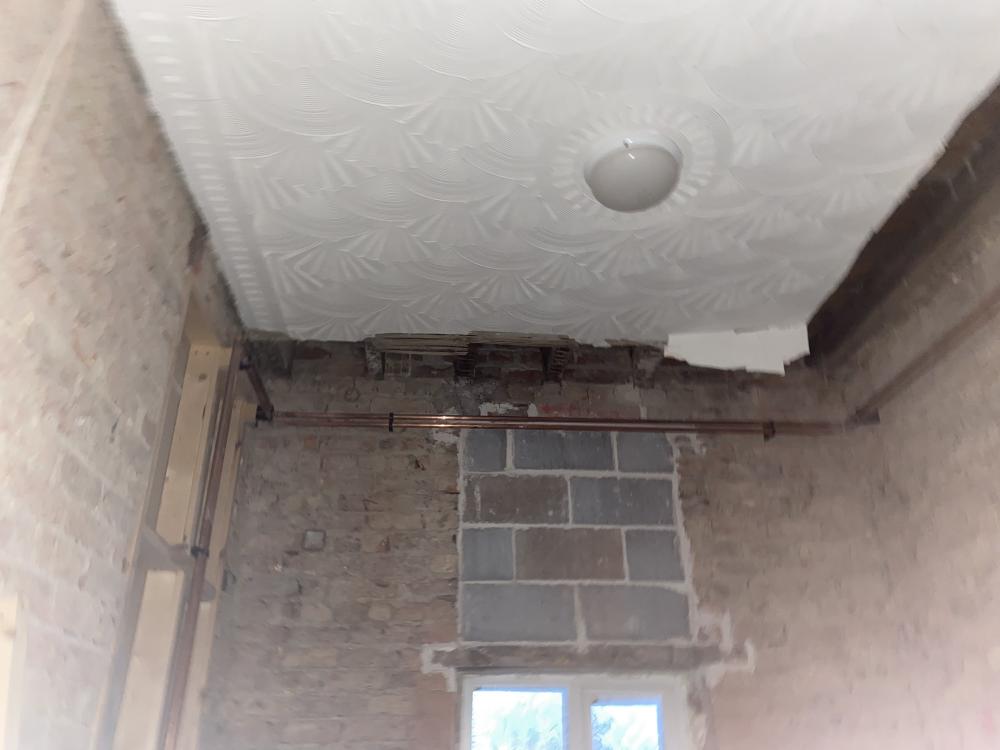
I need to install a false ceiling approx 200mm below the floor joists above. Area is approx 3.5m x 2.5m so not massive. Will only be to hang PB from and a couple of LED spots. Timber or MF? I assume it will need some sort of supports from the joists across the runs?
-
Insulating should help, but damp behind wardrobes, or any other fixed furniture, is generally indicative of additional ventilation being needed too. The VCL does indeed need to be continuous and in your case sealed around the perimeter of the insulated wall, so a plastic VCL over the top of the PIR might be better in your case, generally finishing behind the abutting PB and sealing with an acrylic sealant like this - https://www.ecologicalbuildingsystems.com/product/orcon-f The use of impermeable materials, such as PIR, on solid wall structures is contentious. Some are firmly in the camp of only ever using breathable materials, such as woodfibre insulation, and a lime plaster finish, whereas other's don't consider internal breathability to be as big a concern. The biggest imminent risk is interstitial condensation, where warm moist air reaches the cold side of the insulation and condenses, so foam and taping to create the continuous barrier is important. Some breathable materials are "safer" in this regard, wood fibre, for example is hygroscopic so will retain moisture during the cold season and release it during the warm. What's on the outer face of the wall? Render/paint, if so, what kind, cement? I've taken a more pragmatic approach to my renovation, I'd love to use breathable materials, but they were cost prohibitive for me, and plasterers that will work with lime around me are like hen's teeth. There's certainly no one-size-fits-all-solution. What works for one house may not work for another. I'm of the opinion that so long as a wall can "breathe" to at least one surface, the risk is reduced (although not removed), so things like ensuring gutters are working, not leaking, ensuring good pointing, any paint/render on the external face is breathable, and that there are now raised ground levels, has been key to my renovation - eventually I plan to install a French drain round the perimeter of the house too. Internally, the walls are back to brick, junctions around joists etc have been pointed using lime (I didn't want to risk trapping moisture directly against the joists) and I'll be using the "Warm Batten" approach to gluing PIR directing to the wall using PU adhesive, and screwing battens through it which will act as a service void. To stick the board, I applied a continuous bead of adhesive around the perimeter of it and a continuous zig-zag bead across it, the idea here is that any cold air that does make it through the wall gets is limited to one of these cavities thus reducing any thermal-bypass. Once a board was on the wall, I also applied a bead of the adhesive around the edges of it to be doubly-sure any cold air behind can't travel between boards. I used window packers to leave a 10mm space around all boards, including those at wall and floor junctions, which I later filled with expanding foam and then taped using aluminium tape - this could have been overkill, my thinking is in an older house, nothing is square, so there will always be slight gaps and deliberately leaving a larger gap to foam up later would make it easier to capture them all. Once one wall had been fully foamed and taped, including around floor and ceiling junctions, I started on the return wall so any abutments should be pretty snug.
-
A membrane on the cold side is to prevent cold air impacting the performance of the insulation (thermal bypass), you could argue PIR taped well enough on the cold side offers the same thing. You still need to tape the warm side though to avoid condensation. Without tape, the risk is warm moist air from the room could get through the gaps between the PIR and joists and condense against the cold side.
-
Assuming the void below is well ventilated, ideally you'd have a wind tight membrane below the insulation (cold side) and an airtight membrane above it (warm side). A few images of the idea here - https://www.ecologicalbuildingsystems.com/post/ask-expert-thermally-upgrading-suspended-floors.
-
We were in a similar situation, much older house though. Before I came across my second home (this forum), we just took the plumbers advice, we ended up with a 32kw system boiler. Massive overkill for our actual demands, and that's before adding insulation! I think he was still working in the days of 70c flow temps and massive radiators everywhere. It's looking like we're going to be needing some sort of buffer tank by the time we're finished to avoid any short cycling, so it pays to make the right decision early on. The heat loss calc has been incredibly useful to me, I'd certainly plug your numbers into it and add 3kw for your DWH. If you don't already have a mains gas supply, I'd also seriously consider a heat pump. Good luck!
-
It's a while off, but as I work by way around the house insulating and improving airtightness, I'm going to eventually reach a couple of open fireplaces. One has a stove fitted, so is lined and has a register plate between the brickwork and the slate tiles. The other is currently back to brick with a bung shoved up it. The one with the stove in will be a PITA to do anything with, it's unlikely we'll get the tiles back off without damaging them and even if we could, even 25mm insulation would likely mean the space around the stove no longer complies with regs, so I'm mainly looking to focus on airtightness around the register plate junction. What's the best option with this one? Remove the plate, glob it up with some sort of heat retardant sealant, refit and drop Vermiculite or similar from above around the lining? For the one that's back to brick, the plan is to build this out and have a media wall installed there, so we have more flexibility. I'm thinking of framing it out, to support the new inset fire and TV and using spray foam insulation to fill the gaps behind, cutting it flush around the frame once set - which should tackle insulation and airtightness at the same time?
-
Calculating ducting size
jayc89 replied to jayc89's topic in Mechanical Ventilation with Heat Recovery (MVHR)
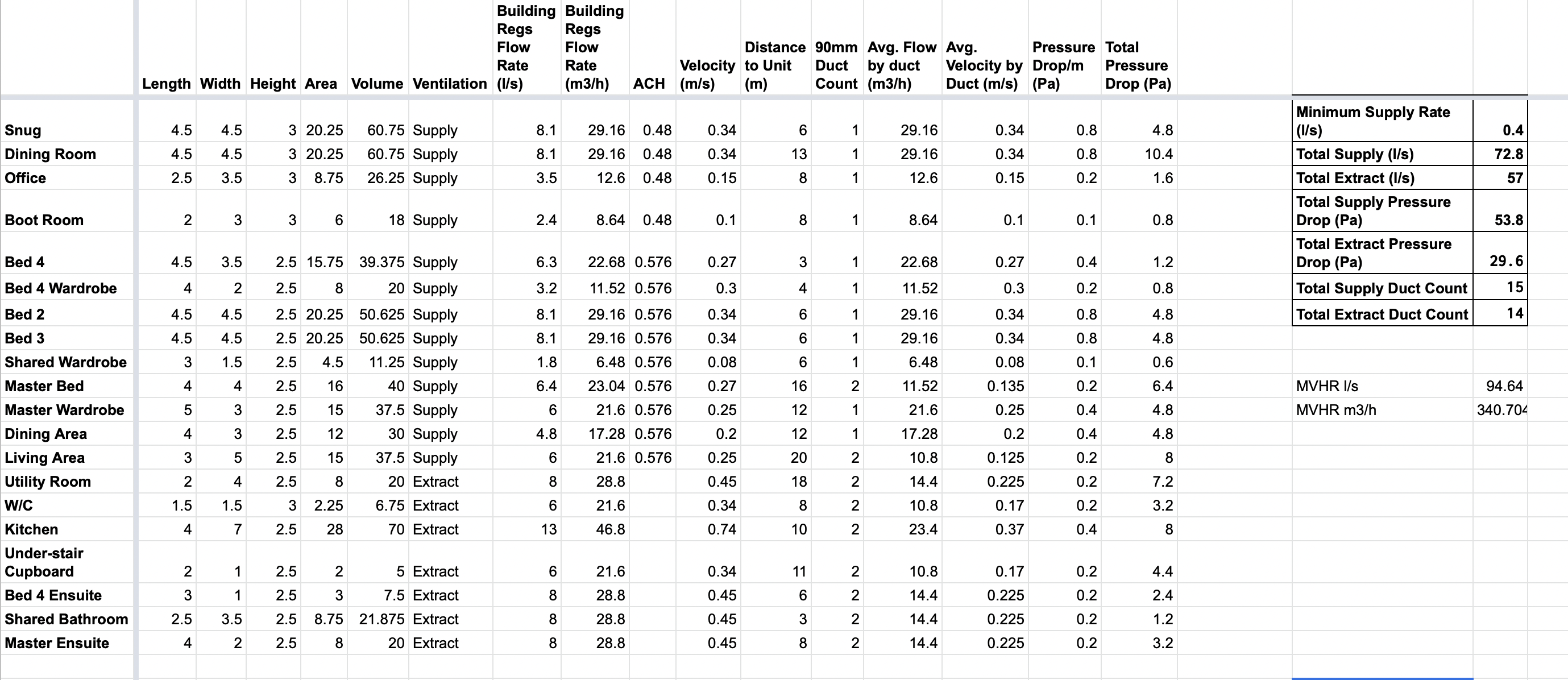
That was based on the max of the supply and extract rates (72.8 l/s) x 1.5 = 110 l/s. Of course in reality, the extracts would be ramped up to match the total supply rate. -
Calculating ducting size
jayc89 replied to jayc89's topic in Mechanical Ventilation with Heat Recovery (MVHR)
Thanks. So, assuming the calcs are correct, I'm looking at a unit with approx. 110 l/s or 400 m3/h. -
Calculating ducting size
jayc89 replied to jayc89's topic in Mechanical Ventilation with Heat Recovery (MVHR)
Thanks. Your rooms are slightly larger than mine and not a million miles of my updated numbers. In terms of sizing the MVHR unit, what sort of multiplier should be applied to the overall house demand to ensure I have a sufficiently sized unit that isn't being laboured under normal load?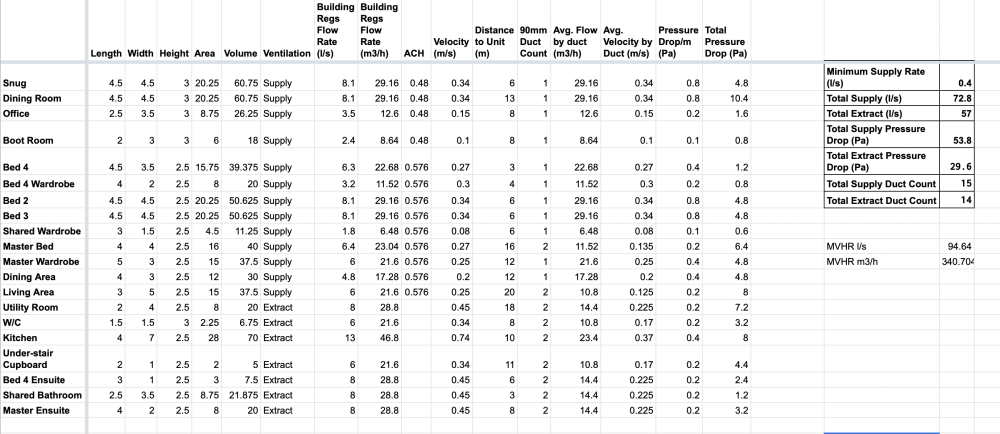
-
Calculating ducting size
jayc89 replied to jayc89's topic in Mechanical Ventilation with Heat Recovery (MVHR)
Thanks, that's really useful. How large is your bedroom/wardrobe and living room for comparison? Assuming my calcs are actually correct, at 0.3 l/s/m2 the per room ACH ranges from 0.36 to 0.432. If I bump that to 0.4 l/s/m2 they range from 0.48 to 0.576. With the master bedroom + wardrobe being supplied with 12.4 l/s (or 44.6 m3/h) and the living area being supplied with 6 l/s (or 21.6 m3/h). Both ACH of 0.576. My assumption was that I'd dial this numbers down once signed off by BCO, not need an increase -
Calculating ducting size
jayc89 replied to jayc89's topic in Mechanical Ventilation with Heat Recovery (MVHR)
I've split the master in bedroom/wardrobe/ensuite. The bedroom + wardrobe combined is 9.3 l/s, or 33.5 m3/h, based on 0.3l/s/m2. All 4 bedrooms are doubles. 3 occupied full time, one being a guest bedroom. Similarly the living area was calculated using 0.3l/s/m2, is this not correct? The under-stair cupboard is artificially high, it's part below ground (previously the access into a now, covered over, cellar), so is prone to dampness in the walls. The walls have since been re-rendered in lime, floor dug up and replaced using limecrete etc, so it's just a case of increase ventilation down there. -
Calculating ducting size
jayc89 replied to jayc89's topic in Mechanical Ventilation with Heat Recovery (MVHR)
90mm ducting certainly reduces the pressure drop across the whole system to below 100 Pa. It looks like I'd only need to double up on the 2x longest supply runs (living area and master bedroom), would you still recommend doubling up on all the extracts? -
Calculating ducting size
jayc89 replied to jayc89's topic in Mechanical Ventilation with Heat Recovery (MVHR)
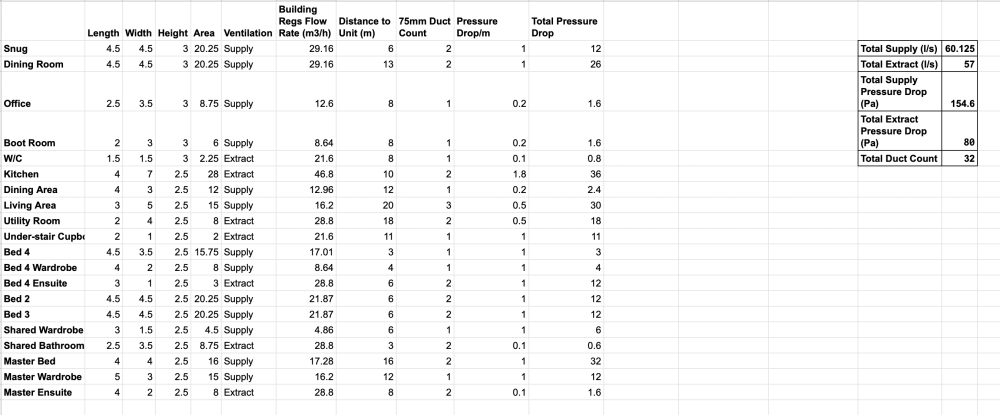
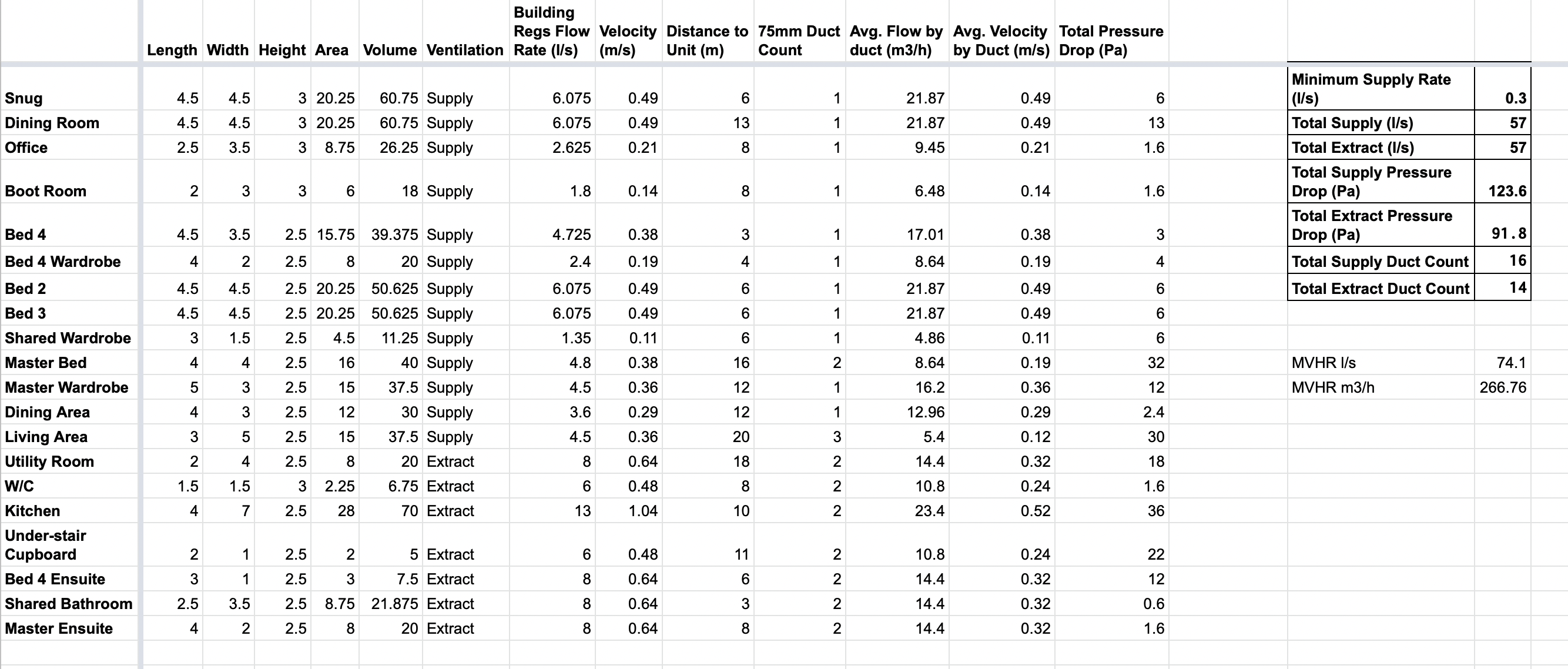
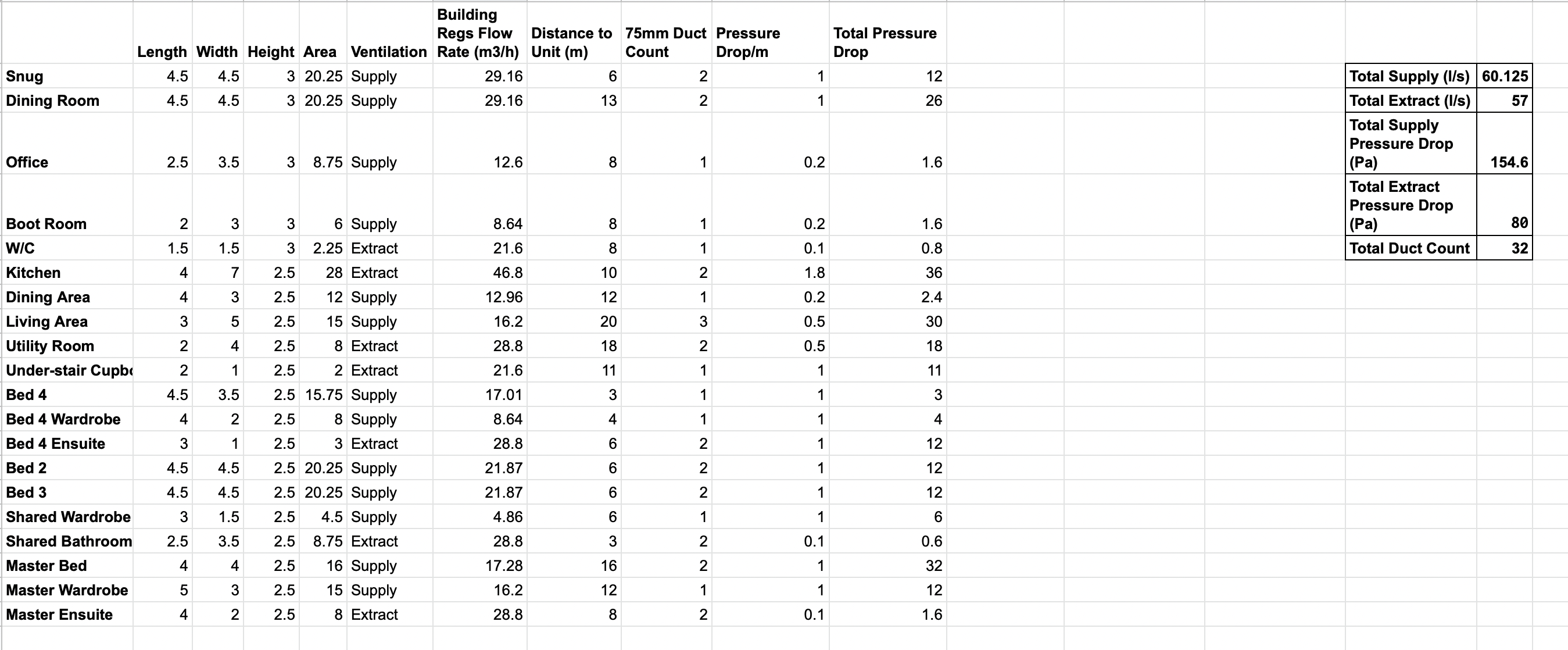
Took another stab at this, also taking velocity into account. Velocity numbers were taken from https://www.cuidevices.com/product/resource/calculators/airflow-conversion using the minimum flow requirements (l/s) from Column K and the ID of the 75mm ducting (68mm) I'd appreciate someone sanity checking my numbers to make sure I'm not talking out of my arse! (For context, there's an extract in the "Under-stair cupboard" as it's part-below ground so prone to slight dampness in the walls - old houses!) Couple of questions though; - Build Regs state a minimum flow of 0.3l/s per m2 of room area, but that doesn't take into account volume. Our downstairs rooms are quite tall (3m) so should I be looking at more than 0.3l/s/m2? - Total supply pressure is > 100Pa. For the longer runs where there are 2x or even 3x ducts being run and therefore the pressure drop is greater, should I be looking at using less, but larger ducts instead? - When sizing the MVHR unit, what multiplier should I apply to the demand to ensure the unit is right-sized. Is 1.3x sufficient?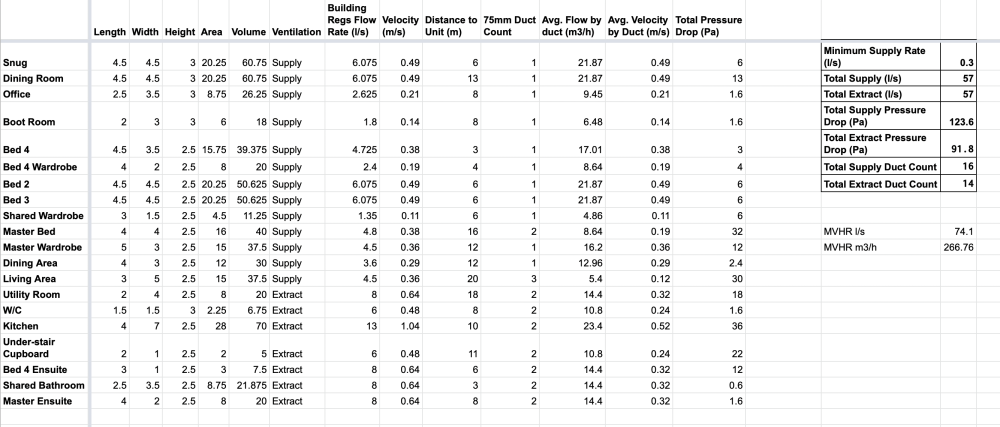
-
Calculating ducting size
jayc89 replied to jayc89's topic in Mechanical Ventilation with Heat Recovery (MVHR)
That looks to be around 30m3/h for 75mm ducting. Due to the distance, or room size, I'm already planning on doubling up the ducts anywhere that's nearing 30m3/h, so each duct should be well below 2.5ms That's based on 0.3 l/s per m2 for Supply and Building Regs minimum per room type for Extract (i.e. 13 l/s for kitchens etc)