Rich123
-
Posts
42 -
Joined
-
Last visited
Everything posted by Rich123
-
Integrating an MVHR to our build
Rich123 replied to djcdan's topic in Mechanical Ventilation with Heat Recovery (MVHR)
I am talking about thermal design . There are a number of standards , but NHBC or CIBSE are the 2 industry recognised standards. I would agree that maybe some of this is out dated. But if there is an issue then at least it’s a recognised standard. Having investigated a number of issues with homes the first thing I would do was ask for the specified standard and the calculations. -
Integrating an MVHR to our build
Rich123 replied to djcdan's topic in Mechanical Ventilation with Heat Recovery (MVHR)
Hi yes I understand the argument , and passive house is designed to require minimal heating. I am not a passive house designer but the standard for this is very high, not only U values but zero cold bridges , building orientation etc. This is a fabric first approach and I’d agree that under these circumstances then you should be fine. However as a designer I would want to ensure that any design is 100% suitable for use . People use houses in different ways and from what I gather from this thread there has been no detailed thermal analysis to support what the system will achieve. If I was buying a house with no heating in the bedrooms , I would want to have supporting evidence that this is an engineered solution and not a guess. -
Hi , I am a Member of the Chartered Institute of Building Services Engineers ( MCIBSE). I spent many years as a Project Manager and Designer of Building services. I have done a lot of commercial work but also a fair amount of domestic design, probably in excess of 1000 projects, so I’ve seen most things. Im actually on here to get some info on construction as my experience is mostly M&E. I was a qualified SAP assessor and have done quite a lot of building physics work , facade design and modelling. I have found a lot of difficulty getting contractors to build things to the required spec , most don’t seem to understand why they do things and therefor it gets compromised. I don’t profess to know everything as there are changes in technology , but i can probably help with ideas to find solutions.
-
Hi , just read your response, if I could get the manual I’d have another look for you . But these are a few items 1. The thermostat as you described is optimised start. This calculates the pre heat required to get the temperature to the required level by the occupancy set time. This is an essential element. It may also have economy off which is the same thing in reverse. 2. Ensure that you have set the unit to heating priority. I would actually try turning off the hot water for a day just to see if it responds better. With a standard domestic boiler and cylinder , the heat load required is actually relatively low. Recovery heat up of the cylinders is around half an hour with a 28 kW boiler. So with a 9 kW heat pump that is potentially 2 hours. Heat pumps also ice at low temperatures , therefore there is a defrost cycle. From the very sketchy info on the LG I think it has an electric heater but I’m not sure if that is totally compensating for the defrost. I also see that the system is weather compensated , this changes the supply temperature based on external temperature , this may be adjustable and if you can change the curve it may help as at 5 degrees the supply temperature could be around 65 C .
-
One way to check would be to measure the radiators to establish the heat output. I would then reduce the flow temperature in winter to see the minimum to heat the house , then calculate the heat output from the radiators at the reduced temperature. That will be the actual heat required. Heat pumps generally are required to run longer as they don’t have the output to meet the heat up load - its a difficult job to size them correctly and I have always had a few discussions with the suppliers and installers on this subject. I haven’t been involved in retro fit , only new builds where the options are better. in general for an old house allow 100w/ m2 - New build around 45 W / m2 , however these are calculated loads and in reality you can get away with less but then it’s a bit of guessing unless you can model it using expensive software, and even then I wouldn’t use the figures as they would be low.
-
Hi, ok to size the heat pump you need the heat loss for the rooms . Generally heat pumps are under sized if compared to traditional , I would say 9 kW should be ok. My concern is the system it’s connected to. Is this radiators ? I’ve checked the heat pump and I assume they have installed the high temp version ? As a previous post I would leave the heating on longer , allow 3 hours pre heat so on at 5 to get to temp by 8 Am . Also check your hot water settings , you should have heating priority Heating requires 2 elements 1. to meet the heat loss 2. to meet the fabric absorption - the admittance of the structure. So a masonary building needs a lot more heat to warm up than a timber frame due to the fabric response. Therefore if you have masonary then the problem will be worse timber frame in general.
-
Integrating an MVHR to our build
Rich123 replied to djcdan's topic in Mechanical Ventilation with Heat Recovery (MVHR)
Re ASHP, if your using an ASHP underfloor heating is the best solution. Hot water would be generated by a cylinder with an electrical boost , Daiken do a system for both that integrates well. -
Integrating an MVHR to our build
Rich123 replied to djcdan's topic in Mechanical Ventilation with Heat Recovery (MVHR)
Hi haven’t followed all the threads but I will offer a little advice. 1. install the MVHR on. Solid wall , if not use isolating mounts to ensure that there is no vibration. 2. install flexible ducts on the final connections. 3. consider using attenuators in the duct work, On the external connections And Between rooms . 4. Use pre insulated ductwork 5 . Make sure there is no requirement for fire control, normally on the means of escape you would need to install fire stops. Worth checking. make sure inlet and outlets are 3 mtr apart if possible. 6 Use an approved contractor for installation 7. Use bends with splitters in , these are much lower resistance than standard. Re calculations , I didn’t see the whole house air change rate which boost needs to meet . Keeping the velocity low will improve the noise levels also as this will reduce the pressure loss of the system. Re heating , I would heat every room , no discussion. Especially if you ever want to sell the house. NHBC set standards for design and I would ensure that these are met in every room. Rich -
Hi , in an old property the air infiltration rate will be high as the structure is not designed to be air tight. In 2008 air testing of buildings was introduced and most new builds struggled to achieve the desired air test of 10 m3 per m2 per hour at 50pascals pressure. in recent years most buildings are achieving around 2 , this is by the method of construction , particularly timber frame which is more air tight . Passivhaus is less than 1 . I would expect your property to be around 25 . New builds have balanced heat recovery ventilation , therefore external infiltration isn’t required to reduce humidity. It would be close to impossible to get an old house to meet the new build standard without a radical refurb, lining all of the walls and roof and over cladding with insulation. Plus a whole house mechanical vent system.
-
No Lintel under existing opening
Rich123 replied to Rich123's topic in House Extensions & Conservatories
Thanks , ok I’ll see how we get on , I’m sure that it’s fine. Peter , yes the steels are all grouted in with the correct grout to the pad stones . this was just after we had levelled the steels , fixed down with chem anchors. Well spotted thanks . Rich -
No Lintel under existing opening
Rich123 replied to Rich123's topic in House Extensions & Conservatories
Thanks Joe , sorry the pic isn’t great as we have started cladding the opening. Im sure windows can be with no lintel depending on the width but these are wide openings. however at least it seems this is a method used so thanks for that, attached is another photo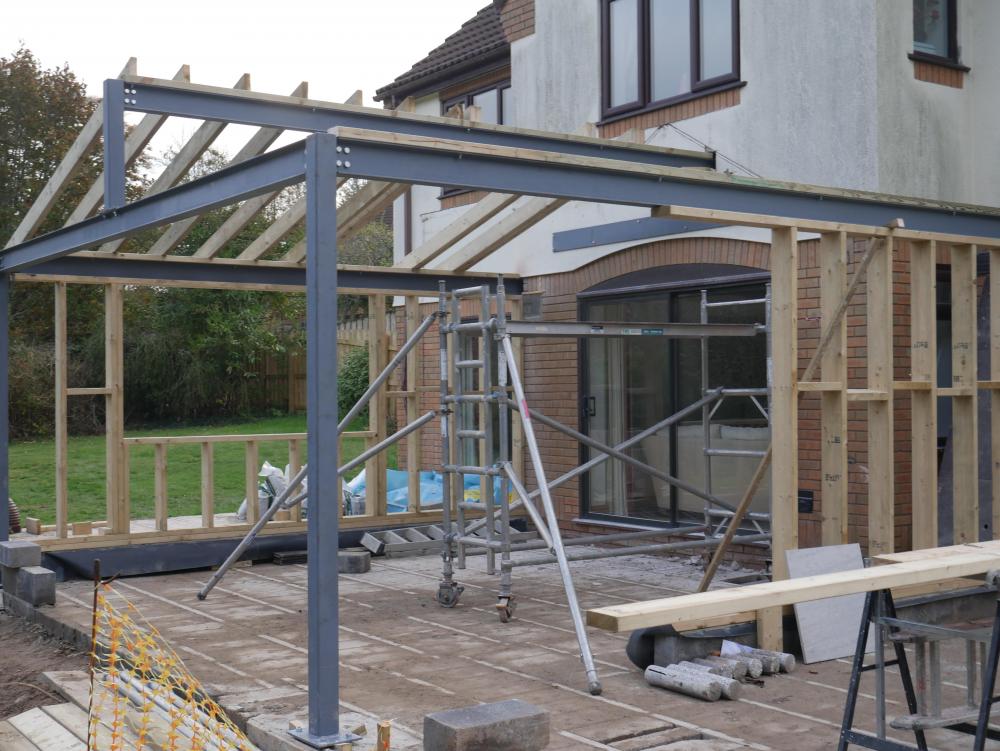
-
Hi, well we are finishing the new extension and the old external wall opening doesn’t have a lintel as far as we can tell The opening is 2400 wide and is formed on the outside wall, the old outside, with an arch. under the arch is a grp former which we have removed , but the builder tells me that it was quite normal to build these with no lintel. I called my structural engineer and he told me it would have been built with a lintel , maybe over the top, but we can’t see it and drilling through the arch masonary upwards doesn’t hit anything. The building is 1987 and was built by a very good building company to a high standard , so I can only assume the method was correct. There is a plate above the opening in the attached photo installed as part of the extension to take the additional roof ridge steel load. My question is 1. Is this something that anyone else has experience with and could there be a lintel in another position.
-
Hi Benjamin , I think that as this is the coldest zone then the use of a zone valve is probably a bit over the top. However you could use a zone valve to the radiator wired in parallel to the underfloor zone . Depending on the existing control system this would need to be either a similar voltage or you would need a relay to operate the valve. The only other issue is flow through the radiator which should be fine but connecting across the manifold may result in low flow due to the small differential pressure across the manifold. As this is the hallway then I suspect it is always required to be warm. If the underfloor is configured with the required boiler enable off the controller the heating to a radiator will only operate if the zones are calling for heat and therefore the boiler is firing . There are of course many solutions , but I would say keep it simple.
-
Hi , running radiator direct from the underfloor loop would be possible but the output would be very low at the temperatures after the manifold. There are a number of options , put the radiator prior to the manifold , assuming the primary temperature of the heating is running at 80 c, or using a fan assisted radiator direct off the underfloor circuit . it could work off its own thermostat to simplify things or a trv. if you run a radiator at 50 c the output would be reduced to less than half the stated value , there are tables to check this if you go to the stelrad website.
-
Timber frame Condensation on outside of vapour barrier
Rich123 replied to Rich123's topic in Introduce Yourself
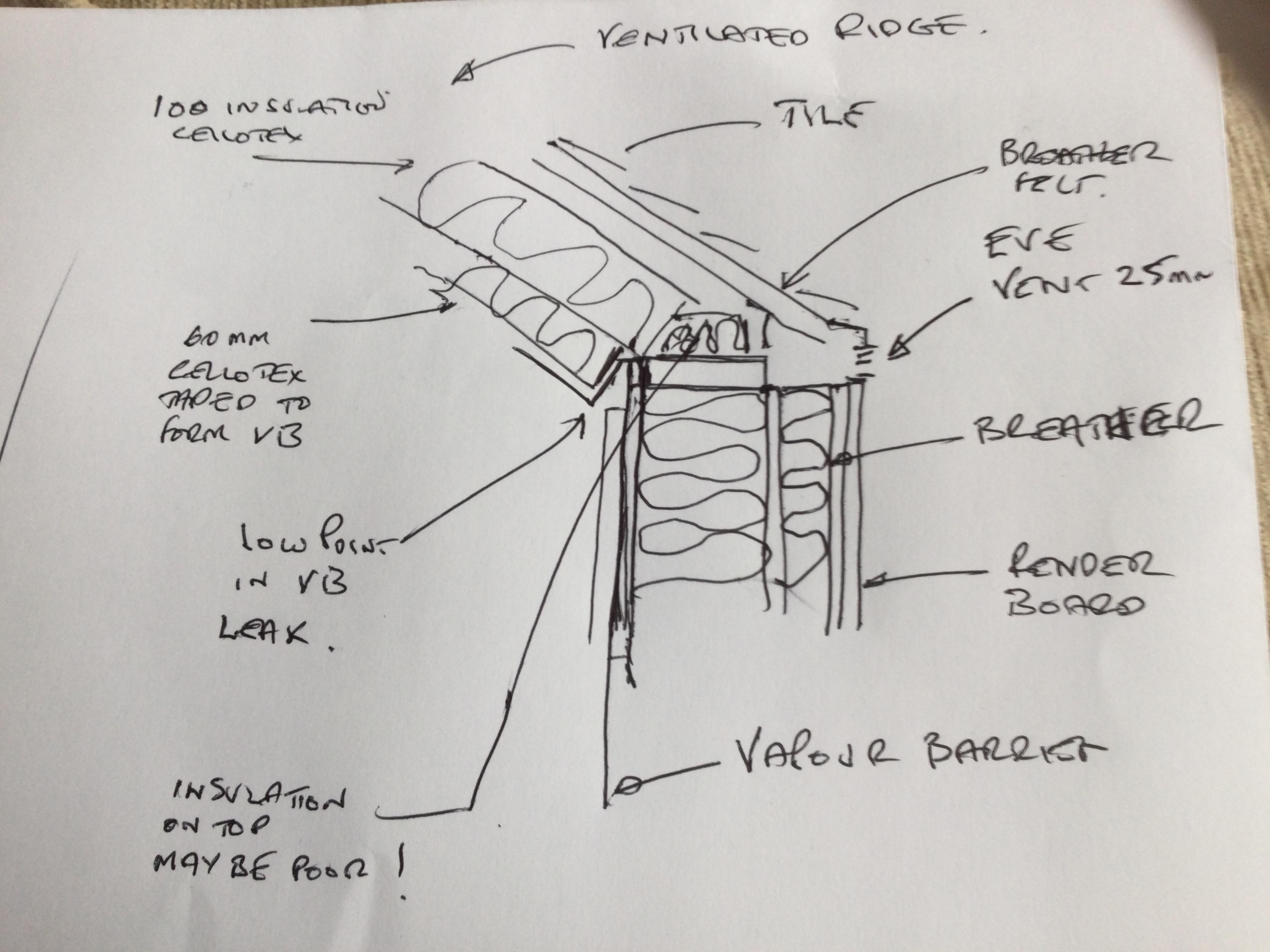
Hi roof build up is outside to in tiles 25 mm air gap breather Kingspan nil vent ventilated eves 25 mm ventilated ridge 150 x 47 timber with 100 mm cellotex between studs 50 mm insulation under taped to form vapour barrier. vertical VB on external timber frame walls taped to ceiling with silver foil .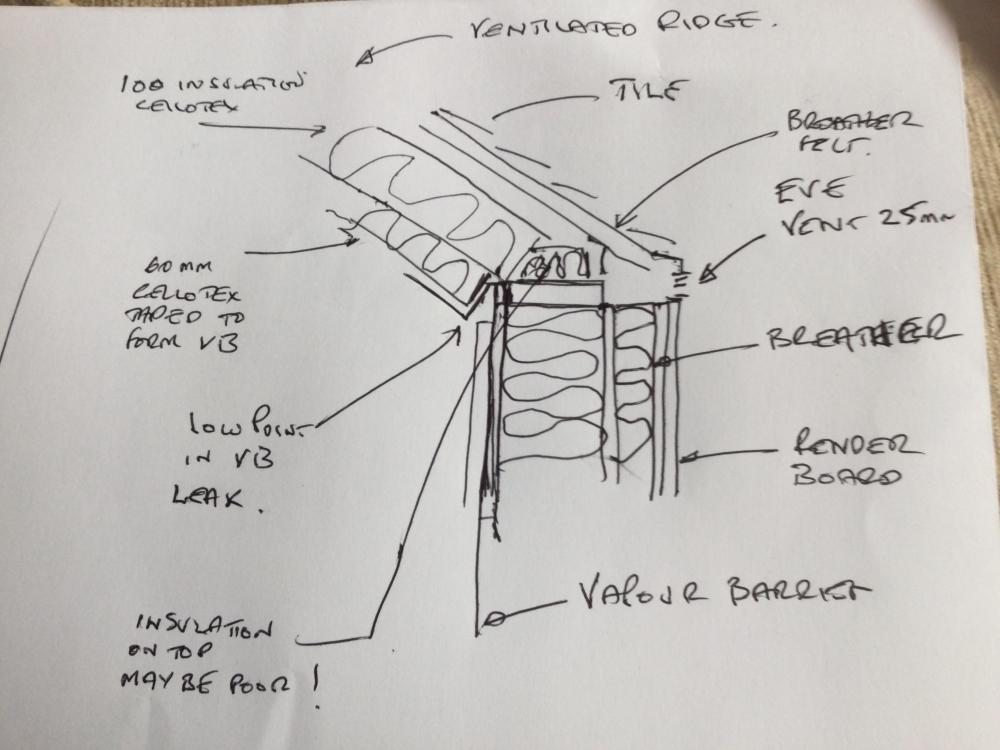
-
Hi all , hope all are well . I have an issue with a new build extension . It’s timber frame and I have been building it with sub contractors over the past 2 months. the roof is on and it’s plaster boarded , heating is on , underfloor in slab. in the past few days we had very cold still weather, I noticed a dripping from inside the frame and removed a board to see condensation which was dripping through the vapour barrier. This is external condensation which is tracking through the vapour barrier. Obviously the frame went up in very wet conditions and my theory is that the low temperature has resulted in the damp frame evaporating and freezing on the roof . The ceiling is vaulted so there is no loft space. Is this reasonable assumption and if so will it resolve itself as it dries, and how long may this take ? one issue is that the Vapour barrier is lapped down and on to the ceiling insulation , which is forming a low point , not ideal but will it be a long term issue ? Any thoughts would be appreciated.