


lineweight
-
Posts
91 -
Joined
-
Last visited
Everything posted by lineweight
-
Ah right, got you, sorry, I missed that page. Details like that of course rely on the gutter never getting blocked. I suppose the idea is that because it's covered over by the tiles, it's much less likely to get leaves and suchlike in it.
-
Do you mean a variation of what the Calder guide calls a "secret gutter" recessed only to the level of the underside of the battens, but with one side turned up and chased into the brickwork? Or do you mean more like what they call a "box gutter"? I assume in the photo above, you've used something more like the box gutter, because it must be recessed well below the batten level in order for there to be no lead showing above the tiles. My question there would be - doesn't this lose you the protection for the "splash zone" where the brickwork gets wet from water splashing off the tiles, and which is one of the purposes of the general principle of 150mm upstands?
-
yes, that makes sense I think. I'd comment that a "secret gutter" like this: https://redland.co.uk/products/components/abutment-systems/side-abutment-grp-secret-gutter Is not quite the same thing as a box gutter as shown in your sketch. I think you've both been meaning a box gutter? I'm now trying to figure out whether using a "secret gutter" can buy you a little bit more space, compared to conventional detail with soakers.
-
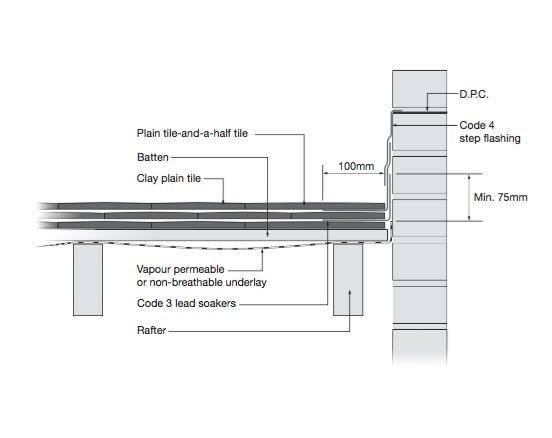
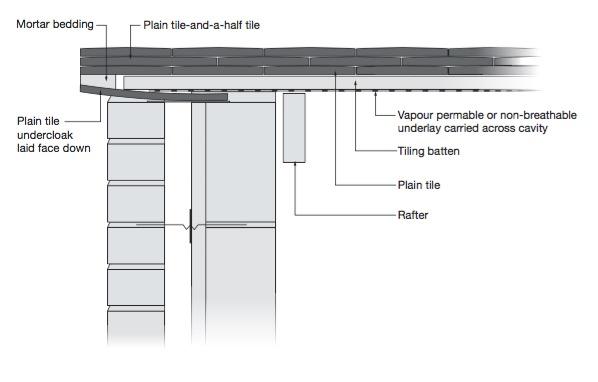
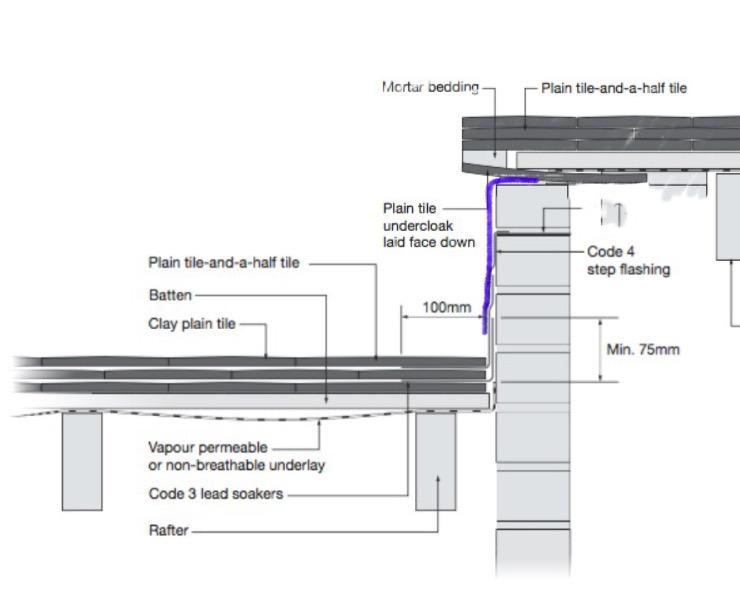
In case we are talking at cross purposes - I mean taking a standard abutment detail, with soakers and then a step flashing covering them, like this: And a standard bedded verge detail, like this: I think your suggestion was to tuck the lead flashing in under the undercloak (shown on this detail as a face-down tile, but could also be a fibre cement undercloak) So if you can forgive the crude mash-up of details, I mean something like this: What I've drawn in blue replaces the step flashing, and instead of being chased into the brickwork like normal, it's tucked under the verge undercloak (which I think is what you were suggesting to do with the hidden valley detail). This would work, I think, as long as you had a minimum of about 150mm between the top surface of the lower roof, and the level of the undercloak for the upper roof?
-
Ok, so the lead sandwiched between the cloaking board and the masonry, secured by friction/weight of cloaking board & tiles on top? What's the reason you suggest a hidden valley, rather than a conventional abutment detail, just with the lead cover flashing secured in the way described above, rather than chased into the brickwork joints?
-
Yes, 150mm is generally what you're aiming for; the problem is when you're trying to chase into an upstand with very little space above that line. An obvious approach is to take that flashing higher up, right up and over the top of the masonry and under the tiles of the higher-level roof, which is essentially what @PeterW is suggesting - what I'm not sure is whether that's a conventional detail in this scenario, and how you would then secure that flashing.
-
Is that going to work with a bedded verge, as shown in the photos, though?
-
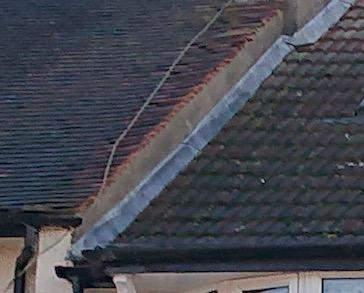
Here is a situation that quite often occurs at the party wall on terraced houses where there is a change in roof height, but not parapet rising above the roof surface: If the change in height is more than about 300mm then it's just about OK - there is room for, say, a stepped flashing, as per the first image, or some kind of apron flashing as per the second image, with a bit of masonry still left above the flashing chase line. If the change in height is less than that, though, it gets tricky. Is there any 'proper' detail, or roofing product, that can deal with a change in height that's less than about 300mm?
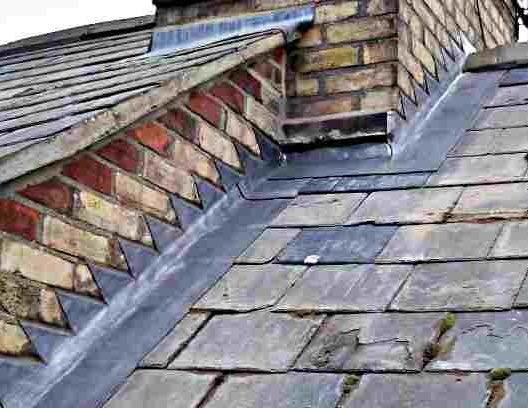
-
Is insulation *outside* studs considered unconventional?
lineweight replied to lineweight's topic in Timber Frame
Note though, that comment is made specifically in relation to situations where the insulation is internal to the timber frame. This is why putting the insulation on the outside of the frame is much preferable from the point of view of reducing condensation risk. -
Is insulation *outside* studs considered unconventional?
lineweight replied to lineweight's topic in Timber Frame
The general principle is that it should be ok if the insulation outside of the frame is equal to, or more than the insulation inside the frame. -
Is insulation *outside* studs considered unconventional?
lineweight replied to lineweight's topic in Timber Frame
yes, I wondered if Celotex have quietly changed their recommendations post Grenfell, even for situations under the 18m limit. Indeed, the issue of fixings is one to check out and I can see how this probably becomes what limits the thickness. Not quite sure what you mean about the interstitial condensation risk... the idea of keeping the insulation outside of the timber frame is to eliminate that entirely, as the inner face of the insulation will be warm, and then then it's continuous through to the outside. -
Is insulation *outside* studs considered unconventional?
lineweight replied to lineweight's topic in Timber Frame
Cheers. So in that case, there's not actually a continuous layer of insulation outside of the timber frame (it's interrupted by the horizontal studs). But in the bits with the blockwork outer skin, the insulation is continuous across the timber frame (only the wall ties crossing it). The reason I ask... when I look carefully at, say, Celotex's guidance for the use of their insulation boards, it's fairly clear that it's ok to run them on the outside of the timber frame when the timber frame forms the inner skin of a cavity wall. It's a little bit less clear, when you want to to the same, but then have some form of cladding (say, vertically hung tiles, or render board as per your case) on the outside, instead of a self supporting masonry skin. When you go and look at the BBA certificate for the celotex PIR, it only really mentions build-ups with a masonry outer layer. I'm curious why this is. Is there something about the combination of insulation-outside-timber-frame and then a cladding layer that they are wary about recommending? -
Is insulation *outside* studs considered unconventional?
lineweight replied to lineweight's topic in Timber Frame
What was your outer cladding in this instance? -
Is insulation *outside* studs considered unconventional?
lineweight replied to lineweight's topic in Timber Frame
I think it might in fact be the 'normal' way to do it when you're using woodfibre insulation? My interest is largely related to how a regular builder (ie one who'd probably generally be used to mainstream products like PIR and Rockwool) would see it ... because that tends to influence cost and their willingness to take on the project. -
Is insulation *outside* studs considered unconventional?
lineweight replied to lineweight's topic in Timber Frame
Is that using conventional PIR type insulation? -
This is a kind of general question - but most likely to apply where there's a timber frame external wall with some kind of cladding such as tile hanging. It might be newbuild or it might be the face of a dormer in a loft conversion. There's a basic choice between putting your "continuous" insulation layer inside or outside of the structural studs. Of course, this can be supplemented with some level of insulation between the studs as well. In principle it usually seems to me that insulating outside the studs is preferable - keeping the structure warm removes much of the worry about condensation, and co-ordinates with a general strategy of keeping structure on the inside of the insulation layer, avoiding various thermal bridging situations. However - it still feels a bit like it's a non standard approach. For example - if you look in the TRADA "timber frame construction" book (5th edition, published 2011) nearly all of the example details assume insulation in between studs and on the inside. The option of external insulation is mentioned - but only under a section called "alternative wall constructions". I'm interested in any opinions on whether this approach is generally considered an unusual one ... and/or whether it's becoming more common over time?
