SuperPav
-
Posts
224 -
Joined
-
Last visited
Everything posted by SuperPav
-
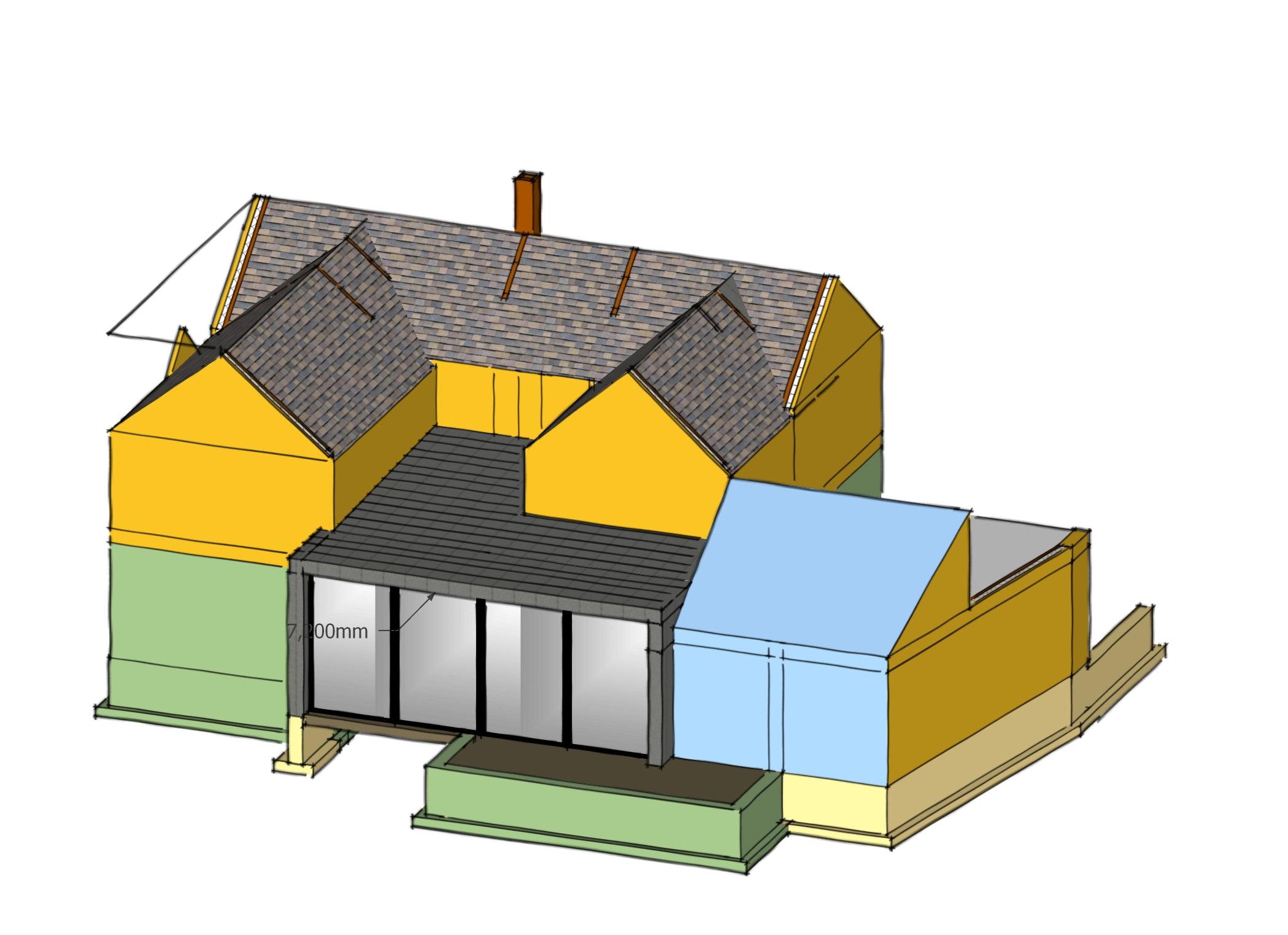
I realised I might have made a bit of an oversight here... We are doing extension (and adding a storey) to our bungalow. To the rear, either side of the kitchen/diner is flanked by masonry walls (on 1.2m deep footings). Across in between these two walls (7.2m span) will be a full wall of glazing floor to ceiling. Internal flooring will be screed over 100mm concrete slab on ~200mm insulation. When doing the schedule of works for the builders, I overlooked the need for footings under the glazing, as I just calculated them under the walls! D'oh! My question is: What/if any foundations are required under the glazed wall (it will most likely be something along the lines of Rationel Auraplus fixed glazing with two sets of patio doors)? I'm hoping it's not necessary to put anything substantial or deep, as the only thing that will be supported is the glazing. What have people done for footings under big aperture spans? Thanks! Pav
-
Supporting stone above opening (parapet)
SuperPav replied to SuperPav's topic in General Construction Issues
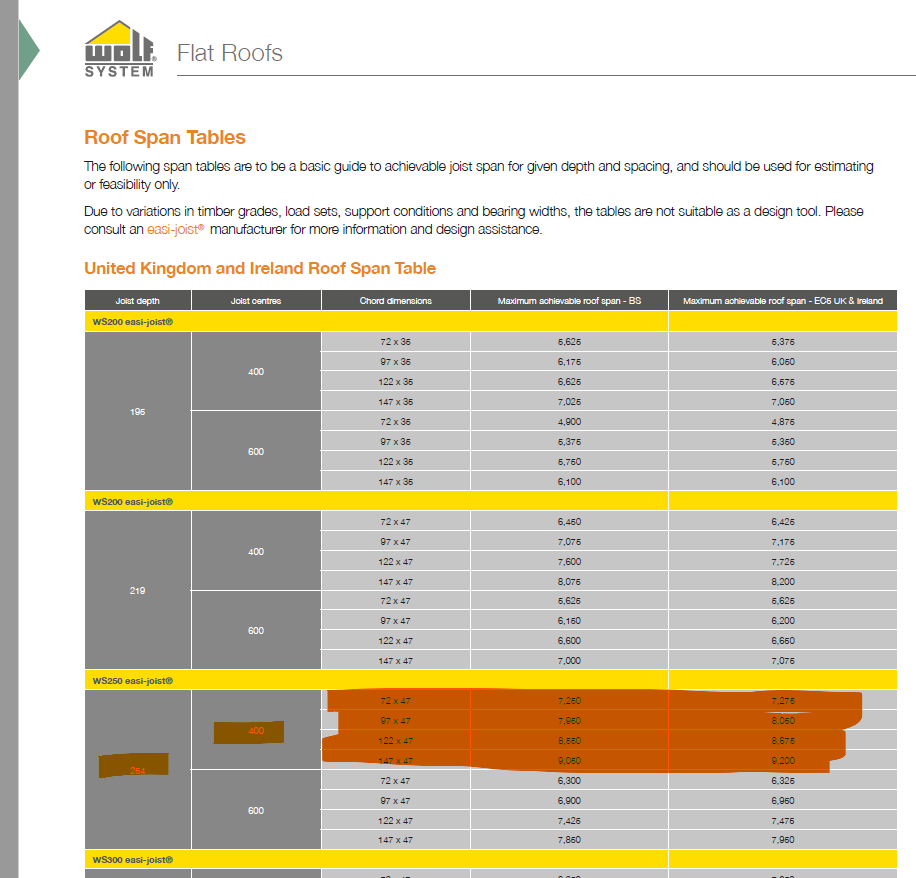
Thanks for that idea, yes appreciate that steel would essentially be "overkill" to support a bit of stone, but equally it's not terribly complicated (or expensive) in the grand scheme of things if we do go that route. I think if we stick with zinc cladding, and I get confirmation from the joist supplier that they can span the 7m then that would be the easiest way to go as it means no steels required at all. The technical doc suggests the span is easily achievable, but I've asked the manufacturer to confirm - the attached span limits are based on 0.5kn dead load flat roof (+0.75kn imposed) which would be fine for a zinc roof (no access other than for maintenance).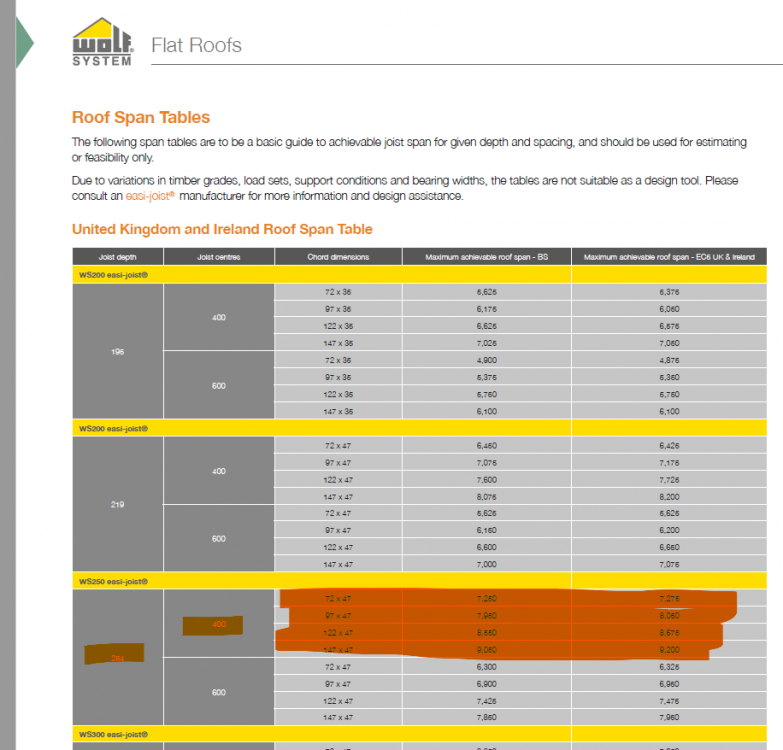
-
Supporting stone above opening (parapet)
SuperPav replied to SuperPav's topic in General Construction Issues
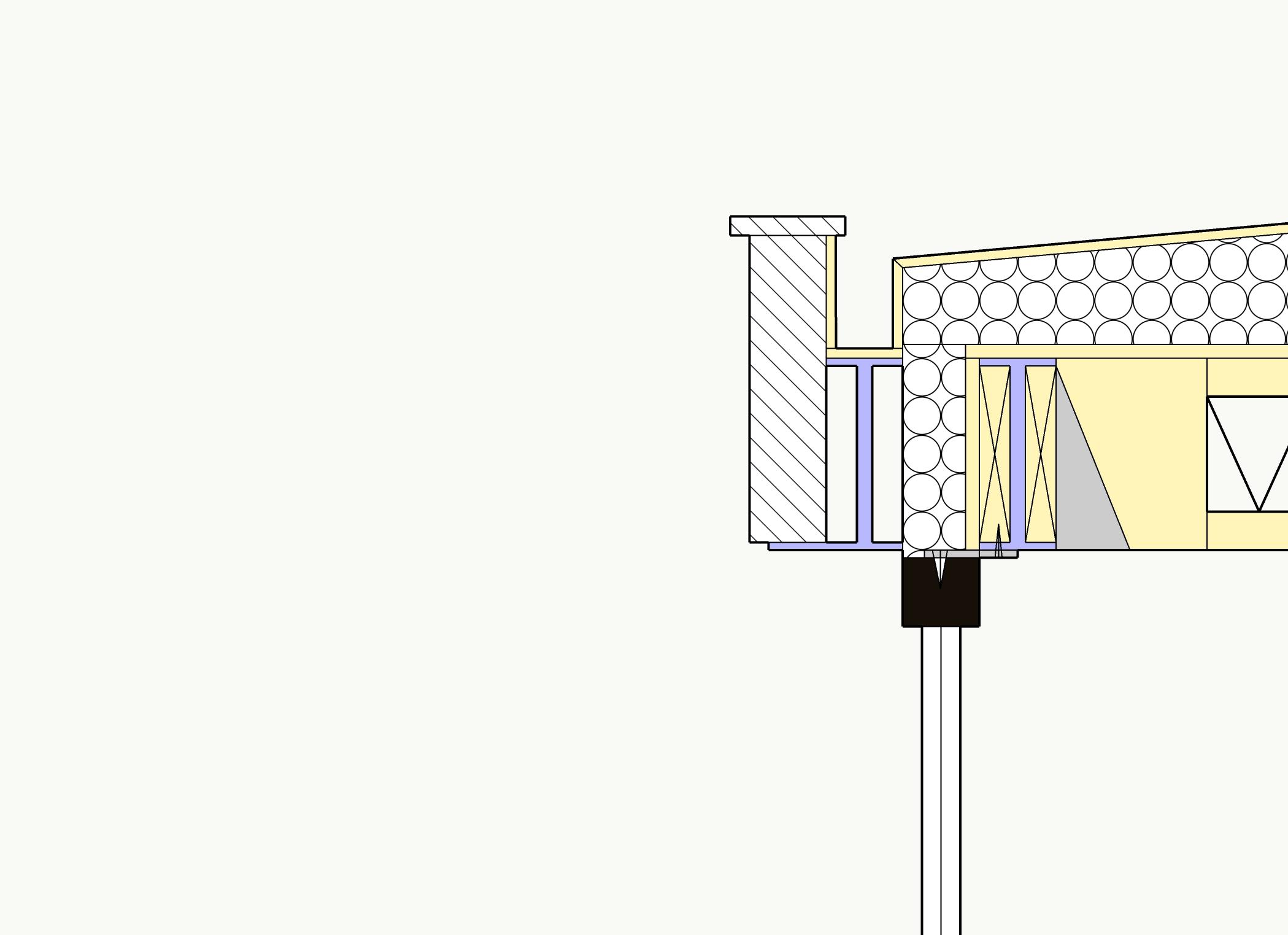
Either side of the opening is masonry wall, so I don't think there needs to be any goal post, just a steel (or pair of steels) resting across the top of it. The pitch I have relative flexibility with, so can do 1:40 going back towards the house that won't be a problem. My thought/reasoning for putting a steel outboard of the glass rather than using a single beam with lip going to the outside was to reduce the thermal bridging through the steel lip... If the posijoists can't span 7m parallel to the glass, then I'd just put another steel inboard of the glass and run the posijoists perpendicular at shorter lengths (it's just the additional cost of the steel then).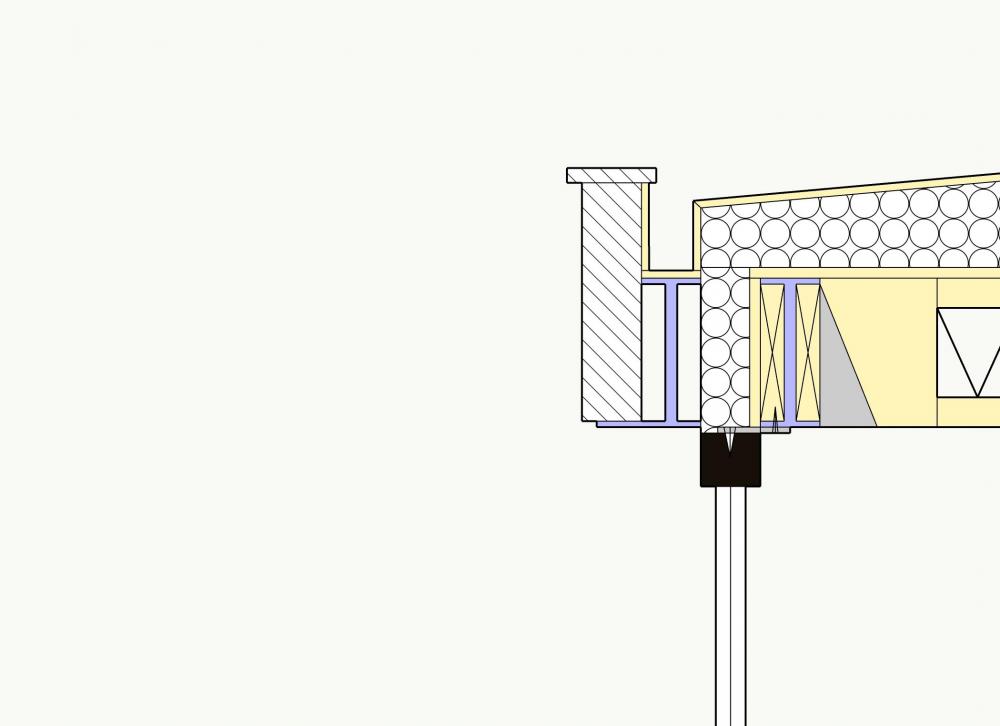
-
Supporting stone above opening (parapet)
SuperPav replied to SuperPav's topic in General Construction Issues
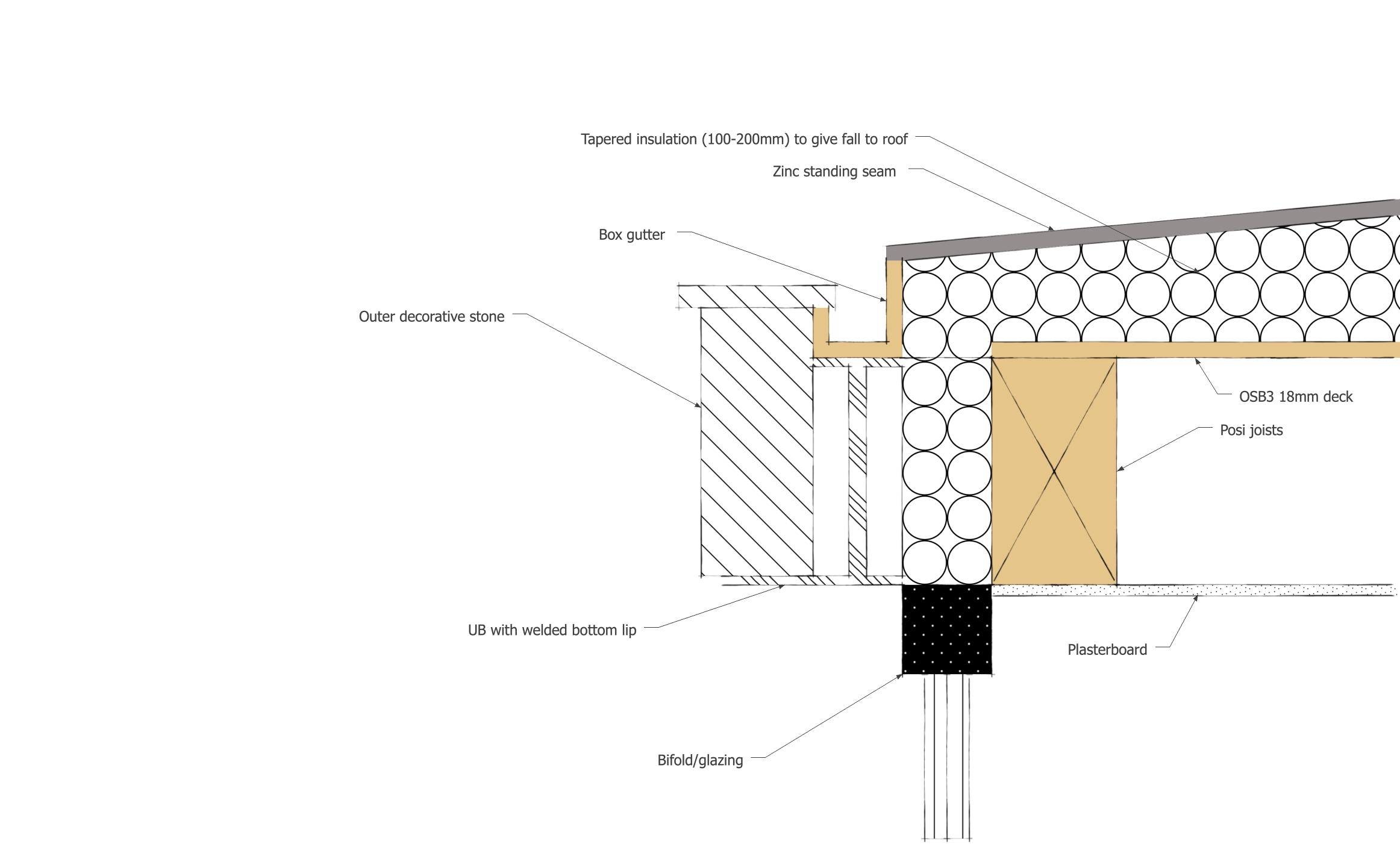
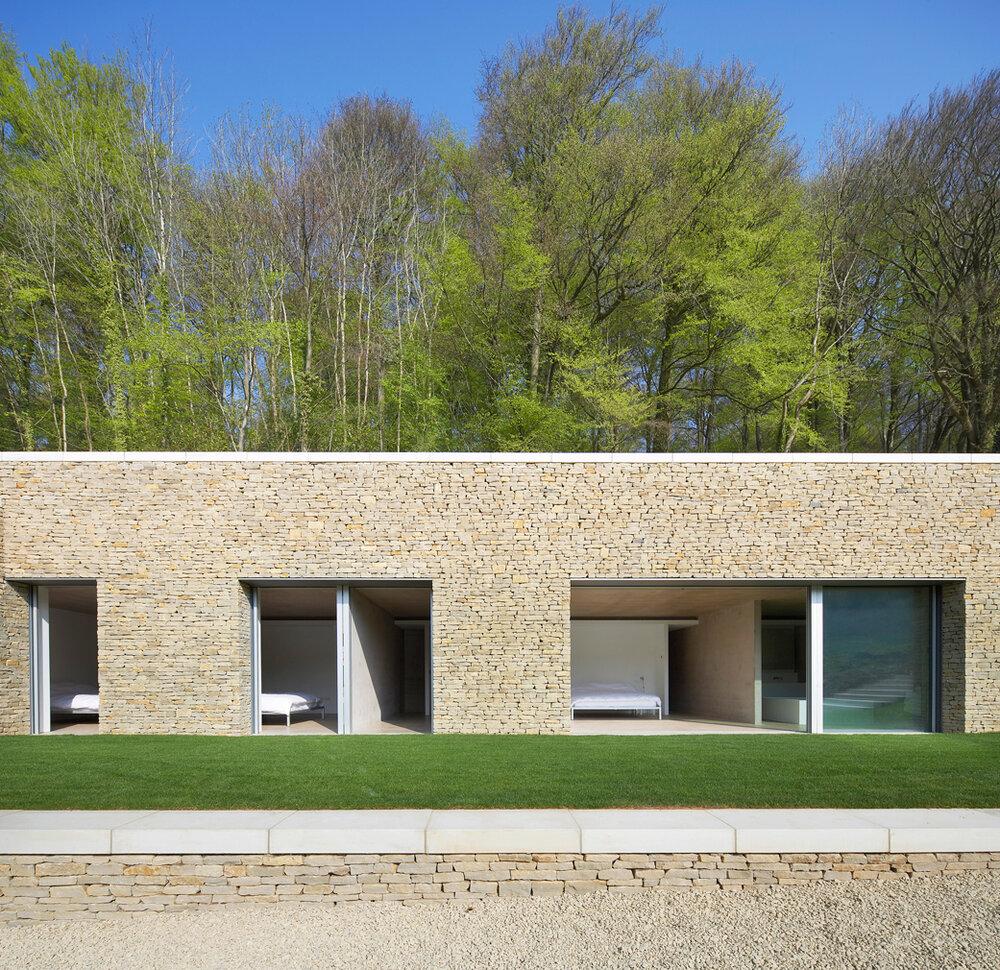
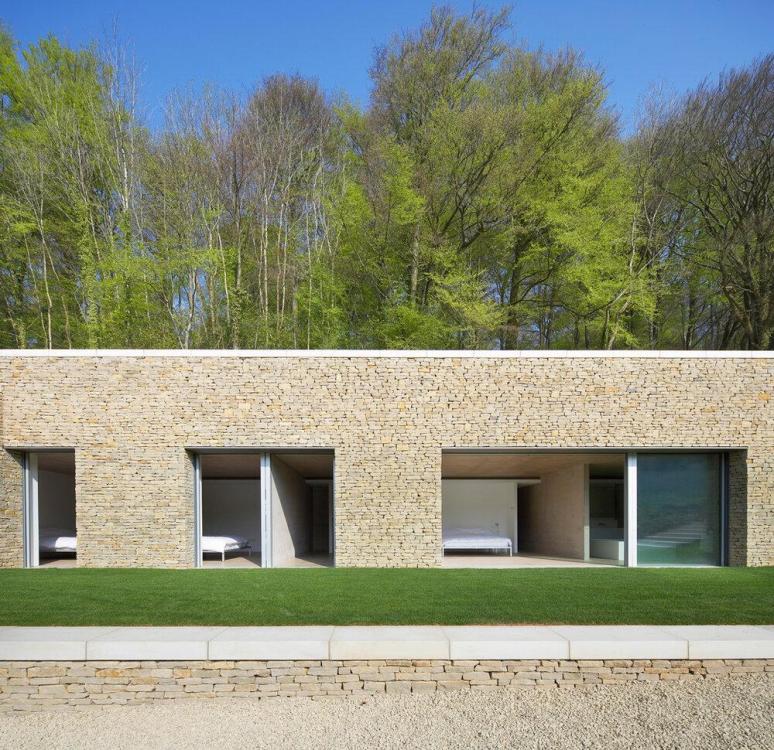
Just to clarify that photo is not of OUR proposed design - attached is the flat roof extension that I'm talking about. It's that border frame currently in zinc that we just thought might be nice in stone having seen the photo above. The lintel would only be supporting the decorative outer parapet leaf of stone, all the roof structure would be in the joists. Fall will always be to the outside (front) where the glass is for ease of drainage, since the "back" of the flat roof is against the house walls. In terms of the joist span, the posijoist span tables suggest a PS10 or equivalent 254 section can easily span 7m for a flat roof @400 centres unless I'm misreading something? Ref insulation depth, the house is solid stone walls, so in terms of overall heat loss, 150mm average on top will give say 0.16 U value, which is (unfortunately) more than good enough for us, given the rest of the house.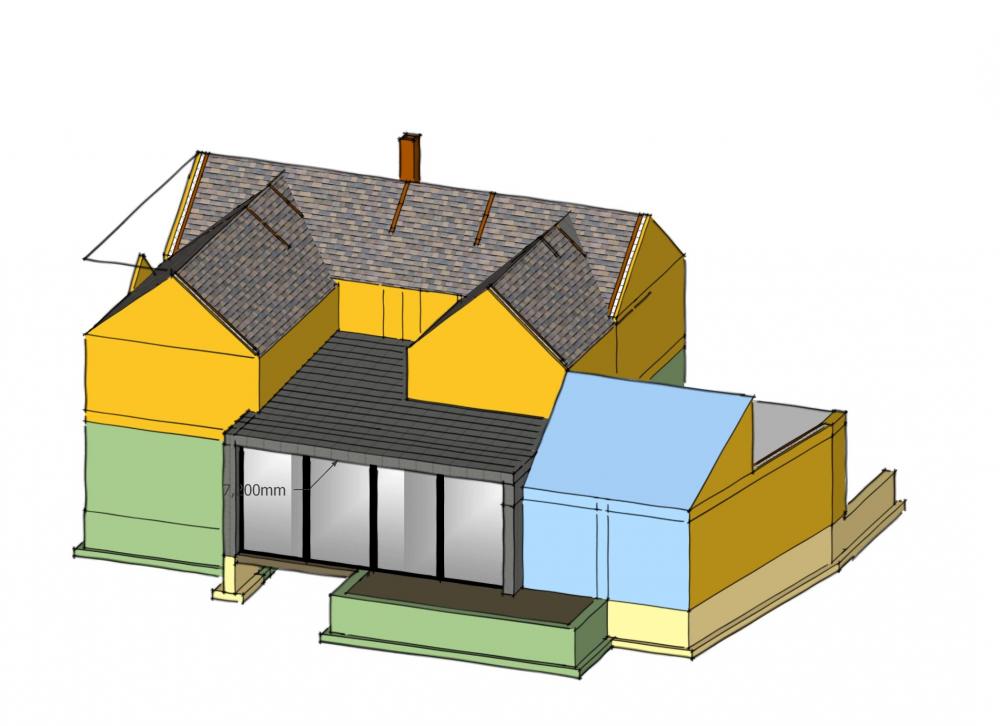
-
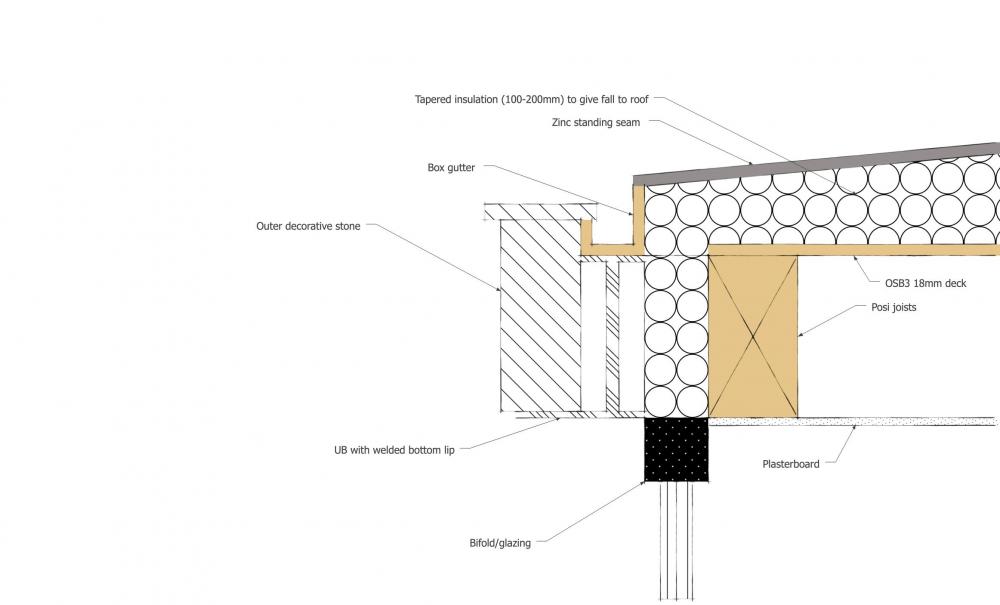
Can somebody shed some light on this... We're looking at having a approx 7m glazed opening on the ground floor - flat roof with zinc on it. The inside is relatively easy, posijoists will cover that span. The question is on the outside and cladding the aperture around the door where we're intrigued by the attached design we've seen. In our case the stone leaf would be smooth cut ashlar and would only be the height of a small parapet (rather than a wall above the opening), but the question remains - to support the outer stone skin to the parapet (say approx 125mm deep by 300-400mm high), what would one use? I've sketched an option for the section but wonder if there's a more elegant solution as this is only my first thought? Either end of the beam/joist bear will bear on masonry walls.
-
So after even more deliberation, we're now considering going for a TF build instead of masonry (existing Cotswold stone bungalow, going to two storeys), given the costs and duration the local builders are coming out with to do the walls in blockwork. We're now considering knocking down and building up in timber frame from the existing footings (with a levelling course of marmox thermoblock to create a thermal break and also to get it to the tolerancing required for a sole plate). Hopefully some TF companies will be willing to work with that. My question is, most of the house will be clad in Cotswold stone, and my footings are about 320 wide (1.5 brick). The outer leaf will need to therefore be about 110mm of stone, and I'm presuming TF always needs a residual cavity of 50mm. I'm therefore left with ~165mm on the footings, is that enough/realistic for a fully built up 140mm studwork wall? Given what we're starting with and cost constraints, I'd be happy with anything around the 0.2 mark for wall U-values... The outer leaf could probably be corbelled out by 20mm or so, but beyond that I think BC would start getting a bit twitchy. I'm mainly hoping that this would result in a watertight shell much quicker with a supply & erect compared to the 12 weeks or so the builders are quoting for the walls and roof to go up. Slightly concerned about the required structure to support the three structural ridge beams, but I guess the TF suppliers will sort that out. Calculations show a 440x180mm Glulam beams will take the loads, it's just transferring them down to the foundations!
-
Having had an extension in another house with similar construction by an average builder (rendered block, rockwool batts, block internally, with dot and dab plasterboard), I can tell you that the air tightness of the inner leaf of blockwork can be incredibly poor, with a gale blowing behind the PB. I'd be tempted to wrap the wall in membrane before you batten over it. Are you adding battens for a service void, or just to mount the plasterboard to? If the latter, then I can echo the above and recommend the foamy adhesive - much easier to at least create contained pockets behind the boards with less air leakage (also helps reduce fire spread I believe!). Alternatively kill two birds with one stone and just wet plaster onto the blocks?
-
I'll try and get a build thread up in one of the other forums, as I'm sure there'll be a lot more questions and changes! Foundations have been assessed with trial pits by SE and calculated to be OK for upper storey in block work with stone outer (worst case scenario), so foundation loading shouldn't be a problem (groundbearing pressure limit 125kN/m2, current foundations are approx. 700mm wide at 1100mm depth, max loading calculated around 65kN/linear metre). Timber frame upstairs was always an option, but because of 3 structural ridge beams (the house is a U shape with infill in the middle), blockwork is easier to the gable walls to support the beams, otherwise we're into a lot of quite complicated goalposts and other elements to spread the load onto the downstairs. So definitely sticking with blockwork on the upstairs. Can't afford to lose much space downstairs either so that will most likely get existing plaster removed, parge coat to the internal brick, and then dry-lined with insulated plasterboard. We're essentially going to be taking the "hat" off the current house, so rafters and ceiling off, wall plate off, the upper storey built up from that level, keeping downstairs ceiling height similar to where it is now. I'll probably put the first course of inner leaf blocks on marmox thermoboard to remove the thermal bridge. First floor joists will be metal webbed posi joists on hangers cut into the celcon blocks. Having removed a few stones from the current wall to have another look following this thread, I now thing EPS or PU injection will give the best result upstairs since the outer stone leaf will be so uneven in the cavity, the cavity will range from 110-140mm in some cases due to the differing bed depth of the stones, if I use batts or sheets, those additional voids will be pointless whereas with EPS or PU they'll get insulated.
-
Great question, probably should have started with that! The priority is to get a good fabric within the dimensional and planning constraints we have, at a reasonable (but not necessarily lowest) cost - in other words maximum efficiency is not a priority (or indeed a possibility) for us but happy to specify and do it right as much as possible. The downstairs will always be poor, so we're being realistic. The downstairs walls are probably currently somewhere around 1.50W/m2 so even a value of 0.25 upstairs will be a big improvement. The house is also currently very drafty due to the floors (mixture of suspended timber and uninsulated slab on loosefill hardcore) so if we sort the floor hopefully it'll feel warmer.
-
Sorry, that should've said values HIGHER. In essence for me it's now a choice of either 80mm PIR with approx 25mm residual cavity, or approx 105mm filled with EPS beads. Using the full-fill cavity (e.g. Celotex CF5000 at 97mm for 100mm cavity) is too expensive, and I'm now concerned that using it with remedial ties will invalidate the certificate anyway! Although if the full fill PIR negates the need for insulated PB on the inside, then maybe the costs even out a bit. The WALLTITE stuff posted above looks impressive but for some reason I would be worried that it doesn't actually fill the full void everywhere, and its benefit and cost only really applies when access to the cavity is difficult, which isn't the case here..
-
Hi Peter, thanks for your input. I could use EPS beads, I reckoned even the full 100-110mm cavity with EPS beads the U-value will be lower than with PIR. I'm now reconsidering it. I would prefer to avoid insulated plasterboard inside upstairs due to the (fixed) layout of some of the corridor areas and bathrooms which are limited in space, but can put 35mm PB on if necessary. The walls below (ground floor) are a solid wall with no cavity - the "middle" bit between the outer stone leaf and the internal brick leaf is loosefill rubble/mortar to tie the two skins together. The downstairs will most likely get 35mm insulated plasterboard on the external walls. Yes this is what I was worried about with regards to approved use. On the initial pre-visits BCO here seemed fairly practical and reasonable but doesn't seem overly enthusiastic on new stuff/methods! And if all the suppliers only warrant the foil faced PIR board for use with a residual 25mm cavity, the U-values vs EPS beads start to look a lot more comparable, so you've now got me re-thinking!
-
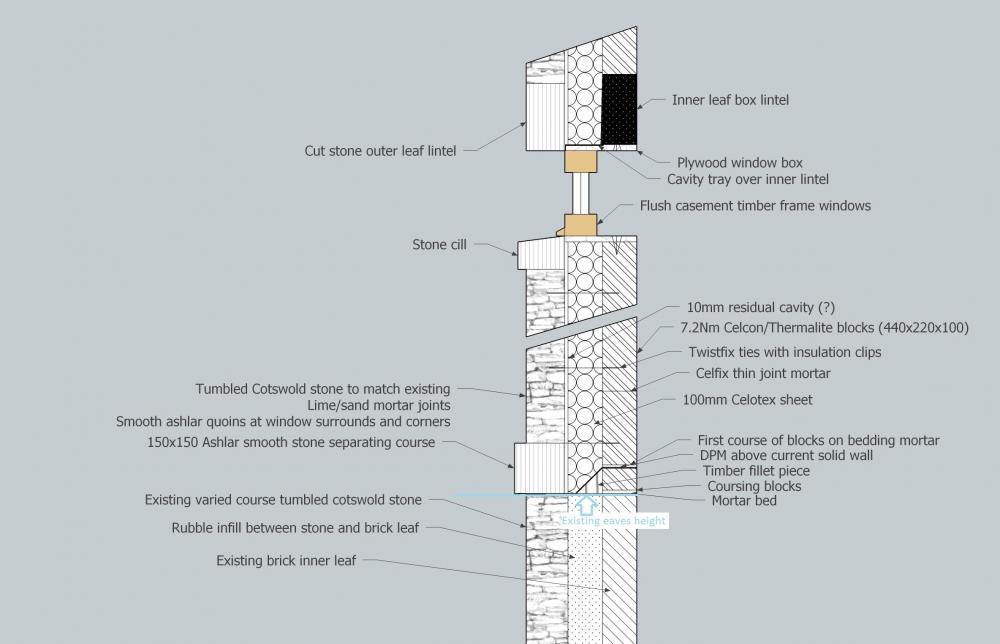
Thanks all, I was hoping that as the inner leaf would be up and complete first, that fitting sheet insulation to it should be straightforward (and we *can* fit it ourselves, but we'll be on site to watch the builder to make sure the detailing is adhered to ). I just wanted to know if as a result of putting the inner leaf up first I can get away with using normal sheet at £15/m2 rather than the T&G Cavitytherm (or equivalent) at double that, given that it's main advantage is its ability to go up easily when coursed with normal block and brick. I assumed that taped 2.4x1.2m sheets going on a smooth thin joint wall will be better in terms of performance than using 1200x450mm T&G panels. If the consensus is that the T&G stuff performs a lot better, I'm happy to go with that. The ties I'm not too worried about as they're impact driven into the celcon blocks so can be inserted as appropriate as the outer leaf goes up, to match the stone coursing heights (the stone courses vary between 60-150mm tall)
-
Hi all, long time lurker/reader, am just hoping to finalise the building drawings with a view to (finally) get the build started in the new year. It's currently a 1950's Cotswold bungalow, and we will be building up from current eaves height. For a number of various reasons, knocking down and starting again is a non-starter, so it's up up up and away... We have decided on masonry construction. I am hoping to use Celcon/Thermalites with thin joint mortar for the upper storey inner leaf, exterior will be Cotswold stone to match existing. Due to the wall thickness we can't get a cavity much more than around 110mm (possibly 120mm if we can get the Cotswold stone supplied in a narrower bed width). I know that normally Celotex board is a no-no for full-fill due to it being impossible to install without gaps etc. However, we are planning on building the inner leaf up completely to eaves height, which means we will be able to sheath the whole building with rigid boards, with minimal cuts (the only walls over 2.4m tall will be the gable end walls), and all joints can be butted/sealed and taped over before the outer leaf of stone goes up. I am hoping this combined with thin joint construction will reduce the presence of any gaps in the inner leaf, and there should be no mortar snots or other protrusions into the cavity preventing the sheets from sitting flat? I would prefer to use 100m solid boards, rather than the T&G 85-90mm as the benefit of those is limited if erecting the inner leaf first, and they cost several times that of the normal boards. My question is in this instance, would it be acceptable to full-fill with normal celotex boards (or leave 10mm residual cavity)? Otherwise we'd have to reduce the insulation to 75mm which I don't really want to do, and we can't increase the cavity much more without the stone becoming prohibitively expensive due to being non-standard size. I've searched on the topic but can't find any that refer specifically to a build where the inner leaf goes up first in its entirety... Thanks!