NandM
-
Posts
151 -
Joined
-
Last visited
NandM's Achievements

Regular Member (4/5)
4
Reputation
-
That's a good point and something that I thought about yesterday. If I go for a mix then I can gain some decrement delay/noise insulation benefits.
-
I think I will do now. I focused of Nyrock as it comes in 150mm, so two layers would nice fill the 300mm rafters.
-
My bad, I meant bats - currently looking at Nyrock 32 and have a decent quote from SIG that is almost £2K cheaper than a cellulose quote I've had! So the pir I mentioned is 1.5K cheaper than the bats, and they in turn are almost £2k cheaper than cellulose (waiting on other quotes).
-
Yeah, I have a bad feeling about that. The information available is scarce, with some mention of them being made for 600mm centres - but then pictures show then boards as being 600mm wide! I'll see if anyone local has them...but even then, I wont know if seconds will have something different.
-
I'm hoping to have our roof built next week, using 600mm centers and was looking at blown-in cellulose or mineral wool - but budget is getting tight! I was having a look on seconds & co and so this size of boards which in theory should just slot into place. Does anyone have experience with these pre-cut strips? (I'm looking at a saving of just under 2K)
-
Fan Coil Units for use with a (cooling) ASHP
NandM replied to ProDave's topic in Air Source Heat Pumps (ASHP)
Is insulation needed for the FCU pipes if the cold water temp hovers around 18c? -
MVHR ducting to outside
NandM replied to Moira Niedzwiecka's topic in Mechanical Ventilation with Heat Recovery (MVHR)
Is an insulated duct needed if going directly into a cavity that will have blown EPS? It seems to me these are for use outside of your insulation layer. -
Restraining column against existing wall
NandM replied to NandM's topic in RSJs, Lintels & Steelwork
Finally got a response today - it's fine not to restrain into the existing wall, but must be retrained into the new walls. -
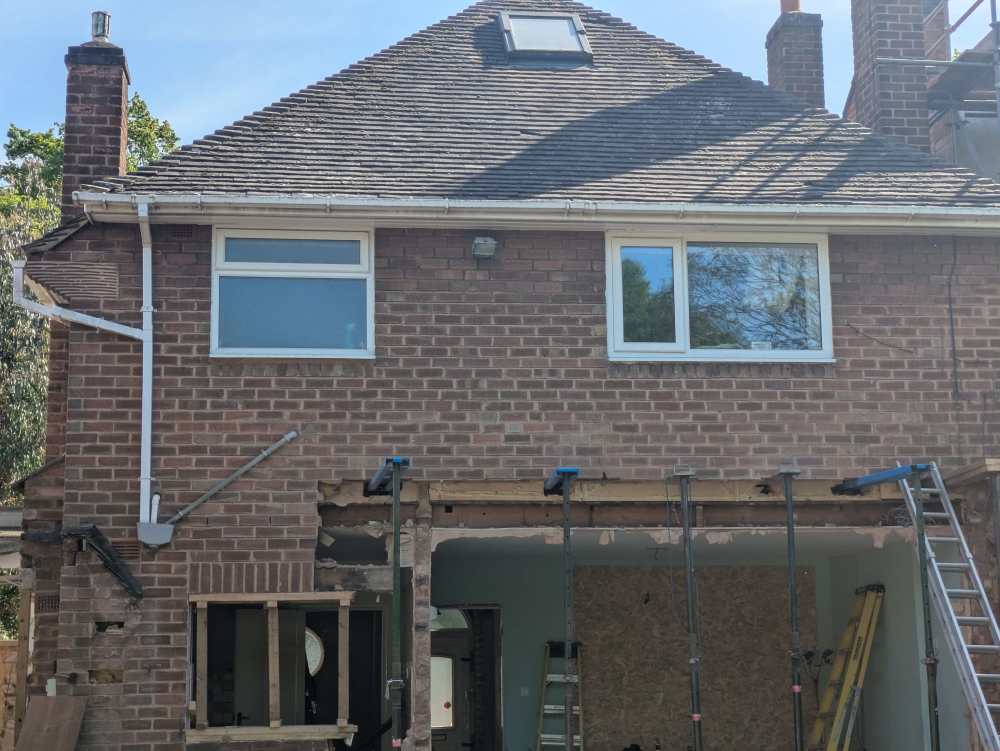
I was hoping to leave most of the demolition work until the brickies were ready to build the gable walls, and minimise the risk of rain damage. But now I'm thinking the old structure is getting in the way too much. I need to get services in the ground and start levelling the oversite etc. In the picture it's the whole left hand side that will need to go and also around the side about the same width. I was thinking about removing the roof tiles to minimise pressure on the walls and use something like dpm as a temp covering. Then to add series of hefty cross beams, before removing that corner of the roof and working down. The three chimneys will also need to be removed. Would removing the tiles from the roof be sufficient to reduce the spreading force of the roof into the walls?
-
Restraining column against existing wall
NandM replied to NandM's topic in RSJs, Lintels & Steelwork
It's the old adage of you get what you pay for! ....and don't get me started on the comms 😂 -
Restraining column against existing wall
NandM replied to NandM's topic in RSJs, Lintels & Steelwork
I'm waiting on a response, but they've not been great so far and seem to lean towards difficult solutions rather than practical. -
My SE has specified the use of Ancon SPB or similar farme cramps to restrain the new steel column with the existing wall. It fairly clear how this would work with the new block wall, but I can't see these being useful with the existing, unless I need to scrape out and then re-motar? What other alternatives are there? A simple option I can think of is the use of masonry framing screws, or for something more robust resin some bolts through into the wall.
-
I've had several quotes in Brum all around 120-140 mark.
-
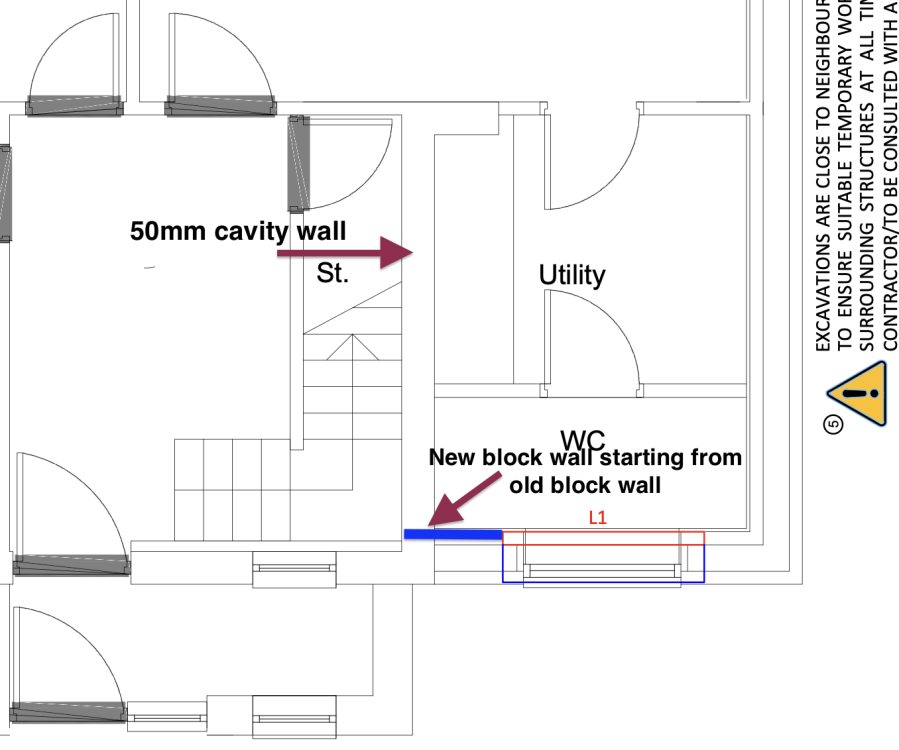
As part of our proposed extension work, a current external cavity wall will become an internal wall. The current brick wall will have a 100mm slit to act as a thermal break, but I will still have a approx 4m length of cavity that is still "connected" to the outside. Do you see this causing any issues with heat loss? I can wet plaster both sides to help with airtightness - but I really don't want to add insulation to the walls on both sides (although I could fill with eps beads). The one idea I have in mind is to start the new block work from the old block work by having an approx. 250mm opening down the entire side of the wall and joining the two. This will result in a separation between the" internal" cavity and the external one. There are two challenges I see here: 1) with the 250mm opening, could it be done from bottom up without the need for any lintels. Google tells me this should be OK. Otherwise, we could do it top down. 2) the new block that will connect to the old would have to use whatever the current foundation depth is - at least for 150mm of the block. Would this be a problem?
-
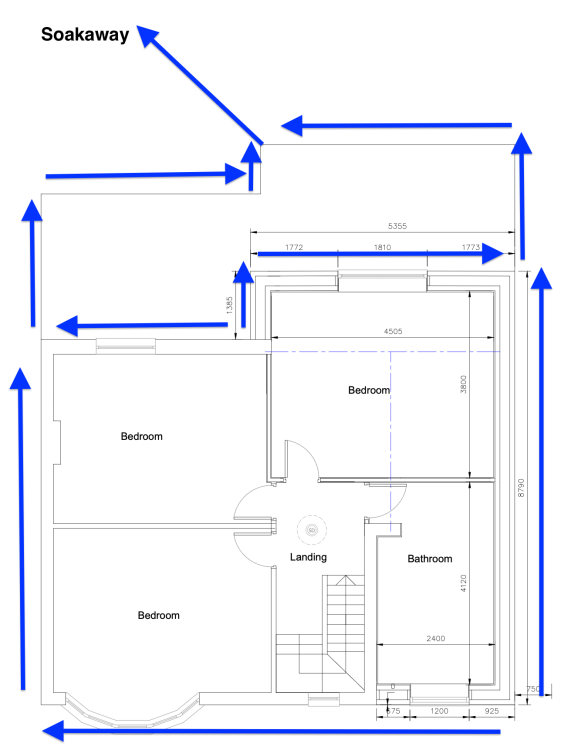
I'm finally about to start the groundwork (yay!) and am thinking about the best way to get the rainwater to the soak away. I'm hoping my simple design by routing all the pipes to one outlet would work? In effect the pitched and dormer roof to route down to the flat roof pipes on ground floor and from there to one gulley and then to the soak away at a distance of 5m, and under 4m of patio.