


Student
-
Posts
47 -
Joined
-
Last visited
Everything posted by Student
-
Hi I need to dig a shallow oversite within an extension as there will be a suspended timber floor over it. I was going to dig around 50mm below the footings, directly along side them. I'm hoping this isn't deep enough to worry about doing it in sections? I'm going to pour the concrete within an hour of digging.
-
Thanks guys. There is a lintel there, it's almost at ceiling level so hard to see. You can probably see it if you look closely, the left end of it is level with the right side of the doorway lintel and the right side of the window lintel is about 100mm away from the corner of the room. It's by no means the most substantial looking lintel but it's the same size as others in the house. I've since replaced the doorway lintel with a concrete one as the plasterer thought it looked damaged. Had I been able to replace the window lintel without damaging the ceiling, I would have. The simplest, non-invasive solution would be to add a concrete lintel below the timber one but I'm hoping I can get away with just cutting the bottom of the window away!
-
Hi I'm hoping to convert a downstairs, rear window into a set of french doors out into my garden, I'll leave the opening the same width or maybe even go narrower. It's a Victorian terrace and the existing lintel is the original timber one. The image I've attached is an old photo showing the lintels in that room, though those wall are now plastered. Do you see any reasons structurally why the brickwork at the bottom of the window can just be cut and knocked through? I've also attached a view of the window from the outside (it's the downstairs window on the main house, not any of the extensions). Appreciate any advice.
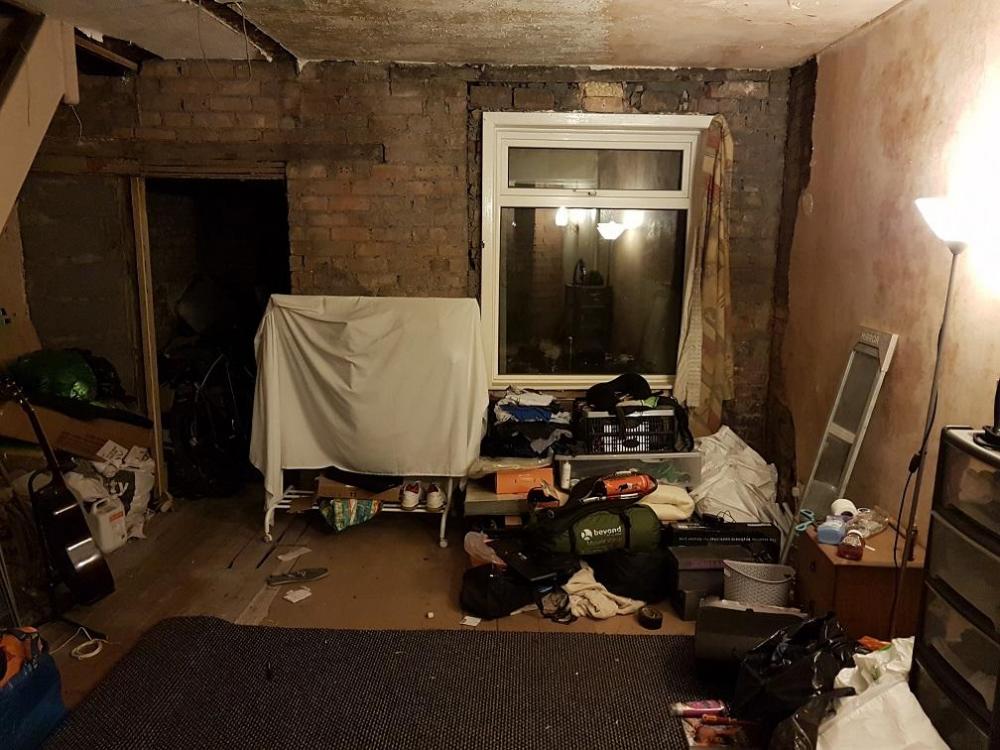
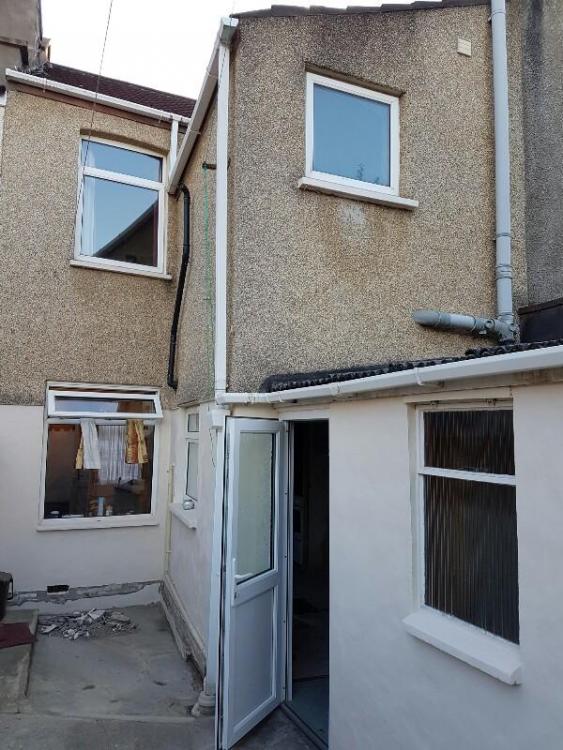
-
Remember that the thing preventing concrete is that there's not enough depth for all the required layers and it'll be so much effort to dig down. Just can't face that right now!
-
Good point. I could do that, thanks! I'm starting to think it might just be easier to build some little walls at the joists ends instead of using ledger plates. Any issues with digging some small strip foundations parallel to the footings? Or better suggestions (other than fill the thing with concrete, ha!
-
Problem is that it's a 100mm plate, 50mm makes it central. Never easy!
-
Guys, I've run into a problem. Such is my luck with this damn house, the fixings for the ledger plate, if put centrally in the timber, is pretty much in the mortar joints between two courses! ? So frustrating. Is it OK to have the chemical fixings off centre? Thanks
-
Replacing an entire course of bricks
Student replied to Student's topic in Bricklaying, Blockwork & Mortar
I can take some photos this evening. I've taken two bricks width out and inspected the bricks. I agree that they wouldn't have used mud as mortar but at the very best, the mud has mixed with the mortar. I can't see why it would be brown otherwise? -
Replacing an entire course of bricks
Student replied to Student's topic in Bricklaying, Blockwork & Mortar
Thanks for the info, that's really helpful. It seems like they are pretty much going about DPC insertion the same way, except they are not taking the bricks out completely. It's definitely mud. I've mixed up and used lime mortar for brick repairs and repointing at the house and this is nothing like it. Brown, clay, smells like mud too. The room has been empty for some time but so hard to comment on damp but the plaster on the wall was blown when I bought the property. They had plastered all the way down to the crappy concrete floor, so it's hard to tell if it was the plinth bridging the DPC on the outside or plastering to the floor on the inside that's caused it. I don't particularly want to risk the 'wait and see' approach when I can already see a problem that can be fixed. Reducing the outside level is going to take a while, so the most effective solution seems to be inserting a new DPC at a higher level. I'm happy to do the work, even if it is arduous, for peace of mind. My main concern was the installation of the DPC and use of perforated bricks. I've found that you can overlap the DPC 100mm and use sealing tape, not doubt it'll be fiddly. Also, Jewsons sell a solid clay engineering brick, which I may go ahead and replace the existing bricks with where damaged. These bricks are slightly smaller than the originals though; https://www.jewson.co.uk/building-materials/bricks-blocks/bricks/engineering/products/BRENG081/clay-engineering-brick-class-b-red-solid-brick-65mm/ -
Replacing an entire course of bricks
Student replied to Student's topic in Bricklaying, Blockwork & Mortar
Not heard of mechanically inserted DPCs, do you have an example? I was thinking that as I'm taking bricks out it'll be easier to slip sections of DPC in with overlaps? If they need to be sealed, then that's more tricky. Might be better off with injection DPC. Yes it will be a lot of faff, but I'll do alternating 600mm sections, so can hopefully do it in two visits but then again, I'm usually overly optimistic about how long this takes, it'll probably be weeks of work. Heartbreaking when I originally thought I might have to rake the odd dodgy looking joint out. ? I honestly think it would have been easier and less faff to rebuild the house from scratch! -
Replacing an entire course of bricks
Student replied to Student's topic in Bricklaying, Blockwork & Mortar
Yes, I wouldn't dream of inserting a PVC DPC otherwise, but as I'm taking out the bricks, I thought it might be OK and save me over £100. -
HiI've discovered that my bottom two courses of bricks on my original rear extension (Victorian terrace) have mud / dirt between them instead of mortar!! This is in the slate DPC layer and the course above. The cause I assume, is that the previous owners had built the external ground level 20mm above the DPC and fitted a large concrete plinth along the bottom for good measure. ? I'd be very grateful for some bright ideas on this but my current plan is to replace the entire width of the wall in 2 brick width sections (including the slate) and mortar new ones back in. The plinth is gone and I plan to lower the ground level outside. My main concerns are:- Can I put a new, plastic DPC in, in overlapping sections or will the breaks in DPC make it pointless? I can use injection DPC if needs be but it seems overly expensive and time consuming if I'm replacing the bricks anyway.- I need to fix chemical anchors into one of the courses at 350mm centres for a ledger plate. I was quite comfortable with the existing solid bricks but if they are replaced with perforated engineering bricks, are those compatible with chemical fixings or should I try and source solid bricks?Really appreciate any help on this.
-
Another thought. How are first floor suspended floors ventilated? As I see it, there's no ventilation at all if sealed from above and below and I assumed I'd want to as it's a bathroom?
-
Thanks everyone. That's some good information to think about. I tried doing the calculations but the timbers are some what of an unknown, I don't know what they are, some sort of pine I guess. From the calcs I have done it seems like each 7x1 can take a point load of 70kg at 1/3 and 2/3 span (note that the joists are running between the smaller distance of 2200) The dead load shared across the two joists is a shower at one end (85kg) and a toilet the other end (weight unknown but guess 50kg with water). There will be tiles and floor surface and potential live weight of a person. I'd guess 200kg dead and up to 300 to 400kg total if being super cautious. I used this site with additional info from the site you recommended SteamyTea; http://www.timbertoolbox.com/Calcs/beamcalc.htm http://www.timbertoolbox.com/Calcs/2ptbeam.html I'm thinking that if I sister without going into the pocket (as per Mr Punters advice) and then put noggins at 1/3 and 2/3 span in the whole floor, I'd be comfortable that it can take the load with minimal deflection. Please do say if you think this is risky though. Absolute worst case, I would consider punching through to outside and sliding in from outside. I do already have some damage to the exterior render due to the timber 'lintels' (actually just a floorboard doubled up) having to be replaced with concrete lintels a few months ago.
-
There are two joists in my upstairs extension floor that are 7x1 instead of 7x2 like the others. It's a Victorian house and there used to be a chimney at that end of the room, which they've removed. If I were to sister another 7x1 without going into the pockets the existing 7x1s are in (no room without knocking through from outside and sliding through), would this significantly increase its strength? If not is there something else that can be done? My current plan was to sister with some M12 bar, square washers and timber connectors. Happy to just screw if consensus is that M12 bar is overkill? My 900x900 shower will be sitting on the corner of the room with these small joists, so I wan't to make sure there is support there. On a side note, I hope to tile this floor with electric matting underneath. I've bought 18mm wbp ply for it. Do you think this, with the existing 7x2 joists (I will add noggins), will resist deflection enough to handle tiles? I've not noticed any spring in the joists myself but I'm no expert. Floor is 2900 x 2200, so quite small. Would you insulate this floor? I don't think it's normal but seeing as the floor will be heated, perhaps it needs insulation to stop heat escaping downward? Thanks for any tips.
-
Great, thanks for the info. Is there any value of adding a layer of insulation between the ledger plate and wall?
-
Thanks for the info guys, how long will I have to leave this before it can be weighted by the joists from above? Approximate of course! Cheers. It's 300mm x 100mm x 2450. 1:2:6 sand, cement, gravel.
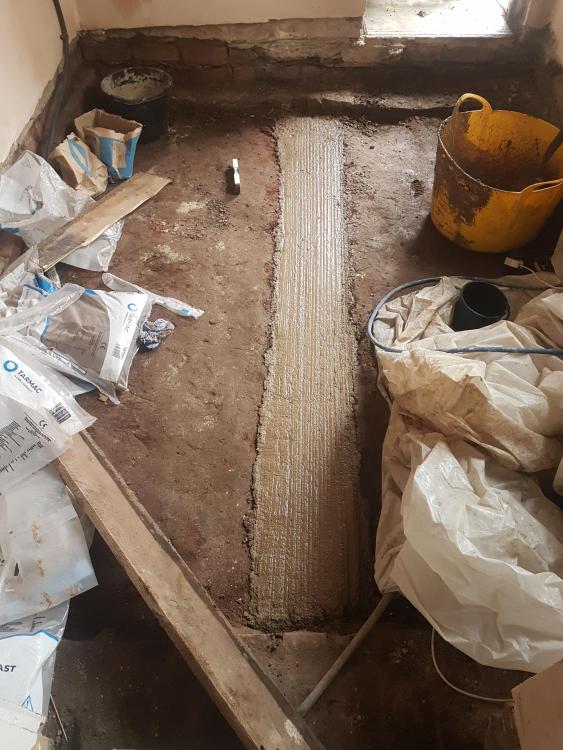
-
Haha, well the delay is stressing me out so I thought I needed to take action! I have a long roll of DPC and plan on using it everywhere that wood contacts masonry (and on the sleeper wall) but didn't think of stapling to the timbers - good tip, thanks!
-
Thanks Russell, that's almost exactly what I have planned. I dug the trench last night and it didn't take very long at all thankfully. I must admit that I hadn't given much thought to insulation yet and would adding a vapour layer above the joists make gluing a pointless step? I was hoping to add heated matting below the tiles to add comfort during the winter months. Does this effect things at all? I'd also been warned off of using chipboard, hence I've bought 18mm wbp ply for the bathroom floor (prior to heated matting and tiles as per the kitchen). Is 18mm sufficient or should I be adding a layer?
-
There's room for 150mm void below the 4x2 joists. There's certainly scope to go with concrete, it's just a bigger job than I'd anticipated and I'm faced with the issues of where to run services. Appreciate they can likely be ducted in the concrete? Is the consensus that even with a sleeper at mid-span I'm going to struggle to get a solid floor? As I mentioned, I can live without tiles if needs be. I need the floor down asap as it's holding up the kitchen being fitted. I'd originally only planned on a single layer of wbp ply under tiles. This is my first house and hopefully a stepping stone into self build so happy to accept any advice you more experienced guys. My only source of information is the internet as my background is electrical and electronic engineering.
-
Thanks for the replies. In terms of spec, I used this table to spec the timbers and C24 47x97 at 400 centres came out at 2.24m permissible span. C16 came out at 2m permissible span. In addition, all the information I could find on typical loading for a kitchen was between 2 and 3kN/m^2 imposed and when I summed the weight of my kitchen, floor tiles, and allowed for 2 to 3 people to be in there, I found that figure to be about right. Could you clarify on how the calculations are out? I found worst case scenario to be 1500kg, spread over 6m^2 to be 2.5kN/m^2. Admittedly, the load might be highly concentrated in specific areas of the kitchen. In the image attached I've highlighted the area on which one of the ledger plates will sit. Actually on this wall, the plate will be fixed higher, it's the opposite wall where the plate will rest on the wall. I'm not sure at what degree I'm allowed to cut away at it to make it level as it makes up the foundation for the exterior wall of the extension? Good point, a couple of reasons why I want suspended. The void is useful for running services, specifically the waste pipes from the kitchen. Also, as I've not constructed a floor before, I deemed suspended timber to be the simplest construction for matching the floor level with the adjacent floor. Also, access isn't great due to being a Victorian terrace with no rear access, so getting materials to the rear extension is quite cumbersome. Deflection of the floor is an issue as the plan is for a tiled floor. If deflection is unavoidable then I can rethink the floor surface. I'm starting to think a supporting wall mid-span would solve a lot of issues and would only be 20 bricks total.
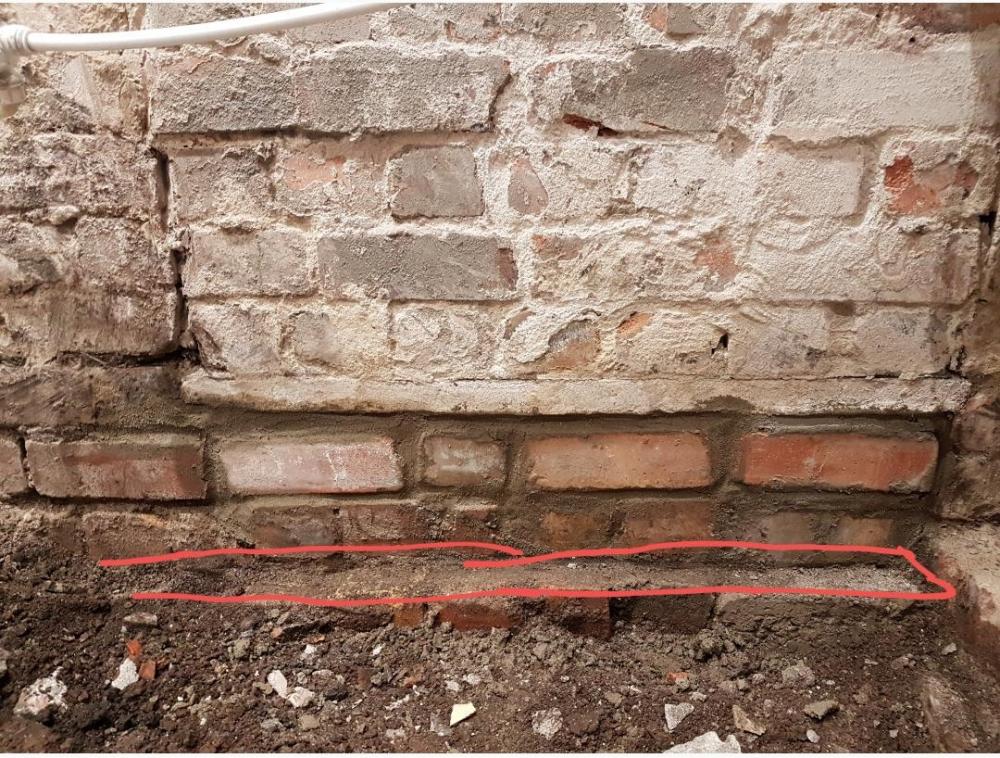
-
Hey, I'm about to rebuild my downstairs extension floor and am after a few tips. It was a very badly constructed concrete floor and prior to that would have been suspended timber (it's a Victorian terrace).My plan is to secure timber wall plates (are they called wall plates?) to two opposing walls with resin secured M12 threaded bar at 600mm centres (2.8m span) and then run C24 47x97 joists between the wall plates (2.1m span) at 400mm centres on joist hangers. I know that the more simple option would be to rest the 4x2s on top of the wall plate but this would not leave sufficient void under the floor for ventilation. If anyone could shine some light on these questions that would be great: - The data sheet for my chemical fixings assumes a min compressive strength of 10N/mm^2 of masonry but bricks are of unknown standard, Victorian and over 120 years old. Do you think I'll be OK? - One of the wall plates needs to rest on the brick foundation of one of the walls and this wall isn't level. For that reason, when the joist hangers are fitted to that wall plate they will be fitted closer to the edge of that wall plate, to the point where I might only be able to get 4 twist nails into the wall plate and quite near the edge of the wall plate. Is this risky? I can't find any information on what load a single twist nail can hold. - it's a small room, only 6m^2, but it will be a kitchen. I've done some calcs and the dead load for entire floor may be in the region of 1000kg, so 1.67kN/m^2 dead and potentially 2.5kN/m^2 live load. The regs tables I've seen don't allow for a dead load exceeding 1.25kN/m^2 and live load exceeding 1.5kN/m^2. the more I'm thinking about this, the more more I think I might have to bite the bullet and build a sleeper wall at mid-span. I'm not familiar with regs on this but I've found some information proposing a 150mm x 300mm strip foundation, then a honeycomb sleeper on top. Is that foundation depth overkill for this application? The trench will have to be hand dug, so the shallower the better for me! Really appreciate any advice and sorry for that information overload.


