


jimseng
-
Posts
135 -
Joined
-
Last visited
Everything posted by jimseng
-
This is the last piece of the puzzle for me and the bit I have been obsessing over, perhaps unnecessarily, but obsessing I am. I believe that when the house goes off grid the inverter disconnects the live and neutral but not the earth. That is certainly what the it shows in the Sunsynk and Growatt manual. Which means installing an earth rod gives two earthing points and therefore a permanent ground loop except when there is a specific DNO cable fault and you lose the DNO earth. And it isn't discussed anywhere as if it has been completely overlooked. Indeed! But I'm thinking about it. And I can deal with it by installing a relay with an extra NO contact to swap the earth from DNO to ground spike. That means whatever the fault is that caused the grid failure, there is a bonded earth in the islanded house but never a ground loop. But since I have never seen this mentioned then either I'm fussing about nothing, nobody has noticed, which they should have, or I have got it completely wrong. I'll move on from this subject once somebody convinces me that I am an idiot or that everyone else except me is an idiot. It won't be the first time. (I'm not saying which way round either)😀
-
@JohnMoI get that. I think I am being really pedantic, and I am considering the long term. Again, probably over thinking it but there are a couple of scenarios. And I am talking about where I am on grid and there is a power cut: 1. Power cut downstream of local earth point. DNO earth still remains so local ground spike creates and earth loop. -Bad 2. Power cut due to cable fault. No DNO earth. Local ground spike is necessary, no earth loop. -Good It seems a simple thing to fit a double pole relay to create the local E/N bond and at the same time swap from the DNO earth to local earth rod. But I haven't seen a single mention of this being done anywhere, which, in my experience, doesn't mean it shouldn't be done, just that it is a detail that is ignored/ nobody cares/ hasn't been discussed.
-
I'm sorry to keep banging on about this but it is a complex subject without a definitive answer and easy to get wrong (and I bet many professionals get it wrong despite their qualifications). @kelvin. When you added your earth rod, did you leave the SSEN earthing permanently in place? It seems to me that inverters in islanding mode probably leave the existing earth in place, which potentially is fine until there is a local cabling fault. However an additional earth rod would surely introduce a ground loop if the DNO earth isn't disconnected in islanding mode. Maybe I am over thinking it but it seems this isn't a settled subject yet, and it should be simple to get right with the correct information.
-
@Kelvin. Just to be clear, were you happy to use the earth provided by SSEN or are you talking more generally about running off grid for a while. Sorry to keep banging on about it but I am obsessing about getting my install right and the earth neutral bonding is niggling me.
-
It does occur to me that due to the ground works required generally on site it makes sense to get the DNO to hook up the supply but hold off on the meter installation until I am closer to building regs sign off. National grid have specified a PME. I guess I can use the earth connection from that rather than a ground spike and provide my own local N/E bond? Unless this statement affects that?
-
I had forgotten that, and had a quick look and remembered that they don't show up on the ENA database as G100 compliant. I think that is why I had forgotten. Shame because the pricing seems better than Sunsynk, with better availability.
-
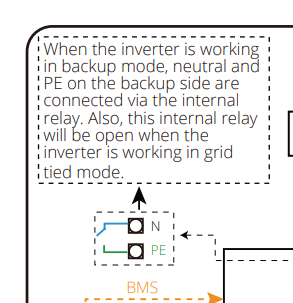
I'm actually struggling to get to the truth! It seems from what I have read that professional installers don't get this right either. In the Sunsynk manual I read this to mean that the Sunsynk inverter internally bonds the earth and neutral on the load side when the gird fails as the DNO bond is lost. Although in the same manual it states (as Mattg4321 has pointed out) that the inverter provides a 240v connection to drive an external relay to achieve this...So which is it Sunsyk? Growatt do the same but the 240v signal is present when on grid and goes to zero on grid failure. (So one has to choose a NO or NC contactor accordingly.) It seems that one can link the grid DB and backup load DB neutral together and use the permanent DNO bond. This is fine until the DNO earth neutral bond fails and any local bonding inadvertently serves as the bond for the entire local infrastructure. Although it seems this is only a problem in countries where people steal the cabling. I'm still working through it but it seems I will likely go with the Growatt due to budget and fit an external contactor to provide the E/N bond in the event of grid power failure.
-
@Mattg4321 The Sunsynk has an internal relay, that was why I asked this question and you have confirmed what I was thinking, that many inverters don't, and I do need to fit my own system for this, probably if I go for the Growatt. I'll investigate.
-
@Dillsue I think I need to be a bit more specific when forming my questions. I just assume everybody telepathically knows what I am asking.
-
I haven't chosen an inverter yet and I am still specifically inquiring about the earth neutral bond requirements in the uk. And more specifically that one make (Sunsynk) mentions there is an earth neutral bond relay internally and the Growatt doesn't mention this so I thought I would ask what people do on this forum. As for the grid connection, I don't see the point in hooking it up and paying the standing charge months before I actually move into the house but if there is all that solar on the roof and the batteries are in I might as well at least use it to make the tea, just to curry favor with the builders. I should get enough for that at least, and possibly a cupcake.
-
What I am asking is what is needed in terms of earth neutral bonding as the Sunsynk manual states there is an internal relay to bond the earth and neutral when the grid shuts off in event of a power cut and the Growatt doesn't specifically mention this. There is a lot of talk about earth / neutral bonding but it is hard to distinguish what is for the American market and other countries and what is required for the UK. I'm not sure I understand how my first post suggests I don't have a plan. I think I am mis-understanding something. Can you explain?
-
I do have a plan! I am just holding off on the grid for a while until I am closer to building regs sign off but the solar is going up much earlier. It would be a shame not to use it. I am going to by a hybrid and run it off grid until the DNO turn up. So I won't need to change anything when I hook into the grid?
-
Hello. I think I will have my inverter up and running way before I get round to getting the grid hook up on my new build. I assume this means I need an earth neutral bond and a ground spike to start with. Is this correct? In the long term I see that Sunsynk inverters have an internal relay to achieve this but I can't find one mentioned in the Growatt manual. I just thought I would ask for any pointers when I get round to installing this. Once I have the grid connected how would I go about setting this up for grid power failure? Thanks
-
Hello. By budget says Growatt 10k or Sunsynk 8.8k. The Growatt on paper seems to be the right choice, the numbers are a bit better generally. The Growatt is a significantly cheaper brand. Given that either unit will do what I need is there anything I should be worried about with the Growatt brand? Thanks
-
24 panels on a new build roof. 2 strings of 12, or 3 strings of 8?
jimseng replied to jimseng's topic in Photovoltaics (PV)
So it seems I have a choice of getting close to the max PV ISC with 3 strings of 8 or close to the max PV input voltage with 2 x 12. Even at the never attained -10 degrees I am still 3 volts below the stated max input voltage with 2 strings of 12. Unless I go for a Growatt which, on paper gives me +25v of max voltage headroom. There must be a reason why the Growatt is cheaper though. I still can't make up my mind! -
24 panels on a new build roof. 2 strings of 12, or 3 strings of 8?
jimseng replied to jimseng's topic in Photovoltaics (PV)
The panels imp is 13.43, short circuit isc 14.2. 2 strings of 6 would be comfortable but perhaps means starting later in the day. I think it makes sense to keep them at 2 x 12 strings. The VOC gets a little close at -10 degrees but it is still, on paper within limit. And the lowest recorded temperature here in somerset was -8.5 a few years back. There is also a Growatt 10k inverter which gives me an extra 25v of max PV input headroom. In fact the Growatt has 3 trackers with a total of 2 strings per tracker, but it must be cheaper for a reason... -
24 panels on a new build roof. 2 strings of 12, or 3 strings of 8?
jimseng replied to jimseng's topic in Photovoltaics (PV)
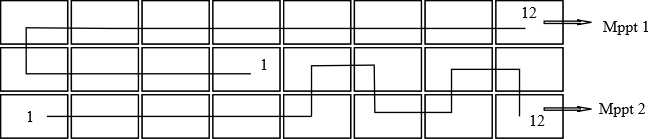
Thanks JohnMo. I believe the inverter can take two strings per MPPT but it is nice to confirm the point about extending the start and stop time, I just wasn't sure if I was getting too close to the max PV input. Do you think my series wiring layout makes sennse? -
I am planning my solar install and want to check a couple of things. I have bought 24 in roof solar panels that mount landscape. The roof shape dictates 3 rows of 8 panels. No shading, all on one 43 degree roof. This is a new build so the roof isn't finished yet. I am planning on something like a Sunsynk 8.8k inverter (the 10k version seems pretty rare at the moment in the UK.) The inverter pv input voltage is stated as 370v (125-500v DC, startup/max) and has 2 mppt inputs. So it seems to me that my best option is 2 strings of 12 panels. With a VOC of 38.15 per panel this would give me a voltage of 458v (498 at -10 deg C) per string, which is (just) within range of the inverter. It looks like a better option than 3 strings of 8 but I just want to see what people suggest. As for connecting up the strings, I was thinking of something like the attached image. My reasoning is that it keeps the cable lengths the same and brings the connections out at the correct end of the house. Perhaps that is unnecessary but it seems like a logical thing to do in my head.
-
Actually, re reading the manual I'm still trying to get my head around how to set an export limit, but I am getting there. Luckily I don't have kids. I'm not convinced I will let any into my new house. They are noisy, sticky things that leave jam and muddy footprints everywhere.
-
Not sure I fully understood this. Can you expand? When I briefly looked through the manual today it seemed you can set the export to any KW value, but it was a fairly cursory browse through. I'm talking about the Sunsynk 10 / 12k inverter. If I do want to try and export at some point Then it likely going to have to be the 2k limit under a G100 application with anything other than a G98 certified inverter.
-
Exactly. A 10kw Sunsynk and a 16kWh Fogstar battery is around £3.5k all in. That is a G100 / 2 compliant system. With the 60 amp pass through I think I would struggle to max it out, unless I really try.
-
Maybe. I'm a bit of a stickler for rules in case it comes back to bite me. If I got investigated it might become tricky. I'm open to all suggestions though. I will be using the grid power too, otherwise I would fit a battery charger and not connect the inverter to the grid at all, that would mean I wouldn't need to involve the DNO. I have thought about that route but I think it would be a bit limiting in the winter. I must admit I haven't done the maths yet as I'm not sure how much battery power I will start with.
-
That isn't how I understand it. My understanding is that to even fit an inverter that is capable of > 3.6k export, even if it is set to export nothing requires a G100 application and maybe even a witness and password to prevent the settings from being changed. Or a G100 limiting device between the meter and the inverter (costly from what I have found). If I am wrong then that would simplify everything. If there is an inverter that is incapable of exporting to the grid then I expect that would work. There is a Victron option of a 5Kw set to 3.6kw in firmware from the supplier, and therefore G98, but it then effectively becomes a 3.6kw inverter, all be it with a higher grid pass through, which, to me, seems pointless.
-
Do you mean there was a fee to Octopus to allow you to get paid for a non MCS approved install? The whole energy supplier side of things is another bit of research I have to do as I don't even have a DNO connection yet. Sometime in the new year.