


Workerbee
-
Posts
41 -
Joined
-
Last visited
Everything posted by Workerbee
-
PIR sensor for secondary circulation
Workerbee replied to Workerbee's topic in Boilers & Hot Water Tanks
Thanks @Spinnyand @-rick- - I think I will put in the secondary loop in 15mm, and then I have options: use a pump (the Wilo SB 30 looks decent) or, if I find that setup problematic, then repurpose it as the actual feed to the shower. It would mean the hot being in 15mm and cold in 22mm, but presumably it would still work. Would you hardwire the PIR to the Shelly? I was imagining some kind of WiFi control but I'm new to home automation. -
PIR sensor for secondary circulation
Workerbee replied to Workerbee's topic in Boilers & Hot Water Tanks
😂It's not so much that I'm keen to have the faff, but that I've already put the 22mm copper in, so I feel a bit stuck. The thought of taking out the pipework after spending so much time (that I couldn't really afford) getting it through difficult gaps is heartbreaking. Such is the life of house renovation, I guess... I will follow your sound advice: I'll try squeezing a 15mm hep2o line through the tight wall cavities and test the flow, and I'll report back if that's okay. Thanks again. -
PIR sensor for secondary circulation
Workerbee replied to Workerbee's topic in Boilers & Hot Water Tanks
Thanks @Nickfromwales - okay, I'll avoid that. I'll add a hep2o 15mm line for secondary circulation, and if I find it's a nightmare then I could swap the pipes around and use it as the hot feed to the shower instead. It would mean the hot being in 15mm and the cold in 22mm, but still. The Wilo SB 30 has a good flow rate and decent price, so I might try that. Which PIR sensors and smart plugs etc did you use, please? -
PIR sensor for secondary circulation
Workerbee replied to Workerbee's topic in Boilers & Hot Water Tanks
That's interesting - 0.5m3/HR Vs 3.2m3/HR! @Wolfman310 if you're able to give any info on how it's worked, that would be brilliant. What sensors and smart sockets did you use? As a "cut my losses" option, could I run 15mm hep2o through the 22mm copper? And maybe not insulate the 22mm except in voids? I'm losing floor space in a small room because of a large service void behind the wall. I'd have to remove the tees to the kitchen sink and find another way of doing those. -
PIR sensor for secondary circulation
Workerbee replied to Workerbee's topic in Boilers & Hot Water Tanks
Thanks so much @JohnMo and @Nickfromwales. Unfortunately I've already done the run in 22mm copper because I wanted to give people a great shower and 15mm would have produced 1.5 bar, which sounded a little weak. I've probably messed up, but I did my best with the research I'd done at the time. I don't know if my 2 bar is static or dynamic; the water board came and measured it for me off the outside tap. With the PIR idea, has anyone tried it and can recommend products? Or is it just a no-go? KISS would be best! Thanks again -
Hello! My shower is 17m away from where I'm getting a UVC installed. Because incoming pressure is only 2 bar, I've done the run in 22mm copper (the property will sometimes be let for holidays so I wanted a great shower experience). However, this will cause hot water delay. My idea was to connect a secondary return to the UVC incoming cold feed, connect the pump to either a smart fused spur or Shelly, and trigger it with a PIR sensor in the bathroom. There are some very tight gaps for the pipe runs so I planned to do the secondary loop in one run of 15mm plastic, uninsulated in tight areas. I could set the smart fused spur to run only long enough to clear the 22mm run of cold. The PIR could be set not to trigger again for eg 20 minutes after sensing movement. Has anyone tried something like this and could recommend products? And would I lose pressure if the PIR triggers while someone's in the shower? Any other issues I've overlooked? Thank you.
-
Thanks @Nickfromwales - those pictures look great. It's my first wetroom installation and I'm nervous of making mistakes, so I might be a bit belt and braces (and holding the waistband with both hands) with it. It's a bungalow with a concrete slab, so once I've installed the waste on to the existing pipework it'll be pretty inaccessible. Do you have any tips for reducing the chances of leaks? I'm presuming solvent weld rather than compression fittings, but is it worth eg embedding the pipework in waterproof hydraulic cement (it's currently rested in a bed of sand in a strip down the side of the bathroom where the slab ends before the wall). Coating the pipework in anything? Types of shower former like linear drains where the pipework might be more accessible? Or even embedding a moisture meter probe hidden in the stud wall? Thanks again!
-
I've taken the advice from @Nickfromwales and I've put the batten idea out of my mind! The XPS solution sounds excellent and I've been researching over Christmas in preparation. I like @garrymartin's idea of a second layer at right angles, as this will give me depth for dropping in an XPS shower former. So from concrete slab upwards: 1) 50mm Ravatherm XPS (https://www.insulationuk.co.uk/products/ravatherm-xps-x-300sb-extruded-thermal-insulation-2500mm-x-600mm-50mm?variant=52655697101134) stuck down with S1 tile adhesive. 2) 20mm XPS tile backer board stuck down at right angles, again with S1 tile adhesive. A 20mm XPS shower former will then be level with the rest of the floor 3) For the walls, 12mm tile backer board 4) Tape all joins then membrane over the floor 5) UFH mat, then - if feeling brave - S1 tile adhesive straight over for tiles My subfloor looks in fairly good condition for attaching the XPS (the slab doesn't reach the wall, however, and there is an area of sand where the drain is embedded): Does this sound about right? I'll take the same approach for the kitchen floor. Will I need to tape all joins here as well? In the absence of a polythene VCL it would act as a VCL to stop moist air reaching the slab, although in a 17sqm room all that tape will be expensive! Thank you again

-
Thank you @Nestor - that's great. Really appreciate your and @Nickfromwalesinput, as I've been going around in circles! That's interesting - I'd aimed for about 10-15mm difference and add a threshold strip, but perhaps I should aim for less. If so, would 10mm insulated tile backer board work, screwed to battens? It would lower the height and at least add a little more insulation, although the screws would be thermal bridges. Or gypdeck 18, which is t&g. I'm not sure which electric ufh - yet another thing I need to research, so I'm open to recommendations!
-
Thank you for your help with this. My two worries about that would be the low amount of insulation for the electric ufh (xps a worse insulator and the self levelling eating into an already shallow buildup), and that when the ufh breaks, I'd need to cut into the tanking and self levelling, not just the tiles. Would the chipboard idea (either with battens, or without and bonded to the slab) definitely not work? I'd also looked at gypdeck 18, but it's expensive and presumably wouldn't connect into the 22mm bedroom chipboard.
-
Thank you both. It's a renovation that previously had 50mm polystyrene on the slab, topped with 22mm chipboard, so I don't feel I have much choice about it being floating. My thinking was that the battens would provide more stability for tiling. I would screw the battens to the slab, then screw the chipboard to the battens. I'd originally thought about XPS tile backer boards adhesively stuck to the slab, but manufacturers seemed to think tongue and groove was essential. Would there be a better way, do you think?
-
Hello - I was wondering if you'd be able to sense-check my floating floor plan, please? The wetroom is just a corner of the bedroom, about 3.7sqm. In the bedroom, I'll be putting 50mm PIR on the slab, topped with 22mm chipboard. For the wetroom floor, I therefore thought I'd do the same, then topped with impey waterguard, electric ufh, and natural stone. To help with stability on the floating floor, I thought I could add a perimeter of battens like in the picture below, and screw the chipboard into it: Does this sound like a plan? Thank you.
.thumb.jpg.771e3f76b2f880806bd5eacf16a25a2b.jpg)
-
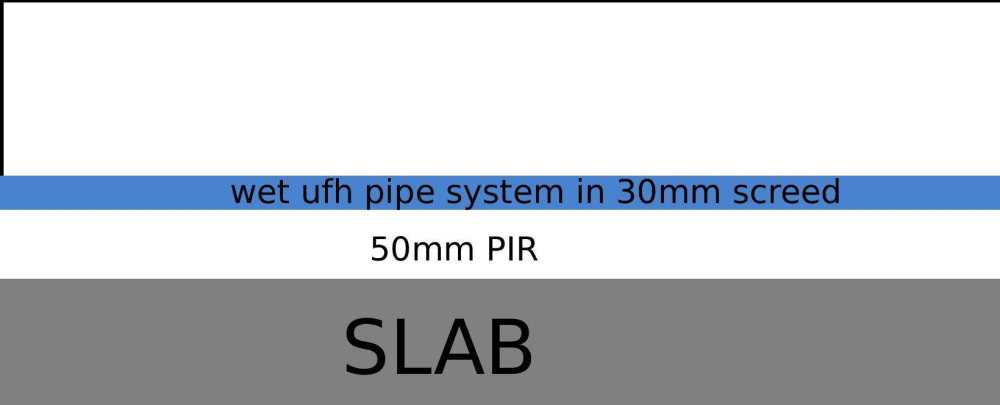
Hello! My floating floor research continues...I'd posted previously about options for wetroom and kitchen flooring and got some useful feedback. I've now got three options. It's an all-electric bungalow; bathroom is about 3.5sqm and kitchen about 20sqm. Old floor: concrete slab, then 50mm polystyrene, and 22mm t&g chipboard on top. I'm keeping the concrete slab. I'll add electric heating mats as a secondary heat to take the chill off the stone tiles. Option 1: 50mm PIR then 22mm chipboard. Basically, what was already there. Not sure about chipboard in a wetroom - would I have to cover it with 6mm tile backer board, which will add to the height? Option 2: Phenolic foam and gypdeck 18 gypsum fibre board. The best insulation (equivalent to 70mm PIR) but very expensive Option 3: 50mm PIR then a low profile wet system like this instead of boards: https://www.elementshop.co.uk/profix-plus-panel-low-profile-system-20mm-depth-14-17mm-pipe?gad_source=1&gad_campaignid=17190333812&gbraid=0AAAAAoLtzP8iYrR1bZmw5I1Nv6dekc2Bc&gclid=Cj0KCQiAoZDJBhC0ARIsAERP-F_Hahv5xh4NmuS9ME_vn1_shoXRaCY0TsHN_pwsQQTPzPKcmpZu_QkaAnxFEALw_wcB Together with electric ufh, this would futureproof me if I ever got a heat pump. Would this also give me some thermal mass if I heated the electric ufh on overnight offpeak? Are there any better options? Thanks!


-
Floating floors: compression vs vibration
Workerbee replied to Workerbee's topic in Floor Structures
I've continued my floating floor research for the wetroom and kitchen and I've come down to three options to put on top of the slab: - keep it simple and cheap with 50mm PIR topped with 22mm t&g chipboard. - 50-60mm phenolic topped with gypdeck 18. The gypdeck's lambda is 0.038, so if I squeezed in 60mm phenolic this buildup would be the equivalent of 80mm PIR. - 50-60mm PIR topped with a low profile screed system like this one: https://www.elementshop.co.uk/profix-plus-panel-low-profile-system-20mm-depth-14-17mm-pipe?gad_source=1&gad_campaignid=17190333812&gbraid=0AAAAAoLtzP8iYrR1bZmw5I1Nv6dekc2Bc&gclid=Cj0KCQiAoZDJBhC0ARIsAERP-F_Hahv5xh4NmuS9ME_vn1_shoXRaCY0TsHN_pwsQQTPzPKcmpZu_QkaAnxFEALw_wcB which would future proof me for a wet system, without raising the floor height Floor finish will be electric ufh then natural stone. Is the extra cost of the phenolic or gypdeck worth it, or would it not provide enough difference? Has anyone had experience with the gypdeck? Thank you -
Floating floors: compression vs vibration
Workerbee replied to Workerbee's topic in Floor Structures
Thank you for finding these @JohnMo - I'll have a look. -
Floating floors: compression vs vibration
Workerbee replied to Workerbee's topic in Floor Structures
Thank you very much for this, @JohnMo Yes you're right, I've had concerns about cost, but I feel I'm trying to find a balance with different factors. It's a bungalow, less than 50sqm. I'm adding 100-125mm PIR in the ceilings and 50mm on the walls. I'll be draft proofing and, although it'll never be ultra airtight, I'll add dmvhr instead of dmv. So hopefully it's a fairly small, fairly well insulated space to heat. A heat pump would be nice, but I can't really afford the cost up front. It's also a very quiet location, and after visiting several heat pumps I didn't feel it would be suitable. Also, with the size of the house, I don't know where I'd fit the extra equipment. Even a uvc is a headache (but I want the better flow rate vs an electric shower)! I have no wet system - it's an all electric house. The electric ufh is mainly just to take the chill off the floor, with a mind to it being used more in the future if I get batteries. Kitchen is about 16sqm, bathroom 4sqm. I also considered adding pipework for wet ufh in the kitchen as well as an electric mat, so it's ready to use if a more suitable system came to market in the future. Storage heaters would be a better idea than oil filled radiators; however, I've never found any that look particularly nice, so I'm a bit stuck. Thanks again -
Floating floors: compression vs vibration
Workerbee replied to Workerbee's topic in Floor Structures
Having spoken to a few technical departments, it sounds like compressive strength and 'vibration' (ie movement that could crack grout) are separate issues. Movement is caused by gaps due to each layer not being perfectly flat. Therefore I might as well use PIR/phenolic instead of XPS. Bonding the layers with pu foam will help with movement. In terms of what to put on top of the PIR: I was thinking xps tile backer board, as it adds more insulation and high rigidity. However, one technical department thought this might not work as it's not tongue and groove. Are they right? If so, and I need to use something with tongue and groove, is there anything offering better moisture resistance or thermal qualities than chipboard? Thanks! -
Floating floors: compression vs vibration
Workerbee replied to Workerbee's topic in Floor Structures
Thank you for the replies, and sorry for my poor explanation! It's a bungalow, and in terms of compressive strength I think any of polystyrene, PIR or XPS should be fine. I've done a crude drawing of what's currently there: The finish is currently carpet or tile. I'm basically just thinking of replacing the polystyrene with either PIR or XPS (ravatherm seems to have a decent lambda value), and replacing the chipboard with insulated tile backer board. This will mean I can bond everything together with suitable adhesive so that it's technically no longer floating, because the finish will be natural stone, which can obviously cause issues on a floating floor otherwise. I wondered if the ravatherm might have two benefits over PIR: would the fact it's not foil faced mean it bonds better? And more importantly does the higher compressive strength equate to lower vibration, or is that a separate characteristic? It's an all-electric house, so that's why I'm thinking of electric ufh. It'll probably be secondary heating, but given I'll be installing oil filled radiators it'll end up being just as expensive! Thanks again.
-
Hello! I know floating floors have been discussed before, but I wanted to check my thinking with you guys before going ahead. I want to install natural stone and electric ufh on top of a floating floor in the kitchen and bathroom. Currently the buildup is concrete slab, then 50mm polystyrene, a vcl then 22mm t&g chipboard and carpet/stick-on vinyl tiles. Current ideas are: - 60mm ravatherm XPS, bonded to slab with approved adhesive, then 6mm insulated tile backer board. This would eliminate the floating floor as everything's bonded. XPS also has very high compressive strength; but does this also mean low vibration? - 50mm PIR or phenolic, then 10mm insulated tile backer board. Again, I could bond this with pu adhesive; it's only being squashed, so the fact it's foil faced shouldn't matter? - PIR/phenolic then insulated routed XPS boards for wet ufh pipework, then electric ufh mats above. I don't have gas, and heat pumps aren't currently suitable for my property, but this would give electric ufh now and the option for wet ufh should a suitable product come to market in the future. - if none of these is an improvement, then leave as is. So it's basically xps Vs PIR/phenolic: very high compressive strength vs better insulation. But does compressive strength mean low vibration for fitting stone? Can PIR be adhesive bonded to the slab? Thanks!
-
I'm looking at the direct, electric heated sunamp model as I'm an all electric house. So does this mean I was right in thinking the sunamp can't be 'overcharged' to increase its storage like a direct uvc can be? I'd been looking at the 210 version because I thought it would be overkill for two people; it's sometimes quoted for 6 person houses. But if my back-of-fag-packet sums were right, then even a 210 wouldn't be enough. Only an 'overcharged' - or at least above 55 degrees - uvc would do it, with the additional benefit of a second immersion if a boost was needed. As @SteamyTeasays, though, I'd need to check for thermal cutouts.
-
Thank you everyone - it's been very useful hearing your experiences and knowledge. I've continued my research (ie put off making a decision); leaving aside the customer service question for now, I've got a list of pros and cons for the Sunamp vs uvc, which I can post if it might be of use to anyone in future. But one thought occurred which might swing it decisively in the uvc's favour, and it's that you can 'overcharge' a uvc - ie increase the capacity by keeping it at a higher temperature, which you can't with the Sunamp. I'm thinking of the Sunamp eplus (direct) 210 - ie Sunamp say it's equivalent to a 212l cylinder. Mixed down to 40 degrees with an assumed 10 degree cold feed, it produces 301l according to the tech specs. (footnote: is this right? It would imply a temperature directly out of the Sunamp of only around 53 degrees). The only thing I need dhw for (other than hand washing) is a shower. My showers are about 8 mins, my partner about 14 mins. 22 mins total. Assuming a 12lpm shower, that's 22 * 12 = 264l. If I get a great shower experience at 15lpm, that's 22 * 15 = 330. Either way, it doesn't leave me much wriggle room. I would then be relying on a rapid recharge time with on-peak prices, and if we had guests, we're stuck. In winter, even more so. But with a 210l uvc, I could heat it above 70 degrees and get more water volume. Am I missing something?
-
How to approach this wetroom floor...
Workerbee replied to Workerbee's topic in Bathrooms, Ensuites & Wetrooms
Brilliant, thanks @Nickfromwales - that's a much better idea than mine! Is compressive strength related to vibration in a floating floor ie the higher the compressive strength of the insulation, the less risk of stone tiles failing? If so, whether I could go for something like Ravatherm XPS X 300 SL and then a layer of insulated backer boards over the top. Or whether it's simply the act of bonding the insulation to the slab that eliminates the floating floor, regardless of compressive strength. In that case, I could perhaps go for max insulation value with something like tissue faced phenolic boards. -
Thank you for that, @Russdl. Do you find the flow rate is as good as a uvc? Sunamp mentions main pressure hot water but nothing about flow rate, and I wondered if it might get restricted in order to maintain temperature, particularly when the incoming mains temperature drops in winter. I'm keen to have a decent shower experience!
-
Thank you @JohnMo - yes, £250 seems very cheap, which made me question it. Rough prices on text message rather than a formal quotation make me nervous! My fear would be deciding on a uvc over the sunamp then finding I can no longer get hold of him when the time came. The 210 was the sunamp size (uvc litre equivalent); the next one down is 150, and with potentially 4 showers a day from a powerful shower, I thought I should play it safe. If going with a uvc I was thinking of a 180l. I'd probably go with the multibloc solution. On paper, the sunamp is the much better solution for me both in size and price, so it's very sad that it's let down by reliability and customer service. I could forgive the former if the latter was excellent. That's why I wondered if anyone had had experience in the last year or so in the hope that things had improved, as much of the online discussion is from 2023 or earlier.
-
One was £2230, and the other was £3600. This is for a direct uvc (I think one was 170l gledhill, the other was unspecified) and pipework. Two others didn't turn up, another wanted to charge to quote, and the sixth offered to do it for £250 labour if I piped up to the cylinder (which is what I requested, to keep costs down). At that price, I wonder what he'd be like. Alternatively, I can get a 210 directly heated sunamp for £2k and fit it myself. Coupled with having a small property where space is an issue, the sunamp seemed a great solution in theory. Thank you for sharing your experience, @Nickfromwales - very useful. I'd read your comments on a previous thread when I was researching. It would be a great shame if quality and service hasn't improved.


.jpg.331fa52903f35be7c6039b056c4d5d4f.jpg)


