sgt_woulds
-
Posts
229 -
Joined
-
Last visited
-
Days Won
1
Everything posted by sgt_woulds
-
Where should I put a vapour membrane on IWI
sgt_woulds replied to thetdog666's topic in Heat Insulation
And the dimensions? -
Where should I put a vapour membrane on IWI
sgt_woulds replied to thetdog666's topic in Heat Insulation
So thetdog666, which build-up description is correct? -
Back to the original subject, and regarding the efficiency of the wood burn, (which requires a short, high temperature burn) and the need to remove the combustion process from the internal environment I agree that Iron WB stoves are a non-starter and definitely shouldn't be DIY modified. So we should be installing masonry stoves, (Kachelofen, steinofen, pystyuuni, kakelugn, other names depending on where you are in the world) all of which are easily DIY-able - although the best ones with special ceramic burn chambers and venturi ventilation to boost burn temperatures above 2000°C do require special components. Most of the ones I've seen and used in Hungary had external firing chambers for easy loading and cleaning. Some did have a window inside where you could see the flames but as the burn typically lasts less than 60 to 90 minutes it's not worthwhile. Even the most basic designs will effectively use faggots of thin sticks, (not inefficient logs), leave very little ash and produce very low waste gases and particulates, (and low-temperature exhaust) from the chimney. They have efficiencies heading towards 90%. I have looked in the inspection holes and there doesn't appear to be any tar or other deposits in the chimney and I'm told they rarely need cleaning unless wet fuel or logs are used. Rocket stoves, a combination of a fire barrel, flue and cob - are a poor relation masonry stoves - but are quicker, easier, and cheaper to build. I don't have experience with them, but some say the indoor air is less pleasant due to dust scorching on the barrel, similar to modern iron stoves. I have lived with an iron WBS and although the sight of a simmering fire was soothing on a dark evening, that was pretty much the only plus point I could see. A true masonry stove produces low-temperature radiant heat, and many have in-built seats or day beds so you can snuggle right up. In the depths of winter, our relatives fire their stove twice a day, using two faggots at a time. In the shoulder months, 1 burn a day is sufficient.
-
Where should I put a vapour membrane on IWI
sgt_woulds replied to thetdog666's topic in Heat Insulation
According to your drawing, there doesn't appear to be any racking board on the frame. Is that correct? In 'traditional' UK timber frame I would expect to see OSB or plywood fitted external to the timber frame. (You also show a 120mm frame in the drawing but say it is only 90mm? If it is 90mm why not fully fill the space - use two layers of 45mm or 90mm boards - both options available from Celotex?) Is your frame open to the cavity? What protects the insulation and timber frame from the moisture in the external cavity - there should be a breathable membrane external to the frame? This is very important as it determines the 'breathability' of the structure and the type of VCL you need to fit internally. This also creates follow-up questions regarding your insulation choice and fitting methods. Detailing will be critical to ensure no long-term repercussions of 'upgrading' the insulation. Are you insulating the whole house, or is this just a small section? -
The membrane forms the water tight barrier ?
sgt_woulds replied to Post and beam's topic in Roofing, Tiling & Slating
Too true - too many monkeys not enough craftsmen. The adage 'never do to a customer's house that you wouldn't want done to your own' is one I've always worked to and tried to instil in apprentices, but I've worked with many so-called tradesmen of all types who couldn't give a toss as long as they got paid. Having said that, I've yet to come across any roof that is 100% waterproof but a properly installed and detailed membrane should keep out 99.99% 🙂 -
The membrane forms the water tight barrier ?
sgt_woulds replied to Post and beam's topic in Roofing, Tiling & Slating
A valley is a likely area to leak due to the amount of water it will see. Have they fitted the dry valleys yet? Gable ladders are a strange location for issues unless the undercloak is not in place. As ever, pictures speak a thousand words... -
The membrane forms the water tight barrier ?
sgt_woulds replied to Post and beam's topic in Roofing, Tiling & Slating
The tiles and flashing form the primary waterproofing layer. In older houses this is also the only waterproofing, which is why traditional buildings have slates or plain tiles, both of which have greater overlaps and can resist wind-driven rain quite well. Wooden sarking boards were introduced in high exposure zones to prevent wind from blowing through one side of the roof and lifting tiles on tiles on the other. These were gradually replaced with paper and bituminous membranes that performed the same function but were cheaper and quicker to fix. As modern interlocking tiles were introduced, wind-driven rain became more of an issue, and the membranes became important as a secondary weathertight barrier. They became standard fit in all situations, but gradually changed to the breathable types. The membrane should provide good weather tightness until the roof proper is on but are not 100 % proof thanks to nail holes etc. The better types will have tape at the overlaps and a conscientious roofer will ensure there is a slight 'droop' between the rafters to ensure good runoff and tape penetrations and abutments if leaving exposed. In certain situations the membrane can be deleted, e.g. wood fibre insulating sarking boards above the rafters on a warm roof. Tiles still provide primary weatherproofing and the hydrophobic coating on the woodfibre is the secondary waterproofing layer. In any case, whatever is under the tiles is only ever a backup. -
www.paintzero.com Make breathable paints that come as bags of powder - mix with water and off you go. Seems quite a good idea as unused paint powder can be stored easily until it's needed again, unlike large tins of paint that can go wrong. Crown were making bold claims, (probably still are) in their literature and website to push people to use their contract trade paints over freshly plastered walls as the paint was 'more breathable'. I couldn't find anything in the datasheets or the tins that gave the Sd or mu values. After a lot of back and forth they finally said: "We don’t measure the Sd value on our Trade paints as the paint will always have a low Sd value due to the nature of the paints. A couple of years ago we measured the Sd value on Covermatt and Crown Trade Matt and both of these had a Sd value of approx. 0.060. The measurements were carried out in our R&D lab. Please see table below for Sd value and the classifications Sd 0.060 Classification v 1 HIGH Classification Sd 1 HIGH The Covermatt, Trade Matt and Contract Matt are similar types of paints so I would expect the Contract Matt to have similar Sd value and classification as the other two paints." (sic)
-
If you are looking at building a house with natural materials like straw bales I assume you are happy to trade the low(ish) cost and complexity of the materials against the sheer amount of extra labour required? In which case, have you considered Cobbauge which would be similarly hands-on but not subject to the vagaries of straw bale quality and procurement?
-
That's not oversight, it's incompetence. It's about a lack of fundamental knowledge of how a PV system works. Any solar installer would check the system requirements before wiring the system. To complete the work they need to update the schematics of the system, (displayed at both inverter and mains incomer locations) to show how the panels and inverter are wired. If you've paid them on the basis of their alleged knowledge then they should be liable for the cost of scaffolding and rewiring to remove the redundant lengths of DC cable, (which will affect the performance of the system by a negligible amount, but the principle remains). They should also ensure that the inverter wiring and labelling are compliant with the wiring regs and MCS requirements and the grid regulations, (at least the ones in place when the system was first installed - G83 I think -G98 came in around 2020 from memory). I'm unsure if there are any additional requirements under the 18th edition WR - I've been out of the game for quite a while - but I'm sure there are some up to date electricians on here who can advise further...
-
GSE tray fixings for gutter adjacent location
sgt_woulds replied to Greeners's topic in Photovoltaics (PV)
Don't forget to check that your clamps will fall within the clamping zones specified by the panel manufacturer too. Clamps outside these zones may invalidate any warranty and may stress the cells/glass, and the frame may not provide the necessary uplift resistance. Not all solar panels can be clamped on the short sides - best to check. One thing to factor in when installing direct to the gutter - water rushes quicker down non-stick glass than other roofing materials and a large PV array can cause undersized gutters to overflow. Based on my own experience - and pessimism about future weather patterns - I would recommend deep flow gutters in general but certainly in this scenario. -
If it were my panel on my roof I'd connect the two strings in series, then connect to one inverter. I'd have a bit of extra inefficiency from the additional cable length, but if I couldn't get on the roof to re-string it'd be the easiest option. However, I'm stating ON RECORD that I DO NOT recommend that you do this. It appears neither you nor your installer are competent enough to install panels or connect high-voltage DC to a grid-connected inverter. My recommendation is to have a suitable qualified PV installer commission the system for you.
-
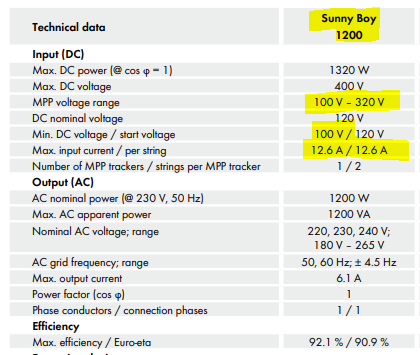
You don't necessarily need a new inverter or more panels. 6 panels should fire up a single SB1200. Whether it will make the most efficient use of the panels, who can say. For maximum returns, a PV system should be designed, not just thrown together.
-
Yes. Who designed this system for you? Is the 'installer' a MCS competent person? If not, what are their qualifications for installing panels and working with high voltage DC? Why did they not check the requirements before connecting to the inverters?
-
The panels, string design, voltage and amperage would have been designed to match the inverter specifications. What panels did you have before? What were they rated at? How many panels in a string? (presumably 5 each but not necessarily) What is your string voltage and amperage now? Is the polarity correct? A string of six panels should have an open circuit voltage of 120 - 225 v and 10-15 Amp depending upon panel specs which should be fine on one of your SB1200's. These things are bullet proof, but keep the other one as a spare. Who has installed the panels? What are their qualifications? Are the clamps within the clamping zones of the panels? Have you run uplift and dead weight calculations to ensure the correct number of fixings and screw sizes to work with your roof timbers? Distance from roof edges and ridge? If the installation was poor before, did the original installers properly assess the roof structure? Most times not. [Back in those early cowboy days we turned down installs on some roofs rather than risk roof damage or panels flying off. Often the homeowner would call back later to say company 'XYZ' had fitted 'twice as many panels' as we had recommended but had gone out of business. We had quite a good business fixing all the badly installed panels during the solar crash...] Who is connecting the panels to the inverters? What connectors are they using? Are they original manufacturer or 'generic compatible' with the original connectors, (MC3 or MC4 depending upon the age of the inverter). NEVER mix and match connector types - there are plenty of examples of fires caused by incompatible 'compatibles'. What size cables? Are they double insulated and how do they enter the roof space, (are they mechanically protected, or just run under a tile?
-
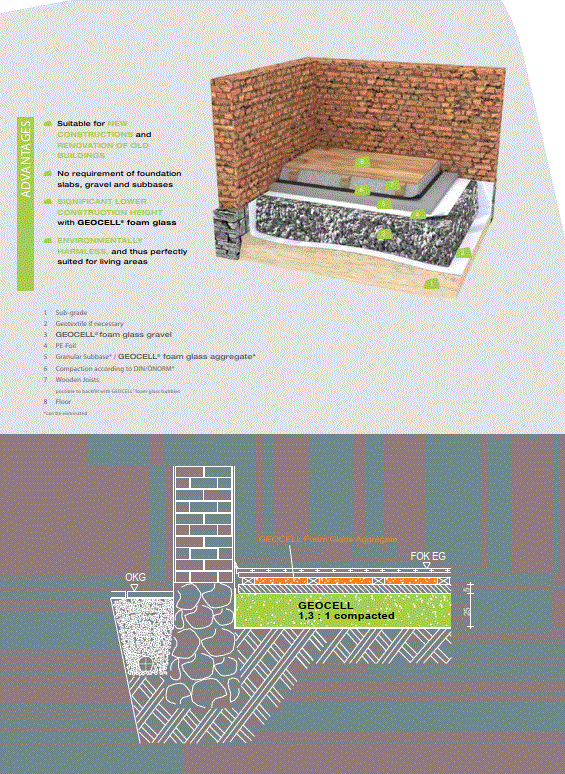
Says a man who has never done it ! 🙂 Try shovelling 2 1/2 tons of it into wheelbarrows and making what feels like the equivalent of a round trip to the sun backwards and forwards! Geocell binds together making it incredibly hard to get a shovel in, (had to use a shallow frying pan in the end) - moving it was the hardest physical thing I've ever done. I'm saying this as an ex-roofer used to shifting tons of slates up onto a scaffold 'cos the boss was a tight old so-and-so who wouldn't pay for a Bumpa. Other than that, yes it's lovely and light...
-
A toilet doesn't need to be connected to a sewer for occasional use: Online Shop - WooWoo Waterless and Composting Toilets
-
You could try the Geocell system (from Mike Wye) - although it would mean wheelbarrowing a ton of expanded glass rubble to your back garden which might be just as hard as pumping concrete there. Is very DIY-doable though: Back to Earth also do something similar: Solid floor insulation – How to create a solid, insulated floor - Back to Earth
-
Yes, but Egypt tends to have less rain - although I suppose the Pyramids and other buildings probably get sandblasted regularly! Lime render may stand up to extreme weathering - but I'd take the advice of an expert - there don't appear to be any on here at the moment... These walls will likely be seeing horizontal wind-driven rain on a regular basis - if a stone rain screen can be made to work it will probably require less maintenance than a Lime render. Scottish John - I've not heard of this being done with bales, but the situation will be similar to using a brick or stone face with a ventilated cavity on a timber frame building. Will need to be signed off by a structural engineer. I'm sure I read an article in a (very) old magazine where the owner used a drystone wall over rendered bales for a shed/study. Can't remember if/how it was tied in, but it's not beyond the wit of man. I wouldn't want to try it though - would be Mouse City... On a separate front, a rubble foundation would not only be cheaper and easier to self-build but might also reduce the embodied carbon count enough to justify using a more conventional structure/insulation without so much environmental guilt. To annoy the FUD brigade - this is quite often employed with Earth Bag construction which the OP could consider as a more weatherproof construction method, with suitable internal insulation 🙂
-
The OP also said they planned to clad in stone; in any circumstance, they wouldn't leave the straw exposed to the weather. I wouldn't be confident about using lime render in that exposure zone without expert advice, but that come back to my point about designing for the conditions. As an example, our woodfibre insulation can be used behind a close-slatted rain screen or roofing without a weatherproof membrane in most circumstances - but in high exposure zones, we always specify a membrane for belt and braces. Similar consideration should be given when designing with any material. You wouldn't clad the building in EPS without protection for the same reason.
-
I'm not advocating either method, I don't write them off either. I think using them for infill is a better idea - the blown straw you linked to is a case in point. They are also designed to be stacked for storage and thus to take loads. The amount of loading and the timeframe in which it will maintain structural integrity is for a structural engineer to confirm, but can also be gleaned from empirical evidence of existing strawbale structures. There are many issues with straw bale construction as ProDave has rightly pointed out, but has anyone got evidence of a structural failure that wasn't due to poor design or construction? A house shouldn't be made out of them because they are polystyrene! Strawbales should be thought of like SIPs and the building designed accordingly. You could argue that SIPs are rubbish for a number of reasons, (I wish I'd built my extension from anything other than SIPs - a story for another day) but I don't think anyone here would argue that they are inherently structurally inferior to 'traditional' methods without some sort of evidence.
-
and should be used as animal bedding, not to build houses in a very wet and windy part of the world there is a reason why they built crofters cottages from stone when they did not have the mechanical means of moving heavy objects easily 2-300 years ago and it is why a lot of them are still standing us it to build an insulating inner wall by all means but not as an outer weather shield Who said anything about using it as an outer weather shield? This isn't the 3 little pigs 🙂 There is plenty of straw for bedding - using the excess for embodied carbon reduction in new homes is an ideal use for the rest. At the moment - as I understand it - most of the excess is burned to make power, which is nuts. Back in the day an exciting - but unpleasant - job was to help with burning the stubble fields to create biochar to be ploughed back into the ground. This is, (rightly) no longer allowed so all straw is now a low-value waste product of producing food crops. The farmers buy back the 'biochar' from power production at inflated values to perform the same function they used to achieve for free, (barring labour costs and the odd visit from the fire brigade). I agree that using stone for the outer face of the construction makes perfect sense in this location due to the weathering; if quarried or recovered locally it makes for an excellent low-embodied carbon building material. Crofters cottages were often insulated, (inside the stone!) with wool or heather - they made use of what was easily and cheaply available. [That’s why they built with stone. If they’d had bricks or abundant timber they would have used that instead] A friend of mine stayed in a cottage on the coast in Norway that was renovated using some of the original wool which was still in perfect condition after 80-odd years. No reason to assume that any other natural material,(suitably protected) wouldn’t last as well. I doubt if fibreglass or PIR would be suitable for reuse in the same circumstances. I do agree that we should be looking carefully at the chemicals sprayed on crops that become insulation – but this applies to crops in general. Industrial farming commits a lot of environmental crimes in terms of chemical use – but compare this to insulation produced by the chemical companies. Most VOC will dissipate naturally in storage before entering the building and the remainder will be effectively locked away from inhabitants behind the surface finishes. I’d rather have this slight risk in my home compared to the toxic soup of chemicals used by unnatural insulations. We have hijacked this thread and I don’t want to get into the weeds about the health benefits of natural, breathable, [not the best term but it’s the one people understand] construction materials. This discussion is about the suitability of straw for the OP’s use and I haven’t seen any logical arguments presented to preclude its use in a properly considered and constructed building in his location.
-
"Bales are naturally compressible and the building will move throughout it's life and you'll have jamming windows and doors and extra cracks opening up allowing air to leak through the structure with the associated impacts on comfort energy efficiency and building durability. " Would you tell someone not to use a green oak frame for the same reason?
-
To be clear, I'm not sure that structural straw bale is the best solution for the OP's location, but is perfectly viable for infill insulation. He'd be shipping in insulation anyway, might as well be natural / low(er) carbon stuff.
-
Thanks, that's exactly the kind of evidence I was seeking. I have seen that post before and, from my, (admittedly not top notch these days) memory this is the only such site where I've seen such complaints. The build referenced seems to use materials finishes that have not been considered in context with the build location. Earth/clay external render rather than lime, plasterboards internally rather than direct applied plasters. He moans, but does not answer any of the sensible questions asked by the others. As such it is not helpful because we learn nothing to ensure better buildings in the future. The great joy of the natural house-building community is the willingness to try new things and share what works and what doesn't. I think the methods he used were probably poor and more concerned with being cheap than being effective. I can only speak from the UK context, but cob buildings in areas with burrowing bees etc changed to using Lime render to prevent them digging in. Lime - (or at the very least a lime wash) is also very effective at deterring rodents from chewing through. They are unlikely to be burrowing into the bales themselves, but living in spaces formed between external finishes and gaps between bales. Like you, I grew up playing with straw and hay bales - stacked in the traditional manner in barns. We used to find rodent nests, (and feral kittens) in the straw stacks, but only in the gaps between the bales - they either couldn't chew into the dense straw or wouldn't waste the energy to do so. In the hay bales they would chew and dig in, but this was probably because they were much easier and full of seeds to eat. Rodents are opportunists - they make use of what exists and will find easier places to live if the opportunity arises. That's not to say they couldn't chew their way in, it's just unlikely - more likely they found a gap in the building and exploited it. Mesh could be a perfectly viable solution in some cases and why not? It is regularly used for external render works - why would this make the build less viable? You'd only need it for the first couple of feet unless you have Parakeets in the area; nothing is safe from those little green barstools - but again, design accordingly or buy an airgun. I agree with you regarding the vagaries of weather on straw production and modern methods of farming - but this has nothing to do with the underlying qualities of straw and is about care in the selection and use of materials. If straw becomes more valuable as a resource to farmers when sold for insulation then they will invest and change methods accordingly. There certainly should be a premium paid for any material used for building purposes. Cost has nothing to do with this topic though. This is about building a healthy low-carbon building that is better for people to live in. It is about the suitability of the material for its location and use case. Straw won't be the best option in all situations, but it is one of them. A lot of people are prepared to pay more for natural materials and offset this by supplying more of their own effort and time in completing. Sadly, most buildings with natural materials will cost more since they are not produced on the same scale, (or as heavily subsidised) as unnatural materials. U-value is a matter of providing enough depth but your figures seem wildly pessimistic. Ecococon 400mm panels using straw compressed at 115 kg/m3, (probably much higher than a standard strung bale) have U-values of 0.15 W/(m2K). Where are you sourcing these figures? Compression and movement should be assessed and ameliorated in the design and build, but historically a building that can accommodate movement to a certain extent tends to be longer lasting than a rigid one. Are there any reports of modern bale builds with non-opening windows and doors?