PiMike
-
Posts
48 -
Joined
-
Last visited
Everything posted by PiMike
-
Is my Vaillant ecoTEC working properly?
PiMike replied to PiMike's topic in Boilers & Hot Water Tanks
I can't see any mention of load compensation. However, the VRT392f has two operating modes. It's currently in 2-point (like a conventional thermostat) so I could try analogue mode. Mike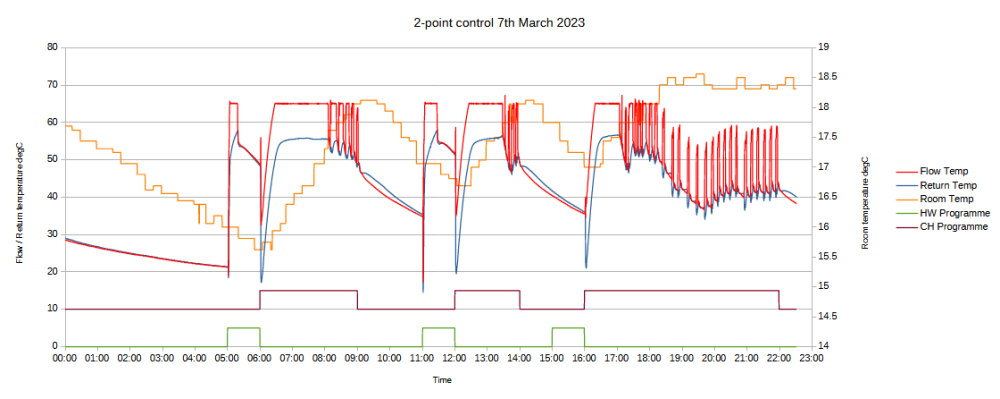
-
Is my Vaillant ecoTEC working properly?
PiMike replied to PiMike's topic in Boilers & Hot Water Tanks
Sorry you're correct, I misread the manual. d.5 is Flow or Return target depending on whether Flow or Return regulation is selected in d.17. I read elsewhere that Return regulation works better with the VR392f thermostat so I will try it at some point. Is SetModeOverrive persistent? I could try setting disablehc to 0. Mike -
Is my Vaillant ecoTEC working properly?
PiMike replied to PiMike's topic in Boilers & Hot Water Tanks
Thanks for that. Yes I found the problem with -f by trial and error. A typical output from SetMode is: auto;0.0;65.0;-;1;0;1;0;0;0 I decided that a FlowTemp of 55C was insufficient to achieve the 18C room temperature so I increased it to 60C and set the CH Part Load to 8kW. I started a new plot at midnight and the interim result is below. I only started plotting SetMode at 1pm. The only SetMode parameters that vary are flowtempdesired (which swings between 90 and 0) and disablehc (the inverse of flowtempdesired and plotted on the graph). I believe flowtempdesired is only relevant to return regulation and I am using flow regulation. What is driving disablehc? Mike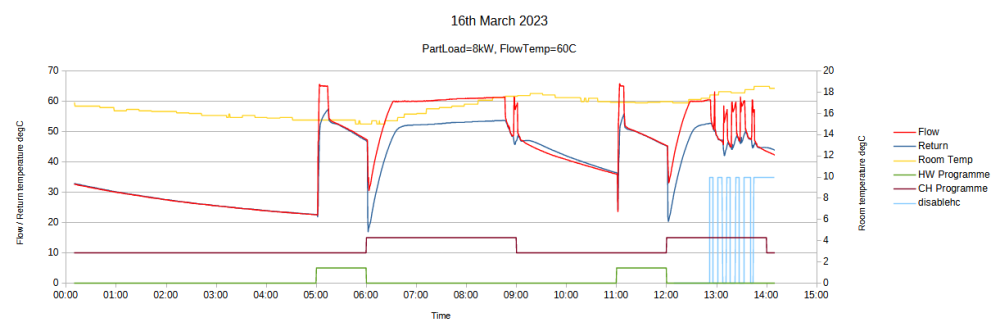
-
Is my Vaillant ecoTEC working properly?
PiMike replied to PiMike's topic in Boilers & Hot Water Tanks
OK I've sorted it with Popen 😇. Which of the SetMode parameters are you interested in? Mike -
Is my Vaillant ecoTEC working properly?
PiMike replied to PiMike's topic in Boilers & Hot Water Tanks
Hi Radian, how's your Python? Mine's pretty poor and I'm struggling to come up with the code to capture the SetMode string. This is how I capture FlowTemp: bai = ['/usr/bin/ebusctl', 'read', '-c', 'bai', '-f'] flow_temp = float(check_output(bai+['FlowTemp', 'temp'])) Mike -
Is my Vaillant ecoTEC working properly?
PiMike replied to PiMike's topic in Boilers & Hot Water Tanks
Mike -
Is my Vaillant ecoTEC working properly?
PiMike replied to PiMike's topic in Boilers & Hot Water Tanks
Yes because the part load was set to 12kW and the minimum for this boiler is 5kW. Mike -
Is my Vaillant ecoTEC working properly?
PiMike replied to PiMike's topic in Boilers & Hot Water Tanks
Well that's what's happening now, but in the graph I posted in reply to Radian (above) it doesn't shut off when it reaches the desired flow temperature (65C in that instance). Mike -
Is my Vaillant ecoTEC working properly?
PiMike replied to PiMike's topic in Boilers & Hot Water Tanks
Yes it's a RPi4. I've played with the ModulationTempDesired but converted it to kW as in this earlier plot: I'm not sure what's telling the boiler to turn off yet. I need to go deeper into the rabbit hole ... Mike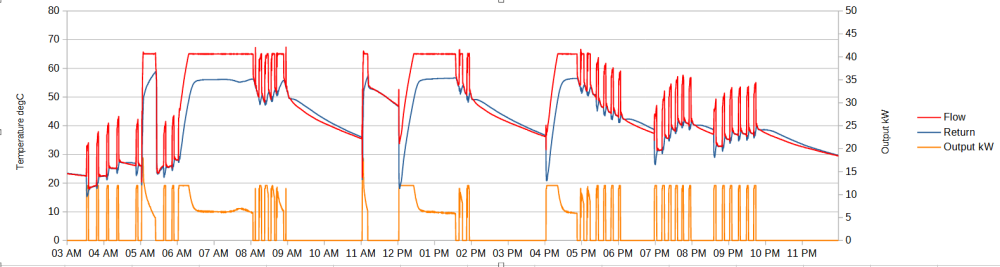
-
Is my Vaillant ecoTEC working properly?
PiMike replied to PiMike's topic in Boilers & Hot Water Tanks
That's good to know, thank you. I can measure CH gas consumption so will see what it gives in a day or two. Why doesn't the boiler run until the desired room temperature is reached though? Mike -
Is my Vaillant ecoTEC working properly?
PiMike replied to PiMike's topic in Boilers & Hot Water Tanks
I missed that about the VRT392f because at the time I read the blog I didn't have one, so thank you. I've used a number of different calculators to estimate the heat loss of our property with one bedroom in use and the answers range from 6 to 7kW. Given that the HW has its own part load setting (and it's not on at the same time as CH) then I think the original setting of 12kW for CH was far too high. Final question - should the boiler stay on for the entire period of the CH programme, modulating its power as required to maintain the desired room temperature, or should it turn off periodically as mine did in the most recent graph above? Thanks, Mike -
Is my Vaillant ecoTEC working properly?
PiMike replied to PiMike's topic in Boilers & Hot Water Tanks
Simon, yes I saw that a few years ago but it really applies to systems with outdoor temperature sensing. I have a partial plot for today after turning the CH part load down to 5kW as JohnMo suggested. HW 5-6am, CH 6-9am. Now it's behaving at night and giving longer burns, but it turns off before the target room temperature of 18C is reached. The house is still warm though ... Mike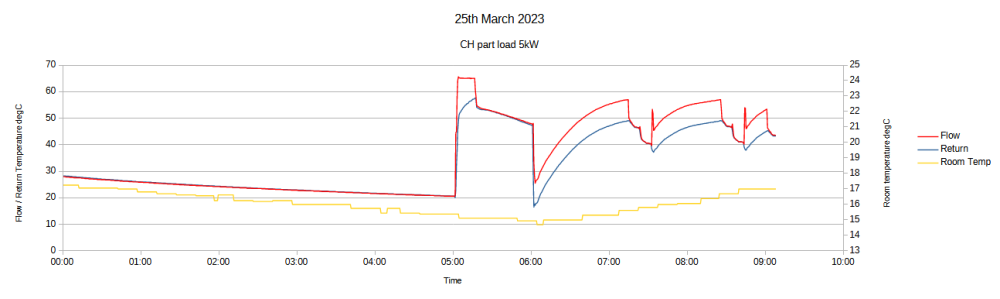
-
Is my Vaillant ecoTEC working properly?
PiMike replied to PiMike's topic in Boilers & Hot Water Tanks
Hi Mike The set-back is 14C and on the graph above it was firing at a room temperature of 18C. It doesn't do it every night, which is odd. The boiler manual specifies an external ABV and one was fitted when the system was installed in 2009. It was replaced and adjusted last month by my heating engineer before the new Vaillant controls were fitted. All seven radiators currently in use get hot. Mike -
Is my Vaillant ecoTEC working properly?
PiMike replied to PiMike's topic in Boilers & Hot Water Tanks
Actually I'll do it now as it's looking decidedly odd. I reduced the CH target flow temperature to 55C. The other parameters are: HW target flow temperature: 65C CH part load: 12kW HW part load: 18kW Not only is the short cycling constant but it's firing at night when it's well above the set-back temperature. I don't understand ... Should I reduce the CH part load? Mike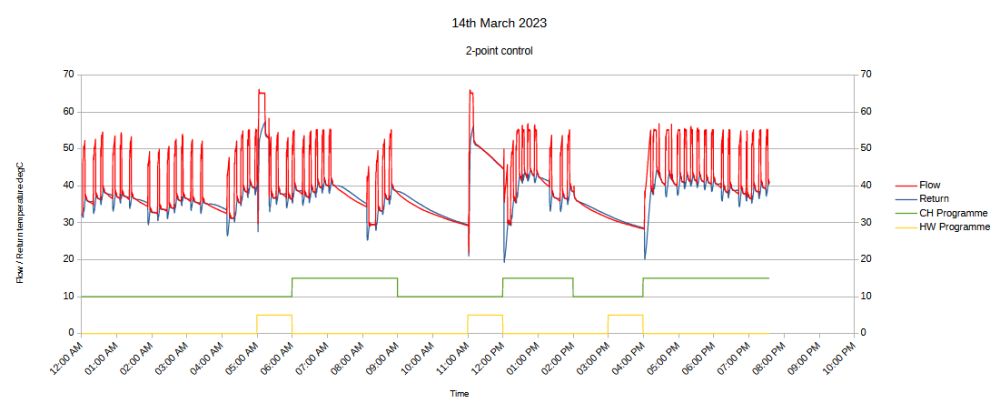
-
Is my Vaillant ecoTEC working properly?
PiMike replied to PiMike's topic in Boilers & Hot Water Tanks
Hi Simon, the VR65 is connected to (and powered by) the ebus. The VR392f is wireless with a receiver connected to the ebus at the boiler. There is an endless list of parameters that I can monitor and change remotely (including for example separate gas counters for CH and HW). Yes I can set different flow temeratures for CH and HW and as you can see in the graph above it does modulate. I have two 2-port valves that are controlled directly from the VR65 but a conventional thermostat on the HW cylinder. I'll put up another graph tomorrow with the CH flow set to 55C. Mike -
Is my Vaillant ecoTEC working properly?
PiMike replied to PiMike's topic in Boilers & Hot Water Tanks
That looks interesting but the cost of converting my system would be prohibitive (even with gas prices the way they are). I've only just replaced the controllers so I'd like to get the best out of them before considering more changes. I have lowered the target flow temperature to 55C and will see what difference that makes after a couple of days. Mike -
Is my Vaillant ecoTEC working properly?
PiMike replied to PiMike's topic in Boilers & Hot Water Tanks
Ah OK, but my system doesn't have an outside teperature sensor. Mike -
Is my Vaillant ecoTEC working properly?
PiMike replied to PiMike's topic in Boilers & Hot Water Tanks
Hi JohnMo, first a disclaimer: I'm not an expert on heating systems! it's a 4-bed detached house with seven radiators currently active, one fitted with a TRV (bedroom). I understand the requirement to keep the return below 55C but are you saying that a continuous run time at a lower flow temperature is better than short cycling? There is no reference in the installation manual to ramp rate. Would reducing the part load have the same effect? Mike -
Is my Vaillant ecoTEC working properly?
PiMike replied to PiMike's topic in Boilers & Hot Water Tanks
Thanks both I will try that, although that plot was made on a cold day and it's a lot warmer now so perhaps not a good comparison? There was a typo in my post, the thermostat is a VRT392f. Mike -
My ecoTec 418 was installed in 2009 with traditional Danfoss controls. I recently replaced them with a Vaillant VR65 controller and VRT2392f room thermostat. I also built an adapter so I can monitor the ebus to see what the boiler is doing. I set the part load to 12kW, flow temperature (CH and HW) to 65C and room temperature to 18C. Here is a plot showing a long initial burn time then multiple shorter burns. Is that how it's supposed to be operating? Thanks, Mike
-
Thanks, it's a Vaillant ecoTec 418 with ebus. I've made a bus adapter and can read the parameters but now I need to understand what they all mean! Mike
-
Hi Radian I'm following your experiments with interest as I have just started to monitor the ebus on my Vaillant ecoTec 418 boiler. I built a bus adapter from here: https://gitlab.com/fromeijn/ebuzzz-adapter It converts ebus to USB and works very well with my Raspberry Pi. Just getting my head around the hundreds of parameters on the bus (I have a VR65 controller and VRT392f wireless thermostat too) and wondered if you could help me identify the contents of the Status messages? pi@vaillant:~ $ ebusctl read -c bai Status01 63.0;50.0;-;-;-;on pi@vaillant:~ $ ebusctl read -c bai Status02 auto;60;65.0;80;60.0 My guesses after scanning the bus are: Status01: FlowTemp;ReturnTemp;??;??;??;Flame Status02: ??;HwcTempDesired;??;HwcPostrunTime;StorageTempDesired Also, what are you using to display your MQTT data? Thanks, Mike
-
Hi everyone, I'm a retired electronics engineer and I joined the forum to find out more about monitoring the data bus on my boiler. I built a workshop in the garden where I can play with my projects without disturbing my wife! Mike