PhilT
-
Posts
505 -
Joined
-
Last visited
PhilT's Achievements

Regular Member (4/5)
67
Reputation
-
Ecodan r32 keeps flipping into immersion mode.
PhilT replied to MorganP's topic in Air Source Heat Pumps (ASHP)
I have an Ecodan R32. Have you checked the heat source setting via the service menu? The "Heat Source" should be set to "Standard". If it's set to "Heating" that's wrong and needs to be changed to "Standard" -
Currently BBC news have an article "Heat pump growth stalls as government support cut, warns climate watchdog". Not surprising! Even the BBC itself is guilty, for example Evan Davis published an article recently: "Heat pumps work for me - but they're not yet a money saver" https://www.bbc.co.uk/news/articles/ce358gkx9vpo In it the cost of electricity for a heat pump is quoted as 28p/kWh! I complained to the BBC about not reporting the obvious fact that much cheaper heat pump tariffs are available, and got a response asking for evidence of this! So could we do a little survey of our forum members. What average variable rates are people in this forum currently achieving over the course of the last 12 months (or for 2025 if easier), for imported electricity for their heat pumps? Mine was 18p/kWh average for 2025 using Octopus Cosy.
-
Haier is a very good heat pump, but unfortunately Chinese. I would rather buy closer to home. Ideal make one of the most efficient heat pumps available, the HP290, made in UK. Support british industry!!!
-
Interesting couple of days with the new heat pump.
PhilT replied to MikeSharp01's topic in Air Source Heat Pumps (ASHP)
Surely by far the cheapest would be running continuously with Cosy? You get 8 hours plus battery hours at the reduced rate and only 3 hours, or no hours with a big enough battery, at the premium rate. -
Observations on need for heating upstairs
PhilT replied to Post and beam's topic in Air Source Heat Pumps (ASHP)
how do you operate your daily schedule; on all the time at one temp? Any set back? Any switch off for a period of time? -
It's the Czech Vaillant tables - this is a good resource to access and understand them https://energy-stats.uk/vaillant-arotherm-performance-data/#:~:text=The Czech tables give you,your system should be doing. Taking a simple example, for a nominal spec of -2°C / 7kW heat requirement, at 35°C flow temp, the 7kW model has a COP of 3.3 but the 10kW model has a COP of 4.0 - a 21% advantage. At those power levels, the 10kW compressor is revving at 50rps vs the 7kW compressor at 90rps (see my previous comment about how friction loss is affected by rotational speed compared to surface area). In answer to the other comment, I was trying to explain, rather poorly, that my heat pump is an 11.2kW model, but the power requirement at -2°C is only 6kW. The Mitsubishi data tables show a similar picture to Vaillant, in that the next size down (8.5kW) is less efficient at similar power levels.
-
The data tables don't support this. For a house with a theoretical heat loss of 7kW at ΔT of 22°C, if you compare a 10kW Vaillant Arotherm+ with a 7kW version, the 10kW will give lower operating costs across a whole year, because it is so much more efficient during the coldest days, when energy use is at its highest. In the real world of (hopefully) common heat pump ownership this is likely to be even more relevant as the larger pump will be far more forgiving of less-than-optimal operation by non expert users during the coldest months of the year.
-
The data tables published by Mitsubishi and Vaillant, as examples, an 11.2kW vs an 8.5kW Ecodan, or a 10kW vs a 7kW Vaillant Arotherm+, indicate that the extra efficiency of the larger, slower revving scroll compressors* outweighs any inefficiencies in warmer times, but why would there be any significant losses for modern oversized scroll compressors cycling at reasonable intervals of no more than once or twice per hour in the warmer months anyway? Long gone are the days of fixed speed reciprocating compressors. Isn't the oversized low modulation inefficiency paradigm something of an urban myth now? *(friction losses rise only in direct proportion to surface area, but rise exponentially with RPM)
-
how many people will be living in this house? 5kW is too low to keep up with family hot water demand in a property of this size. I have an oversized heat pump (11kW vs 6kW at -3degC) and it's great, I never have to worry about not being warm or getting hot water quickly. My experience, backed up by the data tables, is that oversized heat pumps are no less efficient overall, and more efficient during the coldest periods like we have been having over the last few weeks. Some headroom is essential for all sorts of reasons especially those situations where a strong recovery is needed - defrosts, power cuts, all the family off work and school with the flu, and any other situation where you need extra warmth, or the house temperature drops significantly and you need a fast recovery.
- 43 replies
-
- 1
-

-
- mvhr
- ashp and dhw
- (and 2 more)
-
Out of interest why are you doing this? I can't see how this would save any significant amounts of money given your bill was already very low. What about recovery times - how often do you get power cuts and for how long? Impact on hot water heating time? Impact on defrost recovery time, headroom for other unexpected issues etc?
-
I've been using Octopus Cosy since they introduced 3 cheap rate windows. As far as I know it's the only one which "allows" you to have the fixed outgoing 15p/kWh for your PVs (correct me if I'm wrong I haven't checked recently). My Cosy rates went up by 10% from November because Octopus were losing money on it. My average variable cost before VAT for November was 18.5p/kWh. I have radiators and load shifting is minimal. low/std/high variable rates are p/kWh 13.38 27.29 40.93
-
Ecodan Fixed Flow Mode - Exceeding Flow Temp Setting
PhilT replied to BadgerBadger's topic in Air Source Heat Pumps (ASHP)
possibly the heat pump's minimum modulation level cannot get that low? What happens if you set it to 27? -
30 Year Old 8mm Microbore Circuit Changes
PhilT replied to PhilT's topic in Central Heating (Radiators)
Certainly worth considering now I know the top floor is mostly 15mm -
The figures vary a lot by manufacturer for example, at 35C the 10kW Vaillant Arotherm Plus SCOP is 5.03 vs the 7kW model at 4.36 (MCS test results). But my calcs look at this in a different way, by comparing an 11.2kW heat pump running comfortably within it's so-called "mid-range" capacity (c. 9kW ball park) vs the equivalent 8.5kW running flat out, at different ambient temps. So an over-sized heat pump could be more efficient or, at worst, no less efficient than the "perfect size" (for want of a better description).
-
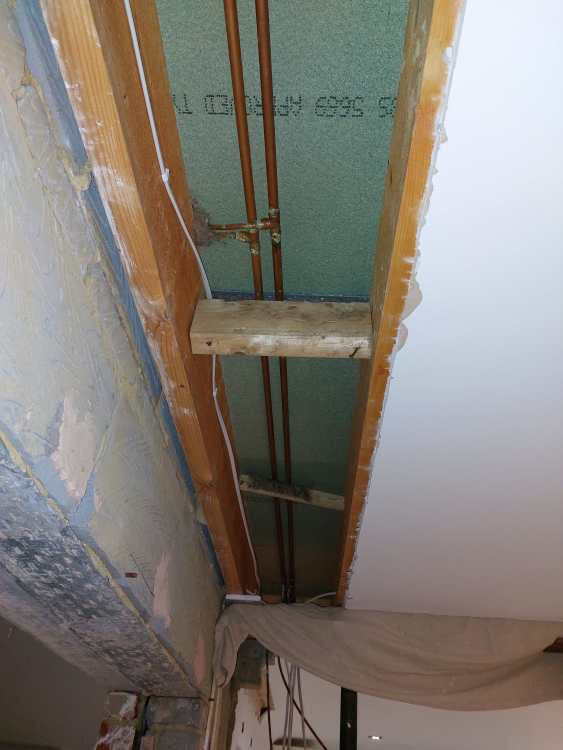
Looking to upgrade to 15mm. I thought the 8mm microbore circuit was fed by manifolds, but removing the downstairs ceiling reveals instead a 15mm secondary circuit feeding short 8mm microbore feeds to the upstairs rads, and long 8mm microbore runs dropping down to the ground floor rads (see photo). This should make things easier because I won't have to hunt around for the manifolds, I can just leave the upstairs rad circuit as it is, run two new 22mm pipes dropping down from the primary circuit upstairs, just after the secondary circuit pump in the airing cupboard, and then connect new 15mm runs from the two central 22mm drop downs to the downstairs rads. Any issues with that approach?