low_and_there
-
Posts
81 -
Joined
-
Last visited
Everything posted by low_and_there
-
Designing new flat roofs with PV from the start
low_and_there replied to low_and_there's topic in Photovoltaics (PV)
good point @SteamyTea, I recall reading something like 10 degrees is needed. For the projections, I just inserted the roof slopes angles, but I'll see what happens when I increase it to account for that. And thanks @Ronski - have you got any experience / heard anything about these systems in use? -
Designing new flat roofs with PV from the start
low_and_there replied to low_and_there's topic in Photovoltaics (PV)
Thanks again for the explanations @Gus Potter, super helpful! Based on this thread, I'm now thinking: 1) For the existing roof where we're (hopefully) not re-tiling, we'll go over the existing tiles - if we have to re-tile the roof then the in-roof trays are an option. 2) For the two new flat roofs we're creating, we need to factor in the additional weight considerations of the trays, ballasts and panels, along with the various loading scenarios that you outlined in your earlier post - that is the simplest and safest way rather than building in any frames or any screwing into the roof that could compromise weather tightness. 3) For the new pitched roof we're creating, we could go for in-roof trays so long as we ensure decent ventilation behind them. -
Designing new flat roofs with PV from the start
low_and_there replied to low_and_there's topic in Photovoltaics (PV)
Thanks for your notes @Gus Potter, appreciate the breakdown of things to think about in terms of weight. In terms of the lightweight trays you refer to, are these something like the "GSE" trays that @JohnMo mentions? Are there any such items for flat roofs you could point me in the direction of? -
Designing new flat roofs with PV from the start
low_and_there replied to low_and_there's topic in Photovoltaics (PV)
hi @SteamyTea I had looked at that simulator previously and noted it was lower, but still thought it may be worthwhile. I've just re-run the numbers, and pasted them below for review. Whaddya think? Roof Type PVGIC Azimuth angle Roof slope Yearly PV energy production [kWh] - based on 1kWp per elevation % of the 'optimum' angle Front Roof Pitched -45 (SW) 35 degrees 1,061 93.34% Main Dormer Flat -90 (W) 3 degrees 956 84.05% Rear Dormer Flat 0 (S) 3 degrees 985 86.61% Kitchen rear Pitched 135 (NW) 35 degrees 702 61.72% -
Hi all, I’ve done a bit of googling and forum searching on this topic and come up short, so hoping you can help us: we want to understand how best to factor in Solar PV to the design of our loft extension (mid-terrace house c.1905) Subject to planning, the aim is to have one dormer on the rear roof slope and another on the outrigger roof; facing NW and W respectively. We’ve been advised we could get 6 panels for the main dormer and 3 on the rear. We will also seek permission to put one on the front elevation (all we can fit because of Velux and a gable), which gets the morning sun (SE facing). We also have a tiny little strip of pitched roof to play with at the very rear, NW again and totally unshaded, which could host three smaller panels (200w). I’ve so far had one person come to take a look, and when I asked about how we best plan this into the design of the dormers, they just said they’d use trays with ballasts for the flat roofs and mount the smaller panels atop the new roof at the rear, so no need to consider it in the design. I find this a bit odd - presumably there is a flat roof material that makes more sense when fitting PV, or a way to build a frame for PV into the new roof during construction, and weight considerations we ought to plan for? I had thought about in-roof for the rear (a small pitched strip), to avoid paying for new roofing tiles, only to have them covered up by solar panels… I’ve been told in-roof is a bad idea as the panels need ventilation. But isn’t there anyway supposed to be a ventilated gap between the roof and the internal felting/insulation etc? Also wonder about the angle - we could angle the roofs more (3 degrees is current design) to slope more towards the ideal pitch - but maybe this complicates the build and the trays with ballasts are just as good? Suggestions appreciated.
-
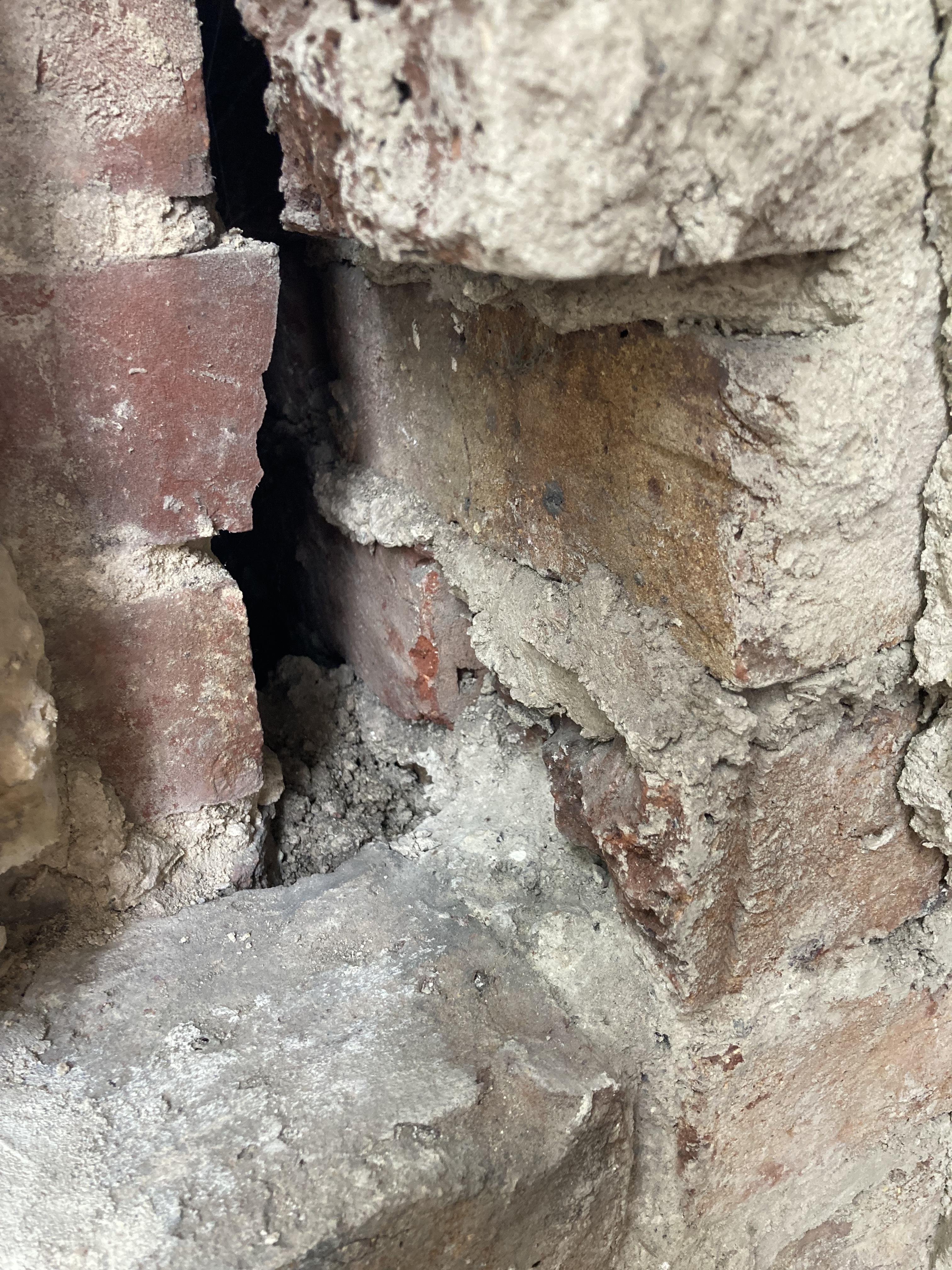
Our house is solid brick except for a couple of sections of the front wall to either side of the square bay window, where there is a 2-deep solid brick wall, then a small cavity of about 45mm, then another wall of brick to the inside face. One person I showed this to suggested that I fill it with some loose fill (breathable) insulation. It's probably doable, but would be a bit tricky to do. The only reason I saw it is because a single brick has come out there. Would you put insulation in, or leave it as air? I'll post a pic in a mo.
-
Spiral or serpentine UFH layout - which is better?
low_and_there replied to low_and_there's topic in Underfloor Heating
Thanks for articulating the rationale behind your earlier post, @PeterW, ISWYM more clearly - appreciate it. Back to the UFH, I am now looking at a 'pug' system with dry screed - doesn't weigh as much as the wet (I've read 25kg/m2), so I think the joists can take the weight (when I'd looked at wet screed earlier, I'd read that it is super heavy and not recommended over joists as it'll crack). Do you have a view on the Pug option? It looks like it can deliver a higher w/m2 than chipboard (90 is claimed by Wunda) and leads to a lower build up than wet (I'd read 65mm for wet but looks like dry can be 30mm). For example: https://www.wundagroup.com/wp-content/uploads/2019/10/F05-Wunda-Pug-Screed-fact-sheet-30-4-2018.pdf Thanks -
Spiral or serpentine UFH layout - which is better?
low_and_there replied to low_and_there's topic in Underfloor Heating
It’s not irrelevant at all. If I have a preference for traditional materials that do less damage to the environment, that’s my preference. The outer wall is only rendered (in the original lime) at 1m and below and the rest brick, and internally I’m using lime. Because I want to and because the materials and labour cost isn’t the only driver: I have an interest in sustainability, where PIR falls short. Your opinion is your own, but please respect when others may have a different one. -
Spiral or serpentine UFH layout - which is better?
low_and_there replied to low_and_there's topic in Underfloor Heating
You seem very sure of your assertions - why do you say that an overlay UFH system will deliver less heat than rads in this context? Can you articulate your reasons? Yes, I've done heat loss calcs. Why woodfibre? Because it is a relatively sustainable form of insulation and suitable for solid brick as it's hygroscopic. I have stayed in houses that match this make up of build and insulation and they're not 16 degrees in winter - they're toasty and cosy. -
Spiral or serpentine UFH layout - which is better?
low_and_there replied to low_and_there's topic in Underfloor Heating
ok, cool, thanks, so: Floor height build up max 55mm from joist level house built c1905 IWI on front (80mm of woodfibre probably), EWI on rear (225mm) - working assumptions Likely a 5KW Heat Pump -
Spiral or serpentine UFH layout - which is better?
low_and_there replied to low_and_there's topic in Underfloor Heating
The void beneath is big so I’ve laid batons underneath, hung from joist hangers from the sleeper wall timber, and then a breather membrane to hold the insulation. In one room I get 200mm below the joists, the other 150, leaving in excess of 250mm ventilation underneath- in most areas it’s more like 500mm (house is on a hill) -
Spiral or serpentine UFH layout - which is better?
low_and_there replied to low_and_there's topic in Underfloor Heating
Our joists are only 4 inches deep so I’m disinclined to notch them. I appreciate your critique - have you a suggested alternative floor build up for UFH based on overboarding? thanks -
Spiral or serpentine UFH layout - which is better?
low_and_there replied to low_and_there's topic in Underfloor Heating
It won’t be 2/3 or the chipboard that is routed out, although a non-trivial amount will be. But it’s not that much - 12mm out of 22mm across some of the board is probably less than 7% of its surface (at a guess). This is the exact build up offered by several UFH suppliers, for example: https://www.continal.co.uk/systems/suspended-floor I’d be surprised if they were all pedalling something that will break… -
Spiral or serpentine UFH layout - which is better?
low_and_there replied to low_and_there's topic in Underfloor Heating
I don’t get the question - the proposed approach is to lay the pipes in routed grooves in the Chipboard… so between the pipes - horizontally - it’s chipboard…? -
Spiral or serpentine UFH layout - which is better?
low_and_there replied to low_and_there's topic in Underfloor Heating
between 250 and 300mm of Cosywool between and under the joists. -
Spiral or serpentine UFH layout - which is better?
low_and_there replied to low_and_there's topic in Underfloor Heating
Thinking is for the structural floor: 1) 22mm chipboard with UFH pipes 2) 6mm or 9mm ply on top of joists. Then finished floor will be either: a) 16-18mm engineered wood or b) Thin self levelling screed and 2mm Marmoleum (Lino) depending on the room. Any thoughts on that? -
Spiral or serpentine UFH layout - which is better?
low_and_there replied to low_and_there's topic in Underfloor Heating
Ok, thanks for the steer on this. I’ll be laying the boards and pipes myself, plumber will do manifolds and commissioning (that’s the current plan anyway). Just now I’m gathering quotes. -
Does anyone have any thoughts on whether the spiral design layout for UFH is significantly more performant than the serpentine one? We’re planning on wet UFH throughout and I’ve had conflicting recommendations on layout (havent yet had actual design done). I’ve been advised that the spiral design is better as it takes the heat first to the outer edges of the room, which will benefit from the heat more, but two other people I’ve spoken to (all people who have some experience or expertise) suggest it makes no odds, especially as we’ll have MVHR moving air around. If spiral is much better, does anyone know somewhere we can get 22mm chipboard overlay boards (I can’t find anyone who supplies those with a spiral design - presumably it would need to be custom..) For context, we’ll have a very well insulated and airtight subfloor (0.13 u value) under the UFH, plan is to have it served by a ASHP. thanks
-
Thanks @Redbeard for the guidance!
-
thanks @Redbeard, that's reassuring to hear you think it would work; in terms of 'oversailing', I hope I have understood what you mean - I will for example, be returning the IWI 90cm in from external walls to mitigate a thermal bridge in the corner. I am less clear on how to achieve here though... I think so, yes; some of the sleeper walls are honeycombed and for the rest, I have knocked through several bricks lower down below the future insulation level, throughout the sleepers and through the external wall at the front the house and the rear. The front of the house I dug down about a foot into the soil there to create those new airbricks.
-
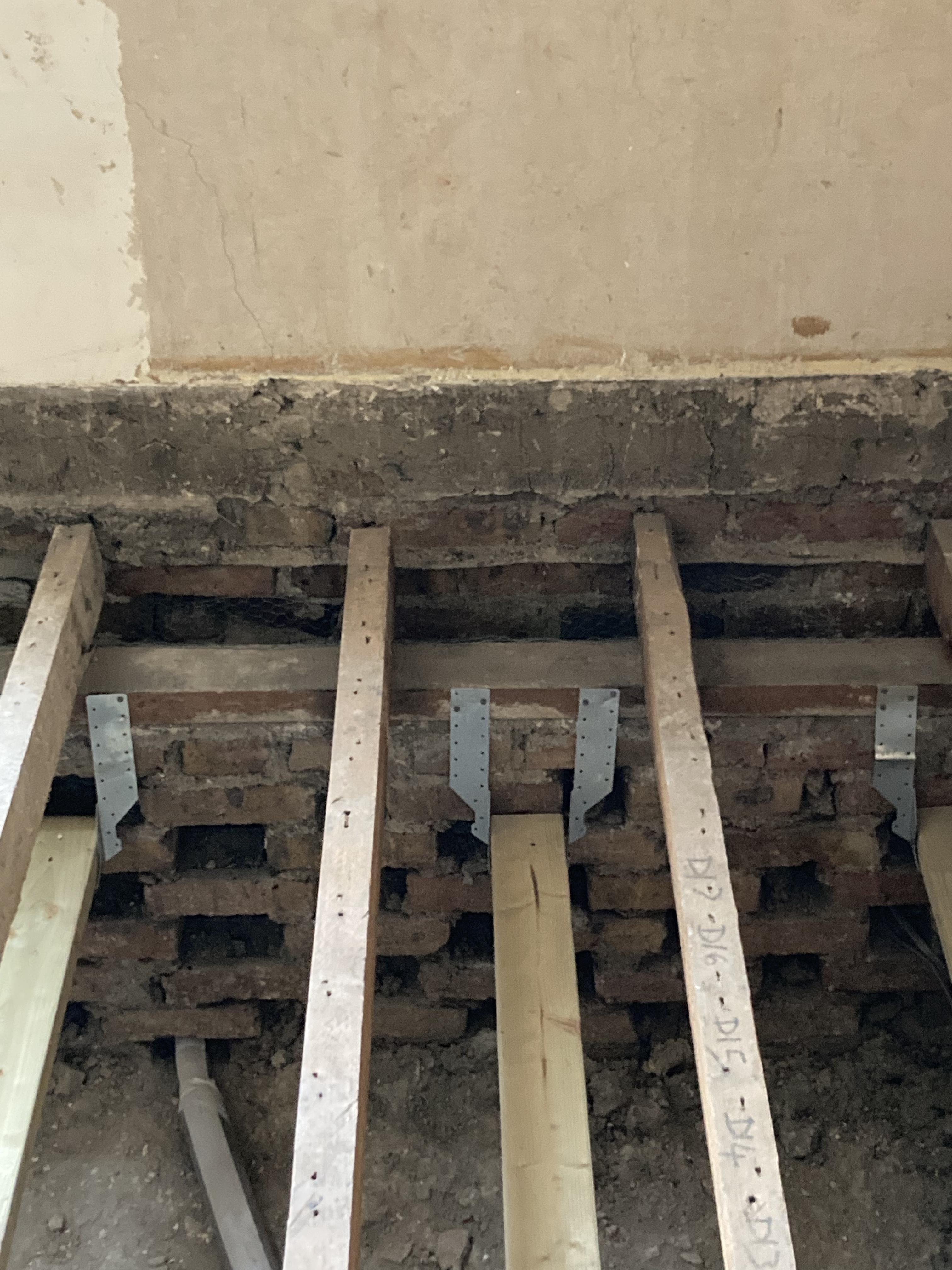
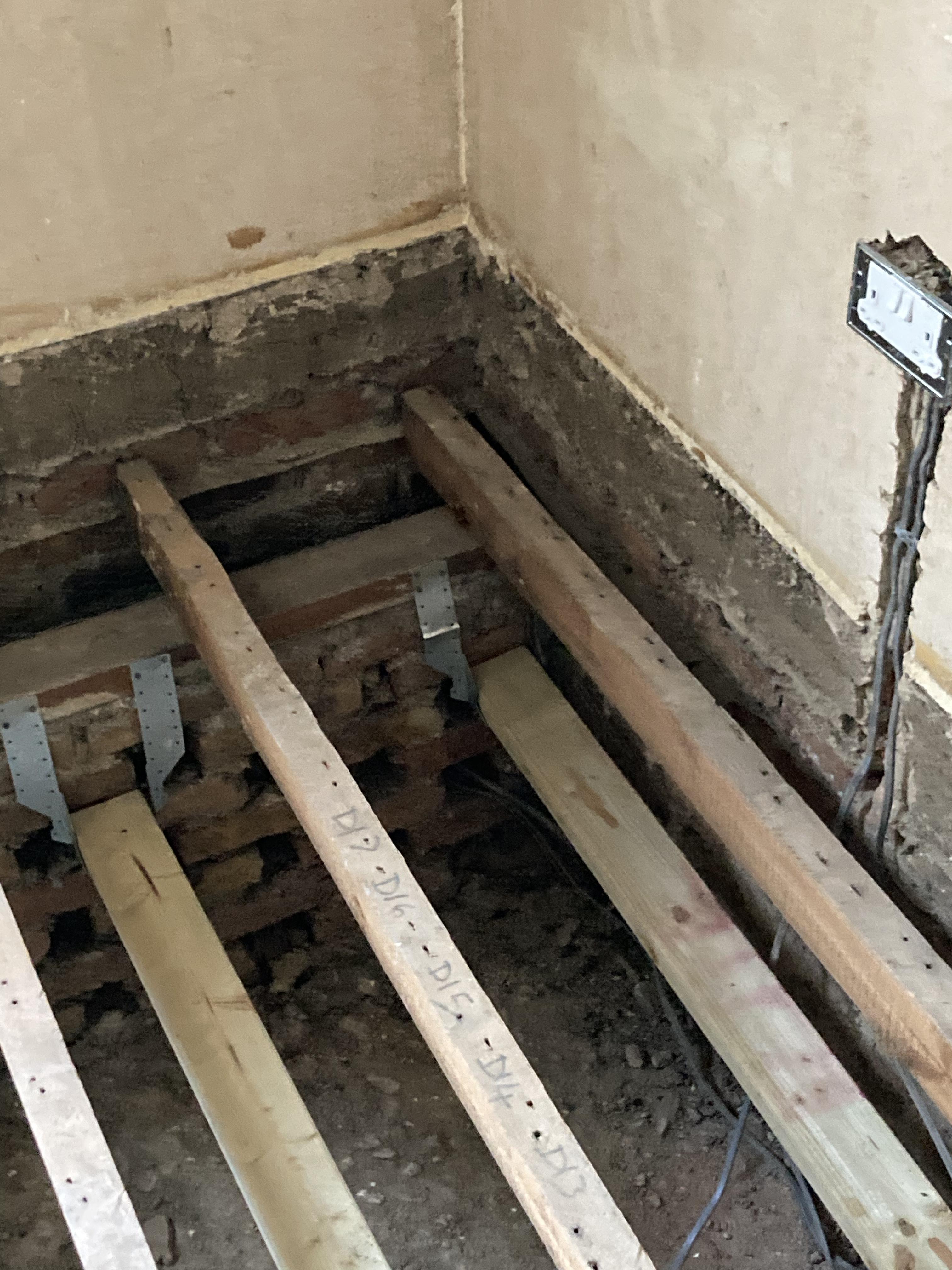
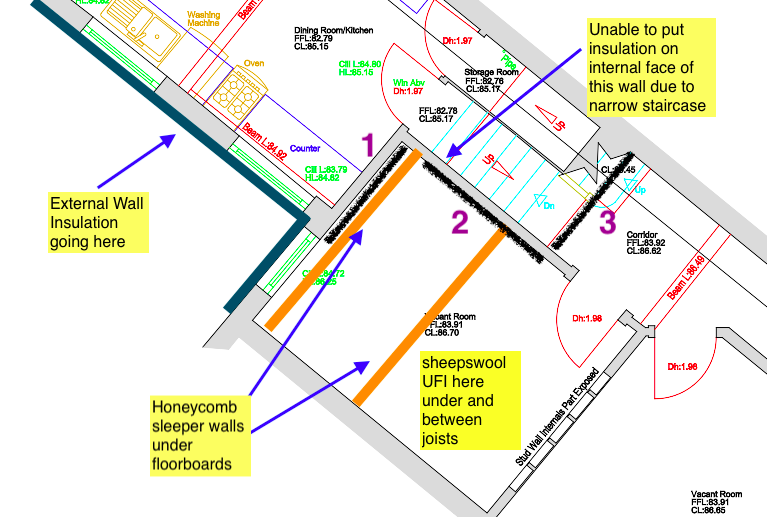
I've attached a diagram to accompany this and will post a couple of photos of the inside of the rear reception room that this concerns. The problem statement is: We have a split level victorian mid-terrace, where the rear addition (aka outrigger) is 1.4m lower than the reception rooms. Doing heat loss calcs I have just realised that as a result of this, we've got some walls that whilst appearing internal, they partly face the ventilated void space under the reception rooms, which means that unless we insulate them, we're going to have some 14sqm of solid brick wall facing a cold ventilated void (made colder by the fact we're putting insulation above it). We're using breathable insulation throughout - sheepswool, woodfibre or cork. If we don't insulate, I think we'll may end up with cold bridges and higher heat loss, so I am looking for suggestions on ways to approach the insulation detail. It's not possible to place the insulation on the inside face on all of it, because it would eat into the Staircase, which is already narrow, but I could do some on some sections. In my sketch attached, the black lines indicate the areas where we've got internal walls facing the ventilated void upto a height of about 1.4m. For stretches 1 and 3, I could insulate on the internal face, losing space in the kitchen and WC respectively if there's no suitable alternative; for stretch 2, I can't do that - it has to be done on the opposite side of the wall. I've got the floor boards up, so have access to do that right now. Options for stretch 2: a) Apply a lime parge coat to the bare masonry under the original DPC, then mount 100mm cork board - not applying any render the cork board as it's not visible and not facing any rain b) Construct a timber cavity in the underfloor void, line it with the Vapour Breathable membrane I'm using for the UFI, and stuff Sheepswool in there (assume this is a bad idea but floating it anyway!) c) Construct timber cavity and fill with loose fill cork insulation Some concerns I have are avoiding breaching the original DPC and also not creating paths for moisture to rise from the chalk ground. Suggestions extremely welcome. * the joist hangers and battons underneath are to host deeper underfloor insulation, nothing to do with this particular problem statement (I'm doing that because the joists are only 100mm deep).
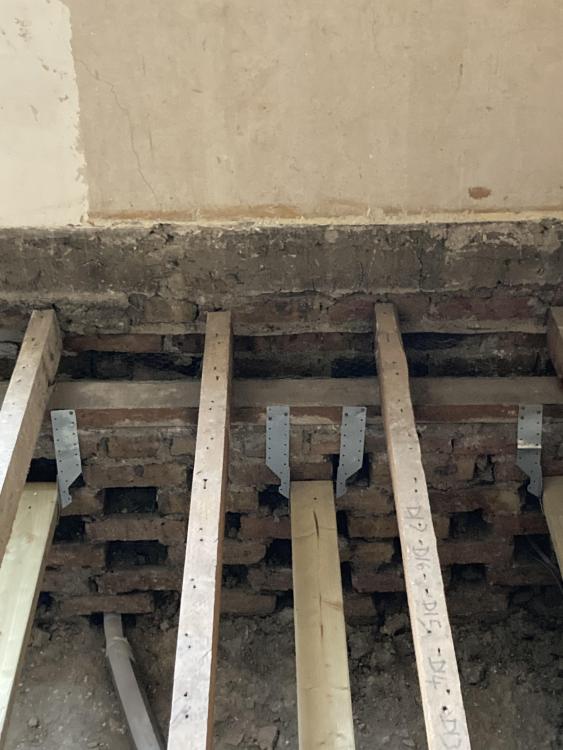
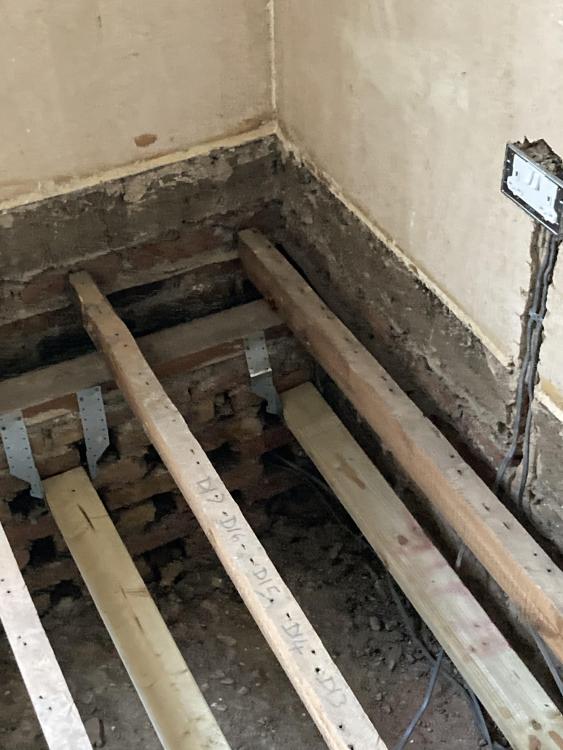
-
Hello again, looking for any recommendations for expanding airtight tapes or finishing caulks/sealants to use as part of my retrofit of the front door area (mentioned in another post recently). Two scenarios to solve for: 1) Replacement of the fanlight (the single pane of glass above the door) with a triple glazed unit; the unit will be 32mm (4mm | 10mm | 4mm | 10mm |4mm with Krypton gas). The door frame is set back from the elements as we've got a little storm porch outside, so there's little risk of driving rain hitting it, but nonetheless it needs sealing. I am thinking of the following approach: a) Using an expanding airtight tape - options I'e come across on this forum and from mentions elsewhere: - Isobloco - Contega Fiden Exo Does this approach make sense and any suggestions on particular products? b) Seal on both inside and out with some airtightness product.. Options I've come across: Mastic/sealants: - Siga Primur - Soudal seal system Tapes: - Tescon vana or similar, wrapped around the edges and under the wood finish. 2) Adding double glazed units behind the stained glass in the door itself. DG unit will be 14mm thick. Again, thinking that the expanding tape would be useful here, but not sure if it's overkill? Then layer over that the timber beading, sealed in with an airtightness sealant (as above). -- Given I'm only doing this on a very small area, I can't buy hundreds of metres of stuff, and the Soudal system, while it looks attractive, is pretty pricey overall, so that is a consideration too. Thanks for any advice!
-
Insulating timber door with Aerogel?
low_and_there replied to low_and_there's topic in Heat Insulation
Hi @Conor thanks for the tip - I’ve found it in Switzerland available in all sorts of forms, including in board form - although with a cement face.. Do you know any supplier that makes foil backed sheets to spec? That’s a great idea! @Icevergewe want to retain the external appearance of the door so not really an option to do external. But thanks for suggestion. -
Insulating timber door with Aerogel?
low_and_there replied to low_and_there's topic in Heat Insulation
Hi @JohnMothank for the suggestion but the entry hallway is so narrow that I can’t go beyond adding 13mm in total, hence thinking of using Aerogel given that it is the thinnest insulation I believe exists in terms of U-value/mm. Aerogel comes in many forms, ideally I guess it would make most sense to us use it in “board” form but I’ve not found it available in the UK yet.. seems the most common one available is in “blanket” form. i am aware it’s expensive but it’s within my budget for the overall door work that is needed - approx £155 will get me sufficient to do the door. Appreciate some people may think that amount of money on 2sqm of insulation is absurd but hey, each to their own. @Radian thanks for highlighting the need to vapour seal! Such a good point that I’d overlooked! a question - Aerogel is used extensively on vertical surfaces.. maybe I’m misunderstanding your comment - what should be kept horizontal? Thanks! hi @Simplysimon I’ve not got a photo to hand, will try sort - but picture a narrow hallway typical of a 1900 brick built mid-terrace, with a 80cm wide door and very little wiggle room either side