Paene Finitur
-
Posts
85 -
Joined
-
Last visited
Everything posted by Paene Finitur
-
Potential sagging on cupboard shelving
Paene Finitur replied to Paene Finitur's topic in General Joinery
I thought of having several arched brackets across the back. Could even make a feature of it though I worried they'd get in the way of the hanging rail - would have to measure up properly. Also, as some of the cupboard backs are partition, I'd probably need two rows of back batons, one above the other, to fix the back of the brackets to. I also thought of a descending middle section to attach to the ceiling, not sure I'll go for that though. -
We had cupboards built into our build, but now that we are in, they are a bit spartan and I'd like to take the first step of installing a fairly standard high shelf and hanging rail. I'm intending to use at least 1.5" battening on three sides for support and then make the shelf itself from 18mm ply. I'm a bit worried that the width of the shelf - roughly 1500mm or two internal doors width and 400mm deep - will cause it to sag; particularly since the metal hanging bar will also be long and will need vertical supports dropping down off the shelf. I tried out my parameters on the sagulator (useful tool) and sure enough it calculated the sag to be 3.05 mm total or 4.208 mm per m, which it categorized as excessive. There is no central vertical bar between the doors that I can anchor to, so my options seem to be either a fairly ugly vertical support dropping down from the cupboard ceiling, or spaced brackets at the back/underside of the shelf. Interested to know if anyone has come across anything like this and any potential solutions?
-
Thanks all. Good to know I'm on the right track. I'm going to check out whether backing the upper wall with a brush-on waterproofing layer might be a cost effective option. The delta sheeting is good but more suited to indoor use, I'd say, and pretty costly. As for the front, yes, I plan to replace the copings and the step surface, with something more substantial. The facing, I'm not sure about. Would love brickwork but I'm still not convinced that slips are the answer due to potential adhesion issues and the curvature on one section. Plus the cost is high. Guess, I'll have to look around - it's either that or render. It wouldn't have been my first choice but I'm kind of tending towards render as it's just a lot cheaper and easier!
-
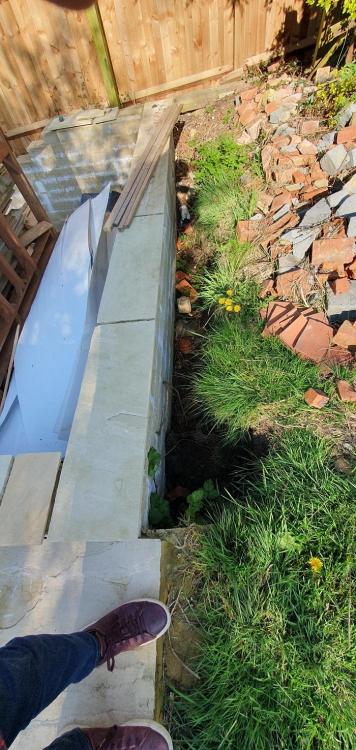
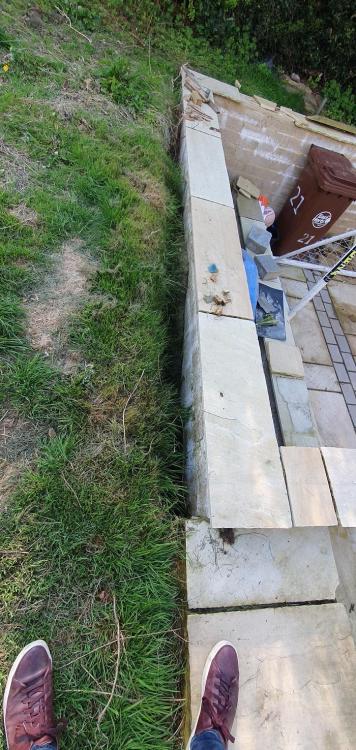
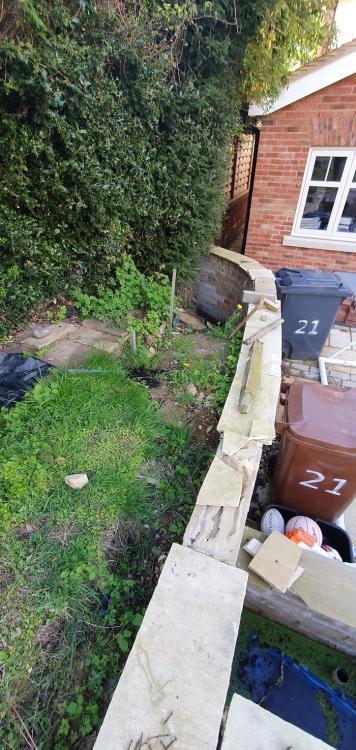
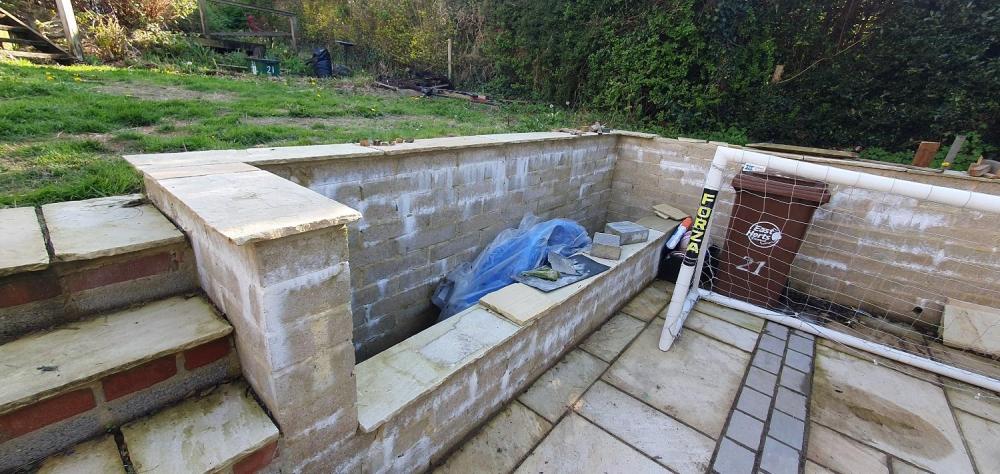
Our patio is bounded on three sides by a retaining wall built from blockwork. There are steps leading up to our back garden in the middle and he's constructed a double wall with a planter section either side of the steps. I had originally asked for this to be in red brick and flint and wanted quite an old fashioned/traditional look, but clearly the message did not get through. Anyway, we are where we are and I now need to make it look better but have a number of issues with it, that I'd really appreciate some advice on. As you can see from the pictures, the wall has not yet been backfilled. I bought some 20mm shingle to do that with and was perhaps going to bulk that out with a bit of the bricks/blocks you can see lying around it. However, I've been advised that if the front of the wall is simply rendered, before too long water will get through, it will start to look dirty and mouldy and awful. There are some weep holes on the back wall, but there is a fair bit of moisture built up there too. I was wondering whether I should dig out a bit further and then brush a coat of Seka onto the back of the wall to help with waterproofing? I intend to backfill with shingle up to, say 9" below the top level, cap with a geotextile to prevent silting and then backfill the rest with topsoil. Does that sound sensible? Would using the Seka help matters or be a bit of a waste of time? The guy who created the wall assumed I was going to render it, which was not my first choice though I now think it would probably be easiest. That said, a couple of people, including an experienced landscape gardener, told me I should tile it as render will look naff fairly quickly and require repainting frequently. Trouble is that you can maybe see from one picture that there's quite a curve on one wall which doesn't lend itself to anything but really small tiles I'd have thought. Any ideas?? Lastly, he's coped the wall using the same Indian Sandstone that we used for the patio. It looks nice on the patio but I think it's far too thin to be used as coping. It's already broken up in places, particularly on the edges of the steps. I feel we should use something similar looking but a bit more robust. Any ideas on how I might take this forward or on my backfilling strategy are gratefully received.
-
Level door access disaster. Advice needed
Paene Finitur replied to Paene Finitur's topic in Doors & Door Frames
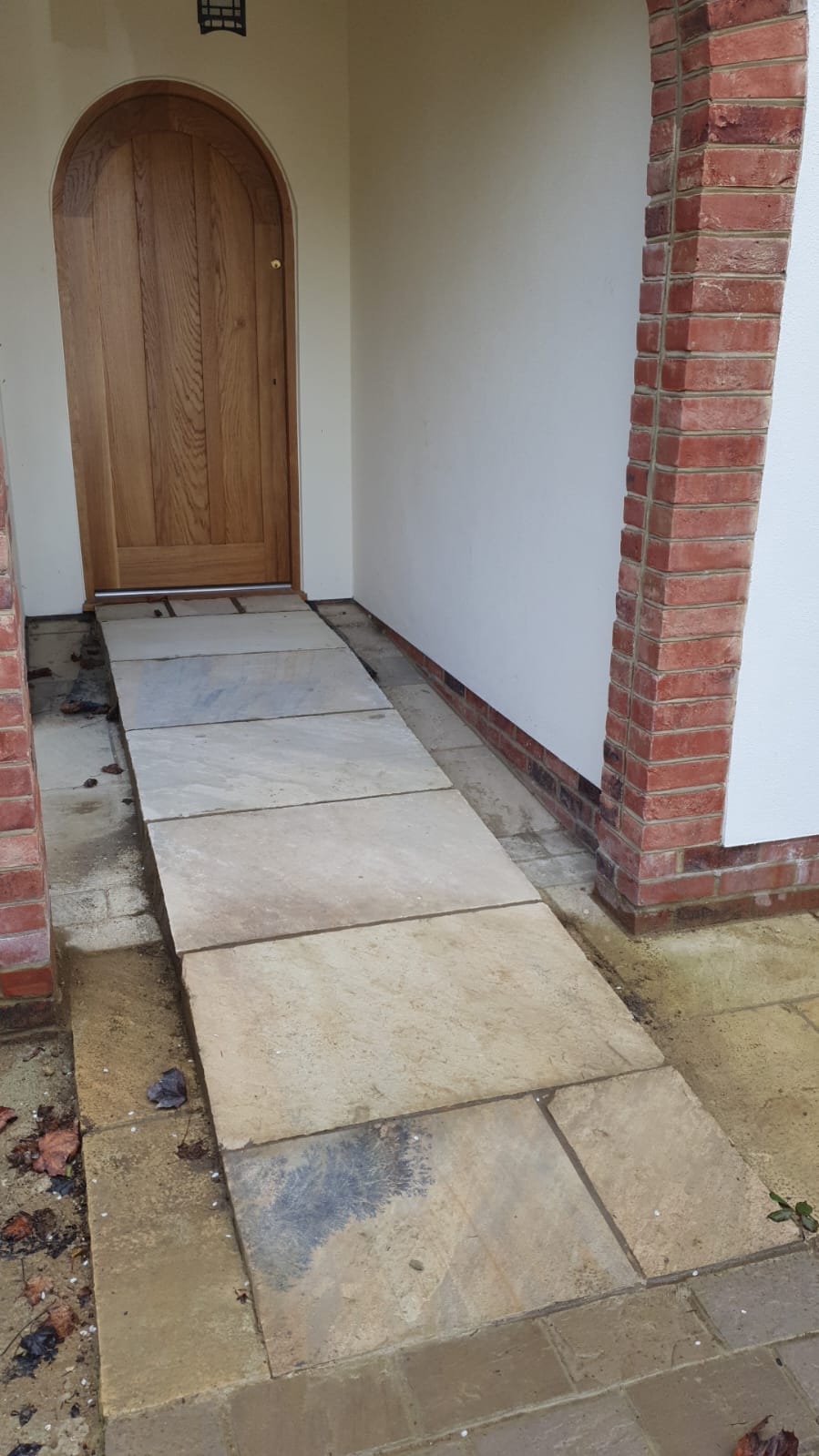
So just a bit of feedback. As I think I mentioned, the Building Control guy would not countenance anything in metal or wood stating that "only concrete was suitable for a new build" He also insisted on 1:10 at least which is what its' meant to be, but was a bit tricky to achieve on a path that already been sloped. Here's what my builder came up with. TBH I'm not delighted with it (though the fossilised plant on the bottom slab is quite nice 🙂) Wondering whether to put some plants down the sides for the time being. Anyway, thanks for all your feedback, suggestions and encouragement. 👍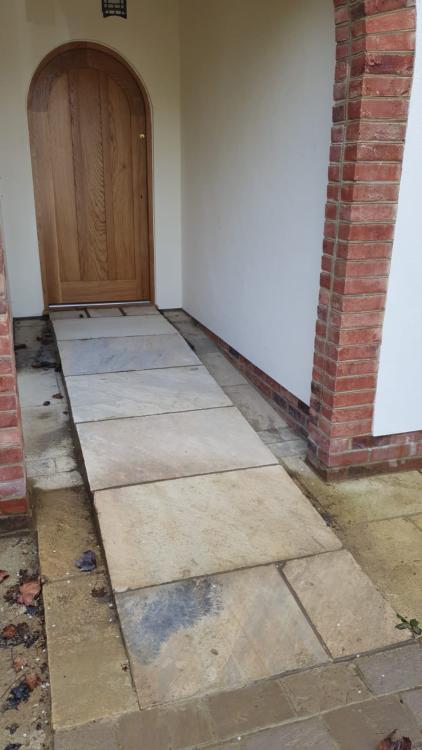
-
Looked back at this thread and remembered the sheer panic I felt when I wrote the original post! Thank you all who contributed, whatever you contributed. Such a comfort to know there's others out there who've trodden this path. 👍
-
Thank you, yes, it did in the end. I got the paperwork from LABC and, I'm pleased to say that in the last week. I've finally got building control sign off 🍾, so I can now try to rearrange the mortgage a bit to get a better rate and apply for my VAT clawback. 🤞
-
Yeah, in my case the basement is entirely underground and the floods happened before any mechanical ventilation was fitted. I tried all sorts, even walking up and down trying to dry the slab with a propane torch. All I got was a bill for gas and headaches from the CO fumes! My feeling is that heat won't generally work, or at least external heat - switching the UFH on might well be far more effective. But fans were very the most effective thing; getting the air moving.
-
Watch your electric bill. I've been astonished at how much my ASHP is using. Also, I was advised against using heat to dry the screed; not because it would cause any problems but mainly because I was told good ventilation and a commercial dehumidifier would be much more cost effective.
-
Indeed. I will check but the thing that attracted me about it was that they monitor it remotely and, if the alarm goes off, they can attend the property and sort out the problem. I'd have to check whether that's really included but it's a bit of piece of mind if we go away. Other than that, yes, I can't see any great advantage to just doing it myself. I'm hoping that the AlertMaxx can connect to an app so that I can monitor it directly myself.
-
Just picked up on this. What an ordeal @Thorfun. My sympathies go out to you. I had a similar issue with two or three floods in a full tanked basement early this year, once because the float got caught on the cable and twice because workman accidentally switched the power off. Luckily, I had nothing down there but the screed took months to fully dry out and I made the mistake of running some 2K heater/blowers down there which cost me a further £1K in electric! I tanked the entire basement using Delta membrane and a cementitious layer although the project manager persuaded me that Sika was not necessary - another decision I regret, as the water rate into the sumps is pretty aggressive. I have two sumps with two ground water and one with a single foul and they seem to be coping with it quite well. On timing it around February time, I found that I had 35 minutes from the pump disengaging to the sump reaching flood levels! Because of this, I got the Delta AlertMaxx EG High level water alarm & monitoring system and Delta Hi-power Maxx2 Battery back-up, which should give me a day or so, should we be out of power. All the kit is, I believe, manufactured by https://www.ppspumps.com/ I believe that the AlertMaxx can switch the primary pump on a regular basis which I prefer to the idea of just setting the float slightly higher on the second pump - I worry that an unused pump will sieze through lack of use (limescale?) and fail when needed most. I think I got stiffed on the price. The products are good but they are not cheap, and now PPS are proposing charging me £280+VAT for commissioning and a further £300+ every six months for service, or the option of £42 per month, which covers remote monitoring, but doesn't cover replacements if one of the pumps needs replaced. Wondered what others thought about ongoing service plans? Seem a bit of a rip off, but then again, what's the alternative?
-
Thanks for the great replies. This looks like a plan. I'd considered foaming it but I've not plastered onto foam before and was assuming that I might get movement and cracking. @Radian, have you had good results skimming illbruck? I've not used that before but can give it a try. 👍
-
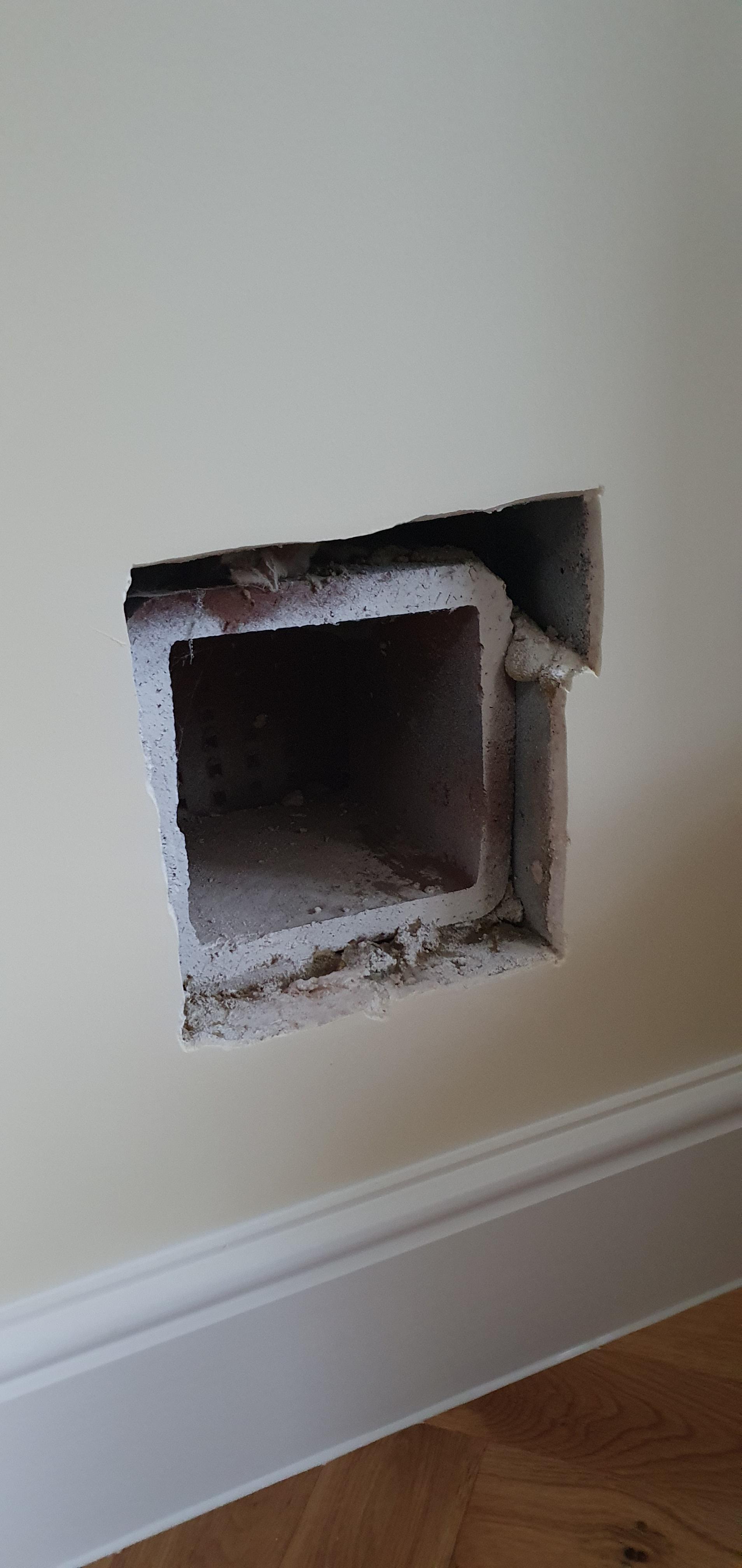
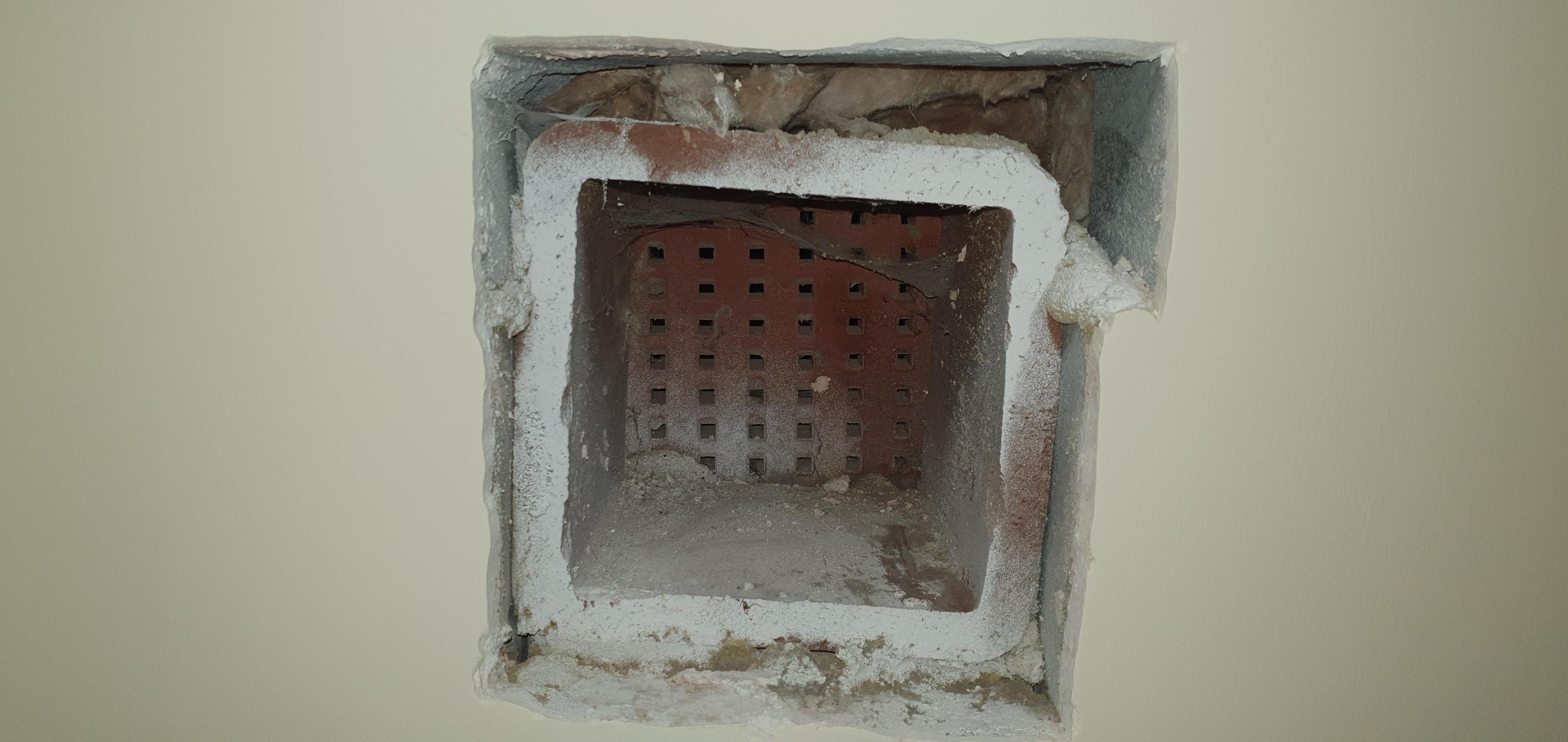
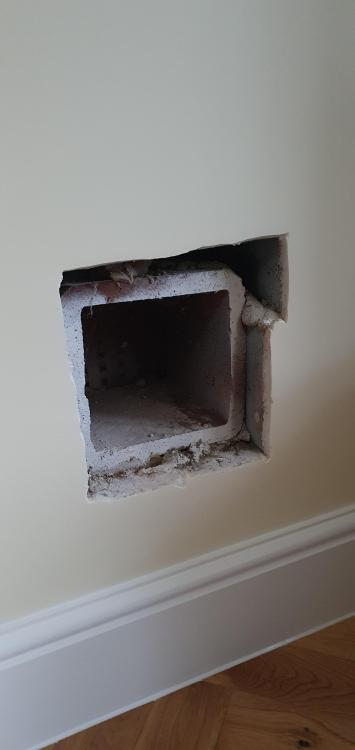
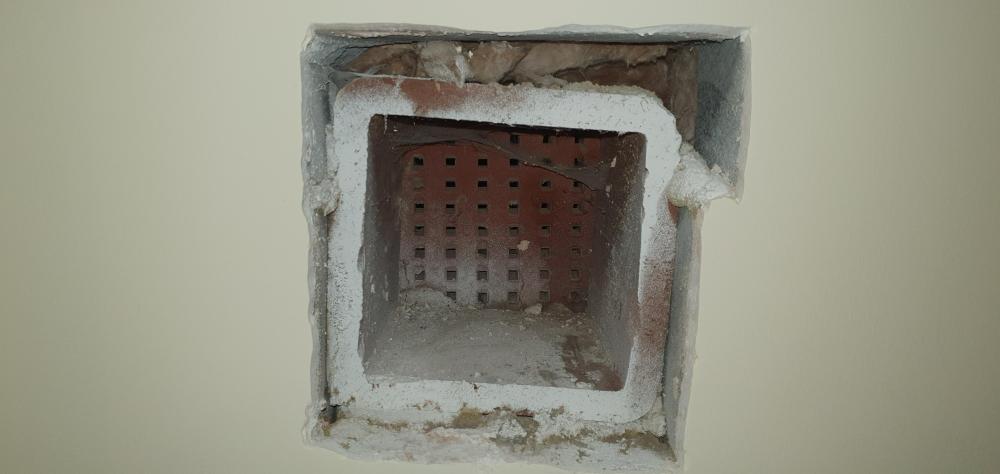
Hi all. One of the cavity liner vents in our front room has not been finished properly and is in a bit of a sorry state. If the aperture were smaller I could simply put a decorative vent over it, but I'm going to have to make good round the edge to bring it in a bit. It's a bit awkward since it's quite deep at the top, so I believe I'm going to have to use a combination of materials/techniques. Can anyone suggest something to bring it out with?
-
So, a bit of an update: The Building Control guy came round and had a good look on 23rd. Unfortunately, he wasn't able to pass it because the basement hadn't been tacked, so represented a fire hazard (from quite what, I don't know, but anyway) which was a bit of a blow. I then contacted the warranty company to beg for an extension. I got through not to my usual warranty surveyor but to his boss, who told me that (a) they didn't need building control sign off since we were building the property for ourselves rather than as a commercial developer and (b) the basement wasn't covered by the warranty anyway! He asked that I send him the gas and part P certs and, pending one visit from my normal surveyor, they would complete the paperwork. The visit went OK and, though I've no paperwork yet from LABC, I have at least emails from the surveyors a few days prior to 30th stating that all has been satisfactorily completed. I don't feel I'm out of the woods yet, until I get a completion cert from them but I can at least concentrate on a few other things now. Thanks everyone for your help, encouragement and great advice!
-
Level door access disaster. Advice needed
Paene Finitur replied to Paene Finitur's topic in Doors & Door Frames
Sadly not. 😟 I'm not sure why, but I was talking to a builder who was working on a new development in Brighton. He said every single one of the houses had two steps going up to them. Sure enough, when I checked locally on a new build estate, many of the houses appear to not have level access. I wonder if they only have to provide a proportion? -
Level door access disaster. Advice needed
Paene Finitur replied to Paene Finitur's topic in Doors & Door Frames
Thanks, yes the path slopes up to the door. As I understand it, the slabs would have to be level with the top of the sill, which is a 2.5-3 inch rise. I don't know if I could slope the sides at that height without cutting into the render. Perhaps if I leave the side triangles as they are, though that would leave rather a rough edge on the stone. Might be the best (i.e. cheapest) thing to do. -
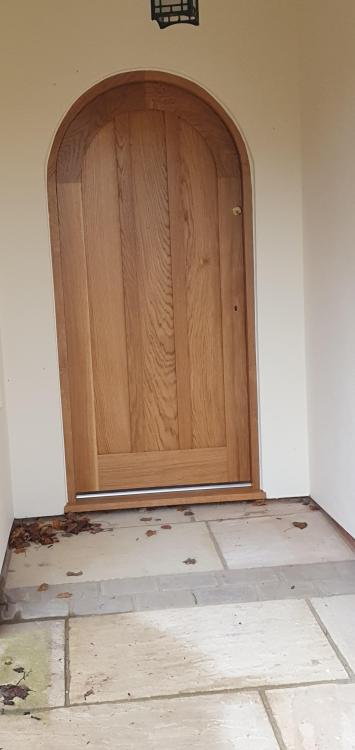
I've had the Building Control chap over, and one of the issues that he noticed straight away was that our front door is not level with the ramp outside. I must admit, with everything else, I hadn't noticed it, until it was pointed out. I can't really blame the contractors as the sloping path was laid before the door arrived (project manager should have picked it up though) Anyway, it now looks as if the entire path will have to be pulled up and re-laid, at huge expense unless there's another way I can deal with this. To be honest, looking at it, it doesn't even look like I can raise the path to the level of the door without hitting the line of the render. Has anyone got any bright ideas? I asked whether I could construct a wooden ramp but he said it has to be permanent.
-
Front door patio building regs
Paene Finitur replied to Gerhardt's topic in Landscaping, Decking & Patios
I asked this very question yesterday. I was told it has to be permanent. What 'permanent' means, I've yet to research. -
Yes, the thought had occurred to me although (a) I'm worried that the Warranty Co will somehow inform the Mortgage Co and (b) it traps me in to that mortgage provider who's rate is pretty bad right now. Selling would be an issue too as it would narrow the market quite a bit. We're not planning to sell for another ten years but you never know.
-
Thanks for the replies which are really helpful, but what I really wanted to know is whether anyone had been in the position of having to get a retrospective warranty and/or any constructive ideas for a plan b if the warranty is canned? I've got everything in place now (bar part p which I'm hoping to receive tomorrow from the electricians, who have been round today to deal with the basement), but the Building Inspector is making his final inspection on Wednesday and I'm worried that a curveball will leave me unable to get everything done for the warranty by 30th. The anxiety is getting to me big time!
-
Thanks, I asked for a comprehensive list from both BC and LABC(Warranty), but it didn't stop the Warranty guy adding items when he made his final items. Hopefully, we've got all of them covered but the BC guy is coming on Wednesday for his final inspection which gives me 7 days to correct anything he raises, get his sign off, get it to Warranty Man and get Warranty sign off - far closer than I'd like. And like I say, I wouldn't mind any of this if it they were not so intransigent about the deadline.
-
Many thanks for your responses. The building control guy is nice but very thorough. He needs part g (water usage), gas competence and part p. He rejected the part p I sent in because the electrician marked the basement as incomplete. To be fair, the basement has not been completed yet but I had asked the electricians to complete the electrics to the point where they were safe and would pass part p. Annoying. They are coming in Monday to address that. The LABC warranty guy is equally nice and just as thorough though he has a tendency to keep adding things in. On his last visit, he added that the smoke alarms weren't working in unison and a juliet balcony hadn't been fitted. Fair enough; I've had the electricians address the smoke alarms and I'm heading down to pick up the Juliet balcony on Sunday. It will be fitted on Monday. Aside from that he also wants gas competence, part p and building control sign-off. It's all doable, but it only needs either of them to call out something they're not happy with at the last minute to throw things into chaos. The problem with LABC is that they are split between building surveyors and insurance and while the surveyors might be pragmatic, the insurers are being intransigent. They did actually write to me a while ago suggesting that they might want more money for the warranty since prices had shot up. They certainly had, but was that my fault? I suspect they might be "shaking the tree" a bit now that the economy is retracting, to get rid of even the slightest risk and focus only on the most risk free warranties. I checked the terms and conditions an sure enough, there is a clause allowing them to cancel after three years if incomplete (without any refund I might add), though given that we are moving in on 28th and it's perfectly habitable, that seems a bit much to me. It's the implications that worry me, because effectively there is no plan b and, yes, I believe that the mortgage provider will want a structural warranty in place, which leaves me, if/when they find out that it's been voided, in a position where I will likely lose my mortgage and because I don't have a warranty, I won't be able to get another.
-
A started my build just over three years ago and took out a warranty with LABC. I never expected it to take so long but what with Covid and a pretty incompetent (and often absent) project manager, it has dragged on. I parted company with the PM in July due to cost and time overrun and have been trying to manage the build and a day job at the same time. Even with the increased stress, we've made a lot of progress. However, in September, LABC contacted me to tell me that as it had been over three years since I took out the policy, unless the warranty was fully signed off by 30th November, they would consider it null and void. I have been frantically running around trying to get part p, part g, building control, and all sorts of other actions completed. I'm hoping to get everything submitted in time but most of it is outside my control in that I am hassling/nagging contractors to provide me with documentation for work that they've done. Some have been super helpful but most are so swamped they just keep putting it off. The house is ready to live in and we are planning to move in just over a week, but when I phoned LABC today, they were absolutely immovable about the date. I've provided 80% of what they wanted, but they told me they wouldn't even consider an application for a new warranty, if this one expires! It seems insane to me as the property is almost there and it's just documentation that's holding things up. Nevertheless, I have a large mortgage on the property and the worry of losing it all is making me sick. Has anyone been through this and have any constructive ideas for a plan b if the warranty is canned? Thanks in advance.
-
OK. It's not now a cupboard. It was space taken from a cupboard. It is going to be used as small office. I'm heating it because it has no source of heating and it is also above a porch, as I mentioned. My calculations came out at about 300w for the room. The kit I linked was about 200/m2 so probably a bit much. That said, I can't find a great amount of choice in UFH kits for this size of mat. It is connected to a thermostat which should tend to mitigate things. I expect it to be on timed, running for a short period early evening to take the chill off the floor. Why would it be crap? There are no other heating sources (other than a PC perhaps) and space is at a premium for radiators.
-
It actually is a cupboard. The room was originally specced as a box room but the Velux was too high to meet fire regulations, so some of the back of a very large cupboard in an adjacent room was borrowed to create a little ante-room. It has another Velux in it (this one meets FRs) and works well as a little study annex. I considered a panel heater but as you mention, space is limited.