Gordo
-
Posts
243 -
Joined
-
Last visited
Everything posted by Gordo
-
Wow that is low for a regular house. spec of house would be interesting. High performance windows/doors? 300 - 400mm loft insulation? MVHR or just passive ventilation? Unknown/known air permanently? Form of house IE bungalow/chalet/house basic rectangle or intricate? What is target/ actual internal temperature Thanks in advance
-
Potentially but unlikely, obviously a condensation risk analysis should be done to avoid this problem. Like anything I guess this may not be done or not to spec or with poor workmanship. Over 12 month cycle (unless the moisture is trapped) if the element make up can breath it shouldn't rot. Persistent damp is the concern IMO
-
Good point, there is that to consider. Hopefully the airtight VCL and breathable layer does it's thing 😁
-
That's good, you have made your choices and with proper maintenance and a balance MVHR with room sealed stove there is unlikely to be a problem.
-
Think of it as a sealed bottle. If it can't escape the air pressure just increases some until an opening is created. If there is some leakage (there always will be) through imperfections, the excess air escapes. Better that than negative pressure that sucks in cold unfiltered drafts, IMO.
-
Curved ceiling / Vaulted rafters insulation
Gordo replied to InspiredSloth's topic in Building Regulations
Yeah rigid PUR insulation and like isn't ideal for a curve, but if depths limited may be only way to achieve acceptable U values -
I think you should read over this a few times then make your own conclusions. I would advised from research and common sense to slightly pressurise house from MVHR, but you do what you like based on your research. The carbon monoxide and particulate matter in your room won't affect me.
-
Curved ceiling / Vaulted rafters insulation
Gordo replied to InspiredSloth's topic in Building Regulations
Why increase the thickness of timbers? If you lowering plasterboard slightly just use insulated plasterboard with say 25mm PUR lining. Then 70mm PUR between existing rafters or whatever to leave 50mm ventilation air gap. U value for these iminimum insulation thickness likely less than 0.18 tho. -
Wise words. All this stuff is supposed to be maintenance checked including MVHR & stoves. A lot of stoves get once over every few years I’m sure. HETAS etc say MVHR is supposed to be have flow rates checked annually and ducts cleaned (lol dead on). I doubt many are checked following commissioning. I wonder how sanitary they are after 10 years. Interesting as I never thought much about this before. TBH the MVHR controls are mechanical dampers that are adjusted and fixed in position so shouldn’t need adjustment I guess. Ducts are bound to be lined in bacteria laden dust. Maybe just the extract ducts as filters should protect supply ducts
-
As a rule a room sealed stove in a room with a supply vent should be safe but even safer if overall the house is slightly pressurised I would be more concerned with an non room sealed stove and look for a "flue gas interference test" as proof. There were concerns raised about the risks when refueling which is OTT IMO. Similar risk with an open flue solid fuel effect gas appliance. But your gas fitter should check draft
-
Agree 100%. But you got to love a log stove
-
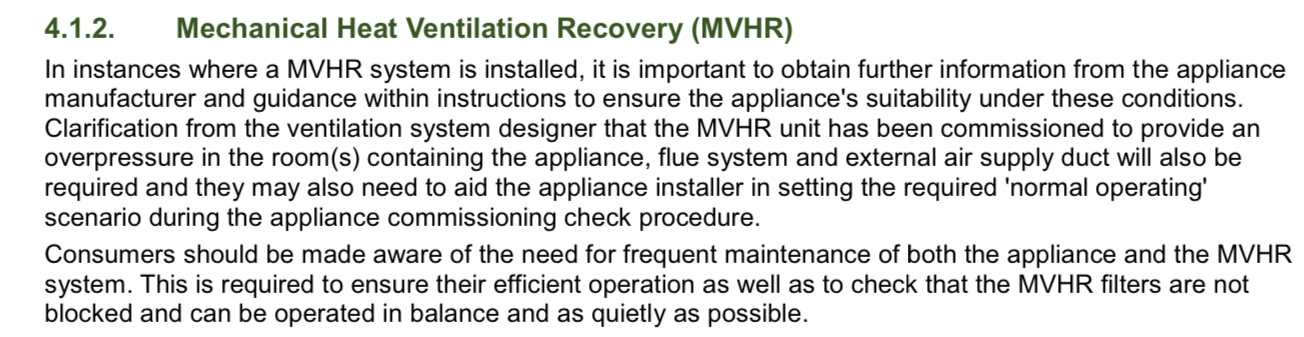
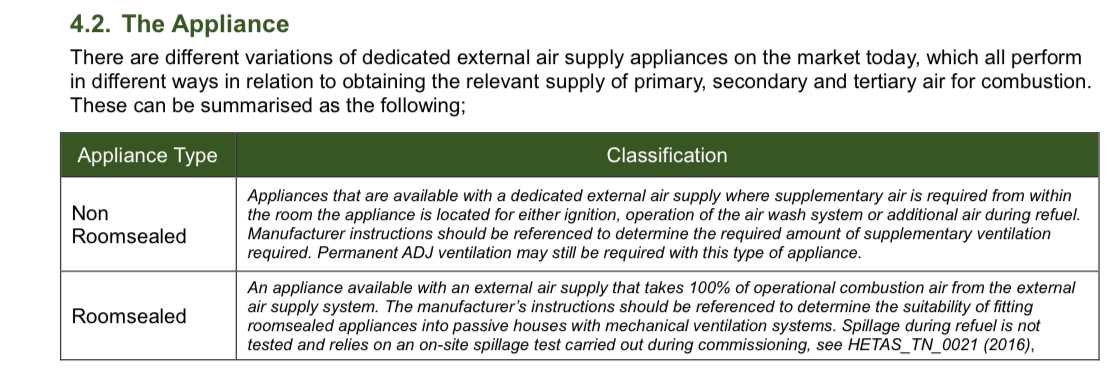
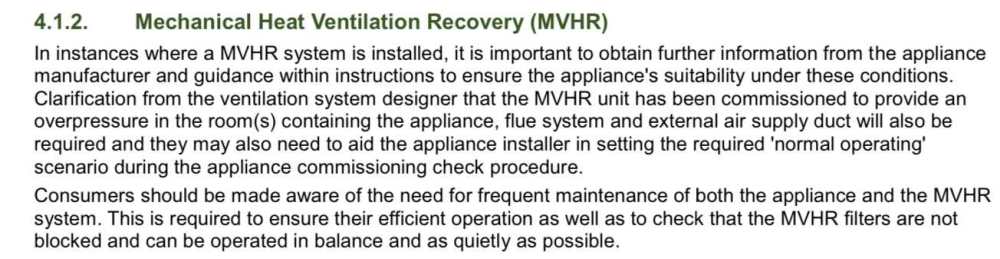
Here’s an extract form HETAS guidance regarding MVHR. For @JohnMo benefit so he knows I’m not just making it up. There so many reference materials out there. I can’t think of any benefits in opting for overall negative pressure MVHR
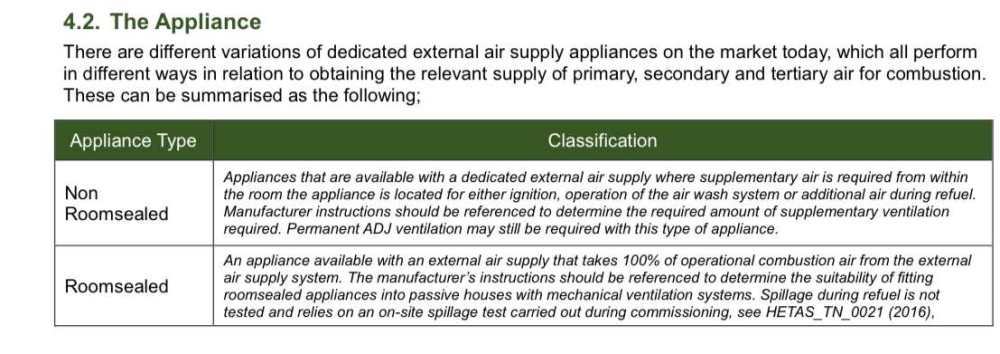
-
I think what chatGPT was referring to here is the pressure within the flue rather than the room. As a neutral or negative pressure in a flue is necessary for safe operation ie gasses will not escape
-
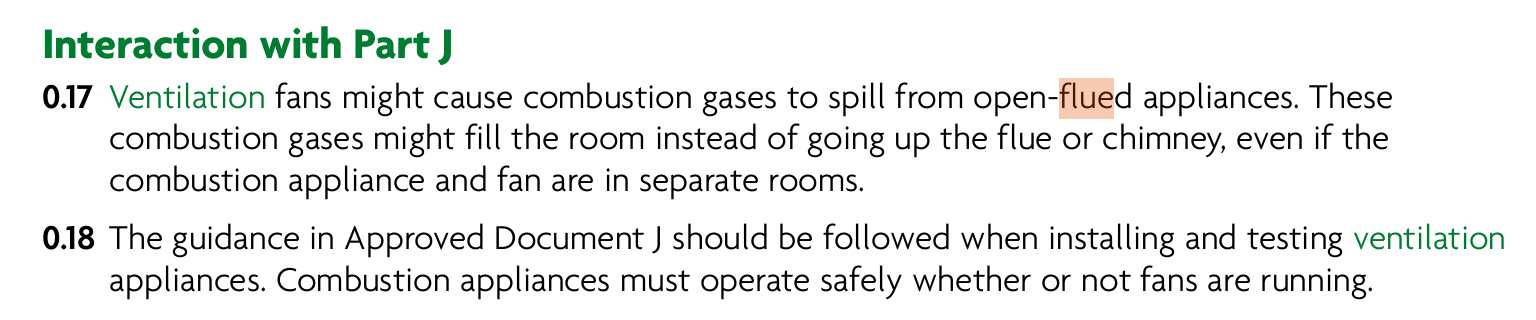
Here’s an extract form AD J which in typical fashion skirts over the subject
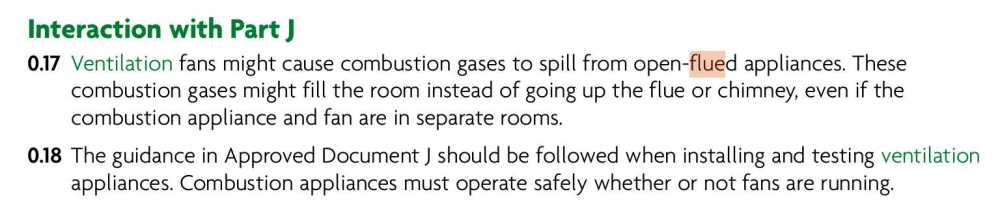
-
Yes I’m afraid you must have got a bad result from chatGPT. Never trust chatGPT without researching it yourself. The key is in your question. This is my question to it “Concerns about MVHR and open flue heating appliances ” this is my output from it Mechanical Ventilation with Heat Recovery (MVHR) systems and open-flue heating appliances can pose safety and operational concerns if not properly designed and coordinated. Below are the primary concerns and considerations: 1. Risk of Backdrafting Open-flue appliances rely on natural ventilation to expel combustion gases (such as carbon monoxide). MVHR systems create a tightly sealed environment, which may interfere with this process by altering air pressure. Negative Pressure: If the MVHR system is not balanced (supply and extract airflows are unequal), it could create negative pressure in the home, drawing combustion gases back into the living space. Health Risk: Backdrafting of flue gases can lead to carbon monoxide poisoning.
-
You will find many references to this. Some not so obvious. If there is a negative pressure in the room there would obviously be risk to reduced draft in the flue particularly with open flued. HETAS has identifed concerns. Only a "flue draft interference test" can confirm safe operation and even then it would be unwise not to have positive room pressure. Do you disagree
-
Do you dispute something it said? What do you dispute and what are your sources for disputing it?
-
I stand corrected legally Inspection would be the correct word rather than supervision.
-
I wouldn't suggest an open flue appliance with MVHR is a good idea at all. But some people do it. You can do it with a room sealed unit but it needs to be a positive pressure MVHR
-
The guidance documents don't cover such detail simply that it should be commissioned against design flow rates. CIBSE will give the design parameters.
-
You are incorrect here. Some (few) do. Mainly for valuation/ mortgage purposes. Obviously it's not proper supervision in my eyes. In large projects they employ a clerk of works to be their "eyes and ears" on site.
-
Sorry that was a typo error on my part. Ventilation is indeed a huge % of the heat loss in a well insulated house now, not like years ago
-
House should be slightly pressured. Especially if a open flue heating appliance is fitted.
-
Sorry to bust your bubble. But it is indeed correct. Look at your commissioning / design fow rates measurements. If it has been set up / balance properly
-
“Build tight ventilate right” goes the saying. Still I stand by my tmy quote that MVHR doesn’t increase ventilation losses if the envelope is reasonably air tight. Ventilation overal is not a huge % of the overall heat load. Years gone by with poor insulation and air tightness is was less significant proportion. The 24hr electric running costs are significant tho especially if you have a limited battery size.