


Ben Weston
-
Posts
78 -
Joined
-
Last visited
Everything posted by Ben Weston
-
ASHP + electric boiler instead of water cylinder?
Ben Weston replied to Ben Weston's topic in Other Heating Systems
Thanks Joth; yes, I did mean 19 kWh (despite having an EV, I still get my kW and kWh mixed up ) You and ProDave are both right on the discharge rates and inverter. I guess I need to do some sums. I imagine, on our general use, a 'boiler' might be on for baths/showers for a total of 45 mins - 1 hr day. That's potentially £4.75/day if it all came from the grid (worst case scenario) on our current tariff! -
ASHP + electric boiler instead of water cylinder?
Ben Weston replied to Ben Weston's topic in Other Heating Systems
That's an excellent point. I think the inverter we're looking at is rated at 4 kW max continuous (peak 10 kW). -
ASHP + electric boiler instead of water cylinder?
Ben Weston replied to Ben Weston's topic in Other Heating Systems
We'll have 19kW-ish of batteries too so, hopefully, whatever we went for, we'd have the capacity to utilise the solar at any time (or off-peak rate electricity). I take onboard everything else you say, thanks. I presume an accumulator couldn't sit before an electric instant heater to boost the pressure/flow for showers, then? Also hadn't realised it'd need to be 10kW+ but makes sense. I was looking at this sort of thing: https://www.screwfix.com/p/strom-sbsp15c-single-phase-electric-combi-boiler/655hr -
ASHP + electric boiler instead of water cylinder?
Ben Weston replied to Ben Weston's topic in Other Heating Systems
Thanks ProDave! I was looking specifically at a high power electric boiler with no storage. I.e. like a combi boiler but not gas and not used for space heating. We can fit a water cylinder in but we'd lose an airing cupboard upstairs or an appliance space in the utility room. Neither are end of the world if it's a better solution. Mains water into the house (from meter) is 32mm but it's actually the flow rate that's poor. I probably need to get it measured but it's a problem for all the properties nearby. Given that space is at a bit of a premium for this type of stuff (we've over-concentrated too much on living space in our design - live and learn), I wonder if the space would be better used for an accumulator and continue the electric combi boiler route for hot water? -
ASHP + electric boiler instead of water cylinder?
Ben Weston posted a topic in Other Heating Systems
Hi all, We're currently building a 4 bed house with high insulation levels, MVHR, triple glazing, wet underfloor heating throughout, etc. We're trying to be as environmentally-friendly/sustainable as we possibly can be. We'll be using an ASHP for the space heating but are considering whether an electric boiler might be a better fit for our hot water needs than a convention water cylinder with immersion. We could probably squeeze a water cylinder in somewhere but, to be honest, would rather have the space. The house will have solar and batteries so, theoretically, there's the potential the electric boiler could provide 'free' hot water for showers/sinks/baths. We don't want gas; in fact we had the gas line removed. Has anyone else had this configuration and is there any reason why a water cylinder might be a better choice here? Our water pressure generally is pretty poor so I don't know if a cylinder might give us more scope to improve this over an electric boiler? -
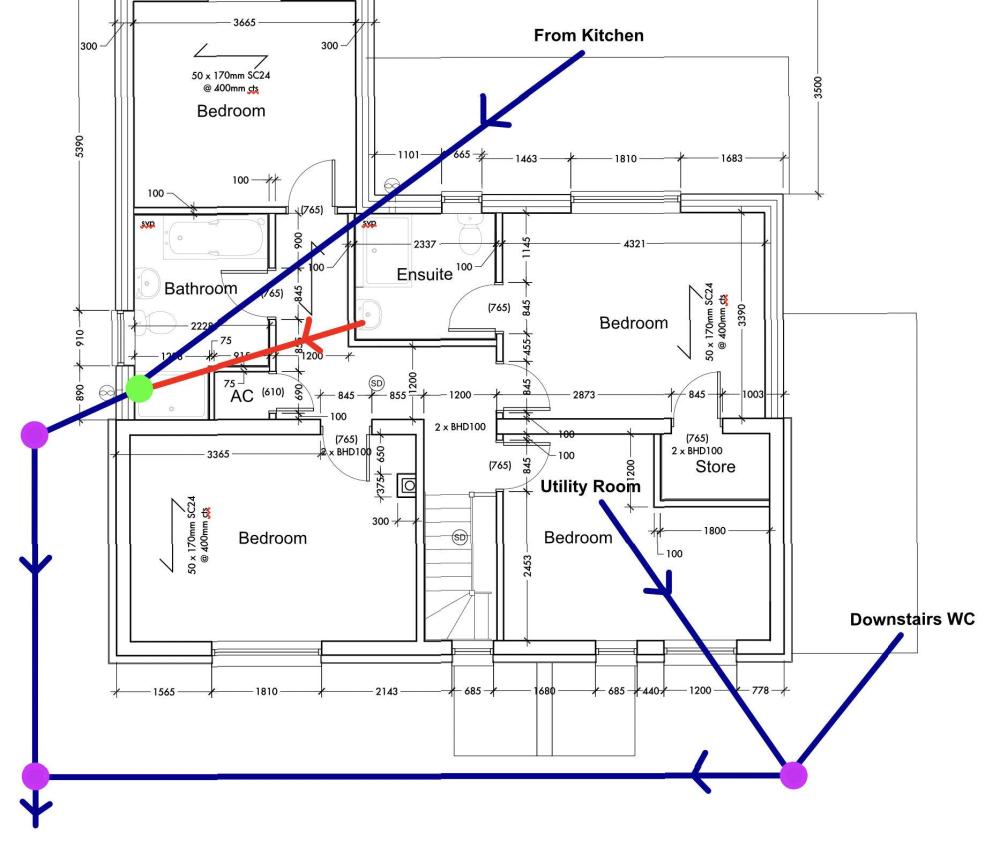
Thanks for all the comments; this forum is a trove of information! BC said it was OK for our kitchen waste to connect via a branch into the same run from the stack to the inspection chamber. I didn't know about the stack not being able to connect to a branch though. We've got a rest bend at the base of the stack into a 'Y' branch on the inspection chamber run. That's the "green blob"! We'd prefer a separate inspection chamber for kitchen waste too around the back of the house but the falls don't allow it - we'd be well above ground before we'd got round the back! We have Posi-Joists but I understand the point that, even with them, it'd be difficult to thread through at an angle. Can we go straight left with a slow radius 90 bend to the stack in the corner or is a change of direction not allowed 'above ground' (i.e. in the first floor) either? BC basically said to us "we're happy as long as every run is roddable", which it would be with this set up; but doesn't really help the specifics of achieving that.
-
Hi all, Wondering if someone far more knowledgeable than me can look over our drain plan to make sure it's workable. We're planning to have one stack in the corner of the upstairs family bathroom which the ensuite in the middle of the house can connect to (we have posi-joists so can pass it through them) and the downstairs kitchen waste can hook into. This will go out to an inspection chamber and then off to the sewer. The downstairs utility room and WC will connect to a separate inspection chamber at the front of the house. Presume I'd need AAVs on the main family bathroom stack and ensuite but unsure how natural ventilation will be achieved - presumably the gulley on the kitchen run won't suffice? Main sewer in our street is quite high so trying to keep runs to a minimum to make sure falls are right. Blue lines: underground drain runs Red line: upstairs drain run Green blob: main stack Purple blobs: inspection chambers
-
Deciding how to use our new 3 phase connection
Ben Weston replied to Ben Weston's topic in Consumer Units, RCDs, MCBOs
Well, the total potential load is well above what one single phase 100amp supply can provide. I know not everything is run at once but 32 amp ASHP, 32 amp induction hob, 2x EV chargers, future hot tub and pool, etc; seemed the right thing to get three phase for a minimal amount more. Made sense to put it in to give the potential for future fast EV charging, etc. Yes, kiosk is relatively easily accessible between house and garage so perhaps I don't need to worry at this stage. How much solar and EV chargers largely governed by what we do with the phases. If we could get three phase to the garage, we'd have 2x 22kW chargers. -
Hi all, As part of our extensive renovation, we've had three phase installed as it wasn't much more on top of the works we were already having done. The electrician has run a single phase to the house from the kiosk, with a view to running another phase to the garage when it's built and the third phase unallocated at present. I'm now wondering if this is actually the best setup. For context, we have two EVs, will be installing solar and battery storage, an air source heat pump and an induction hob. I have a garden office with a few lights, a computer and a TV in so not much load at all and currently connected to a 32amp RCD in the temporary house fuseboard. I'm wondering if it might have been better to run all three phases to the house, use three phase solar/battery equipment, and then run the ASHP and induction hob on one phase, the rest of the house on another and terminate the third phase over to the garage (and on to the garden office)? The garage, due to where our static caravan is currently located, will be built after we move in so the option of running all three phases to that and then splitting from there isn't an option, sadly. To complicate matters further, we still don't have a smart meter installed (have been trying for 6 months), but that will be sorted in time. Any and all advice welcome as always!
-
Thanks all. Yes, I knew there was an obvious solution I was missing: cut out the trench block. Obviously. It's been a long week!
-
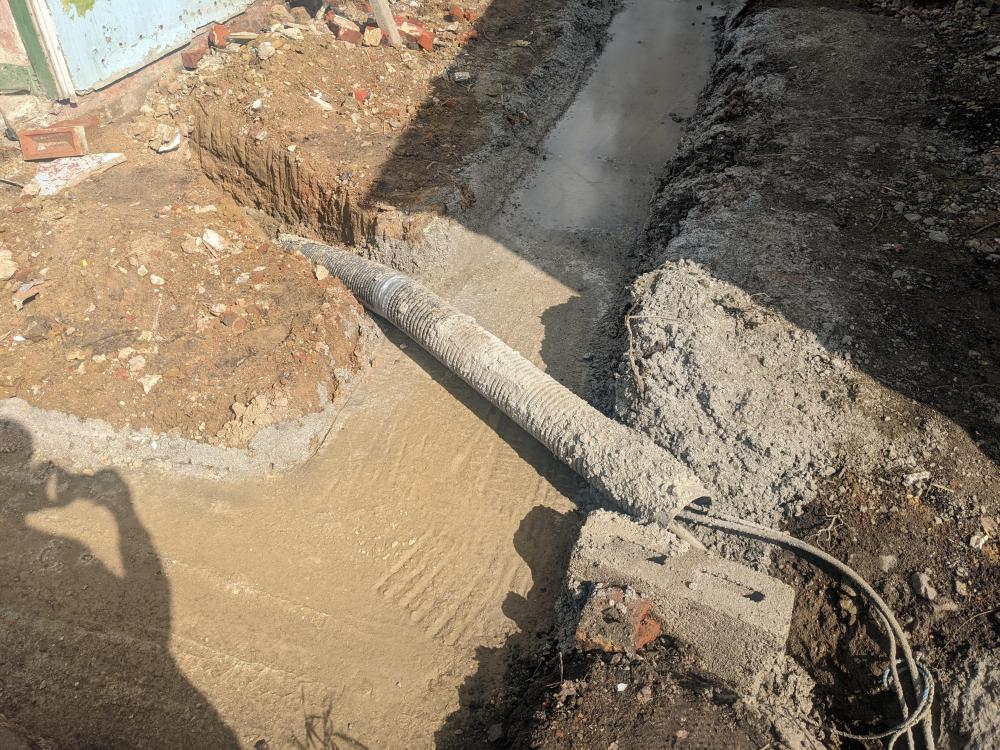
Thanks all! Yes, would have buried it under the footing but it's all connected up so didn't have that much play in it. The issue I have with lintels is that they will go over the trench block in place of the engineerinb bricks and will be seen as it'll be above ground level. Yes, quite. That's why I thought the duct would go through the footing, continuing the 600mm depth. BC insisted they prefer the cables to come up from depth and lap over the top so the foundation itself is continuous, the logic of which I sort of understand. We can build up the earth a bit around the cables (they're all armoured too). It just feels wrong to penetrate the DPC all the way through; I can't see how that's better than having set the duct (which is corrugated for load) within the footing of a single-storey lean-to. But there we go.
-
Hi all, Our electricity line comes in from a meter cabinet the other side of the driveway (as it's 3 phase). It's buried at 600mm deep under the drive but BC said nothing can penetrate the footing so were advised to bring it up and above the top of the 600mm footing, through DPC level presumably. Having poured the foundations, it just doesn't seem right. We're one trench block and two brick courses away from DPC. The ducting you see (which I'd originally intended to be buried in the foundation until the inspector said otherwise) currently sits on top of the foundation. Trench blocks would go either side but we'd then presumably need lintels above (where the brick courses would go) which would be very obvious and unsightly as they're out the ground. I'm sure I'm missing a better way to deal with this?
-
Thanks all. After a lot of confusion, and speaking with Thermalite directly, we're using 3.6N Thermalite trench blocks. They pass the requirements for the load-bearing, frost protection, etc below DPC that NHBC/Building Control require. We will then use two courses of engineering bricks externally to DPC and a standard aerated block internally.
-
Thankfully ours is a fairly standard 100/100/100 build-up so I'm hoping SE/BC are happy with 100mm 7.3N block, concrete infill and another 100mm 7.3N block instead. More work (of course) but I can't afford any more delays if I can avoid them!
-
Hi all, We're about to pour our foundations and am looking ahead to getting to DPC. We need one course of trench blocks and two courses of brick. However, despite it being a standard-ish two storey extension, Building Control and structural engineer are saying we need 7.3N trench blocks?! My bricklayers say they've only ever used 3.6N and 7.3N are for three storeys+. 3.6N 300m wide blocks (for a 100mm cavity) are readily available but 7.3N Thermalite or concrete blocks are seemingly out of stock with long lead times across the ccountry. I just can't get hold of them. The only alternative I can think of is to use two 100mm 7.3N blocks and infill with concrete. Those blocks are available too. Have I missed something? Is 7.3N normal here?
-
That's worrying. Is there not an obligation to provide a meter in this type of situation? The single phase lines are being taken out as part of a betterment thing, so new cables are undergrounded (we're paying extra to upgrade to three phase at the same time); surely it can't be right we'd be left without power for weeks or months?! Maybe it is. No idea what my 'consumer rights' are in this instance.
-
Thanks all for your advice! I don't really want to switch supplier at this time as my rates will go up but it might come to that. Bulb offload their meter services to EON who, I presumed, were one of the 'big guys' but maybe not? I'm not sure what else we can do? Can we pay a company to install one directly?
-
Anyone had any luck getting a three phase smart meter installed? Our single phase supply is being cut off, and the new three phase laid, in a few weeks. As soon as I got the date from UKPN (many weeks ago), I let our supplier (Bulb) know that we needed a new three phase meter installed prior to them removing the cables for the single phase. As yet, we've made no progress. Bulb say their supplier (EON) has no three phase meters available and they're waiting on a date from them. What are our options? We're a family of 5 and can't be without power but we're seemingly at the mercy of Bulb and EON? I can buy a smart three phase meter online with no issues but presume I can't have a meter installed privately?
-
That was my understanding too. We'll actually need all three phases and will utilise them fairly equally (hence our huge daily demand at the moment). I'll have to give it some thought how we implement this. On the hot tub — yes, this is what we're going back and forth on at the moment. Hot tubs are a huge energy hog and we're not too keen on the environmental impact. If we could run the majority of it off solar or cheap electric from the grid (usually mostly renewables at that time of day), our conscience would be a little clearer!
-
Our general daily use is around 30 - 40 kWh, admittedly a little less than this in the summer. But yes, a fair whack and ££££ even now, let alone with next week's increase. Ideally, I'd like to run as much of the house on solar and reduced-rate stored grid electric as I can. That's the plan. Will purchase it all and get everything except the panels themselves in place. When we're signed off circa October, we'll add the panels. This is really helpful information, thank you. I can't foresee a situation where we'd even be close to 6 kW continuous and I presume, in the event we breached those sorts of numbers, the inverter/BMS would begin to pull more from the grid? Any idea on how best to plan the 3 phase supply with this? Keep it on the 'main' phase or bridge all three?
-
Thanks, yes this was my understanding. It is definitely our intention to add PV as soon as we can but, with rates as they are at the moment, it seemed prudent to add the batteries straight away as they don't require extra planning permission. I'm keen to understand if my thoughts of using a 48V 200Ah LiFePO4 battery is along the right lines? Obviously it's cheaper to down-rate to 150Ah or 100Ah (and also to 24V) but that seems possibly like a false economy for our needs?
-
Hi all, We're currently doing a full renovation and, as part of that, our single phase supply is being upgraded to three phase to support EV charging, air source heat pump, hot tub (in the future), etc. Our planning permission didn't include PV so we've been advised to wait until it's signed off and add the panels under PD rights straight after. We'll therefore run the cabling for a solar array but won't install it to begin with. However, I'm very keen to get some home battery storage installed from the start to, ideally, charge on the cheap EV tariff between 2am and 6am and use throughout the day (as much as possible). This will also be supplemented by the aforementioned PV down the road. We don't have the funds for expensive Sonnen or Tesla batteries so were investigating various Chinese options to couple with a Victron Multiplus inverter/charger, or similar. I'm not sure how we'll 'split' the three phases yet (or if we even would?). I'd considered one phase for garden office & garage EV charging, second phase for induction hob, ASHP and hot tub and third phase for the rest of the house. This might be the wrong way to approach it? Basic questions time. If I bought 3x 12 kWh 200Ah 48V LiFePO4 batteries and used them through an inverter, would this roughly translate to 36 kWh of AC capacity (minus inverter losses)? We use around 30-40 kWh a day (I know) so I'm keen to understand if the battery storage translates to AC the other end? And is 48V the right choice? I've seen 12V and 24V systems but I don't see how they'd provide sufficient current for a house? Lastly, would I only be able to integrate this on one of the phases mentioned above (probably the house phase as there's no single item with a huge draw) or is there a better way to split the phases and battery/PV (i.e. one battery per phase with three inverters instead)? I'm not interested in exporting back to the grid at this stage as I gather that gets more complicated with the DNO, etc. Thanks in advance for any help!
-
Insulating a pebbledash solid wall and damp concerns
Ben Weston replied to Ben Weston's topic in Heat Insulation
For anyone who's interested (and I think everyone must have lost interest by now, including me ?), the working plans have been submitted. We've gone with building the new extensions with traditional cavity walls and marrying up to the solid walls that will have EWI with a small overlap to the cavity. The EWI itself will be a build-up of rockwool and a mineral-based breathable render, with lime render internally. We won't be injecting a DPC in the old solid walls. I've highlighted the EWI on the attached plan. I realise there are many opinions on this subject and I'm sure some will disagree with this approach.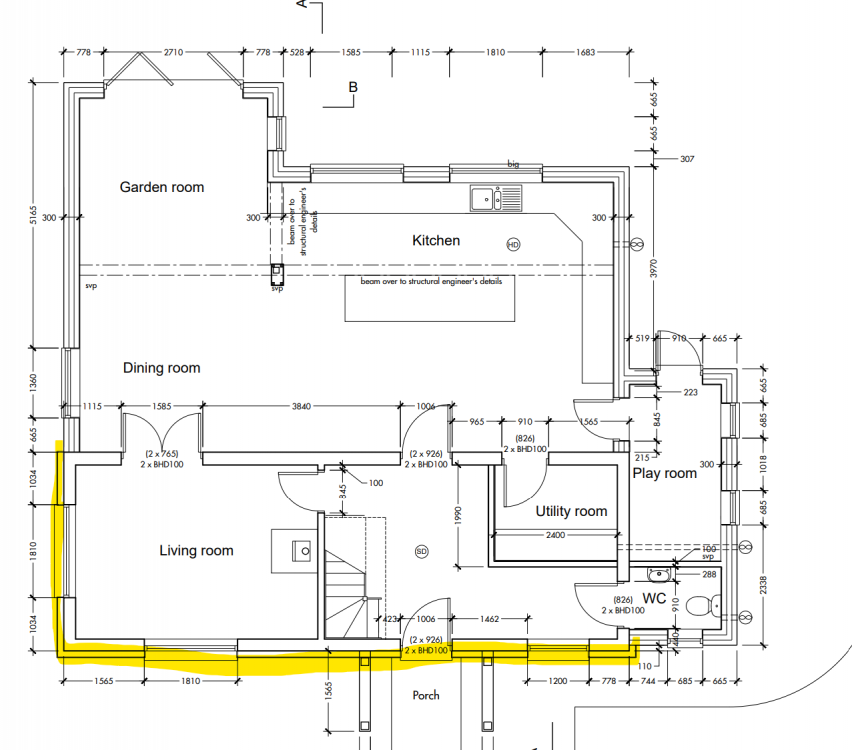
-
Insulating a pebbledash solid wall and damp concerns
Ben Weston replied to Ben Weston's topic in Heat Insulation
Well done! What an achievement. It's somewhat reassuring to know we're not the only mad ones ? Although I'll be undertaking most of the finishing and "donkey work", we'd intended to pay for bricklayers and carpenters to get the shell up and watertight. I can do the foundations, drains, floors, etc myself but I obviously can't lay bricks as fast as a bricklayer and would rather leave the roof to a carpenter. Another morning on Excel looking at costs of the two options again for me! -
Insulating a pebbledash solid wall and damp concerns
Ben Weston replied to Ben Weston's topic in Heat Insulation
All really interesting information yet again, thanks all. @SimonD and @Adsibob – On demolishing and starting again, your experiences sounds very similar to ours. We started this process intending to retain and improve the old cottage, and add an extension. As we've progressed, we've realised floors need digging up, first floor levels need raising, roof needs completely scrapping and starting again, etc, etc. As we've gone on, we've got to the point where, while working on the detailed plans, we've ended up keeping just the outer 3 walls of the original cottage. This is contrary to all the advice we'd also had initially and is frustrating as, if we'd known we'd knock it down from the beginning, the new design we have would likely have been different. I have asked the question again as, although it's slightly more expensive to demolish and build again, it seems to work out a bit cheaper/the same once we factor in the VAT reclaim (if we can get it). I think it would be quicker too. I appreciate all the advice I've had. It may very well be that we cut our losses at this stage and forge ahead with the plan to keep those three walls and use EWI around the whole building. I'm mindful of the timeframe and cost and that'll determine the decision ultimately. I'm confident we'll have a well-insulated house either way (roof and floors will have identical U values, walls will be about 0.1 less with cavity obviously). As I say, my wife and I – and three young children! – have been living in a static home on-site since August last year and we've not laid a brick yet. I'm not up for making this any longer than it needs to be! Incidentally, I downloaded BuildDesk and used the trial to run a condensation / heat loss analysis. It was extremely helpful. Interestingly, where we live and the way the house is currently constructed, there is apparently no interstitial condensation risk. Would explain why we have no damp. Tried modelling with rockwool EWI with lime render, as well as Weber's system, and both still had no condensation risk. Obviously both offered significantly lower U values. I'll take it with a pinch of salt but it was very helpful.


