Deejay_2
-
Posts
104 -
Joined
-
Last visited
Everything posted by Deejay_2
-
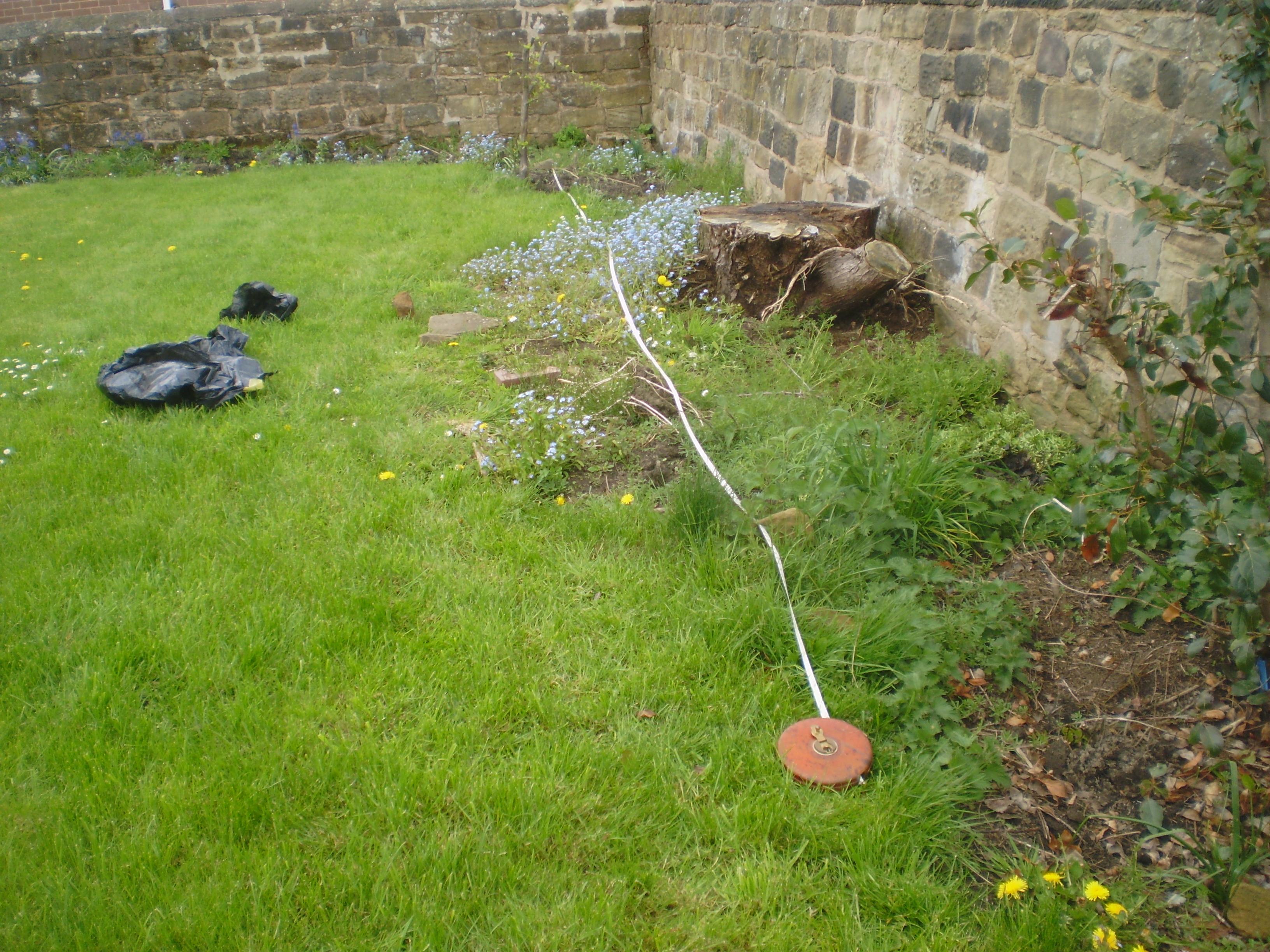
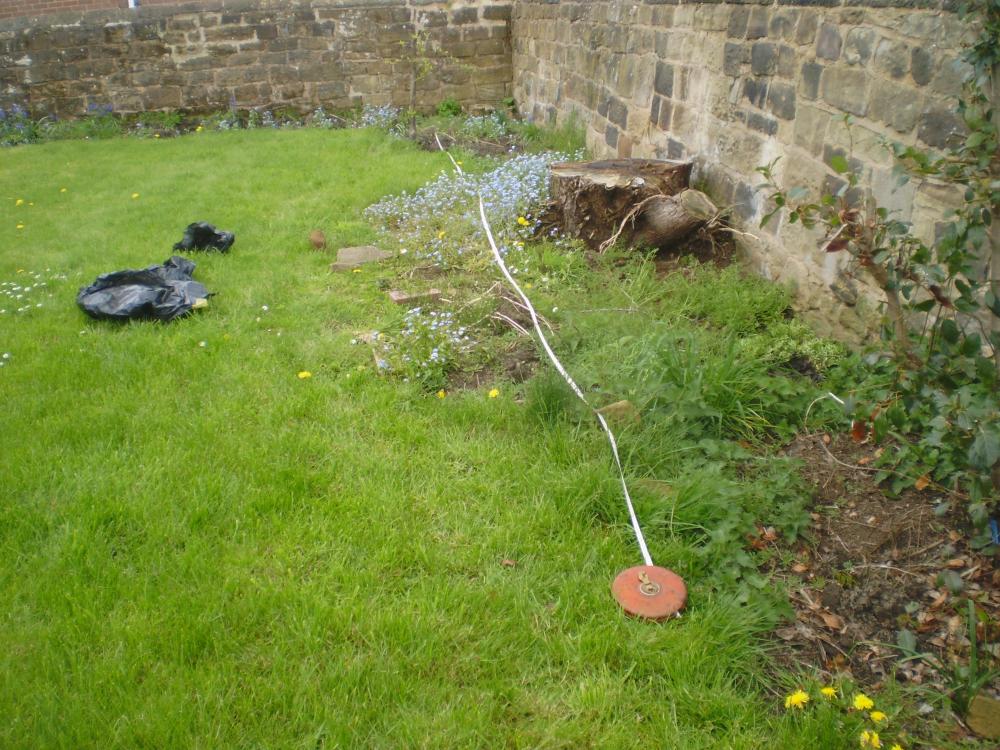
We are about to remove a very large tree stump from our site. The stump is/was a conifer of approx 20 m in height which was felled 2.5 yrs ago and stump killer applied at that time. I am attaching photos to show how near this 90 cm stump is to an old stone boundary wall and the tape on the ground shows approx where the wall of the one storey new building will sit. The stump is encroaching where the trench will be by several cms. My questions are: Should the groundworker attempt to remove the whole stump. Have the tree roots had time to die back. Is this even possible. The tree stump is almost touching the stone wall which we need to preserve and the digger may be unable to remove the whole root ball, so is it possible to do half and half ie remove as much as possible of the stump which lies over the footing area and then grind down the remainder as necessary. Does anyone have suggestions about how to measure the depth of the trench fill foundation that might be required in a situation like this. This proximity of a tree is not covered in the NHBC calculation table as far as I can see. I have worked the depths out for the rest of the foundations but am "stumped" on this one. Any help will be much appreciated. (Sorry, I could only upload one photo - I'm useless at this).
-
Commencement before New Building Regulations re-submission?
Deejay_2 replied to Deejay_2's topic in Building Regulations
Thank you for your replies. The BCO has confirmed in writing that excavating a trench is sufficient but it has to be the whole length of the trench. We have the size of the trench which is 9m L x 600 w x 1 m deep. We will also remove tree stumps and do trial holes and the BCO said he will advise at his site inspection re soakaway requirements, if any. It is an opportunity to do a soil test and have some preparation done for when we eventually start the build. I am awaiting an estimate from the groundwork company but in our tel con he seemed to be advising against refilling the trench with soil and suggested concreting it. My feeling is to do as little as possible at this stage ie less to go wrong/rectify in the future. Therefore I think partial backfilling,as previously advised, is the way to go and then cover the trench with substantial sheeting. We can make the final decision on this, I would think, by discussing with the BCO on his inspection. There is no danger of anyone falling in because of the site's position. It's been really helpful getting the views of experienced members. Any further comments regarding my intentions outlined above would give me further reassurance as time is now running out. Many many thanks. -
Commencement before New Building Regulations re-submission?
Deejay_2 replied to Deejay_2's topic in Building Regulations
Sorry I'm back again! I have spoken to the groundwork company and he feels it's probably a mistake to dig the trench and backfill and that we should concrete the trench. I said this would involve a large concrete lorry and pump (difficult access) just for one trench, when all we are trying to achieve is to "commence work". I asked him about covering the excavated trench with heavyweight plastic sheeting and he said the trench will still fall in if it rains heavily. Anyway he has agreed to come and do the work before 15 June and NOT to refill the trench. I am therefore unsure about what would be best: 1 Would we be better backfilling the trench - it may be 6+ months before we return to complete the foundations. Would this make it more difficult for the groundworkers. 2 If we don't backfill, would strong plastic sheeting preserve the trench, held down with heavy stones, of which we have many. I hope someone has time to give their opinion/advice on this as I'm very unsure what to do. Many thanks -
Commencement before New Building Regulations re-submission?
Deejay_2 replied to Deejay_2's topic in Building Regulations
I have had a response from the Building Inspector who has agreed we can dig a foundation trench for one length of the proposed building to deem to have commenced work. We shall also be removing tree stumps and digging trial holes. I have contacted a surveyor with a Total Station for a price for setting out. At this point in time we are just wanting to commence work (before 15 June) so my question is: Do we need to have the site scraped before setting out and foundation trench dug. The site is currently lawned and fairly flat. We would like to keep to a minimum of work but don't want to cause problems later down the line by cutting corners. Thank you for any advice. -
Commencement before New Building Regulations re-submission?
Deejay_2 replied to Deejay_2's topic in Building Regulations
Thank you - that's really helpful. You are right, we just want to be deemed to have commenced before 15 June. I have emailed the BC officer I spoke to outlining our intentions to make sure we have confirmation in writing. He was the one who originally said we had to do all the trenches with concrete to prove we had started work. It's his senior colleague's recent email that has prompted us to have "another go" as this cheaper route enables us to commence within our current financial restraints. Thank you once again as your response has been really helpful and reassuring. -
Commencement before New Building Regulations re-submission?
Deejay_2 replied to Deejay_2's topic in Building Regulations
I have only just read this and am now trying to get my head around what you mean. We intend having a chat with the groundworker company next week about a price for digging a 9 m trench (1 m deep at this stage) which would be the trench used in the future for the northern wall of the building. removing some tree stumps and digging a couple of trial holes to determine the soil structure for when the remaining foundation trenches are dug in the future. Carry out a percolation te I assume the groundworker would have to set out the site to ensure the correct position of the trench - at this stage would this involve removing the existing lawn and top soil to level the site or can they just dig the trench. What you suggest would be less work but why would we dig the trench in the wrong place and would they accept only 4 m. Also would digging the trench satisfy Planning that we have started. Any help would be much appreciated. -
Commencement before New Building Regulations re-submission?
Deejay_2 replied to Deejay_2's topic in Building Regulations
Absolutely agree. My experiences with every so called "professional" including architect and draughtsman have been woeful so far and this is why this site is so helpful. We managed to submit and get approval for our Building Regs plans before the Regs changed in June 2022 - we were give a year's transitionary period to commence so only have until the end of May 2023 to start the work. -
Commencement before New Building Regulations re-submission?
Deejay_2 replied to Deejay_2's topic in Building Regulations
Thank you. This is what occurred to me. The email from the Senior BC officer doesn't mention the actual drain 'furniture', and neither did the other Building Inspector. I am wondering whether we could 1 Just dig the trench and put the pea gravel in and then either cover it over with something, or fill it back in after inspection 2 Or alternatively dig out one of the 1.2 m foundation trenches and cover it which would be less desirable. We only have until June 14th 2023 to implement commencement before we have to resubmit everything under the new Building Regulations (altho I don't know what this will involve). So if we undertake item 1 can you see any future problems arising from this. Many thanks for your input. -
Commencement before New Building Regulations re-submission?
Deejay_2 replied to Deejay_2's topic in Building Regulations
-
Diary of Events June/July 2022 Plng approval and Bld Regs app for detached double garage with granny flat attached. Sept 2022 Bld inspector visited site – said we would need filled trenches to prove commencement. Decided to put things on hold due to situation with economy. Feb 2023 Received new plng approval with small changeswhich led to my emailing Senior BC Officer re amended plans and putting things on hold. This resulted in him emailing back, from which I quote” “Once you are in a position to commence please let us know, works will require to commence within 3 years of the application being approved or additional fees may be incurred (Commence means some footings dug out or drainage laid.).” March 2023 This has resulted in our rethinking commencing the work before our one year transition period runs out (14 June 2023). 1 checked with original Inspector and he agrees we can lay the drainage trench to prove we have started and we feel we should go ahead with this but before I rush into things I am concerned that this could be a mistake. So I have the following questions: 1 The attached plan shows the position of the main drain running along the back of the building (west facing wall) and along the north facing wall from the kitchen. Is the plan clear enough for the groundworking company to work from or do I need to get a specialist drainage plan done? 2 The drainage trench will presumably not be as deep as the footings trench (1.2m min). Will the drainage trench cause problems when the digger digs out the western wall foundation trench? 3. I assume we will need to put pea gravel into the drainage trench and install all the required drainage pipes. Then refill the trench with the manhole covers etc already in situ. 4 Whilst the digger is on site we shall also do some stump removal, get a soil test and percolation test done. Have I understood the process correctly? Any advice would be greatly appreciated as this could be a costly mistake and I wonder why the original Inspector didn’t suggest this when he visited last year. Are we sensible doing this to get things started in order to avoid having to redo and resubmit plans under the new Building Regulations in the future, or could doing this create more problems when we return to start the job in the future. Drainage for commencement_20230406_0001.pdf
-
Permitted Development checks and approach for large garage/office?
Deejay_2 replied to Pabbles's topic in Planning Permission
If you end up having to exempt yourself from CIL because the m2 is over 100 m2 it really is important to read up the rules very carefully and to find some examples of where people have come a cropper. There is a very strict process to follow and if you get it wrong there are no concessions from the Local Authority. Basically the LA charge a fixed price per square metre for the CIL contribution to support local "infrastructure". Our LA charges over £70 per m2 which is relatively cheap when compared with other LAs. Exemption relieves you of this cost, but put a foot wrong and you will have to pay it and it could cost you thousands of pounds. Also if you obtain exemption you have to live in the property for 3 years after its completion. As long as you are fully conversant with the procedure, and possibly seek advice from the CIL officer (ours was very helpful) then the process is not that arduous, but remember not to start any work until you have the exemption certificate in your hand. Amazing that no information whatsoever is provided at the point of submitting a planning application. Good luck -
Permitted Development checks and approach for large garage/office?
Deejay_2 replied to Pabbles's topic in Planning Permission
Just something to check which may not apply if your Local Authority does not impose the Community Infrastructure Levy. If it does, then your new square meterage is over 100 m2 which would attract CIL and the need to apply for exemption. We are in a similar position ie double garage including granny flat area - all ground floor - 12 m x 9 m externally. As a point of interest if we decided to use the roofspace (albeit tight) and put in a staircase we would have to count this space which would incur CIL hassle (regarded as habitable space). However, if we use a loft ladder then the loft space is not counted! So many things to research and consider. You have probably already checked this out but worth a mention. -
A block of 8 flats was refused permission and is now going to Appeal. This is close to where we live and we along with many many others and the Parish Council submitted objections. The Planning Officers approved the application but were overruled by the Committee members. All the paraphenalia has now been put on the Planning website and letters sent out to all objectors informing them of the Appeal. I have done some research and it seems in these circumstances there is little chance of the Inspector rejecting the appeal. The following is from a House of Commons publication "The planning consultancy Lichfields published a report in August 2018, Refused for good reason?, which found that residential schemes refused against the recommendation of planning officers were more likely than others to be allowed at appeal. The report looked at appeals on residential proposals decided in 2017 in England, Wales and Scotland. It found that 65% of appeals that had been refused by a planning committee against officers’ recommendations were allowed, compared with 40% of appeals where refusals were in line with officers’ recommendations." Presumably it's up to the Councillors to defend their decision - I can't see how the qualified officers would be allowed to help. The developer has appointed a Planning Consultant etc and has put up what seems to be a very good case. Does anyone know how the process works eg will the Councillors be afforded a Planning Consultant or other type of representation is there anything the objectors can do such as appointing a planning consultant, or are we now just bystanders. The local authority letter states that all the objections will be sent to the Planning Inspector for consideration and objectors can re-submit their particular objection to the Inspectorate with additional information if they so wish but I am not sure whether there is anything else we can do. Has anyone had any experience of this type of situation. A lot of residents sent in objections and are now wondering what the next step is where we are concerned. Any guidance would be much appreciated.
-
Thank you - that's very helpful. We had to lower the roof considerably during the original planning process. I obtained some sketch plans from a roof truss company and briefly it appears that raising the roof by half a metre would provide "habitable" space say for a spare bedroom. We are not sure whether to include this on the new application or leave it until the build has progressed and then go back with a Section 73 application. I The current changes we are envisioning are not contentious and I would be surprised if we received objections. However the increased roof height might attract the attention of the Parish Council and presumably if they objected this would scupper any further application in the future. Does anyone have any thoughts or previous experience on this. Thanks again for any help.
-
We received planning approval in June 2022 for a double garage with granny accommodation attached at the bottom of our garden. We managed to obtain Building Regs approval just before the June 2022 changes. We would like to make some changes, mostly the positioning of a couple of doors and windows, but also increasing the double garage space by bringing it forward 1 metre. This will enable us to make better use of the rear of the garage and provide better access to the loft space, even though it is only for storage. 1 I emailed the Planning Officer (Conservation Area) who said these changes would not fall within a Non Material Amendment application and would require a new planning application mainly because of the extra metre to the garage. This app would be free as it falls within the 12 month period from the original approval. 2 If we do this, as the changes are minimal, does anyone know whether we have to do a new submission to Building Control. The plans will be almost the same. We have paid for all the inspections already and hope to get the footings done in April 2023. I really thought this would be a NMA and am not looking forward to going through the planning process again. Thanks for any help.
-
Update at 17 09 22 I contacted the Timber Roofing Company and forwarded our plans for a quote. I was quoted for attic trusses and Fink Trusses (another word I've added to my vocabulary). Attic trusses are approx £1500 (inc VAT) more expensive than Finks but I assume the latter require more labour on site. I am attaching 3 plans they have sent showing different pitches - the 32 degree pitch is in accordance with our approved plans. I am considering approaching Planning to increase the height of the roof ridge by half a metre to accommodate the 38 degree pitch which appears to me from the plans to give a decent amount of space for storage and possibly, for example, a small office. I think it's worth a try as I think it's advantageous having a roof that can be usefully used. If Planning said no to our request, would it be feasible to dig down a further half metre to lower the whole building and increase the roof height/space or does that sound like massive expensive for little gain. The truss supplier was extremely helpful so the advice given to contact them worked in our favour. Any thoughts/observations would be much appreciated. PDF32 degree pitch drg 16 9 22.pdf PDF 38 degree pitch roof 16 9 22.pdf PDF 40 degree pitch roof 16 9 22.pdf
-
I just want to thank everyone who has offered advice. This has helped massively. Footings/foundation questions next I'm afraid!
-
OK - will do, thank you.
-
Thanks for that - it will help me explain myself to the company. Really I suppose all I need to do is ask if they will look at the plans and decide what we need and hopefully offer calculations. When I phoned them ages ago I didn't have the plans for Building Control.
-
That's really helpful and clarifies things for me. I phoned an Attic Truss company a while ago and got a negative response regarding supplying a traditional cut roof but I can see I wasn't asking them the right questions. We did use them in the past for attic trusses on a new build house, but the traditional cut roof has confused me and I probably confused them. I'll phone them again and see what they say. Thank you.
-
Thank you and sorry I didn't explain clearly. Our original plans showed the roof as habitable space but we had to lower it to such an extent for Planning requirements that it is now storage space only. When you say standard trusses do you mean trusses that are not pre manufactured ie traditional cut roof. I'm still trying to work out what the Building Control condition requires (as in my first post) and if I need to submit calculations who would I ask to do these.
-
Thank you for all the responses. Our original plans had a straight habitable roof but planning wanted a much lower single storey building which is why it now looks like a bungalow and presumably this is why a traditional cut roof is required. I am hopefully attaching some drawings that will help. I have a written specification and layout plan but something's gone wrong and I'lll have to wait until someone comes along that can help. I am keeping my fingers crossed that I have not ended up with a difficult roof as that was never intended. I hope that what I have attached so far is OK and look forward to any comments. Plan Garage Section 14 6 22 Build hub PDF.pdf Plans Elevations 14 6 22 (3) Buildhub pdf.pdf
-
Thank you for the above information. Although I am aware of the requirements to join the sewer I had no idea of the costs involved. The sewer we would like to join runs across the back gardens of the bungalows on the street to the west of the proposal so the footpath between two of the properties would be the only place to connect. Our current bungalow is served by a combined sewer in the private access road - it is not very deep and we take great care of it. The new proposal sits considerably lower and approx 20 m from said sewer and would presumably require a pump which we hoped to avoid. The proposed new connection is approx 20 m from our proposal with a slight downward slope so this seemed the way to go. I have spoken to a grounworks company (this was many months ago) who just said they take care of the path closure - we just have to get permission from the Water Authority - but as yet no costs have been discussed. I was waiting until I'd sorted out the precommencement conditions before inviting him to quote but your post has given me the information to ask the right questions. Many thanks.
-
Thank you ETC. The Building Control Officer who issued the approval referred to roof "trusses" which is why I wondered if he had misread the drawing. I'll try and post the drawing but have new printer and will have to work out how the scanner works so it might be a while. Thank you though for your input which has at least confirmed that I should check this out. As far as I am aware there is nothing special about the roof but I'm no expert. As regards the drainage we're not building over anything. We do have to get permission to close the footpath but this will be with the Local Authority as and when we're ready. So again, not sure why a Build Over agreement is required so will question this further. Principally the proposal is for a detached double garage for the occupiers of the original bungalow (my son) with a small flat for myself added on. We already have the limit of 5 dwellings on our private road so a further separate dwelling would not be allowed. We have increased the wall and floor insulation thickness and hope the living area won't require much heating. We'll see if they come back for U-value calculations which would seem a reasonable request. Thank you for your input which has been really helpful and I'd be grateful if you would look over the plans if I manage to upload them. Best regards.
-
Thanks for your reply. Sorry I used the term "sticks" which I picked up from the internet - I've looked on our drawings again and the written specification refers to a traditional roof where I believe the timbers are cut on site. So would I need to ask a structural engineer to supply a drawing (I don't have a structural engineer engaged at the moment, otherwise I'd ask him/her). Is this something Building Control would normally include in pre-commencement conditions. I am asking because it could be a mistake as there have been so many made firstly with Planning and now it seems with Building Control. Although No 3 sounds like a mistake I find myself asking did the original author make a mistake or is the response from his colleague a mistake. I don't seem able to get a further response to confirm one way or the other - hence my asking if anyone else has an opinion. As these are pre-commencement conditions I need to be clear about what's required as soon as possible so any views would be much appreciated.