


TimD
-
Posts
5 -
Joined
-
Last visited
TimD's Achievements

New Member (2/5)
0
Reputation
-

Relaid patio now above some vents, water pooling... what to do?
TimD replied to TimD's topic in Landscaping, Decking & Patios
Thanks for all the input folks. Wish I knew more about the construction of these old buildings! Got some full-time patio pros who did an excellent job at a similar property down the road coming to take a look (should have used them in the first place rather than someone who seemed to be more a "landscaper"; ho hum you live and learn). It's basically the same patio as was there before but the slabs were pretty much just laid on earth as a quick-fix for a grassless back plot (think some sand or gravel went down, but no membrane) about 20 years ago. It was grouted but I think a lot of water just drained away down through cracks. It's not so dissimilar from what neighbours have.... there's certainly no "French drains" up against the building. But the last time we had damp problems it around 15 years ago when a storm ripped the gutters off the back wall roof above it (and most of the roof felt too!) and by the time that was properly fixed (it took months) the back wall had gotten quite damp and everyone (there's 4 floors above us) needed plaster stripping and dehumidifiers running. Keen not to have a repeat of anything like that though, so want to get on top of this pronto. BTW, received wisdom is that sandstone construction tenements of this age do not normally have a damp course; supposedly the sandstone's breathability enables it to deal with it: see e.g https://mysweethomes.co.uk/tenement-damp-why-the-standard-answer-is-usually-wrong/ and https://dampdetect.com/rising-damp/edinburgh . Fortunately we've never seen anything like the "rising damp tide-marks on ground-floor flats and stair walls" one of those mentions as a common issue. -
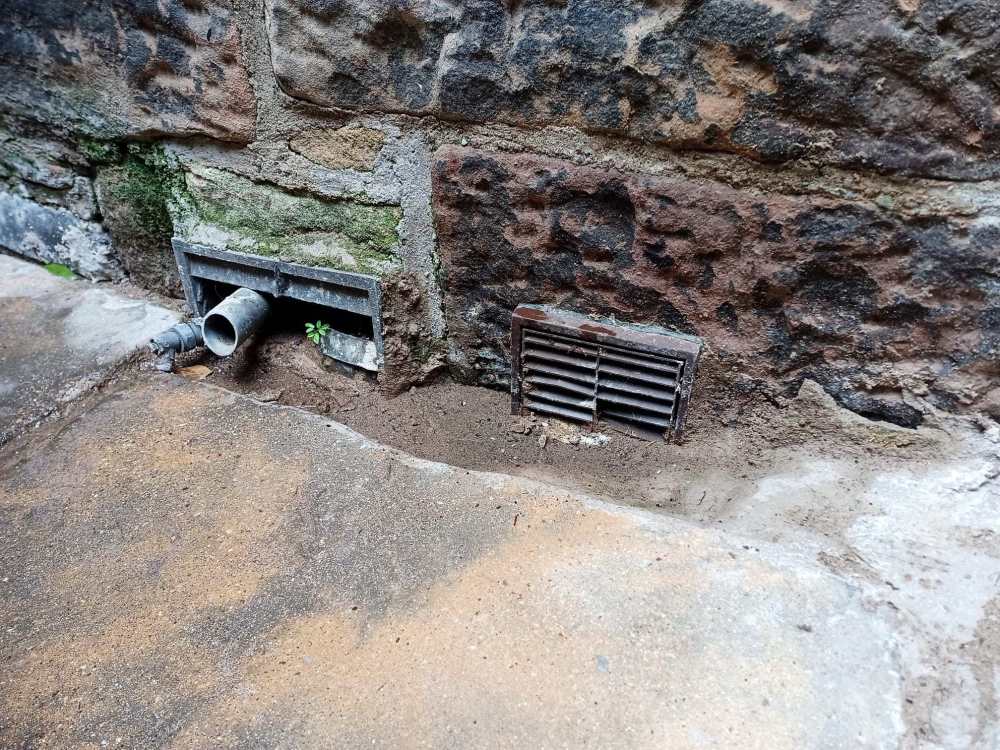
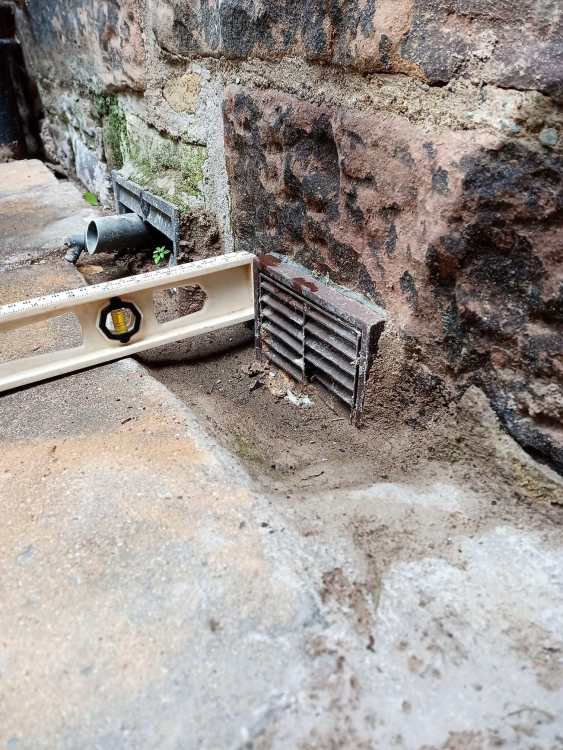
Recently had a decaying bit of back patio behind our 1890s Edinburgh tenement taken up and relaid. Apparently there wasn't much under it before and by the time the guy (recommended by some gardeners we use) had put down a base he was happy to put it all back on, the whole thing was an inch or two higher than it had been before. Unfortunately that means there's now a dip around a couple of low vents in the back wall. One of them (on the right in the photos) is from the bathroom extractor (it runs down and under the kitchen floor behind this wall); I've no idea what the other one is. I noticed the dip had collected pooled water earlier this morning from heavy rain last night, although it had all disappeared (I hate to think where!) by the time I got round to taking the attached photos a few hours later. (The spirit level in the second photo is just something to make it easier to see how deep it is.) Any thoughts on how to deal with this? My first idea is to put some sort of little "hut" over it (with enough louvre to allow the vents to still vent) and make sure it's sealed enough around the sides to not allow water to flow in under it or down the walls. Open to other suggestions though. (And my Google-fu is not having much luck finding where I could buy such a thing ready made if they exist... just endless meter boxes and simple vent covers). Thanks for any ideas
-
Totally agree with "if it ain't broke don't fix it" sentiments! There's always plenty of other little jobs need doing at the place to keep us busy (indeed, it's the access has had a bit of effort put in recently; better drainage and run-off channels etc). Unfortunately the new Welsh regulations on septic tank discharges (now stricter than in England or Scotland I think) now don't really leave us with much choice but to pay some attention to what's going with that aspect of the property.
-
Well this is one of the things which no-one seems to be able to remember about it... does the tank outflow go into an infiltration system in the field downhill from it (which, on the face of it, looks perfect for such a thing), or does it actually just go into a convenient ditch on the other side of a nearby wall? (Well defended by brambles so it's not anywhere anyone's gone looking in recently.) Noone's been able to locate any old paperwork from the installation, and no-one remembers it ever having had any maintenance or pump-outs. Over multiple decades! But then the place has plenty of extended empty periods. Travel restrictions permitting, someone will hopefully get a last visit in before year end to drain the water system before winter, and be able to have a poke around down by the tank now we have a better idea what we need to look for. I half wonder if we should try and do a "dye test" but not sure how much water you realistically need to put through to have a chance of seeing anything.
-
TimD changed their profile photo
-
Hi all... New arrival. I seemed to keep landing on this forum while researching septic tank & treatment plant related things, so decided to sign up in anticipation of seeking a second opinion on various options. The property which principally concerns me these days is a remote cottage on a Welsh hillside. "Cottage" perhaps exaggerates its charms; "bothy" might be a better description. This place will never be on AirBnB or one of the twee holiday cottage rental sites. It's "one for the connoisseur" as they say. It's unoccupied during winter, but the warmer and drier months will see a steady stream of extended family, friends and folks who appreciate the place for what it is using it as a holiday getaway. (Not so much this year though.) Final access is along farm tracks; after winter has done its damage it can be marginal whether it needs a 4WD to get to it until the holes are filled in. Water is out of a stream and small reservoir via filters & a UV sterilisation tube but no-one drinks it without a very good boil (there's sheep and sometimes cattle on the hillsides). Sewage goes to a dual-chambered concrete septic tank on the property which noone seems to know much about other than that it was put in before there were standards for such things (in the 1970s sometime? I vaguely remember visits which might have been in the late 60s/early 70s when you did your business in a chemical toilet full of blue liquid which would subsequently be emptied in a hole dug in a neighbouring field). There is electricity (although again, back in the late 60s/early 70s I remember it was paraffin lamps and candles after dark). Until recently it has largely been looked after by the generations previous to me but as they're all getting on a bit its now falling to us young 'uns (relatively) to take more of an interest if the place is to have any future. Needless to say, with it being in Wales the thing which seems to demand urgent attention is getting the septic tank legal. Indeed it appears to me that that should have been done by January 2020 latest... but so far as I can tell there seems to have been some confusion over the terminology around "exemptions" and "registering for an exemption" and someone interpreted "you need to register for an exemption" as "you're exempt from registering". Ooops! Expect I'll be posting more on this topic on the "Waste and Sewerage" page at some point, depending on what we find out we need to do.

