JackOrion
-
Posts
68 -
Joined
-
Last visited
Everything posted by JackOrion
-
Surface water / soakaway advice
JackOrion replied to JackOrion's topic in Rainwater, Guttering & SuDS
Thanks for this. I think in our area we need to allow for a 1 in 100 year storm event, so yes, 3m³ would likely need to be increased. Inspired by some other threads on here and reading online, we're now looking at multiple SuDS planters, a substantial amount of rainwater harvesting, and splitting into smaller soakaways from that point. Hopefully we can find an engineer on the same page. -
One of our planning conditions is to provide details of surface water drainage. The LPA and water company will only allow foul water into the sewer, so we need engineering calcs and drawings showing the soakaway design and location. Site details: Mainly sloping site Soil is very gravelly clay Test pits (400 × 400 × 400mm) drained quickly (in under 7 minutes) Roof area approx. 120m² Paths/driveways will all be permeable A few old Victorian garden buildings are on site with lots of old land drains dotted around (it's an old walled garden). No drainage issues anywhere and we've owned the plot a good few years. From what I understand this probably means we need around 3m³ soakaway capacity. We’ve had two drainage engineers visit and both suggested a single soakaway in a flat area (about 5m²) in front of the house. However, that spot isn’t 5m from the house foundations nor is it 5m from a retaining wall further downslope (neighbour’s property), so it seems like it will not meet the usual guidance, and could prove problematic in future. On the other side of the house we have about ½ acre of sloping woodland, with plenty of space but more difficult digging (tree roots present, and will need to be by hand), and then we have a more gently sloping footpath below that. I’m wondering whether splitting the drainage into several smaller / shallower soakaways in the wooded / footpath area might make more sense, which would keep everything well clear of structures. Does that sound like a sensible approach? Has anyone used any drainage engineers who may be a little more inventive than those who have suggested a single large soakaway, or perhaps have more progressive SUDS experience? Any recommendations / thoughts welcomed.
-
Connection to steep sloping lateral drain
JackOrion replied to JackOrion's topic in Waste & Sewerage
Invert is around 600mm below ground level. Excavation starts this week, so we will see how things stand once our groundworks contractor gets to grip with the levels. Thanks all. -
We have a 100mm lateral drain that we will be connecting to. Runs right through our plot and is five metres or so from the edge of the house. This existing drain runs down a steep gradient (perhaps around 30 degrees), before it drops down to the mains below. We're in a valley hence the slope, and it's an old Victorian drain. We have been given the green light to connect by the water company for domestic foul water (with a soakaway for surface water). Who governs the connection method and gradient of our connection? Building control or utility company? Does anyone have any experience of connecting to a steep sloping lateral drain such as this, and is it likely to be a complex procedure? Have been reading quite a bit about maximum recommended gradients of 100mm drains being more like 14 degrees to avoid solids being left behind, and wondering whether the existing drain gradient makes our job trickier. We can control the gradient of our connection as we're on a plateau midway down the slope.
-
Thanks for this. Initially was thinking / hoping this could be a temporary solution as is.. but overlooked the need for second pump and volumiser. Building the house 2026, starting groundworks in Feb. It's about 25 metres or so across a largely paved old walled garden from this outbuilding to the house (2 bedroom single storey, near passivhaus timber frame). Maybe cheap ASHP is the answer for the outbuidings as you suggest.
-
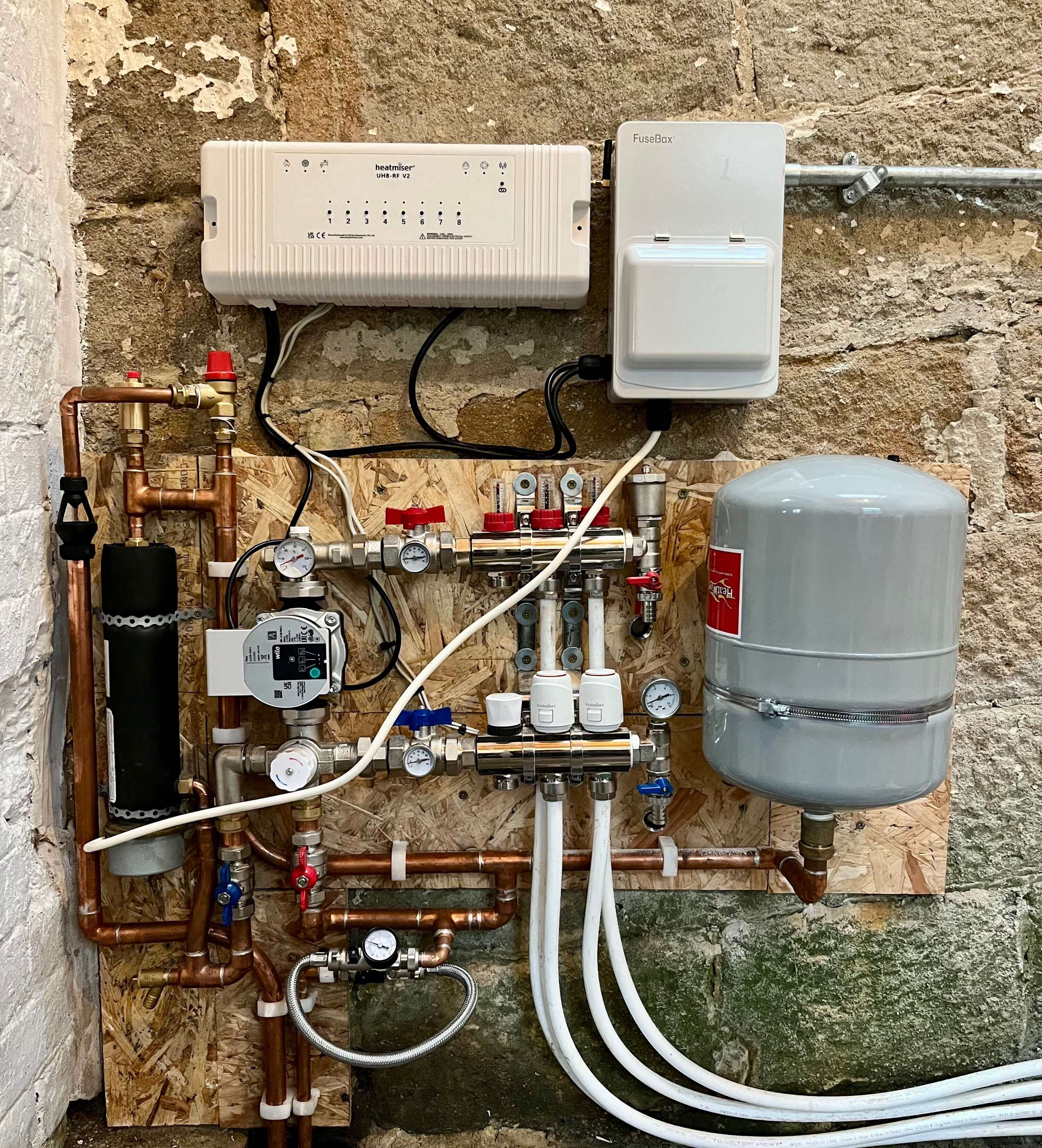
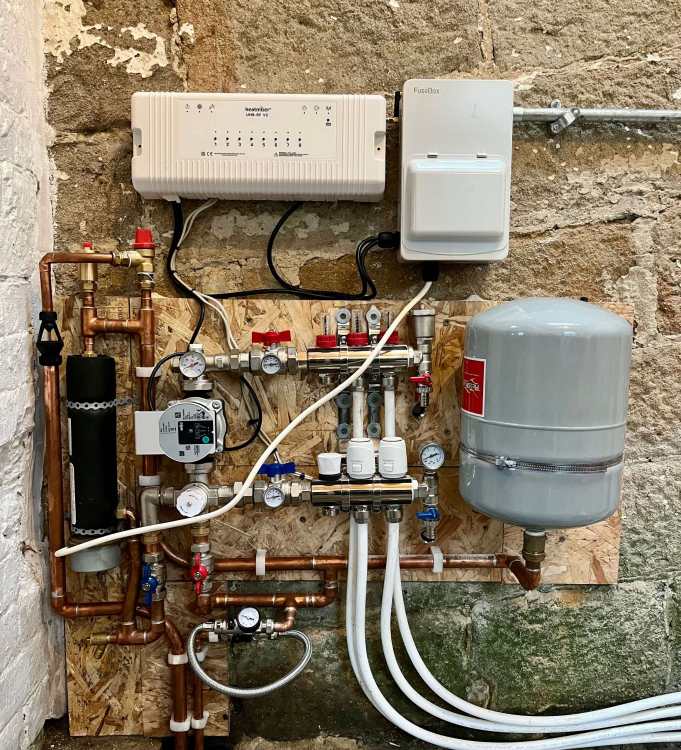
Just had UFH installed in outbuilding (will be studio / workshop eventually / and temp accomm while building), using Willis heater. Two rooms approx 20sqm total. Seem to have the same issue as @oranjeboom did – Willis is 'kettling' when switched on, which is how I've found this thread. Before I get the plumber back.. could someone more knowledgeable than I check our arrangement and advise? Assuming we need a second pump for the heaters as first mentioned by @Nickfromwales ? Any help / thoughts appreciated.
-
What did your build cost come out at 2024/25!
JackOrion replied to PSC88's topic in Costing & Estimating
Been a while since I've visited the forum but interesting to see these figures. We're in West Yorkshire, and were quoted somewhere between £5500 and £7000 per sqm (!!!) earlier this year from main contractors. Single storey 120sqm building. Timber frame to almost passivhaus standard / triple glazed windows / MVHR etc.. Our plot also ticks all the £££ boxes: Tricky access, sloping site, piled foundations. Architects were designing to a budget of around £3k per sqm. Way off. One contractor actually told me their QS had priced it so high as they were looking at the final value of the house and bumped it up accordingly. (Is that standard?!) We're still having to go through some serious value engineering, and looking likely we'll have to do much of the project managing from weathertight shell onwards ourselves. -
The proposals we have had so far include three different piling techniques - but all recommend rock sockets for the extra stability this will provide. For context, our plot is on a south facing slope within quite a steep sided valley, which might help explain the belt and braces approach.
-
Thanks. Yeah, the plot was about 30% market value due to a legal issue that was relatively easy to sort! The ground was at that point was of course unknown... but seems like it will be the factor that evens things out! Win some lose some. We'll see.
-
Many thanks for this @saveasteading – I'll get all the info together and get in touch with some more companies once back next week. I'll keep you posted on progress.
-
Thanks @ToughButterCup – yes, I'd read your previous posts with interest... I can't reach their website at the moment, but I see from their Facebook page that they sponsor a football team not too far from us. Will definitely be giving them a shout, though I fear access constraints will rule them out.
-
Thanks @saveasteading I don't have the ground report to hand at the moment (also, it's a huge file), but in short, bedrock is indicated to be 8m below ground. The 10m depth includes 2m drilled rock sockets. It's a relatively lightweight building (pile loads calculated at 75kN compression). Yes, the slope is stable. This has been established by the original ground investigation engineers plus at least two other geotech consulting engineers. That said, the rock socketed piles can withstand potential lateral force from this slope if required. The plan is for the slope to be more stable after construction. This is a good point. Initial thoughts were they wouldn't be interested in a small project and would charge the earth... but no harm in trying. Assuming you're referring to the likes of Bullivant / Van Elle etc? Any others from the top of your head?
-
Thanks @Russell griffiths I think that's where we're at. The quote we have so far is for a mini excavator with a drill mast (which will work to install the piles on the slope as well as on the flat part of the plot) The problem with the small diameter piles is as you say, many more are needed (£££) than if we had a more regular rig installing 300mm piles for example. Will follow your advice and reach out to more companies though. Agreed, it's definitely not looking like a cheap job.
-
Ah, I see what you mean there now, helpful to see it. I think the problem here comes down to how far beneath ground 'something solid' is...
-
Would be interested to see it!
-
@Russell griffiths @ProDave 3D model attached here, alongside elevation showing sloping 'stilt' detail. (completed design has quite a bit less glazing etc, but this should give the idea) The new house is in two parts and wraps around the hillside, utilising the flattest parts of the plot (and avoiding protected trees). Existing structures are greyed out – it's an old walled garden, which was pretty much a gardeners' tip when we bought it, but is in the grounds of a listed building (downhill, out of shot). So along with the geography we are fairly limited to what we can do. Interestingly, the existing brick potting sheds (greyed out on the left of 3d model) are on minimal foundations (built in 1800s), and slope downhill with the natural terrain, and haven't moved an inch. Image 1.pdf Image 2.pdf
-
Exactly that! 2-3m refusal on each ground investigation borehole would have been a much better result for us.
-
Funnily enough that's pretty much what we've got... the slope is only beneath one part of the house, which is already split into two sections to make the most of the flattest areas of the plot. At this point the building is essentially on stilts with a steel frame above the pile caps.
-
@Great_scot_selfbuild Thanks for this. Will check these out. Given our position, anything man-handleable sounds really appealing but again I suspect they won't do the trick for our ground conditions, as previous screw / helical piles were deemed unsuitable. I'll keep you posted on how we get on though. Likewise keen to hear how you get on...
-
A photo attached here.. although I suspect you were after a borehole log? The ground investigation took three boreholes... in summary they found up to a metre of 'cohesive made ground', below which is 'an extensive thickness of reworked clays with occasional gravel lenses revealed to variable depths' (4.5m to 10m), beyond which was the rockhead. strata.pdf
-
Unsure if we're going down the prefab route yet or not, but certainly can't get an artic anywhere near site. Spoke to a few suppliers (e.g. Eden Insulation), who suggested dropping their kit off at a delivery yard nearby, which would then be shuttled up to site on flat beds. The alternative would be to stick build. Pretty sure helical piles have been ruled out for us due to the ground conditions. Same goes for any major excavation of the slope – would likely require soil nails (more cost + large plant required!)
-
We’re building a 130sqm single storey timber framed house. Part sloping site with very tricky, limited access. It’s a beautiful spot but lots of hurdles to overcome… the latest of which is the piling cost. SE seems to be taking the contractors’ lead in terms of piling method. As mentioned, access is limited (size and weight of plant) and also we need to install some of the piles on a slope. So to be fair to the SE, the pile specification is reliant on someone with good working knowledge of plant / installation etc.. First quote is approx £70k for 54 micropiles. These would be 115mm diameter drilled hollow bar up to 10m depth (based on ground investigation). Around £1300 per pile, excluding mobilisation etc.. Given the huge costs, we’re concerned that contractors aren’t necessarily exploring all possibilities, but just quoting based on their own experience and the plant they have available. Wondering if some kind of independent specialist pile design consultant or similar might be an option here, to ensure we’re looking at as many methods as possible. Does anyone have any recommendations as far as that might go? Or any other thoughts? Noted the vibro stone columns mentioned elsewhere on BH which are something I’d never heard of before, although I’m guessing our access would rule this out. But this is exactly the kind of thing I’m wondering about… are other methods out there which might help us get these costs down? Any thoughts appreciated.
-
Thanks for the suggestion. We're looking into this at the moment, and speaking to our planning consultant. It really comes down to how much wriggle room we have within that planning permission.
-
We won't be able to recover any of that money as the practice was liquidated. And am certain he will want more for work carried out since then. The only written indication of fees / percentages etc is on his practice invoice from 2020. This is the closest thing to anything contractual we have. Since the practice is no more I'm unsure where that leaves things legally. At first it was largely being slow and lack of attention to detail, then later suspected incompetence. The financial side has only come to the fore recently.
-
Only ever agreed drawings, not project management, although we never received an actual written quotation from him. As mentioned, barely anything via email since we started, all just over the phone. Total fee was to be 10% of total original projected build cost (£200k). We've paid 35% of this 10%, so basically £7k + VAT. Ran this by another architect friend of a friend who suggested this was standard practice to charge this kind of amount once planning granted. Although I forgot to mention in my original post: he said we hadn't paid him at all when we spoke last month. I provided his invoice and proof / date of payment and he backtracked, saying he'd mislaid paperwork. My understanding was that the next fee would be due once detailed drawings were delivered. We're quite a way off that, he's done very little the past two years as we've made next to no progress as far as the actual house goes, the project's largely been in the hands of a very slow structural engineer looking at foundations since then. Originally found via the Architect's Journal and seemed to have a decent reputation. Clearly we've also been a bit naive – this is our first time dealing with an architect and we trusted him.